Table of contents
Pest control companies do not cold-email consumers, and this page does not pretend otherwise. Cold email outbound only makes sense on the commercial side of the trade: property managers, HOA boards, facility managers and general contractors who buy recurring pest service across a portfolio of buildings, not a single homeowner deciding whether to call an exterminator.
Key Takeaways
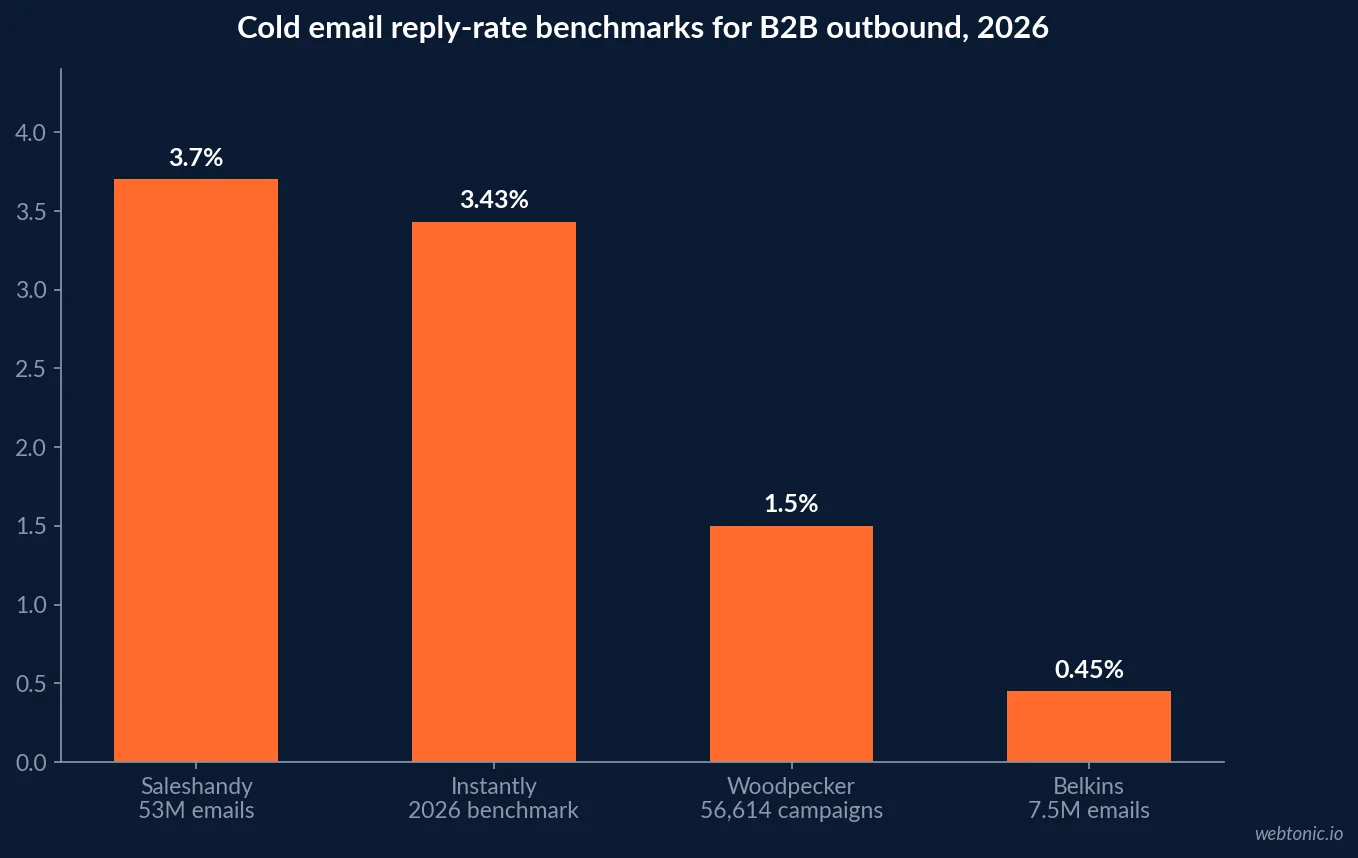
- 3.7% average reply rate across 53 million cold emails sent January-June 2026 (Saleshandy).
- 3.43% average B2B reply rate reported by Instantly's 2026 benchmark.
- 1.5% median reply rate across 56,614 campaigns (Woodpecker).
- 0.45% average reply rate on a narrower 7.5 million-email dataset (Belkins).
- 21% average open rate across the Saleshandy dataset.
- 2 to 3 meetings booked per 100 emails in top-performing campaigns (Saleshandy).
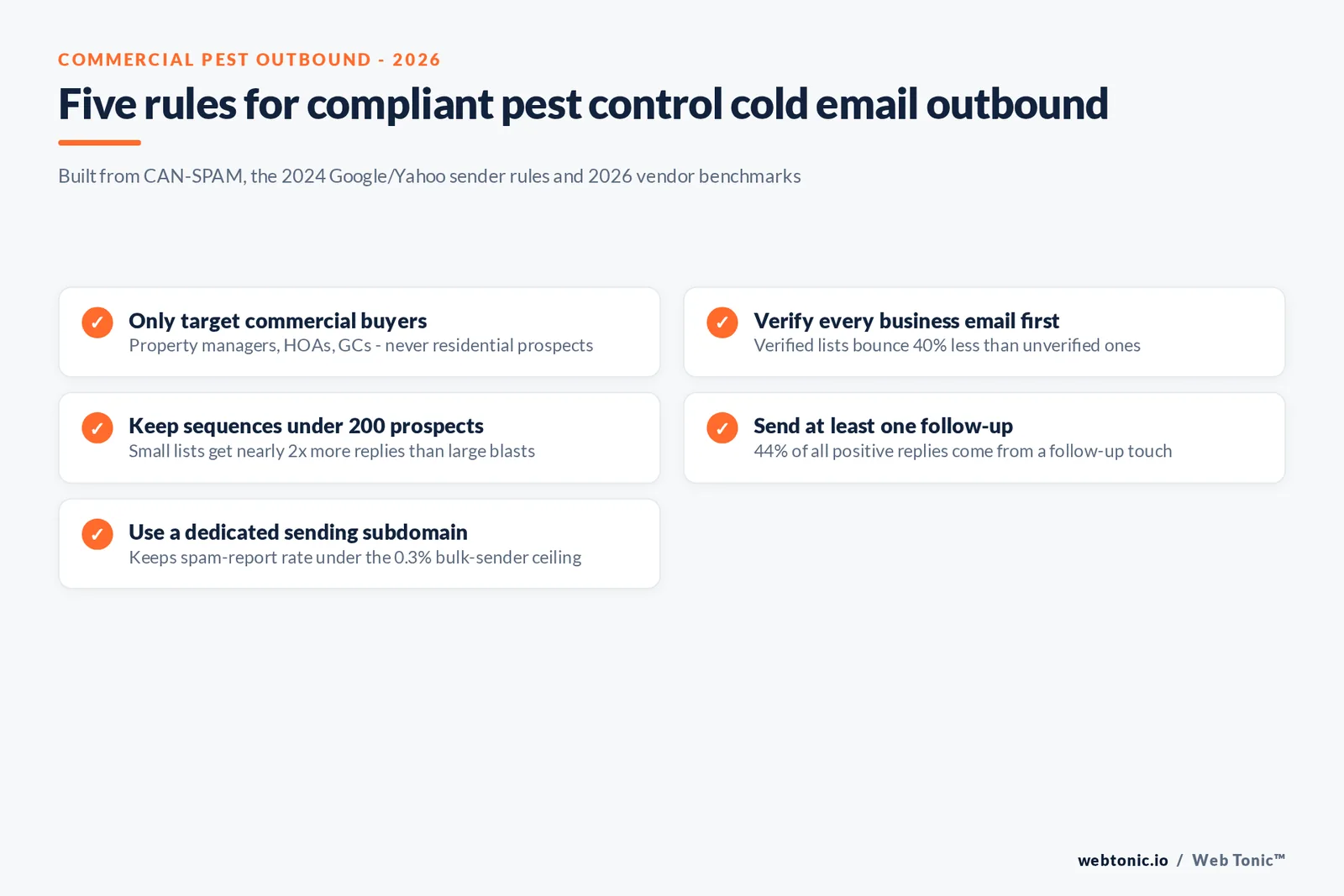
- 44% of positive replies come from a follow-up, not the first send.
- Sequences under 200 prospects generate nearly 2x more replies than large blasts.
- 97% of cold email volume in the dataset sent through Google Workspace.
- Spam-report rate must stay under 0.3% under Google's and Yahoo's 2024 bulk-sender rules.
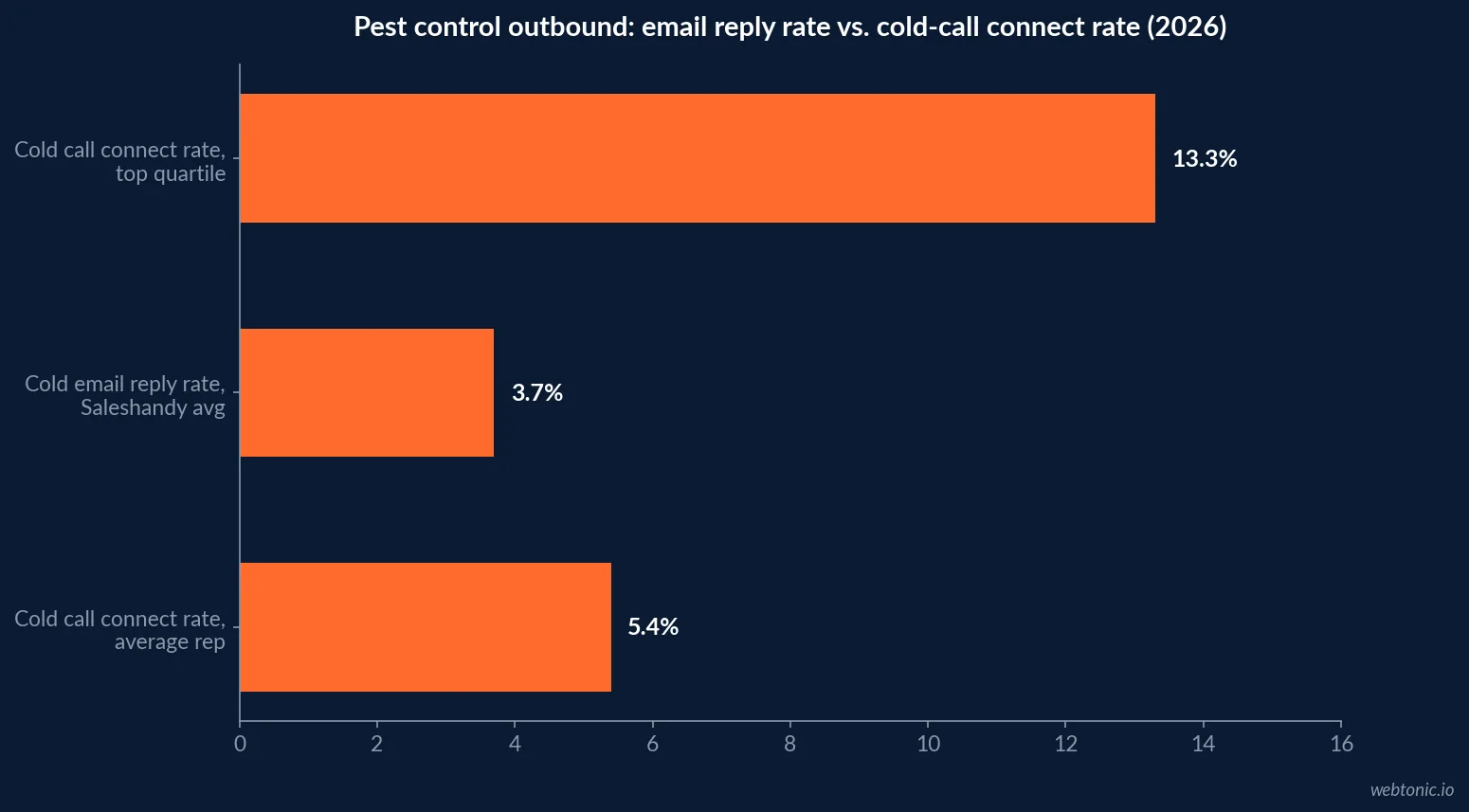
- 5.4% average cold-call connect rate, 13.3% for the top quartile (Gong, 300M+ calls).
- 4.6% average meeting-set rate once a cold call connects (Gong).
- Top 25% of reps land 4.3x more meetings than average reps on the same list (Gong).
- 10-business-day opt-out window is the FTC's CAN-SPAM enforcement floor.
- $13.416 billion is the 2025 US structural pest control industry's total service revenue (NPMA/Specialty Consultants).
- 6% year-over-year growth in that industry total for 2025.
- Verified prospect lists bounce 40% less than unverified lists (Saleshandy).
- One clear soft call-to-action lifts positive replies 78% over a hard pitch (Saleshandy).
Why this is a B2B page, not a consumer one
The US structural pest control industry generated $13.416 billion in total service revenue in 2025, up 6% from 2024's $12.654 billion, according to the National Pest Management Association, reported by Pest Control Technology's coverage of Specialty Consultants' annual analysis. A meaningful share of that revenue is commercial, not residential: Terminix runs a standing national-accounts program, and Orkin's National Accounts Program is built the same way, both selling recurring pest coverage to property management companies and multi-site facility owners. That commercial buyer, not a homeowner, is who a pest control cold email program should ever target.
The reply-rate benchmarks a program should use
Four vendor datasets, four different sample sizes and none of them agree exactly, which is the honest starting point. Saleshandy analysed 53 million cold emails sent January to June 2026 across 23,000+ user profiles and reports a 3.7% average reply rate, a 21% average open rate, and top campaigns clearing 10%+. Instantly's 2026 benchmark report puts the average B2B reply rate at 3.43%. Woodpecker's own live benchmark tool, drawn from 56,614 campaigns, reports a 1.5% median. Belkins' narrower 2025 dataset of 7.5 million emails reports a 0.45% average. A commercial pest control property-portfolio sequence landing between the Woodpecker median and the Saleshandy average is performing in normal range.
| Vendor (2026 unless noted) | Metric reported | Sample | What it measures |
|---|---|---|---|
| Saleshandy | 3.7% average reply rate | 53M emails, Jan-Jun 2026 | Cross-industry B2B outbound |
| Instantly | 3.43% average reply rate | 2026 benchmark report | Cross-industry B2B outbound |
| Woodpecker | 1.5% median reply rate | 56,614 campaigns | Cross-industry B2B outbound |
| Belkins | 0.45% average reply rate | 7.5M emails, 2025 | Narrower B2B outbound set |
| Gong | 5.4% avg / 13.3% top quartile connect rate | 300M+ calls | Cold calling, not email, for comparison |
What actually moves a commercial pest program's reply rate
The Saleshandy dataset isolates a handful of levers that matter more than list size. Sequences under 200 prospects generate nearly 2x more replies than large blasts, which fits a property-portfolio target list: a regional property management firm with 40 buildings is a small, specific list, not a mass blast. A single clear soft call-to-action lifts positive replies 78% over a hard pitch. Follow-up sends account for 44% of all positive replies, so a sequence that stops after one email is leaving nearly half its reply volume on the table. Verified lists bounce 40% less than unverified ones, which matters directly for staying under the 0.3% spam-complaint ceiling below.
| Lever | Effect reported | Source | Applies to a portfolio list of |
|---|---|---|---|
| List size under 200 prospects | Nearly 2x more replies vs large blasts | Saleshandy 2026 | A regional property manager or HOA group |
| One soft CTA vs a hard pitch | +78% positive replies | Saleshandy 2026 | Any commercial pest sequence |
| Sending at least one follow-up | 44% of all positive replies | Saleshandy 2026 | Multi-touch sequences |
| Verified vs unverified list | 40% fewer bounces | Saleshandy 2026 | Facility manager / GC contact lists |
| Google Workspace sending domain | 97% of dataset volume delivered | Saleshandy 2026 | Domain and DNS setup |
Deliverability is a compliance problem now, not a copywriting one
Since 2024, Google's sender guidelines and the Yahoo Sender Hub's FAQs require bulk senders to authenticate with SPF, DKIM and DMARC and to keep spam-report rates under 0.3%. A pest control company that runs commercial cold outbound from the same domain it uses for consumer email marketing and review requests risks the whole domain's deliverability over one bad property-manager list, which is why every serious outbound vendor now recommends a dedicated sending subdomain reserved for cold email.
Email versus the phone versus LinkedIn for a property manager list
None of the three channels wins outright on the published numbers. Gong's analysis of 300 million-plus calls reports a 5.4% average connect rate and 13.3% for the top quartile, with a 4.6% average meeting-set rate once a call connects; the top 25% of reps land 4.3x more meetings than average reps working the same list. That is a similar order of magnitude to email's 3.7% reply rate but a connected call moves to a decision faster. Cold email's advantage is that a property manager can forward a written pitch to an HOA board; a phone call cannot be forwarded. Working commercial pest programs run both channels against the same account list rather than choosing one.
| Channel | Core 2026 metric | Source | Best use for a pest program |
|---|---|---|---|
| Cold email | 3.7% avg reply rate, 53M emails | Saleshandy | Portfolio lists, written record for a board |
| Cold email (alt. benchmark) | 3.43% avg reply rate | Instantly | Cross-check against Saleshandy |
| Cold calling | 5.4% avg / 13.3% top-quartile connect | Gong, 300M+ calls | Fast decisions, single-site accounts |
| Cold calling (meeting set) | 4.6% avg meeting-set rate once connected | Gong | Booking after a live connect |
What CAN-SPAM actually requires, commercial or not
The FTC's CAN-SPAM Act compliance guide and its implementing rule at 16 CFR Part 316 apply the same way to a B2B pest control sender as to a consumer marketer: a truthful header and subject line, clear identification as an advertisement where applicable, a valid physical postal address, and a working opt-out mechanism honored within 10 business days. Scraping personal emails, buying a generic residential list, or omitting the opt-out because "it's B2B" are not exemptions the law recognizes.
Building a compliant, commercial-only list
The Saleshandy figures on verified-list bounce reduction and the CAN-SPAM opt-out requirement point to the same operational habit: verify every business email before sending, source contacts from public property-management and facility-management directories rather than scraped residential data, and route every campaign through a dedicated subdomain so a bad list never touches the domain used for review requests or consumer marketing. Our growth marketing practice builds outbound programs on that separation by default.
| List-building rule | Why it matters here | Governing source | Consequence of skipping it |
|---|---|---|---|
| Business-only, verified contacts | Cuts bounce rate 40% | Saleshandy 2026 | Domain reputation damage |
| Truthful header, no deceptive subject | Legal floor for every sender | FTC / 16 CFR 316 | FTC enforcement exposure |
| Working opt-out within 10 business days | CAN-SPAM's core requirement | FTC CAN-SPAM guide | Statutory penalty exposure |
| Dedicated sending subdomain | Protects the main domain's reputation | Google / Yahoo 2024 rules | Whole-domain deliverability loss |
| Spam-report rate under 0.3% | Bulk-sender inbox placement floor | Google sender guidelines | Loss of inbox placement account-wide |
Where cold email should sit in the budget
A commercial pest control outbound program is a small, targeted line, not a mass campaign: the Saleshandy data on small-list performance argues for tight, verified lists of property managers and facility contacts over volume. Pair it with the phone rather than replacing it, and route every reply into a CRM your data and analytics practice already tracks so a "not interested" reply this quarter does not get re-emailed next quarter.
How this fits next to an account-based plan
Cold email is a volume-and-cadence channel: it works a list, not a single account. A pest control operator running a dedicated plan against a handful of large property-management portfolios needs a different discipline entirely - our companion piece on account-based marketing benchmarks covers that named-account approach, and the two are complementary rather than competing: cold email finds the account, ABM closes it once a facilities contact replies.
Measuring the program without inflating it
A commercial pest cold email program should be measured on replies that convert to a booked site walk, not raw open rates, which Google's and Yahoo's tracking-pixel restrictions are making less reliable anyway. Route every reply into the same CRM used for inbound calls so a property manager who replied to an email and later calls in is not logged as two separate leads - a basic hygiene step our data and analytics practice sets up before any outbound volume goes out.
Our team can help size a commercial pest outbound sequence against a specific property-management target list before any send goes out.
| What to track | Why it beats a vanity metric | Where the data should live |
|---|---|---|
| Reply-to-site-walk rate | Ties the email directly to a sales action | CRM, same pipeline as inbound |
| Cost per booked commercial site walk | Comparable to paid-channel CPL | Shared dashboard with paid media |
| Bounce rate by list segment | Flags a stale or scraped list before it hurts the domain | Sending platform |
| Spam-complaint rate | The number that gets a domain throttled at 0.3%+ | Sending platform / Postmaster Tools |
Frequently Asked Questions
Does cold email work for pest control companies?
Only for the commercial side. A pest control operator has no lawful or practical reason to cold-email residential prospects, and the CAN-SPAM Act plus the FTC's compliance guidance apply the same way to a pest control sender as to any other business. Where it works is B2B: emailing property managers, HOA boards, facility managers and GCs who buy recurring commercial pest service for a portfolio of buildings. Saleshandy's analysis of 53 million cold emails sent January to June 2026 puts the average reply rate at 3.7%, with the best campaigns clearing 10%, and that figure is what a commercial pest outreach program should benchmark against, not a consumer number that does not exist.
What reply rate should a commercial pest control outbound program expect?
Vendor benchmarks cluster differently depending on how each counts a reply. Instantly's 2026 benchmark report puts the average B2B reply rate at 3.43%. Woodpecker's own live benchmark tool, drawn from 56,614 campaigns, reports a 1.5% median. Belkins' narrower 2025 dataset of 7.5 million emails reports a 0.45% average. Saleshandy's 53-million-email 2026 analysis reports 3.7%. The spread is the method, not the market: average versus median, and which sends count as delivered. A property-portfolio outbound sequence sitting between the Woodpecker median and the Instantly average is in normal range.
What do the 2024 Google and Yahoo bulk-sender rules change for this?
Google's sender guidelines require SPF, DKIM and DMARC authentication plus a spam-report rate kept under 0.3%, and Yahoo's sender hub enforces the same threshold. A pest control company running outbound from an unauthenticated domain, or from the same domain used for consumer email marketing, risks the whole domain's deliverability, not just the outbound campaign. The practical fix used across the outbound tool vendors is a separate sending subdomain reserved for cold outreach.
Is cold email better than a phone call or a LinkedIn message for reaching a property manager?
The channels solve different problems and the data does not support picking one exclusively. Gong Labs, analysing 300 million-plus calls, reports a 5.4% average cold-call connect rate and 13.3% for the top quartile, with a 4.6% average meeting-set rate once connected. That is a comparable order of magnitude to email's 3.7% reply rate, but a call that connects moves faster to a decision. Cold email's advantage is volume and a paper trail a property manager can forward to a board; a call's advantage is speed. Most working commercial pest programs run both against the same account list rather than choosing.
What is off-limits when sourcing a list of property managers to email?
Scraping personal or non-business emails, buying a list without consent language, or emailing a general residential contact list are all against the CAN-SPAM Act's intent even where the letter of the law is narrower than that. The FTC's compliance guide requires a truthful header, no deceptive subject line, a physical postal address and a working opt-out honored within 10 business days regardless of B2B or B2C framing. A commercial-only list built from public property-management directories and verified business emails is the version of this that survives an audit.
Sources
Saleshandy - I Analyzed 53M Cold Emails: 13 Stats That Matter in 2026
Instantly - Cold Email Benchmark Report 2026
Woodpecker - Free cold email benchmarks tool
Belkins - B2B cold email response rates, 2025 study
Gong Labs - Does cold email even work any more?
Google - Email sender guidelines
Yahoo Sender Hub - FAQs
Federal Trade Commission - CAN-SPAM Act Compliance Guide for Business
eCFR - 16 CFR Part 316, CAN-SPAM Rule
National Pest Management Association - US pest control industry, 2025
Orkin - National Accounts Program