Table of contents
The honest answer is: personalization moves buying behavior more reliably than it moves a single headline revenue number. Customer-expectation surveys from named research houses are consistent and large-sample; the eye-catching "+19% revenue" claims that circulate online are almost always one vendor's own platform data, not an independent study.
Key Takeaways
- 73% of customers feel treated as unique individuals in 2024, up from 39% in 2023 (Salesforce).
- Only 49% think companies use their data to their benefit, down from 60% in 2022.
- 71% of customers are more protective of their personal data than a year earlier.
- 89% of B2B and B2C decision-makers call personalization invaluable to the next three years (Twilio Segment).
- 73% agree AI adoption will fundamentally change personalization strategy.
- 72% of surveyed businesses now use a CDP to power personalization; 48% use a data warehouse.
- 91% of consumers see at least one irrelevant ad every day (Epsilon).
- 76% view a brand negatively when its personalization is inaccurate.
- 65% say brands have gotten better at personalizing messages in the past few years.
- Only 45% feel they have any control over how brands use their data.
- 60% engage with marketing because they already like the brand, not because they need it.
- 75.4% of consumers used an AI tool to shop in 2026 (Bloomreach).
- 41.4% would now choose to shop through AI over a brand's own site, up from 41.1% in 2025.
- 55.6% plan to lean on AI-assisted shopping even more over the next 12 months.
- 44% of media fans discover content on one channel and buy on another (Deloitte), hiding true personalization impact from single-channel analytics.
- 65% of respondents feel brands have improved advertising personalization - and still see it fail daily.
Why "impact on sales" is the wrong first question
Ask a personalization vendor "does this lift sales" and you get a case-study number built from their own customers, on their own platform, cherry-picked toward the best cohorts. That is not dishonest, but it is not evidence you can apply to your own site either. The better first question is behavioral: does personalization change what a real, independently-surveyed customer population does and expects? On that question the data is large-sample, named and consistent across three separate research houses.
Salesforce's State of the AI-Connected Customer surveyed over 16,500 consumers and business buyers and found 73% now feel treated as an individual rather than a number, a jump from just 39% in 2023. That is a measurable shift in perceived experience quality, and perceived experience quality is what correlates with repeat purchase in every loyalty study ever run.
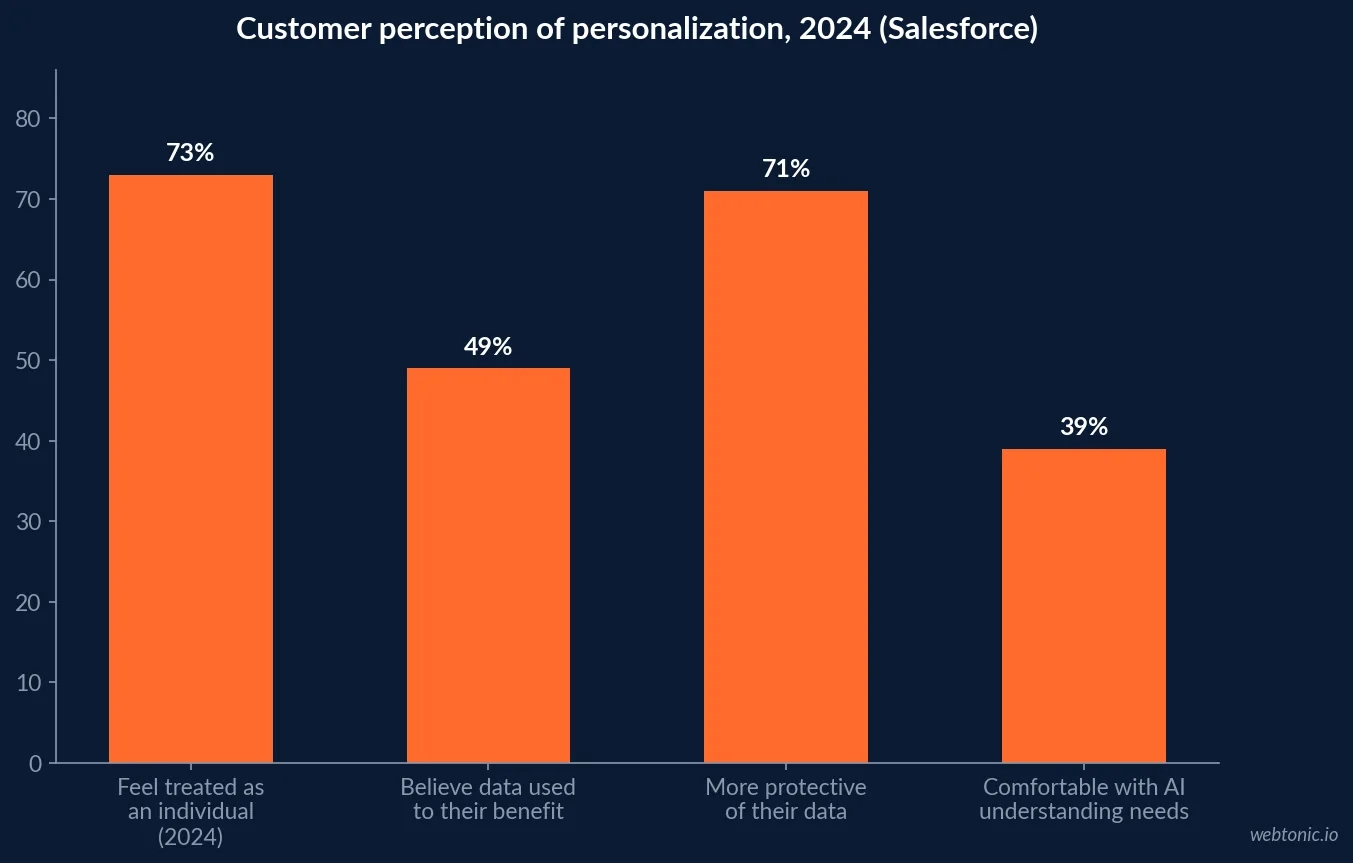
| Metric (Salesforce, 2024) | Figure | Direction vs. prior wave |
|---|---|---|
| Feel treated as a unique individual | 73% | Up from 39% in 2023 |
| Believe data is used to their benefit | 49% | Down from 60% in 2022 |
| More protective of personal data | 71% | Rising |
| Comfortable with AI understanding their needs | 39% | Minority, but growing |
| Believe companies are reckless with their data | 64% | Majority concern |
The gap between "we personalize" and "it worked"
Personalization spend and personalization outcomes are not the same line on the chart. Epsilon's consumer research, drawn from 600 respondents aged 18 to 65, found that 65% think brands have gotten better at personalizing marketing over the past few years - but 91% still see at least one irrelevant ad every single day. Improvement and adequacy are different bars, and most programs are clearing the first without clearing the second.
The cost of getting it visibly wrong is not neutral. 76% of respondents say they view a brand negatively when its marketing includes inaccurate information about them, and only 45% feel any real control over how that data gets used. A personalization program that surfaces a wrong name, a wrong size or a stale purchase history is not a null result; it is a trust withdrawal.
| Epsilon 2024 consumer study (n=600) | Share of respondents |
|---|---|
| Say brands have improved personalization | 65% |
| See an irrelevant ad daily despite that | 91% |
| View brand negatively after inaccurate personalization | 76% |
| Feel some control over how brands use their data | 45% |
| Engage because they like the brand, not because they need it | 60% |
| Engage out of curiosity about a new brand/product | 56% |
What decision-makers themselves believe
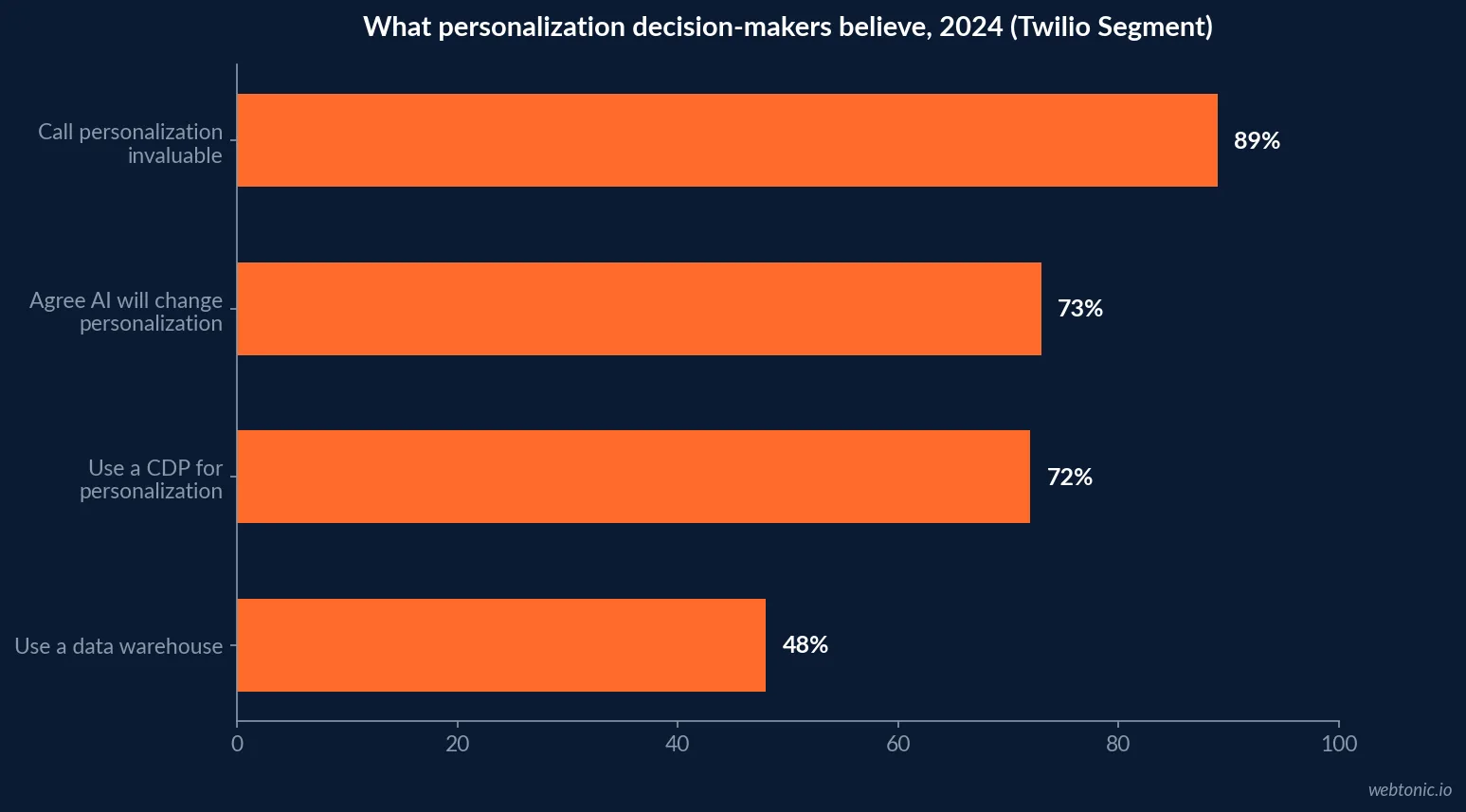
Twilio Segment's State of Personalization Report surveyed 521 B2B and B2C directors-and-above across 12 countries and found 89% call personalization invaluable to their business's success over the next three years. That conviction is backing real infrastructure spend: 72% now run a customer data platform and 48% use a data warehouse specifically to support personalization work, and by 2025 the survey's respondents expected 59% of their teams to be using AI daily inside those workflows. See the full methodology in the Twilio Segment 2024 report PDF.
Belief and infrastructure spend are leading indicators, not proof of return. But 89% conviction from people who control the budget is not a fad signal either - it is what a maturing category looks like before the independent, peer-reviewed conversion-lift studies catch up to it.
| Twilio Segment 2024 (n=521 decision-makers, 12 countries) | Figure |
|---|---|
| Call personalization invaluable to 3-year success | 89% |
| Agree AI adoption will fundamentally change personalization | 73% |
| Currently use a customer data platform (CDP) | 72% |
| Currently use a data warehouse for personalization | 48% |
| Expected daily AI use across teams by 2025 | 59% |
| Addressing data privacy/ethics with a dedicated platform | 54% |
Where personalization is shifting sales channels, not just conversion rates
Bloomreach's 2026 consumer survey of 4,000 US and UK shoppers found 75.4% have used an AI tool such as an assistant or chatbot to help with a shopping decision, and 80.4% say those AI-assisted experiences met or exceeded expectations. The more consequential number: when forced to choose, 41.4% would now shop through AI rather than a brand's own site, versus 38% who still prefer the direct site - a reversal from 2025, when 58.9% preferred the brand's site directly. See the Bloomreach 2026 release for the full breakdown.
A site that personalizes only its own on-page experience is now optimizing for a shrinking share of the decision. If the buyer is asking an AI assistant to compare and recommend before ever landing on your homepage, personalization has to extend into how your product data reads to that assistant, not just how your hero banner reads to a human.
| Bloomreach 2026 shift (n=4,000 US/UK consumers) | 2025 | 2026 |
|---|---|---|
| Prefer shopping directly on a brand's site | 58.9% | 38% |
| Would choose to shop through an AI tool instead | 41.1% | 41.4% |
| Plan to use AI-assisted shopping even more next 12 months | n/a | 55.6% |
| Say AI shopping increased purchase confidence | n/a | 60.8% |
| Say AI shopping increased how much they spend | n/a | 37.5% |
B2B personalization runs inside constraints B2C never faces
Forrester's 2026 analysis makes the useful distinction: B2C personalization is about inspiration and impulse, while B2B personalization has to make pricing agreements, account permissions and governance rules invisible to the buyer instead of turning them into friction. Buyers increasingly assume a supplier's portal recognizes who they are and what they are trying to do - reorder, request a part, get a quote - without re-explaining it every visit.
Forrester's read on why adoption still lags ambition matters for anyone scoping a project: the blocker is rarely the AI layer. It is identity, account data, product data and governance sitting in separate systems that were never connected in the first place. Fix the plumbing before buying another personalization tool that has nothing clean to run on.
The attribution problem no dashboard fixes alone
Deloitte's 2026 Digital Media Trends research, based on 3,575 US consumers, found 44% of self-identified fans discover content on social media and then leave to watch, buy or engage somewhere else entirely - a figure that climbs closer to 60% among Gen Z. Deloitte frames this cross-platform hop as a "black box" for the origin platform: it loses visibility into intent and misses the personalization and cross-sell opportunity that a single connected view would have caught.
The practical read for a site owner: if your personalization engine only watches sessions on your own domain, it is measuring a shrinking slice of the actual customer journey. The 44% who leave and come back somewhere else are still being influenced by what they saw first - your analytics just cannot see the thread.
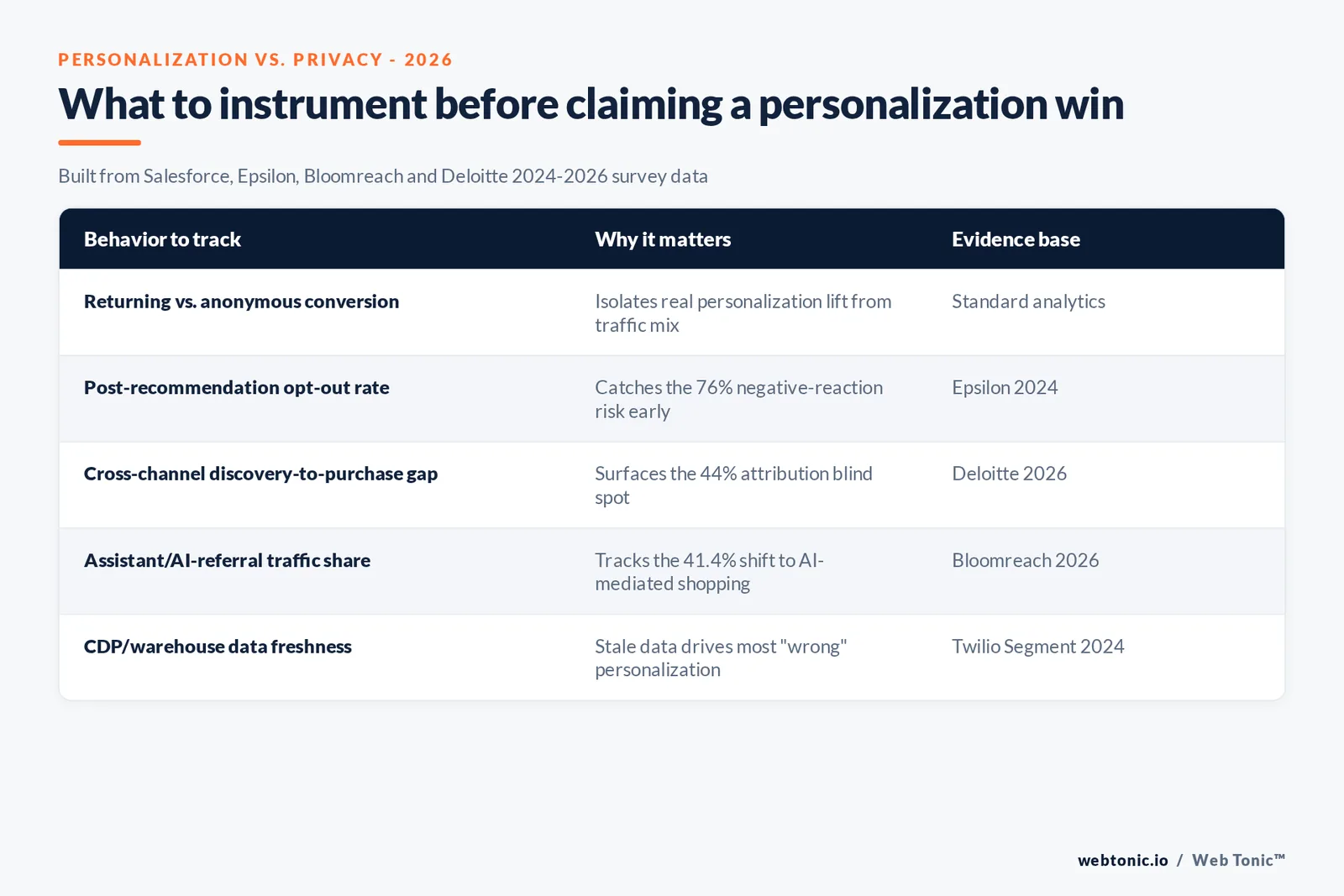
| What to instrument | Why it matters | Where the evidence comes from |
|---|---|---|
| Returning-customer conversion vs. anonymous | Isolates real personalization lift from traffic mix | Standard analytics segmentation |
| Post-recommendation complaint/opt-out rate | Catches the 76% negative-reaction risk early | Epsilon 2024 |
| Cross-channel discovery-to-purchase gap | Surfaces the 44% attribution blind spot | Deloitte 2026 |
| Assistant/AI-referral traffic share | Tracks the 41.4% shift toward AI-mediated shopping | Bloomreach 2026 |
| CDP/warehouse data freshness | Stale data is the #1 cause of "wrong" personalization | Twilio Segment 2024 |
What "impact on sales performance" should mean operationally
Translate the survey data into a sales-facing definition rather than a marketing-only one: personalization impacts sales performance when it reduces the friction between a buyer's stated intent and the next step they need to take, and it hurts sales performance when it substitutes a guess for that intent. Salesforce's 49% figure on whether customers feel their data benefits them is really a proxy for how often that guess lands wrong. A sales team feeling pipeline stall after a personalization rollout should check whether recommendations are running on stale CRM data before blaming the channel.
A realistic personalization roadmap for 2026
Start with the account and product data plumbing Forrester flags as the real blocker, not with a new personalization SaaS tool layered on top of disconnected systems. Instrument the behaviors in the table above before claiming any lift, because your own numbers - not a vendor's platform-wide average - are the only ones that will hold up under scrutiny six months from now.
Our growth marketing team builds that measurement layer before recommending a personalization spend, and our data and analytics practice wires the CDP-to-site connection so recommendations run on data that is actually current rather than a stale import from last quarter.
The takeaway for anyone budgeting a personalization project
Personalization is not proven to add a fixed percentage to your revenue - no honest, named, independent study claims that. What is proven, repeatedly and at scale, is that customers now expect recognition, punish inaccuracy hard, and are already routing a meaningful share of their shopping decisions through AI intermediaries that did not exist as a channel two years ago. Build for that reality, measure your own site's numbers, and treat every vendor percentage as a hypothesis to test, not a guarantee to bank. If you want a second opinion on your current setup, talk to our team.
Frequently Asked Questions
Does website personalization actually increase sales?
The rigorous, named-study evidence points to yes on behavior, even where a single clean revenue percentage is hard to pin down. Salesforce finds 73% of customers now feel treated as unique individuals, up from 39% in 2023, and that shift tracks with how willing customers are to keep buying. Twilio Segment's decision-maker survey puts personalization at 89% invaluable to future growth. The honest caveat: most single-number conversion-lift claims ("+19% revenue") come from vendor platform data, not independent studies, so treat them as directional, not a guarantee for your site.
What is the biggest risk of getting personalization wrong?
Feeling watched instead of understood. Epsilon's consumer study found 91% of respondents see at least one irrelevant ad every day despite brands investing in personalization, and 76% say they view a brand negatively when it uses inaccurate information about them. Personalization built on stale or wrong data actively damages trust rather than sitting neutral.
Do customers want more personalization or less?
More, but on their terms. Salesforce reports 71% of customers are more protective of their personal data even as they expect a better experience, and only 49% believe companies use their data in a way that benefits them, down from 60% in 2022. Bloomreach's 2026 consumer survey found 55.6% of respondents plan to use AI-assisted shopping even more over the next year. The demand for relevance is rising faster than trust that brands will handle the data behind it responsibly.
Is personalization now table stakes in B2B, not just retail?
Forrester's 2026 analysis argues B2B buyers increasingly treat recognition as a baseline expectation, not a feature to be impressed by, inside constraints like pricing agreements and account permissions that consumer sites do not have to handle. The blocker is rarely the AI layer; it is disconnected identity, account and product data that never gets wired together in the first place.
How should a site owner measure personalization's real impact?
Track behavior your own analytics can prove, not a borrowed industry percentage: return-visit rate, switching/complaint volume after a bad recommendation, and whether logged-in customers convert differently than anonymous ones. Deloitte's 2026 media research shows 44% of fans discover content on one channel and buy on another, which means a personalization program that only watches one session will always under-count its own effect.
Sources
Salesforce - State of the AI-Connected Customer
Salesforce - State of the AI-Connected Customer (report PDF)
Twilio Segment - State of Personalization Report
Twilio Segment - State of Personalization Report 2024 (PDF)
Epsilon - The Push and Pull of Personalization
Epsilon - Consumer engagement study press release
Forrester - B2B Hyperpersonalization Is Not A Feature, It Is An Expectation
Bloomreach - 2026 consumer survey on AI shopping preference
Deloitte - 2026 Digital Media Trends
Statista - Personalization in e-commerce topic hub