



Table of contents

Key Takeaways
- Only 22 personal injury law firms (0.1% adoption) use Shopify across the entire U.S. legal market, making it one of the least adopted ecommerce platforms in the PI space.
- 734 live Shopify stores operate in the Legal Services category as of July 2026, with 40.7% based in the United States.
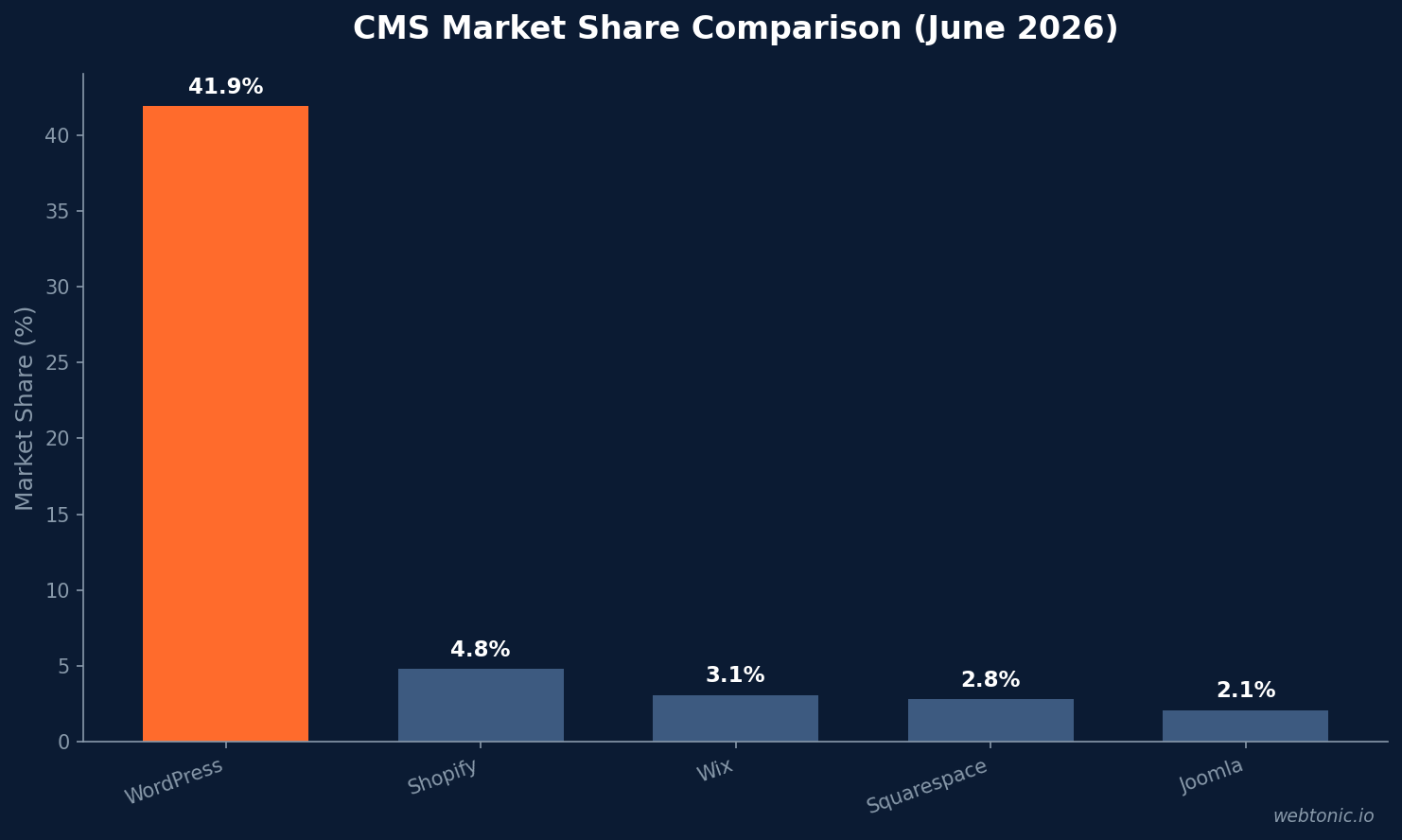
- Shopify holds just 4.8% CMS market share compared to WordPress's 41.9% of all websites globally, a nearly 12:1 gap.
- PI firms using Shopify average a 16.0 Sophistication Index (SI), which is 12.7 points lower than non-adopters, suggesting smaller or newer firms drive adoption.
- Google Ads CPC for legal keywords averages $9.45, climbing past $250 for personal injury terms, making PPC-to-store funnels expensive for legal ecommerce.
- 22.6% of legal Shopify stores sell visa and immigration products, the largest single product category in legal ecommerce.
- The PI legal services market is worth $61.7 billion in the United States, yet ecommerce captures only a fraction of that revenue.
Personal Injury Law × Shopify: Benchmarks at a Glance
| Metric | Value | Source |
|---|---|---|
| PI firms using Shopify | 22 firms (0.1%) | TopLawDog |
| Legal Services Shopify stores (all law) | 734 live stores | StoreLeads |
| WordPress CMS market share | 41.9% (all sites) | W3Techs / Custom.legal |
| Shopify CMS market share | 4.8% | W3Techs / Custom.legal |
| Avg Google Ads CPC (legal) | $9.45 | CuFinder |
| PI / Mass Tort CPC | $180–$250+ | CuFinder |
| PI industry market size (U.S.) | $61.7 billion | IBISWorld via Custom.legal |
| Avg website conversion (law firms) | 3.8% | CuFinder |
Shopify Adoption Among Personal Injury Law Firms
Shopify's footprint in the personal injury space is minimal. According to TopLawDog's technology tracking data, only 22 personal injury law firms use Shopify, representing a 0.1% adoption rate across the entire tracked PI market. This makes Shopify one of the least common technologies in the personal injury vertical.
Firms that do run Shopify average a Sophistication Index of 16.0, which is 12.7 points below the average for non-adopters. This inverse correlation suggests that Shopify adoption in PI law skews toward smaller, less technology-invested practices rather than the large, multi-channel firms that dominate paid search and SEO.
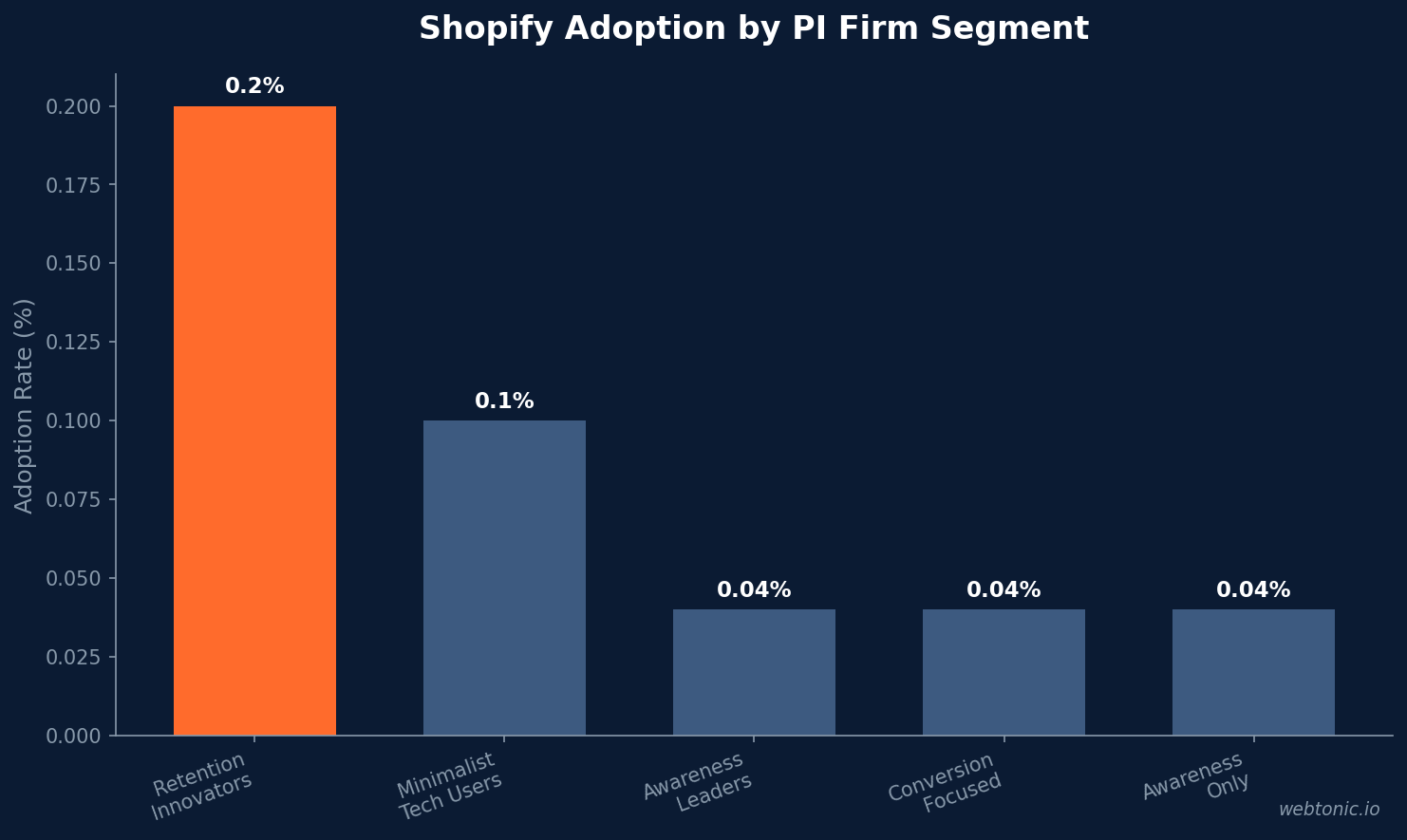
The heaviest adoption comes from Minimalist Tech Users (13 firms, 0.1%), followed by Retention Innovators (3 firms, 0.2%). Only one Awareness Leader and one Conversion-Focused Firm appear in the dataset, reinforcing that Shopify serves a niche within a niche in the personal injury world.
Shopify Adoption by PI Firm Segment
| Firm Segment | Firms Using Shopify | Adoption Rate |
|---|---|---|
| Minimalist Tech Users | 13 | 0.1% |
| Retention Innovators | 3 | 0.2% |
| Awareness Leaders | 1 | 0.0% |
| Conversion-Focused Firms | 1 | 0.0% |
| Awareness-Only Firms | 1 | 0.0% |
Legal Services Shopify Stores: Category Overview
While personal injury firms barely use Shopify, the broader legal services category tells a different story. StoreLeads data updated July 2026 shows 734 live Shopify stores in the Legal Services category. The majority sell document templates, immigration consultation packages, DIY estate planning kits, and legal compliance checklists rather than traditional litigation services.
22.6% of legal Shopify stores sell visa and immigration products, making it the single largest product niche. This aligns with immigration law's transactional nature — fixed-fee services and document packages translate more naturally to ecommerce than contingency-based PI work where growth-focused marketing drives client acquisition.
Contact visibility remains high: 54.4% provide a phone number and 51.5% list an email on their storefront. Social media adoption is moderate, with Instagram at 30.4%, Facebook at 21.1%, and Twitter at 9.5% of legal Shopify stores.
Legal Services Shopify Store Statistics (July 2026)
| Metric | Value |
|---|---|
| Live legal services Shopify stores | 734 |
| U.S.-based stores | 40.7% |
| Canada-based stores | 6.7% |
| UK-based stores | 5.2% |
| Mexico-based stores | 4.1% |
| Stores with phone number | 54.4% |
| Stores with email | 51.5% |
| Instagram adoption | 30.4% |
| Facebook adoption | 21.1% |
CMS Market Share: Why Shopify Trails WordPress in Legal
The reason Shopify's PI adoption sits at 0.1% becomes clear when you compare content management platforms. According to Custom Legal Marketing's analysis of W3Techs data, WordPress powers 41.9% of all websites globally and holds 59.4% of the CMS market share as of June 2026. Shopify captures just 4.8%, making WordPress nearly 12 times larger by market share.
For personal injury firms specifically, TopLawDog data shows 56.9% of PI firms run WordPress — over 20,070 firms. Shopify's 22 firms represent 0.1% of that same dataset. The gap reflects a fundamental platform mismatch: Shopify is built for product-based commerce, while PI firms need content-rich, SEO-optimized informational sites with practice area pages, case results, attorney bios, and local city landing pages for Google Business Profile optimization.
WordPress's ecosystem of 59,000+ free plugins and 12,000+ themes includes legal-specific tools like Clio integrations, intake form builders (Gravity Forms, WPForms), and SEO plugins (Yoast, Rank Math). Shopify has no comparable legal vertical tooling for personal injury practices.
Ecommerce Opportunities for Personal Injury Firms
Despite the low adoption, ecommerce is not entirely irrelevant to personal injury law. The $61.7 billion PI market creates secondary revenue opportunities that Shopify can serve. Trial Guides (trialguides.com), the highest-SI Shopify adopter among PI firms at 78.578 SI, sells litigation training materials, books, and continuing education products — not legal services directly.
According to CuFinder's 2026 law firm benchmarks, Google Shopping placements now appear in Performance Max campaigns for legal products with an average CPC of $1.85 and a conversion rate of 1.90%. That CPC is dramatically lower than the $9.45 average for legal search ads and the $180–$250+ PI/mass tort range.
This opens a narrow but real opportunity: firms can sell branded educational content, accident preparation kits, or legal document templates through Shopify while running their primary client acquisition through data-driven WordPress or custom-built websites optimized for local SEO and PPC conversion.
Technology Stack Among Shopify-Adopting PI Firms
PI firms running Shopify pair it with a specific technology stack. TopLawDog's co-occurrence data shows the most common technologies alongside Shopify in personal injury practices:
- Google Workspace at 50.0% — email and document management across the firm
- Microsoft 365 at 31.8% — productivity suite for case documentation
- Google Analytics at 22.7% — traffic and conversion tracking
- Cloudflare Web Analytics at 18.2% — performance and security monitoring
- Klaviyo at 13.6% — email marketing automation for client nurture sequences
- Facebook Pixel at 13.6% — social retargeting for Meta ad campaigns
- Google Tag Manager at 13.6% — centralized tag deployment for attribution
The presence of Klaviyo (13.6%) is notable because it is Shopify's most popular email marketing integration. Among the broader 734 legal Shopify stores, the top apps are Judge.me Product Reviews (7.6%), Shopify Forms (7.2%), and Shopify Inbox (6.5%).
Website Conversion Benchmarks for PI Firms
Whether a PI firm uses Shopify, WordPress, or a custom platform, conversion rates determine marketing ROI. LEXGRO's 2026 conversion data provides the baseline that every PI firm should benchmark against:
PI Website Conversion Benchmarks (2026)
| Conversion Stage | Average | Top Performers |
|---|---|---|
| Website visitor-to-lead | 2.8%–3.6% | 6%–18% |
| Inbound call conversion | 2.6% | 8%–15% |
| Form submission rate | 3%–5% | 8%–12% |
| Mobile visitor conversion | 1.5%–2.5% | 4%–8% |
| Landing page with video | +86% lift | — |
The average PI website converts 2.8% of visitors into leads. Top-performing firms using Google Local Services Ads and optimized landing pages reach 18%. For Shopify-based PI stores, the ecommerce conversion benchmarks differ: the focus is product sales (document templates, educational kits) rather than lead generation, making direct comparison difficult.
Regardless of platform, leads contacted within one minute convert 391% better than those contacted later. Speed-to-lead matters more than the CMS powering the website.
Conversion Optimization: Website Video and Speed-to-Lead
Regardless of whether a PI firm uses Shopify for product sales or WordPress for client acquisition, conversion optimization determines marketing ROI. Authentic Web Marketing data shows that most law firm websites convert at only 2–5%, but adding strategic video content typically pushes conversion to 5–12%. A dentist in their case study went from 40% to 70% close rates by adding video proof to their digital presence — same traffic, same services, with the only change being video content on key pages.
For Shopify stores selling legal products, the conversion playbook is different from lead generation but equally data-dependent. Product page optimization, clear pricing, trust badges, and customer reviews drive ecommerce conversion. Among the 734 legal Shopify stores, the top-installed app is Judge.me Product Reviews (7.6%), confirming that social proof is the primary conversion lever in legal ecommerce. Firms running both a WordPress site for client acquisition and a Shopify store for product sales should track attribution separately across both platforms to accurately measure each channel's contribution to overall revenue.
Speed-to-lead remains critical across all platforms: leads contacted within one minute convert 391% better than those contacted later. For PI firms using Shopify as a supplementary channel, automated order confirmation and follow-up email sequences through Klaviyo or similar platforms ensure immediate engagement with every customer interaction.
Best Practices for PI Firms Considering Shopify
- Use Shopify as a supplement, not a replacement. Run your primary PI website on WordPress or a custom CMS for SEO-rich content, case results, and local pages. Use Shopify only for selling tangible or digital products.
- Target product categories that fit PI. Accident documentation kits, medical records organizers, legal education materials, and branded merchandise have natural audiences among past and current clients.
- Leverage lower-CPC advertising channels. Google Shopping at $1.85 CPC costs 98% less than PI search ads at $180+. Products from a Shopify store can appear in Performance Max campaigns at dramatically lower cost.
- Install conversion tracking from day one. 22.7% of Shopify-adopting PI firms use Google Analytics — the other 77.3% are flying blind on attribution and ROI.
- Integrate email marketing with Klaviyo. At 13.6% adoption among PI Shopify firms, Klaviyo enables post-purchase nurture sequences that keep your firm top-of-mind for referrals.
FAQ
How many personal injury law firms use Shopify?
Only 22 personal injury law firms (0.1% of tracked PI firms) currently use Shopify, according to TopLawDog's technology tracking data. Shopify is primarily used by smaller firms for selling educational materials, legal document templates, and branded merchandise rather than for client acquisition or lead generation.
Is Shopify a good platform for a law firm website?
Shopify is not ideal as a primary law firm website platform. It holds 4.8% CMS market share compared to WordPress's 41.9%. WordPress offers far more SEO tooling, legal-specific plugins, and content management flexibility for building practice area pages, case results, and local landing pages. However, Shopify works well as a secondary store for selling legal products alongside a WordPress-based main site.
What do personal injury law firms sell on Shopify?
PI firms on Shopify typically sell litigation training materials, legal guides, continuing education products, accident documentation kits, and branded merchandise. The highest-rated PI firm on Shopify (Trial Guides, SI score 78.578) sells attorney training books and litigation resources to other legal professionals.
How many Shopify stores are in the legal services category?
There are 734 live Shopify stores in the Legal Services category as of July 2026. 40.7% are in the United States, and 22.6% sell visa and immigration products, the largest single product category. Personal injury firms represent a tiny fraction of these legal ecommerce stores.
What is the average Google Ads CPC for personal injury law?
The average Google Ads CPC for legal keywords is $9.45, but personal injury and mass tort terms range from $180 to $250+. Google Shopping placements through Performance Max campaigns offer a dramatically lower CPC of $1.85 for legal products, creating ecommerce advertising opportunities at a fraction of search ad costs for PI firms.
Sources
TopLawDog — Shopify for Law Firms (PI Adoption Data)
TopLawDog — WordPress for Law Firms (20,070 PI Firms)
Custom Legal Marketing — WordPress for PI Firms (CMS Market Data)
CuFinder — Law Firms Industry Marketing Benchmarks 2026
LEXGRO — PI Website Conversion Benchmarks 2026
Authentic Web Marketing — How Video Increases Website Conversion
Marketing LTB — Legal Marketing Statistics 2026


