



Table of contents
The average personal injury law firm website converts just 2.8% of visitors into leads, yet top-performing firms reach 18% using optimized landing pages and Local Services Ads. That gap — a potential six-fold increase in lead volume on the same ad spend — represents the single largest revenue opportunity most PI firms overlook.
Key Takeaways
- 2.8% is the average PI website conversion rate across all traffic sources, while top performers hit 18% with optimized landing pages and Google LSAs.
- Dedicated landing pages convert 4–5× better than homepages for paid traffic, yet 52% of personal injury firms still send PPC clicks to their homepage.
- Legal services carry the highest average CPL of any industry at $131–$144, making every conversion rate improvement worth tens of thousands annually.
- Video testimonials on landing pages increase conversions by up to 86%, but remain massively underutilized among personal injury firms.
- 3-field contact forms convert at roughly 2× the rate of 8-field forms, with 67% of PPC leads preferring to call rather than fill out any form.
- Leads contacted within one minute convert at 391% higher rates than those reached later, making intake speed a critical landing page factor.
- Mobile visitors account for 70%+ of traffic but convert 40–50% lower than desktop, requiring mobile-first landing page design for PI firms.
Personal Injury Landing Page Conversion Benchmarks at a Glance
The following table consolidates the most current conversion data across traffic sources, lead types, and funnel stages for personal injury law firms.
| Metric | Average | Top Performers | Source |
|---|---|---|---|
| Website visitor-to-lead | 2.8%–3.6% | 6%–18% | LEXGRO / SeoProfy |
| Google LSA conversion | 15%–18% | 20%+ | LEXGRO |
| Google Ads (search) conversion | 3%–6% | 8%–12% | LEXGRO |
| Organic search conversion | 5%–8% | 10%–14.6% | AuthoritySpecialist |
| Mobile visitor conversion | 1.5%–2.5% | 4%–8% | Sanguine SA |
| Form submission rate | 3%–5% | 8%–12% | Industry benchmarks |
| Inbound call conversion | 2.6% | 8%–15% | MyCase |
| Lead-to-signed (organic) | 14.6% | 20%+ | LEXGRO |
| Lead-to-signed (paid) | 3.75%–5% | 10%–15% | LEXGRO |
Why Landing Page Conversion Rates Define PI Firm Profitability
Personal injury law operates in one of the most expensive digital advertising verticals. Google Ads cost-per-click for PI keywords regularly exceeds $100–$300 in competitive metros, and the average cost per lead sits at $442 for Google Ads versus $183 for SEO. At these price points, a landing page that converts at 2% instead of 6% does not merely underperform — it costs three times as much per lead.
Consider a firm spending $30,000 per month on paid search generating 3,000 visitors. At a 2.8% conversion rate, that produces 84 leads. At 18%, the same traffic produces 540 leads — six times the pipeline on the same budget. This math explains why conversion-focused marketing strategies deliver dramatically higher ROI than simply increasing ad spend.
Conversion Rates by Traffic Source and Platform
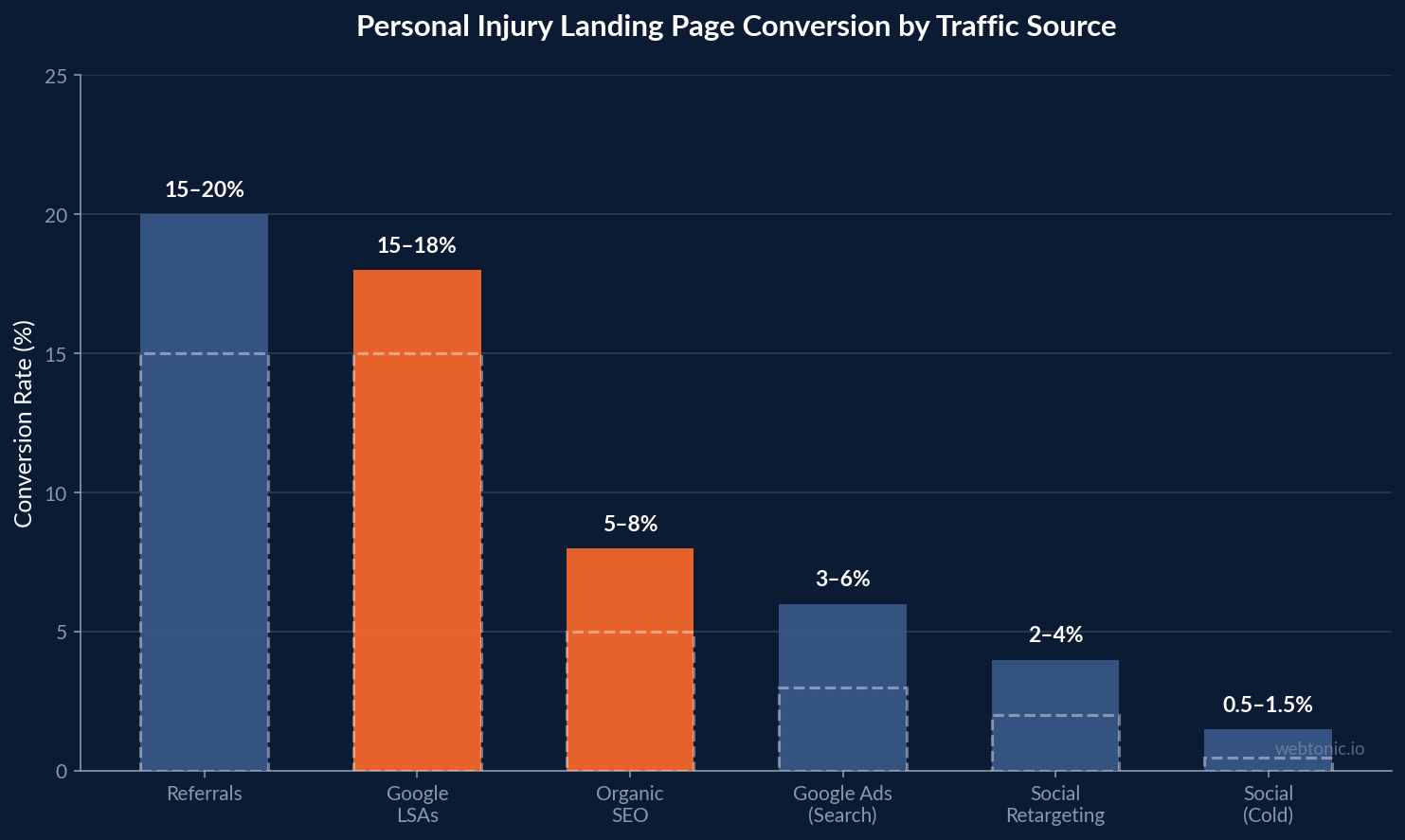
Not all traffic converts equally. The platform a visitor arrives from determines baseline conversion expectations, and the cost structure varies dramatically across channels.
| Traffic Source | Visitor-to-Lead Rate | Avg CPL | Cost Per Signed Case |
|---|---|---|---|
| Google LSAs | 15%–18% | $378 | $3,150–$4,725 |
| Organic search (SEO) | 5%–8% | $183 | $915–$1,220 |
| Google Ads (search) | 3%–6% | $442 | $2,900–$8,800 |
| Social retargeting | 2%–4% | $18–$78 | $450–$1,950 |
| Social (cold) | 0.5%–1.5% | $50–$150 | $3,300–$30,000 |
| TV / CTV | 10%–15% (branded) | $300–$600+ | $2,000–$6,000 |
| Referrals | 15%–20%+ | $0–$100 | $0–$667 |
SEO produces the cheapest leads and converts them at the highest rate. A $183 lead that signs at 15–20% translates to roughly $915–$1,220 per signed case — 3–7× cheaper than Google Ads on a per-case basis. Meanwhile, Google LSAs convert at 15–18% because pre-qualification through Google Screening builds trust before the click. Firms investing in professional Google Ads management often see conversion improvements of 40–60% by shifting budget toward LSA-eligible campaigns.
Landing Page Elements That Drive Personal Injury Conversions
Research across hundreds of PI firm landing pages reveals consistent patterns in what separates high-converting pages from underperformers.
- Form placement above the fold dramatically increases conversions, even when aesthetics suffer. Every scroll a visitor must perform before finding the contact form reduces completion rates.
- Video testimonials increase conversions by up to 86%, yet the majority of personal injury firms still rely on text-only testimonials. Prospective clients connect more deeply with real plaintiff stories told on camera.
- Short contact forms (3 fields) convert at roughly 2× the rate of long forms (8+ fields). The minimum viable information — name, phone, case type — is enough to initiate intake.
- Social proof placed near the contact form — including specific verdict amounts, star ratings, and case results — lifts conversions more than any design change alone.
- Click-to-call buttons must be prominent on mobile, since 67% of PPC leads choose to call rather than fill out a form, and over 70% of legal site traffic arrives on mobile devices.
- Page load speed under 3 seconds is critical — legal pages loading in 5+ seconds see bounce rates exceeding 60%, which kills conversion before the visitor reads a word.
Dedicated Landing Pages vs. Homepages: The Data Gap
One of the costliest mistakes in personal injury marketing is sending paid traffic to a homepage. According to analysis by Foundry CRO, dedicated landing pages convert 4–5× better than homepages for paid traffic. Pages with just 1–2 navigation links convert at 13.5%, compared to multi-nav homepages that scatter attention and dilute conversion intent.
Despite this data, 52% of law firms still send paid clicks to their homepage. For a PI firm spending $15,000 per month on Google Ads, that mistake can cost $7,500+ in wasted spend every month — leads that click, browse, and leave without converting because the homepage serves too many audiences at once.
The personal injury landing page median conversion rate sits at just 5.45% according to LocaliQ legal benchmarks — the lowest sub-category in legal search advertising. Firms that build practice-area-specific landing pages for car accident, slip and fall, and medical malpractice campaigns see conversion rates 2–3× above this median.
The Mobile Conversion Problem in Personal Injury Marketing
Over 70% of legal website visitors arrive on mobile devices, yet mobile conversion rates run 40–50% lower than desktop at most PI firms. That means the majority of your traffic hits the lowest-converting version of your site.
Three factors drive the mobile conversion gap:
- Slow load times — mobile pages with 4+ seconds load time see abandonment rates above 50%.
- Form friction — typing on mobile is harder, making click-to-call the dominant conversion path. Firms that prioritize tap-to-call buttons over forms see 30–45% higher mobile conversion rates.
- Trust signal placement — on smaller screens, review badges, verdicts, and Google ratings must appear within the first viewport to establish credibility before the visitor decides to scroll or bounce.
Investing in performance creative designed for mobile-first experiences is no longer optional for competitive PI firms — it is a baseline requirement.
Case Study: How CRO Lifted a PI Firm's Lead Volume by 784%
NOWLAN Injury Law, a Wisconsin-based personal injury firm, partnered with ProfitPath SEO on a combined SEO and CRO engagement that produced a 784% increase in lead form conversions. The approach included:
- Homepage redesign (conversion-first) — restructured to match user intent and reduce friction, making next steps immediately clear.
- Search intent alignment on key landing pages — each practice area page was rebuilt to answer the specific question a paid or organic visitor had when they clicked.
- Clearer calls-to-action and conversion pathways — removing navigation distractions and consolidating around a single primary action per page.
- Internal linking and topical coverage improvements — connecting related content to build authority signals and keep visitors on-site longer.
This case demonstrates that conversion optimization does not require more ad spend — it requires smarter page architecture that matches how potential clients actually search for and evaluate injury attorneys.
Cost Per Lead by Personal Injury Case Type
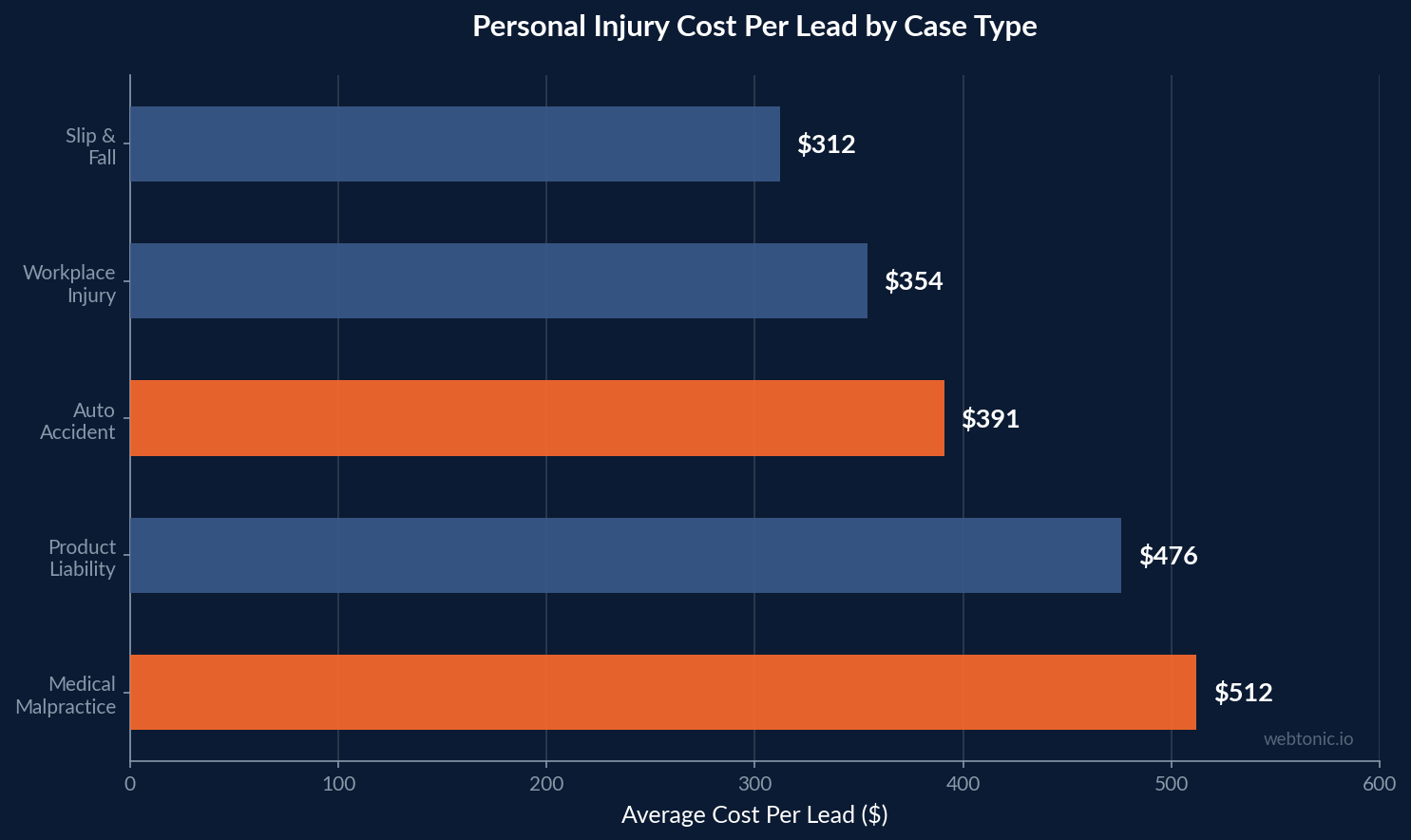
Not all PI cases carry the same acquisition cost. Higher-value case types attract more competition, which drives up CPL and makes landing page optimization even more critical.
| Case Type | Avg CPL | Relative Cost | Landing Page Impact |
|---|---|---|---|
| Slip and Fall | $312 | Lowest | Moderate — lower competition allows broader targeting |
| Workplace Injury | $354 | Below average | High — niche pages for OSHA and workers' comp convert well |
| Auto Accident | $391 | Average | Critical — highest volume, most competitive bidding |
| Product Liability | $476 | Above average | Very high — complex cases need detailed, trust-building pages |
| Medical Malpractice | $512 | Highest | Essential — 64% more expensive than slip and fall; every lost lead is costly |
Medical malpractice leads cost 64% more than slip and fall leads. At $512 per lead, a med mal landing page converting at 3% instead of 8% wastes roughly $8,500 per month in a typical campaign. Firms handling multiple case types should build separate landing pages per practice area to maximize relevance and minimize wasted spend.
Landing Page Optimization Checklist for PI Firms
Based on the performance data above, these are the elements every high-converting personal injury landing page should include:
- Single, clear call-to-action — one primary action (call or form), not three competing options.
- Contact form above the fold with 3 fields maximum (name, phone, case type).
- Prominent click-to-call button — especially on mobile, where 67% of leads prefer calling.
- Video testimonial from a real plaintiff, placed near the conversion point for up to 86% lift.
- Specific case results and verdict amounts — social proof near the form outperforms design changes.
- Google reviews badge or rating widget — external validation builds trust faster than self-promotion.
- Sub-3-second page load time — compress images, defer scripts, use a CDN.
- Practice-area specificity — "car accident lawyer" pages outperform generic "personal injury" pages.
- Intake speed commitment — displaying "We respond within 60 seconds" leverages the 391% conversion lift from fast contact.
- Minimal navigation — 1–2 links maximum; every additional nav link bleeds potential conversions.
Personal Injury vs. Other Legal Verticals: Conversion Comparison
| Legal Vertical | Avg LP Conversion | Avg CPC | Avg CPL |
|---|---|---|---|
| Personal Injury | 5.45% | $100–$300+ | $442 |
| Family Law | 7.2% | $30–$80 | $180–$250 |
| Criminal Defense | 6.8% | $50–$150 | $200–$350 |
| Estate Planning | 8.1% | $15–$50 | $120–$200 |
| Immigration | 7.5% | $20–$60 | $150–$280 |
| All Legal (avg) | 5%–7% | $40–$120 | $131–$144 |
Personal injury sits at the lowest conversion rate (5.45%) with the highest CPC ($100–$300+) among legal sub-categories. This combination makes PI the vertical where landing page optimization delivers the largest absolute ROI. A 1% conversion improvement at $200 CPC saves $4,000+ per 100 clicks compared to less expensive verticals where the same improvement saves a fraction of that.
FAQ
What is a good landing page conversion rate for a personal injury law firm?
The average PI firm website converts at 2.8%–3.6% across all traffic sources. A good conversion rate for a dedicated Google Ads landing page is 6%–12%, while top performers using Google LSAs and optimized intake processes reach 15%–18%. Anything below 3% on paid traffic signals a landing page problem that is likely costing the firm thousands per month.
Should personal injury firms use landing pages or send PPC traffic to their homepage?
Dedicated landing pages convert 4–5× better than homepages for paid traffic. Homepages serve too many audiences and dilute conversion intent. Despite this, 52% of law firms still send paid clicks to their homepage, which can waste $7,500+ per month on a $15,000 ad budget. Every PI campaign should use a practice-area-specific landing page with a single CTA.
How much does a personal injury lead cost on different platforms?
Google Ads averages $442 per lead, SEO averages $183 per lead, and Google LSAs average $378 per lead. However, cost per signed case tells the real story: SEO leads cost roughly $915–$1,220 per signed case (3–7× cheaper than Google Ads at $2,900–$8,800) because organic visitors convert to clients at a much higher rate.
What landing page elements increase conversions for injury lawyers?
The highest-impact elements are above-the-fold contact forms, video testimonials (up to 86% conversion lift), short 3-field forms (2× conversion vs 8-field), and specific case results near the conversion point. On mobile, click-to-call buttons are essential since 67% of PPC leads prefer calling, and sub-3-second load times prevent the 60%+ bounce rates that plague slow legal sites.
How does intake speed affect personal injury landing page performance?
Leads contacted within one minute convert at 391% higher rates than those reached later. For PI firms, this means landing page optimization extends beyond the page itself — the intake process must be fast enough to capitalize on the urgency that drove the visitor to click. Displaying response time commitments on the landing page also serves as a trust signal that improves initial conversion rates.
Sources
LEXGRO — PI Website Conversion Benchmarks
LEXGRO — PI Cost Per Lead Benchmarks
Superpractice — Lawyer Landing Pages
PixelRush — PI Landing Page Optimisation for PPC
ProfitPath SEO — NOWLAN Injury Law Case Study
Authority Specialist — PI Lawyer SEO Benchmarks
Revenue Memo — Law Firm Marketing Statistics 2026


