Table of contents
Webflow now sits on 2.8% of websites in one million-domain crawl and passes Core Web Vitals on 68.9% of its sites — better than WordPress, behind Wix. For a painting contractor paying $13.74 per search click, the platform is the cheap part of the problem; the 2–4% median conversion rate is the expensive part.
Key Takeaways
- Webflow powers 2.8% of websites in 2026, up from 0.6% in 2022 — a 4.7x four-year rise.
- A BuiltWith-based count puts it at 0.8% of all sites, or roughly 822,550 live websites.
- 68.9% of Webflow sites pass all three Core Web Vitals on mobile, against 49.3% of WordPress sites.
- Wix (80.7%) and Squarespace (70.2%) both beat Webflow on that pass rate.
- Median Webflow LCP is about 1.8 seconds versus 2.8 seconds on WordPress.
- Webflow ships a median 918 KB of JavaScript per page against 1,707 KB on Wix.
- Webflow's Premium site plan is $25/month yearly after the May 2026 pricing change.
- Webflow revenue reached $213 million in 2024, up 66% year over year.
- 95% of marketing leaders say current website governance hurts their ability to manage sites.
- 52% of marketing leaders will prioritise optimising for AI-driven search in 2026.
- The median contractor site converts 2–4% of visitors; the top 6% convert at 8–12%.
- Painting search clicks average $13.74 and painting leads $138.38 — the most expensive in home services.
- Average painting job value is $2,021 interior and $3,177 exterior.
- 65–70% of painting leads still arrive by phone, which decides what the homepage must do.
- Construction and AEC website redesigns averaged 340% ROI with break-even at 8.3 months.
- Design-plus-content redesigns returned up to 70% more than visual-refresh-only projects.
Webflow Adoption Benchmarks at a Glance
Two credible 2026 data sets disagree about Webflow’s size, and the disagreement is a scope difference rather than an error. A 1,000,000-domain CMS crawl measures share among crawled domains; a BuiltWith-derived site count measures detected live installs. Read both before quoting either.
| Metric | Figure | Source basis | What it tells a painting company |
|---|---|---|---|
| Share of all websites | 2.8% | 1M-domain crawl, Q1 2026 | Small but no longer niche |
| Share of all websites | 0.8% | BuiltWith detected installs | Different denominator, same direction |
| Live Webflow sites | ~822,550 | BuiltWith trends | Up from 544,053 two years earlier |
| Share of identifiable-CMS sites | 4.2% | 1M-domain crawl | Sixth-ranked CMS overall |
| Four-year growth | 0.6% → 2.8% | 2022 vs 2026 crawl | Fastest-growing mainstream CMS |
| Agency-sector adoption | 24.6% | 1M-domain crawl | Your marketing agency probably builds in it |
| WordPress share of SME service sites | 71.4% | 1M-domain crawl | Most painting competitors are on WordPress |
| Annual revenue | $213M (2024) | Vendor and aggregator data | Platform is funded and stable |
The Speed Claim, Measured Instead of Repeated
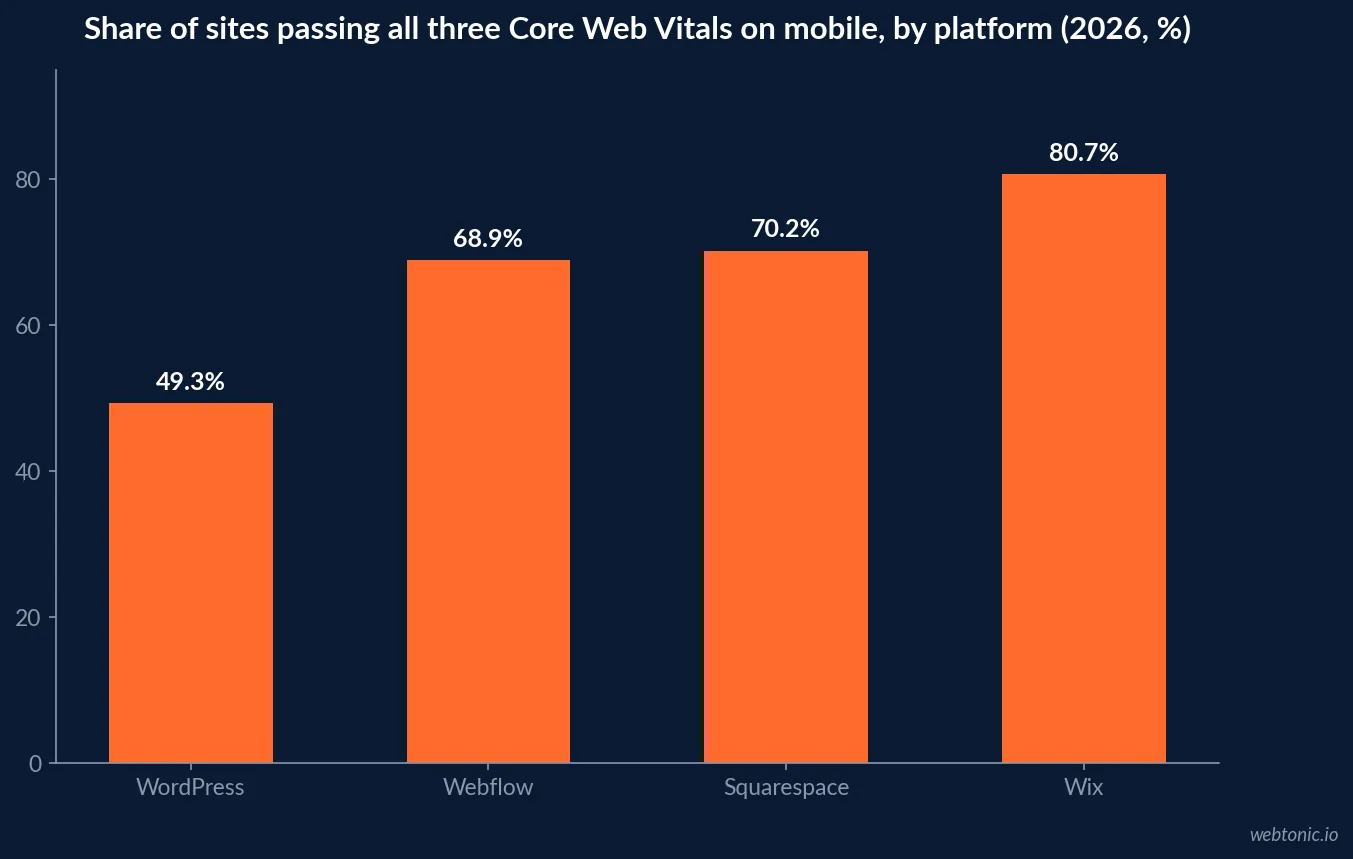
Webflow’s pitch to service businesses is performance. Field data from a 2026 WordPress vs Webflow vs Squarespace speed comparison supports the WordPress comparison and undercuts the “fastest platform” version of the claim. Webflow passes Core Web Vitals on 68.9% of sites, but Wix passes on 80.7% and Squarespace on 70.2%. Where Webflow wins clearly is payload discipline: a median 918 KB of JavaScript and 855 KB of images per page, the lightest of the four platforms.
| Platform | Mobile CWV pass rate | Good TTFB | Median JS | Median images |
|---|---|---|---|---|
| Wix | 80.7% | 66.9% | 1,707 KB | — |
| Squarespace | 70.2% | 80.8% | 1,571 KB | 1,111 KB |
| Webflow | 68.9% | 55.5% | 918 KB | 855 KB |
| WordPress | 49.3% | — | ~2,362 KB page weight | 1,029 KB |
The operational translation for painting: Webflow removes the plugin-bloat failure mode that sinks most contractor WordPress builds, but it does not make TTFB a strength, and it does not compensate for 3 MB of un-optimised before-and-after photography. Our painting technical SEO statistics break down what the crawl and indexation side of that looks like once the pages are live.
What Webflow Costs a Painting Company in 2026
Webflow merged its CMS and Business site plans into one Premium plan in May 2026. For a single-location painting business the relevant tiers are cheap in absolute terms and irrelevant next to media costs.
| Plan | Yearly billing | Monthly billing | Fit for a painting business |
|---|---|---|---|
| Basic site | $15/month | — | Brochure site, no CMS blog |
| Premium site (ex-CMS/Business) | $25/month | $39/month | Service pages, blog, 20,000 CMS items, 50 GB bandwidth |
| Freelancer workspace | $16/month | — | One contractor managing your build |
| Agency workspace | $35/month | — | Your marketing agency's client seat |
| Team plan | $2,500/month | — | Multi-brand rollups, not single-market painters |
Set that against media: at $13.74 per click and $138.38 per lead in 2026 painting marketing benchmarks, a Premium plan costs less than two paid leads a year. Platform fees are never the number that decides a painting website’s economics — see the painting Google Ads statistics for the side of the ledger that actually moves.
The Conversion Gap Webflow Cannot Fix By Itself
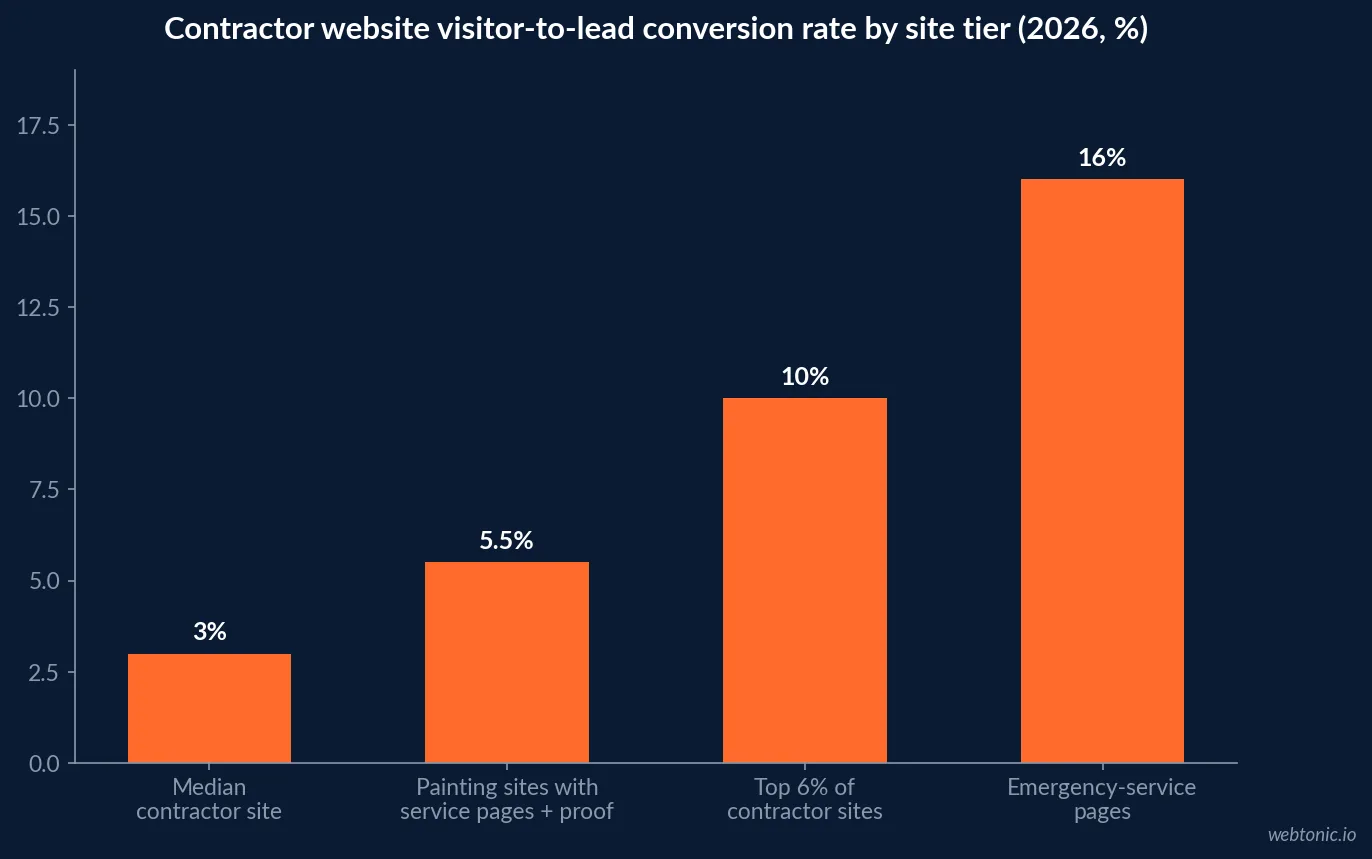
A study of 200 contractor websites across six trades scored each site against 27 conversion elements and found the median site converts just 2–4% of visitors into a tracked call or form fill, while the top 6% reach 8–12% and some emergency-service pages hit 16%. That is a 4x spread on identical traffic. Independent contractor CRO analysis reaches the same 2–4% median and 8–15% ceiling.
None of the 27 elements is “built in Webflow”. The ones that correlate with lead volume are mobile responsiveness, an above-the-fold click-to-call, service-specific pages (cabinet refinishing, exterior repaint, commercial), stacked trust signals and before-and-after portfolios — the same stack painting-specific guidance credits for lifting quote requests to 4–7%.
Why Phone Behaviour Should Dictate the Build
Painting is not a form-fill industry. Roughly 65–70% of painting leads originate as phone calls, with the remaining 30–35% arriving by form, email or text — and many of those form submissions turn into a call anyway. Two design consequences follow, whatever the platform.
- The phone number must be a tappable, tracked element in the first viewport on mobile, not a header graphic.
- Every service and city page needs its own call target so channel attribution survives — the issue documented in our painting analytics statistics.
- Speed-to-lead beats design polish: responding to a web lead within 60 seconds lifts conversion sharply, and waiting five minutes collapses qualifying odds.
- Forms should ask for the minimum needed to quote — address, surface, timeline — not a 12-field intake.
Rebuild ROI: What the Redesign Data Says
A 312-company website redesign study covering investments from $9,000 to $175,000 puts construction and AEC at 340% average ROI, 8.3 months to break-even, a 52% lead-quality improvement and a 28% conversion-rate lift. Legal services led at 485%; e-commerce broke even fastest at 5.6 months.
| Sector | Average ROI | Break-even | Lead-quality lift | Conversion lift |
|---|---|---|---|---|
| Legal services | 485% | 6.2 months | 58% | 41% |
| Healthcare | 378% | 7.8 months | 45% | 35% |
| Construction & AEC | 340% | 8.3 months | 52% | 28% |
| Real estate | 312% | 7.9 months | 49% | 31% |
| B2B SaaS | 265% | 10.4 months | 61% | 45% |
| E-commerce | 189% | 5.6 months | 34% | 22% |
The study’s most useful finding for painting contractors is not the headline ROI but the multiplier: industry-specific messaging returned 2.3x, video content 2.1x and testimonial systems 1.9x, while projects that paired design with structured content earned up to 70% more than design-led rebuilds. A Webflow migration with the same nine pages and the same stock photography is the design-only case.
Webflow vs WordPress for a Painting Business
Most painting competitors are on WordPress: it holds 71.4% of SME service-business sites and 68.4% of local and regional business sites, with an average of 18.4 plugins installed. Webflow’s share is concentrated in agencies (24.6%), designer portfolios (22.4%) and B2B SaaS (18.4%) — not the trades.
| Decision factor | Webflow | WordPress | Practical read |
|---|---|---|---|
| Out-of-box CWV pass rate | 68.9% | 49.3% | Webflow wins without tuning |
| Tuned ceiling | Hosting-fixed | 80%+ on managed host + CDN | WordPress can beat Webflow with budget |
| Plugin ecosystem | Limited | Vast (18.4 avg installed) | WordPress wins integrations, loses weight |
| Who can edit content | Marketer or owner | Depends on builder used | Webflow reduces agency dependency |
| Local SEO tooling | Manual or third-party | Mature plugin stack | Matters for multi-city painting brands |
| Monthly platform cost | $15–$39 | $0 licence + hosting | Both trivial next to $13.74 clicks |
If the current site is a plugin-heavy WordPress build nobody maintains, Webflow is a defensible reset. If it is a well-hosted WordPress site converting at 2%, the platform is not the problem — compare our painting WordPress statistics for the other side of the same decision.
Governance, AI Search and the 2026 Site Brief
Webflow’s own 2026 research reports that 95% of marketing leaders say current website governance practices hurt their ability to manage sites, and 52% will prioritise optimising for AI-driven search this year. For a painting company, governance means one person can publish a new service page without a developer, and AI-search readiness means the facts an assistant needs — service area, pricing structure, licence and insurance, review volume — exist as text on crawlable pages rather than inside images or a PDF.
- Publish one page per service and per served city, with unique copy and unique proof.
- Keep NAP, licence numbers and warranty terms in HTML text, not baked into hero images.
- Mark up Painter/HomeAndConstructionBusiness, service and FAQ entities in JSON-LD.
- Keep before-and-after images under 200 KB each; images are where Webflow builds regress.
- Track calls per page, not sitewide, so the rebuild can be judged — see painting digital marketing statistics.
How Painting Compares With Other Webflow Adopters
| Segment | Webflow share 2026 | Webflow share 2022 | Direction |
|---|---|---|---|
| Digital and design agencies | 24.6% | 6.8% | Fastest adopter |
| Designer and developer portfolios | 22.4% | 8.4% | Native audience |
| B2B SaaS (mid-market) | 18.4% | 4.2% | 64.2% of new SaaS launches chose Webflow |
| Design-led service brands | 14.6% | 3.4% | Closest analogue to a premium painting brand |
| All other websites | Under 1% | Under 1% | Where painting sits today |
That last row is the opportunity and the caveat. A painting company on Webflow will look sharper than most of its market, because the trade has barely adopted the platform — but it also means fewer trade-specific templates, integrations and installers who know both Webflow and job-costing software. Budget for the build, not just the licence, and pair it with the brand work covered in our painting branding statistics.
Frequently Asked Questions
Is Webflow faster than WordPress for a painting company website?
On field data, yes — but not by as much as the marketing suggests. Roughly 68.9% of Webflow sites pass all three Core Web Vitals on mobile versus about 49.3% of WordPress sites, with median Webflow LCP near 1.8 seconds against 2.8 seconds on WordPress. Webflow still ranks behind Wix (80.7%) and Squarespace (70.2%), so “Webflow equals fastest” is not supported by the data.
How much does Webflow cost for a painting contractor in 2026?
After the May 2026 pricing change, the Basic site plan starts at $15/month billed yearly and the merged Premium plan (formerly CMS and Business) is $25/month yearly or $39/month monthly. Agencies managing client sites use the Freelancer ($16/month) or Agency ($35/month) workspace tracks. A single interior repaint at the $2,021 national average covers a year of hosting several times over.
Will moving to Webflow increase painting leads?
Only if the rebuild changes conversion architecture, not just the platform. The median contractor website converts 2–4% of visitors into a tracked call or form, while the top 6% reach 8–12% on identical traffic. Platform choice explains almost none of that gap — click-to-call placement, service-specific pages, proof density and response speed explain most of it.
How many websites use Webflow in 2026?
Estimates differ by what is being counted. BuiltWith-derived data puts Webflow at 0.8% of all websites, roughly 822,550 live sites. A 1,000,000-domain crawl published for 2026 puts Webflow at 2.8% of websites and 4.2% of identifiable-CMS sites, up from 0.6% in 2022. Both can be true: the samples and detection methods are different.
What does a painting website redesign actually return?
Construction and AEC firms in a 312-company redesign study averaged 340% ROI with break-even at 8.3 months and a 28% conversion-rate lift. The same study found projects pairing design with content and technical work returned up to 70% more than visual refreshes alone — which is the argument for treating a Webflow rebuild as a content project.
Sources
CMS Market Share Report 2026 (1M-domain crawl)
50+ Webflow Statistics (2026)
WordPress vs Webflow vs Squarespace speed comparison
Webflow simplified plans and updated pricing 2026
Webflow pricing in 2026: the complete guide
Contractor Website Conversion Study: 200 sites
Contractor website conversion rate benchmarks
Painting Marketing Benchmarks 2026
Website Redesign ROI Statistics 2026
Painting industry phone statistics 2026
Website builder market share 2026