Table of contents

A painting website has two readers: a homeowner standing in front of peeling siding on a phone, and a set of crawlers — most of which never run JavaScript. The average contractor site loads in 5–8 seconds and converts under 3%. That is a technical problem sitting on top of the most expensive click in home services.
Key Takeaways
- Between 65% and 75% of home-services traffic arrives on mobile, and over 80% for emergency-style searches.
- The average contractor site loads in 5–8 seconds on mobile; high performers run 1.5–2.5 seconds.
- Bounce probability rises 32% at three seconds and 90% at five seconds against a one-second baseline.
- Average contractor site conversion is 2–3%; well-built sites reach 8–12%.
- Mobile click-to-call rate is 3–5% on average and 10–15% on optimised sites.
- Only 51.3% of origins pass all three Core Web Vitals on mobile (67.8% on desktop) as of June 2026.
- LCP is the hardest metric to pass at 63.7% on mobile, versus 71.2% for INP and 78.9% for CLS.
- Sites that pass all three Core Web Vitals show roughly 24% lower bounce rates.
- Median load time of a top-10 Google result is 1.65 seconds; position one averages 1.4 seconds.
- WordPress origins pass all three vitals 47.3% of the time, below the 51.3% web average.
- Across 16 million pages studied, 61.94% were not indexed by Google.
- 26% of pages on enterprise sites go unindexed against 4% on small sites.
- 71% of audited sites deploy schema but only 22% pass the Rich Results Test cleanly.
- FAQ schema carries the largest measured CTR lift at about +87%, ahead of How-To at +52%.
- 42% of JavaScript-rendered content is never indexed by AI systems.
- Painting pays about $13.74 per search click and $138.38 per lead — the price of every technical leak.
Painting Technical SEO Benchmarks at a Glance
These are the numbers to measure a painting site against. The industry-average column is where most contractor sites sit today; the target column is what a site built for mobile homeowners looks like, per contractor mobile benchmarking data.
| Metric | Contractor average | Target | Why it matters for painting |
|---|---|---|---|
| Mobile traffic share | 65–75% | Same — convert it | Homeowners search from the driveway, not a desk |
| Mobile load time | 5–8 s | 1.5–2.5 s | Google's threshold is 3 s; bounce doubles past it |
| Site conversion rate | 2–3% | 8–12% | A 3x conversion gap beats any ranking gain |
| Mobile click-to-call | 3–5% | 10–15% | Painting quotes still start on the phone |
| Lead form completion | 1–2% | 4–7% | Estimate forms are long; every field costs leads |
| Bounce rate, slow mobile | 65–80% | 30–45% | Paid and organic traffic leak at the same rate |
| Core Web Vitals (all three, mobile) | About half of the web | Pass | Tiebreaker in a crowded local pack |
| Cost per additional second | −7% conversions | n/a | On $13.74 clicks the second is expensive |
Speed Is a Media-Budget Problem Before It Is an SEO Problem
Painting has the highest cost per click in home services at roughly $13.74, and a blended cost per lead near $138.38 at a 10.80% click-to-lead rate. That arithmetic changes how a contractor should read speed data. A one-second delay costs about 7% of conversions, which on a $4,000 monthly ad budget is roughly $1,400 of wasted spend on a site loading at 5 seconds rather than 1.8.
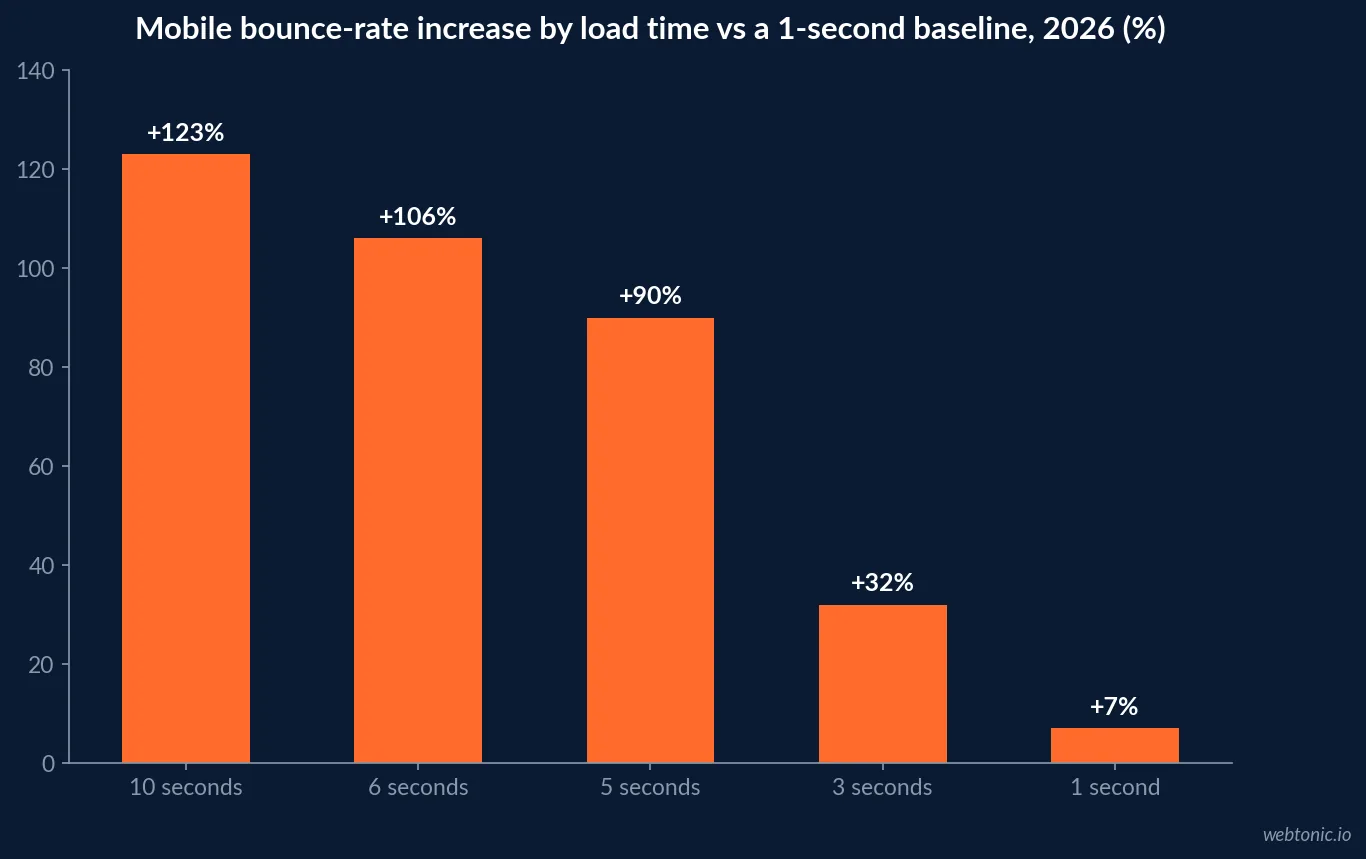
The bounce curve is the reason. Against a one-second baseline, bounce probability rises 7% at one second, 32% at three, 90% at five and 123% at ten — and the average contractor site sits in the five-to-eight second band. Independent measurement of home-services landing pages found an average Largest Contentful Paint of 9.76 seconds, with 82.6% of scored pages in the slow or poor buckets. Painting sites are not usually the worst offenders — they carry fewer scheduling widgets than HVAC — but their galleries are heavy, and images account for about 48% of page weight web-wide.
Three fixes carry most of the value on a painting site: convert the before-and-after gallery to WebP or AVIF (a 30–50% file-size reduction with no visible loss), lazy-load everything below the first screen, and put the site behind a CDN, which cuts Time to First Byte by about 52% and improves LCP by 33%. None of that requires a redesign.
Core Web Vitals: Two Numbers, One Scope Difference
Two credible pass rates circulate for 2026, and the gap is a scope difference rather than a contradiction. Read both with the denominator attached.
| Source and scope | All three vitals (mobile) | LCP | INP | CLS |
|---|---|---|---|---|
| CrUX origins, June 2026 (JustAnalytics) | 51.3% | 63.7% | 71.2% | 78.9% |
| Websites, HTTP Archive / CrUX 2026 (SearchLab) | 42% | 58% | 65% | 74% |
| Web Almanac mobile, 2025 (SEOmator) | 48% | — | — | — |
| CrUX desktop, June 2026 | 67.8% | 78.4% | 89.1% | 82.3% |
Whichever set you use, the same three facts hold. Roughly half the web fails at least one vital. LCP is the bottleneck, and on a painting site the LCP element is almost always the hero photo. And the mobile-desktop gap is widening — 16.5 points in 2026 against 14.2 the year before — which matters when two-thirds of your traffic is mobile.
Platform choice moves the number more than most contractors expect. WordPress origins pass at 47.3%, below the 51.3% average, while Squarespace leads at 61.2% and Shopify sits at 52.1%. WordPress is not the problem; a WordPress install carrying a page builder, a gallery plugin, a chat widget and a popup is. Connection quality matters too: pass rates fall from 58.2% on 4G to 31.7% on 3G, and rural service areas still see plenty of 3G.
The business case is correlational rather than causal, and worth stating honestly. Sites passing all three vitals show about 24% lower bounce rates, and cross-sectional work puts conversion roughly 23% higher on sites with LCP under 2.5 seconds versus over 4. Well-resourced sites tend to be fast and to convert well for many reasons at once. The correlation is still large enough to act on when the alternative is a $13.74 click landing on a nine-second page.
Indexation: The Silent Failure on City and Service Pages
Painting sites are built on templated pages — interior painting, exterior painting, cabinet refinishing, then the same set repeated per suburb. That structure is exactly what indexing systems filter. A study of 16 million pages found a 61.94% not-indexed rate, and enterprise sites leave 26% of pages unindexed versus 4% on small sites.
| Search Console status | What it means | Frequency signal | Painting-specific cause |
|---|---|---|---|
| Crawled – currently not indexed | Fetched, then declined | Top-searched indexing status | Near-duplicate city pages differing only by place name |
| Discovered – currently not indexed | Not yet fetched | Crawl-budget pressure at scale | Hundreds of thin suburb pages published at once |
| Duplicate, Google chose different canonical | Canonical override | 52% of sites have canonical issues | Interior and residential pages saying the same thing |
| Alternate page with proper canonical | Healthy and expected | Normal outcome | Paginated gallery pages |
| Excluded by noindex tag | Deliberate | Normal outcome | Thank-you and quote-confirmation pages |
| Not found (404) | Broken URL | Average 17 per site | Retired promo and seasonal offer pages |
Treat the report as triage, not a to-do list. The statuses worth acting on are the unexpected ones: a service page you want ranking sitting in “crawled – currently not indexed” is a content quality verdict, and no technical fix applies. Site-audit data across 300,000+ sites puts duplicate content without a canonical on 52% of sites, broken internal links on 35%, redirect chains of three or more hops on 28% and orphan pages on 22%. Log-file analysis shows Googlebot spends about 29% of its crawl on pages that never appear in results.
The practical fix for a painting company is unglamorous: keep click depth to three, make every city page carry genuinely local content (real project addresses, local substrate and climate notes, named crews), and stop publishing suburb pages faster than you can differentiate them. A clean internal link structure at that depth improves crawl efficiency by about 31%.
Structured Data: Deployed Is Not the Same as Valid
The largest under-priced technical lever in 2026 is not adding schema — it is fixing the schema already on the page. A 5,000-site audit found 71% of sites deploy at least one schema type while only 22% pass Google’s Rich Results Test cleanly across every type they emit — a 49-point gap. On WordPress, adoption reaches 78% because plugins emit a baseline automatically, which is also why so much of it is broken.
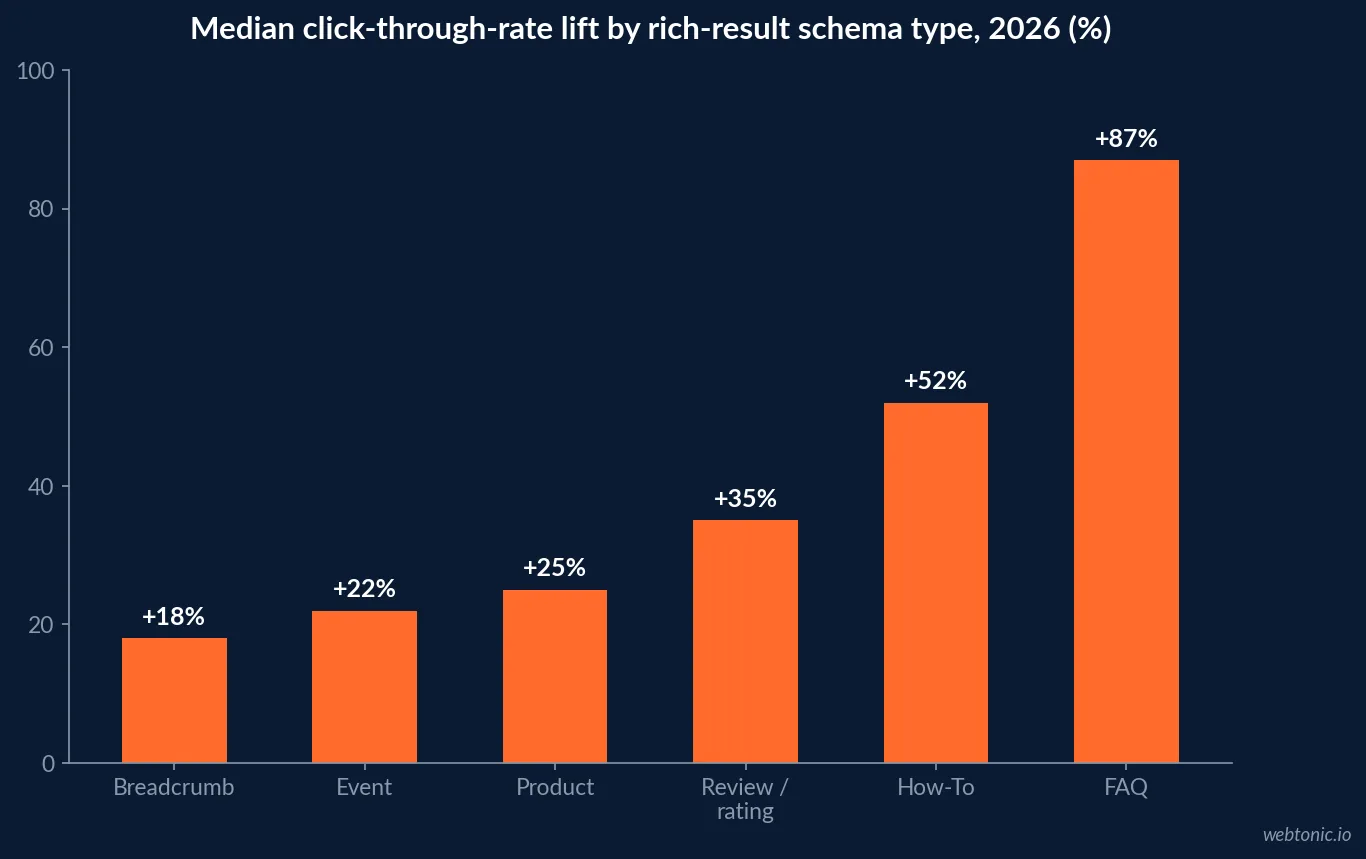
The measured CTR lifts favour the markup a painting contractor can honestly deploy: FAQ at +87%, How-To at +52%, Review or rating at +35%. Error patterns are boringly consistent — missing required properties on 38% of error pages, invalid ISO-8601 dates on 24%, the wrong @type for the page on 12%. All of it is catchable before deployment.
| Schema type | Where it belongs on a painting site | Adoption | Notes |
|---|---|---|---|
| LocalBusiness / Painter | Homepage and each location page | Baseline | Must match the Google Business Profile NAP exactly |
| Service | Interior, exterior, cabinet, commercial pages | Underused | Pair with areaServed for each city page |
| FAQPage | Service pages and pricing pages | High lift | Largest measured CTR lift at about +87% |
| Review / AggregateRating | Homepage and service pages | 35% CTR lift | Only for reviews genuinely displayed on the page |
| BreadcrumbList | Every page | 38% of sites | With Article, adds about +47% AI citation lift |
| ImageObject | Before-and-after galleries | 9% of errors | Missing image dimensions is a common failure |
JSON-LD is the format to use — it accounts for about 72% of structured data on sites that have any, and it is the only variant worth maintaining. Across the 5,000-site sample, valid schema correlated +0.34 with AI-search citation rate, and Article plus BreadcrumbList produced a +47% citation lift over a no-schema baseline. Modest, measurable, cheap.
The Second Reader: Crawlers That Never Run JavaScript
This is the newest and most consequential item on a 2026 technical checklist. Vendor documentation through Q2 2026 confirms that GPTBot, OAI-SearchBot, ChatGPT-User, ClaudeBot, PerplexityBot and CCBot do not execute JavaScript. Googlebot and Applebot are the only AI-relevant crawlers shipping a full renderer, and Bingbot’s rendering is limited enough that Microsoft recommends server-rendered HTML. One analysis puts 42% of JavaScript-rendered content as never indexed by AI systems.
Concretely, for a painting website: if the service list is injected by a page-builder script, if the phone number is written by a call-tracking snippet, if reviews load from a third-party widget, or if the quote form is a JavaScript embed, then a large share of the machines now answering “who paints kitchen cabinets in my city” see a blank page. The fix is server-rendered HTML for anything that carries a fact: name, address, phone, services, service area, prices, reviews.
| Crawler | Renders JavaScript | What it feeds | Implication for a painting site |
|---|---|---|---|
| Googlebot | Yes (headless Chromium) | Google Search, AI Overviews | Client-side content usually indexed, with delay |
| Applebot | Yes | Siri and Spotlight | Safe, but small share of local demand |
| Bingbot | Partial | Bing and Copilot | Microsoft recommends server-rendered HTML |
| GPTBot / OAI-SearchBot | No | ChatGPT training and search | Raw HTML only — no widgets, no embeds |
| ClaudeBot | No | Claude | Raw HTML only |
| PerplexityBot | No | Perplexity answers | Raw HTML only |
| CCBot | No | Common Crawl datasets | Feeds many downstream models |
The exchange rate on this traffic is also worth knowing before you decide how much to invest in it. Cloudflare Radar data compiled into a crawl-to-refer analysis puts ClaudeBot around 2,237:1 and GPTBot at roughly 217:1 — thousands of fetches per referred visitor for some engines. A related bot traffic reference shows the same ratios improving quickly but still lopsided. Serve clean HTML because it is cheap; do not budget for AI referral volume yet.
Mobile-First Is the Whole Game for a Painting Site
Google has indexed mobile-first for every site since July 2024, and mobile is 63.4% of web traffic. In home services the share reaches 65–75%, and above 80% on urgent categories. Median mobile LCP is 3.8 seconds against 2.1 on desktop, and median mobile TTFB is 1.4 seconds against 0.8 — the mobile version of your site is both the ranked version and the slow version.
Two errors show up constantly on contractor sites. Touch targets closer than 48 pixels is the most-reported mobile usability error in Search Console, present on 23% of scanned sites — usually the phone link crammed next to a nav item. And missing viewport meta tags cost roughly 34% of mobile rankings. Both are single-line fixes.
The commercial side of this is conversion, not ranking. Contractor sites average 2–3% conversion while well-built ones reach 8–12%; mobile click-to-call runs 3–5% against 10–15%. On the phone-heavy lead mix painting runs, a sticky click-to-call bar and a three-field estimate form are worth more than any vitals improvement. Our painting analytics benchmarks cover how to measure that shift once it is live.
Security, HTTPS and the Boring Baseline
None of this is differentiating, and all of it is disqualifying when missing. HTTPS covers 95.6% of Google top-10 pages and 97.2% of position-one results; global adoption is 89%. Sites with an expired certificate lose about 33% of organic traffic within 48 hours. Mixed content appears on 18% of HTTPS sites. Security headers are correctly implemented on only 22%. HTTP/2 is on 68% of sites and HTTP/3 on 31%.
For an owner-operated painting company the checklist is short: valid auto-renewing certificate, no mixed content, HTTP/2 or better at the host, an XML sitemap that is actually correct (67% of sites have one, 19% of those contain errors), and a server response under 200ms against a 340ms median. That is a morning of work for a competent developer.
A 2026 Technical Checklist for Painting Contractors
Ordered by return per hour on a typical painting site:
- Compress and convert gallery images to WebP or AVIF, then lazy-load below the fold — the LCP fix that matters most.
- Put a sticky click-to-call bar on mobile and cut the estimate form to three fields.
- Server-render name, address, phone, services and service areas so non-rendering crawlers can read them.
- Validate every schema block in the Rich Results Test; add FAQPage to service and pricing pages.
- Audit Search Console for “crawled – currently not indexed” on pages you want ranking, then differentiate or consolidate them.
- Stop publishing city pages you cannot make genuinely local; merge the thin ones.
- Fix redirect chains and broken internal links — present on 28% and 35% of sites respectively.
- Keep click depth to three and eliminate orphan pages.
- Confirm the sitemap is valid, canonical tags are self-consistent, and the certificate auto-renews.
- Measure field data, not lab scores — lab tests on office wifi hide what a homeowner on 3G experiences.
How Painting Compares With Other Verticals
Painting sits in a favourable position technically and squanders it commercially. Vertical pass rates for all three Core Web Vitals run 57.3% for news and media, 54.9% for SaaS, 52.1% for education, 48.7% for healthcare, 44.2% for e-commerce, 41.8% for travel and 38.9% for finance. A painting site is closer to the publisher end of that list — mostly text, photos and a phone number, with no cart, no authentication and no compliance scripts.
That is why the underperformance is so avoidable. A painting company has the simplest possible site to make fast and the most expensive traffic to waste: $13.74 per click, $138.38 per lead, roughly a 20% close rate on advertised leads, and about $2,021 in revenue on an average interior repaint. Our painting SEO statistics cover the organic side of that equation, and the local SEO data covers the map pack where most of this traffic is decided.
The Verdict for Painting Contractors
Technical SEO will not make a painting company famous, and it will not fix a weak offer. What it does is stop the leak between traffic you already pay for and estimates you actually book. Fix speed and click-to-call first, then indexation, then schema, then serve clean HTML for the crawlers that cannot run your JavaScript. Our data intelligence team runs these audits for home-services operators, and the growth marketing team ties the fixes back to booked jobs.
Frequently Asked Questions
How fast should a painting company website load?
Under 2.5 seconds on mobile, and ideally between 1.5 and 2.5 seconds. The average contractor site loads in 5–8 seconds on mobile, and bounce probability rises 90% between a one-second and a five-second load. Since painting search clicks cost about $13.74, every second of delay is paid for twice — once in wasted media and once in lost organic sessions.
Do Core Web Vitals actually matter for a local painting business?
They matter as a tiebreaker and as a conversion lever, not as a ranking shortcut. Only about half of origins pass all three Core Web Vitals on mobile in 2026, and sites that pass see roughly 24% lower bounce rates. For a painting contractor competing in a map pack against six similar companies, the tiebreaker is worth having.
Why are some of my painting service pages not indexed?
Usually content quality, not a technical block. “Crawled – currently not indexed” means Google fetched the page and declined it — the common cause on painting sites is a set of near-duplicate city or service pages differing only by a place name. “Discovered – currently not indexed” is a crawl-budget signal and mostly affects large sites.
Does schema markup help a painting website?
Valid schema does. Across a 5,000-site audit, 71% of sites deployed at least one schema type but only 22% passed Google's Rich Results Test cleanly. FAQ markup carries the largest measured click-through lift at about +87%, and LocalBusiness plus Service plus Review is the baseline set for a painting contractor.
Can AI search engines read a JavaScript-heavy painting website?
Mostly no. Vendor documentation through Q2 2026 confirms GPTBot, OAI-SearchBot, ChatGPT-User, ClaudeBot, PerplexityBot and CCBot do not execute JavaScript; Googlebot and Applebot are the only AI-relevant crawlers that ship a full renderer. If your quote form, service list or phone number only exists after JavaScript runs, those crawlers never see it.
Sources
SearchLab — Technical SEO statistics 2026
JustAnalytics — Core Web Vitals statistics 2026
SEOmator — 2026 SEO benchmarks report
MBADV — GSC page indexing report reference
DigitalApplied — Schema markup adoption, 5,000-site audit
HybridRanking — AI crawler JavaScript rendering map
SEOmator — AI crawler crawl-to-refer ratios
DigitalApplied — AI crawler and bot traffic statistics 2026
Thomastown Digital — Contractor mobile and conversion benchmarks
PipelineOn — Contractor website speed optimization
PipelineOn — Home-services landing page speed benchmark
BaaDigi — Painting marketing benchmarks 2026