Table of contents
Painting carries the highest cost per click of any home-services category at $13.74, a $138.38 cost per lead, and an ad-lead close rate of roughly 1 in 5 — while referral leads close at over 50%. Branding is the only lever that moves a painting lead from the first column to the second, and in 2026 that makes it a margin decision rather than a design decision.
Key Takeaways
- Painting has the highest CPC in home services at $13.74 and an average Google Ads cost per lead of $138.38.
- Painting click-to-lead conversion is 10.80%, above the home-services average — the cost problem is the click, not the form.
- Ad-generated painting leads close at about 20%; referral leads close at over 50%.
- Average job value is $2,021 for an interior repaint and $3,177 for an exterior repaint, at 15–20% achievable net margin.
- 78% of homeowners cite trustworthiness as a decision driver; only 42% cite lowest price.
- In a survey of roughly 1,600 homeowners, trust scored 4.6/5 and price ranked third at 3.9.
- 72% of homeowners say they would pay more for a better-reputation contractor, and about 70% compare only two or three quotes.
- A full fleet wrap costs $2,500–$6,500 per vehicle and delivers impressions at roughly $0.48 CPM.
- Contractor-category digital advertising runs $15–$40 CPM — roughly 30–80x the cost per impression of a wrap.
- Fleet wrap break-even is about 1.6 jobs at a $2,500 average job value.
- Brand consistency research reports a 23% revenue association (2016), raised to up to 33% (2019) — marketer self-report, not audited data.
- 81% of companies deal with off-brand content and only about 25% enforce their brand guidelines consistently.
- Painters with 50+ Google reviews generate roughly 3x the inbound calls of those with fewer than 20.
- The residential painting market reached about $47.8B in 2025, heading to roughly $51.2B in 2026 — growth driven mostly by cost inflation.
- Typical homeowners now visit 8 to 12 websites before choosing a painting contractor.
Painting Brand Economics at a Glance
Every branding argument in painting starts with one uncomfortable benchmark set. These are the numbers a brand investment has to move.
| Metric | 2026 benchmark | Why branding touches it |
|---|---|---|
| Average cost per click (Google Ads) | $13.74 | Highest of any home-services subcategory |
| Average cost per lead | $138.38 | Brand search and direct calls arrive at a fraction of this |
| Click-to-lead conversion rate | 10.80% | Above category average — recognition lifts it further |
| Ad-lead close rate | ~20% | One in five estimates booked |
| Referral-lead close rate | 50%+ | The gap branding is paid to close |
| Average job value — interior | $2,021 | Sets the ceiling on acquisition cost |
| Average job value — exterior | $3,177 | Larger jobs tolerate more brand spend |
| Achievable net margin | 15–20% | A $138 lead consumes real margin at 20% close |
BaaDigi’s 2026 painting benchmarks, compiled from LocaliQ and Angi data, make the point bluntly: the win is rarely more ad spend. At a $138.38 lead and a 20% close rate, a booked job costs roughly $690 in media — about a third of the gross margin on an average interior repaint. Doubling the close rate halves that number without touching a bid.
What Homeowners Say They Are Buying
The most useful branding data in this industry is not about logos. It is about the ranked reasons homeowners hand a stranger the keys to their house.
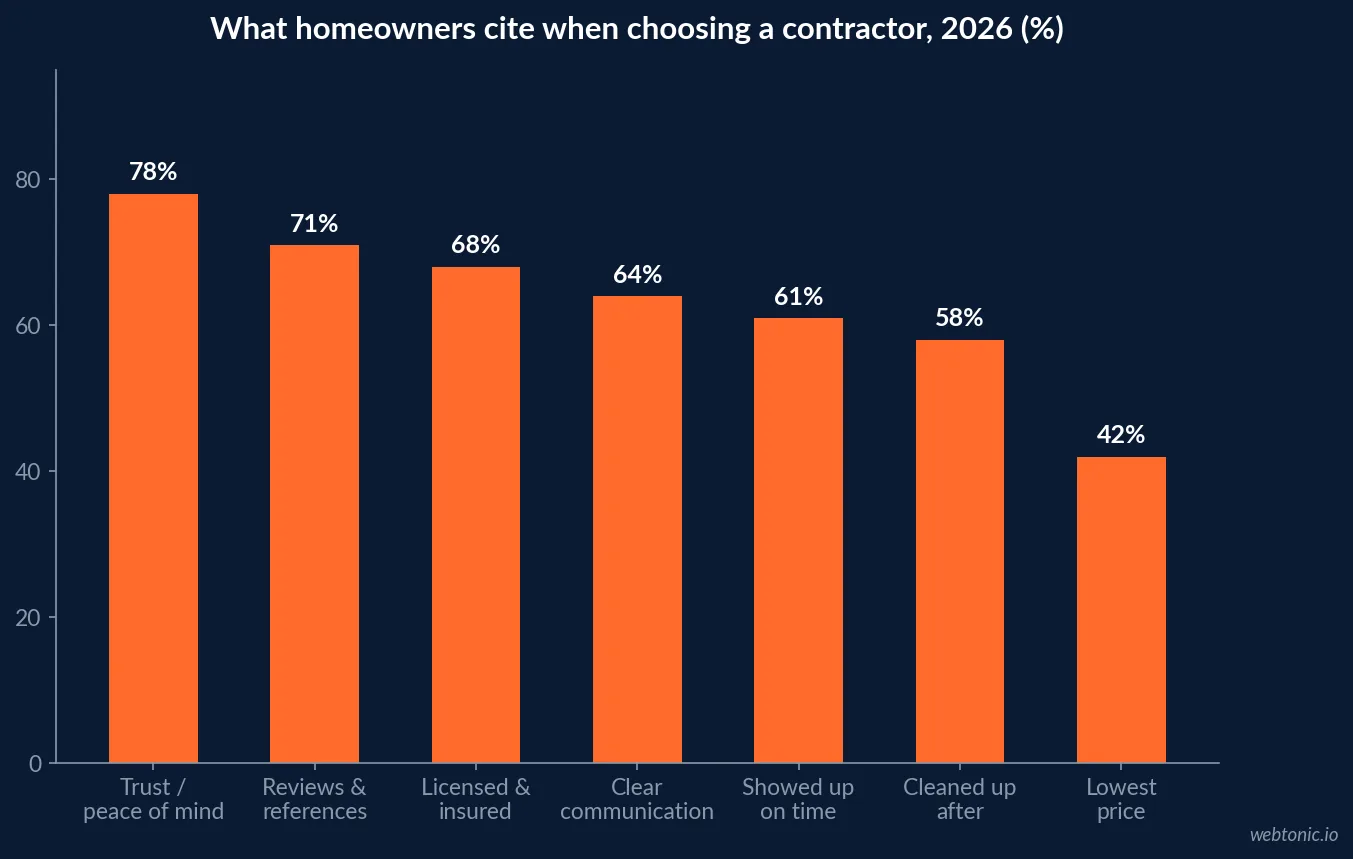
| Decision factor | % of homeowners citing it | Brand asset that signals it |
|---|---|---|
| Trustworthiness / peace of mind | 78% | Consistent identity, named crew, real photos |
| Positive reviews and references | 71% | Review velocity and on-site review capture |
| Licensed and insured | 68% | Badges on truck, estimate and website footer |
| Clear communication | 64% | Branded estimate template and response SLA |
| Showed up when promised | 61% | Uniforms, arrival texts, scheduling discipline |
| Cleaned up after themselves | 58% | Post-job checklist and before/after photography |
| Lowest price | 42% | The one signal a brand should not compete on |
Aggregated homeowner priority data puts price last among primary factors at 42%. A separate survey of about 1,600 homeowners found the same ordering with different instrumentation: “feeling like I could trust them” scored 4.6 out of 5, with availability and responsiveness tied at 4.2 and price third at 3.9.
Two more behavioural findings change what a painting brand has to do. Roughly 72% of homeowners say they would pay more for a better reputation and about 70% compare only two or three quotes — so the brand’s job is to be in the shortlist of three, not to be the cheapest of ten. And today’s typical customer visits 8 to 12 websites before deciding, which means visual consistency across every one of those touchpoints is what makes a shortlist feel like a shortlist.
The Trust Signals That Are Cheapest to Buy
Review infrastructure is the highest-leverage brand asset in painting because it maps directly onto the number two trust driver. Painting contractors with 50 or more Google reviews generate roughly 3x the inbound calls of those with fewer than 20. A 2026 survey of 1,002 US consumers adds the thresholds: 97% read reviews, 47% will not use a business with fewer than 20 reviews, 31% require a 4.5-star average, and 45% now use generative AI tools during research — which means review text is increasingly being read by a model before a human sees it.
- Review velocity beats review count. A steady flow past the 20-review and 4.5-star thresholds unlocks the 47% and 31% of homeowners who screen on them.
- Name the crew. Trust at 78% is person-shaped; a crew lead’s name and photo on the estimate outperforms a stock hero image.
- Put licence and insurance where the price is. 68% cite it, and it costs nothing to display next to the number that triggers anxiety.
- Photograph the cleanup, not just the colour. 58% cite tidiness — almost no painting brand shows it.
- Write the guarantee in specific years. Vague quality claims are the default in this category, which makes specificity a differentiator.
These signals compound with the creative work covered in our painting ad creative statistics, where ads that imitate referral trust cues outperform ads that lead with discounts.
Fleet Wraps: The Cheapest Impressions in the Trade
The painting brand asset with the clearest arithmetic is the truck. 2026 fleet wrap pricing puts a full wrap at $2,500–$6,500 per vehicle, with partial wraps 40–60% cheaper and professional cast vinyl lasting 5–7 years against 2–3 for budget calendered film.
| Vehicle type | Partial wrap | Full wrap |
|---|---|---|
| Compact car / sedan | $800–$1,500 | $1,500–$3,000 |
| Standard pickup truck | $1,200–$2,000 | $2,500–$4,500 |
| Full-size work van | $1,500–$2,500 | $3,500–$6,000 |
| Box truck / large cargo van | $2,000–$3,500 | $4,500–$6,500 |
| SUV / crossover | $1,000–$1,800 | $2,000–$4,000 |
Major metros run 15–25% higher than these national figures. The payback maths is where wraps separate from every other channel a painting company buys.
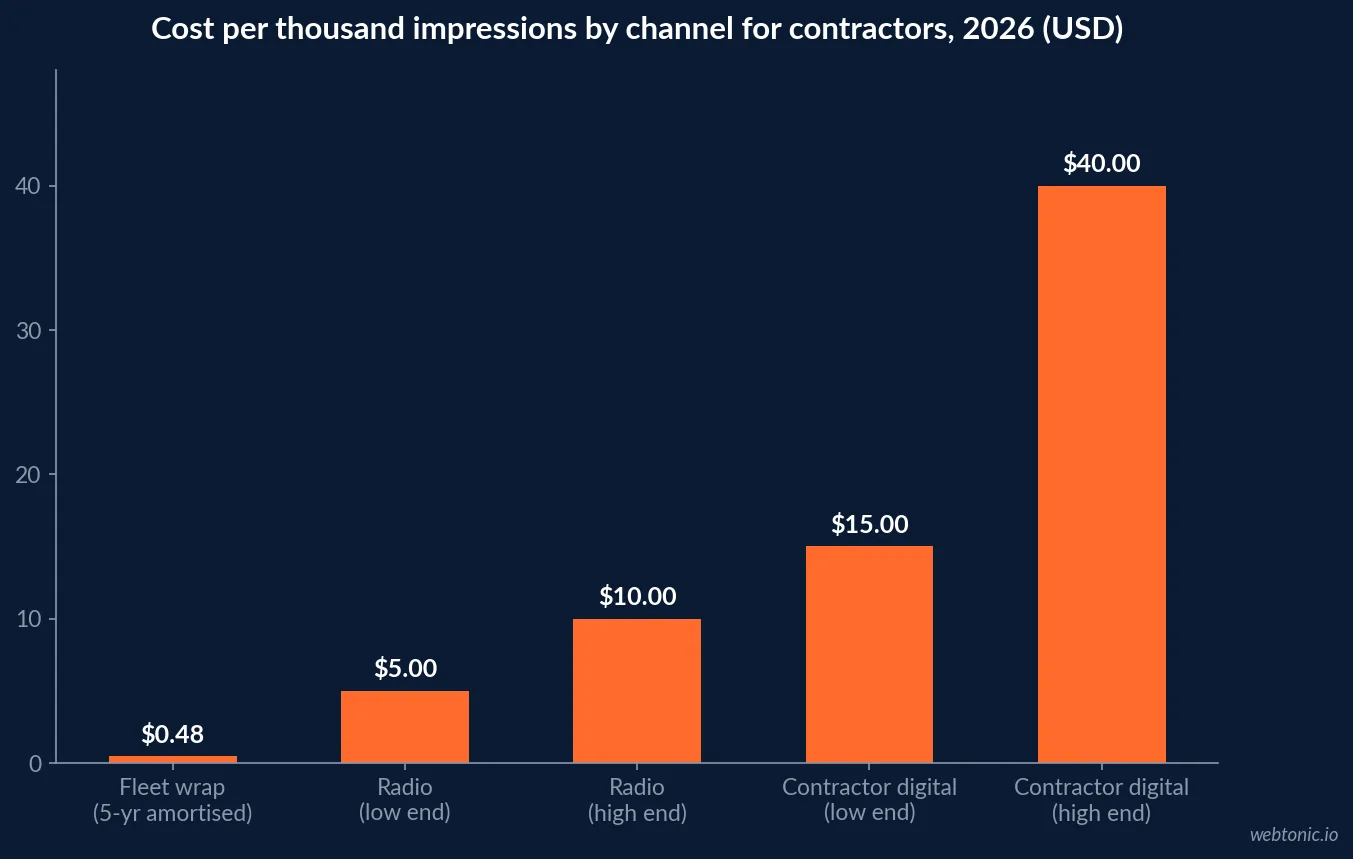
A $4,000 wrap amortised over five years delivers impressions at roughly $0.48 CPM, against $5–$10 for radio and $15–$40 for contractor-category digital advertising. Independent ROI analysis reports 30,000–70,000 daily impressions per wrapped vehicle on standard local routes and 97% recall of truck-side advertising versus 19% for static billboards. At a $2,500 average job value, break-even is about 1.6 jobs.
The honest caveat, from the same source: impressions are not recall. A wrap carrying a company name and a phone number produces views without memory. What converts is a positioning message specific enough for a neighbour to repeat — which is a branding deliverable, not a print job.
What the Brand Consistency Research Really Says
Every branding pitch quotes the same statistic, and it deserves an honest footnote. A 2026 audit of the source material traces almost all of it to Demand Metric and Lucidpress research published between 2016 and 2021 — surveys of marketers, not audited financials.
| Claim | Figure | Original year | How to read it |
|---|---|---|---|
| Revenue lift from consistent branding | ~23% | 2016 | Directional; marketer self-report |
| Upper-bound revenue lift | up to 33% | 2019 | Later edition of the same survey line |
| Credited consistency with 10–20% growth | 68% of respondents | 2021 | Perception, not measured attribution |
| Companies dealing with off-brand content | 81% | 2019–2021 | The reliable finding — a failure rate |
| Companies enforcing guidelines consistently | ~25% | 2019–2021 | Three in four have rules they do not apply |
The 23% and 33% numbers are the weakest part of that body of work; the 81% and 25% figures are the useful part. For a painting company with three trucks, two crews and a subcontracted estimator, the enforcement gap is the operational risk: a repainted truck in last year’s colours, a magnetic door sign, an estimate template built by whoever answered the phone. Consistency in painting is a checklist problem, not a philosophy.
Market Conditions Making Brand Pricing Power Matter More
Branding in this category is being repriced by three simultaneous pressures. The residential painting market reached about $47.8 billion in 2025 and is heading toward roughly $51.2 billion in 2026, but most of that growth is cost inflation: paint prices up about 15% in 18 months and painter wages up about 18% between 2023 and 2026, with experienced painters at $25–$35 an hour in competitive markets. Globally, painting and wall covering contractors grow from $229.73B to $237.54B at a 3.4% CAGR.
| Pressure | 2026 data point | Branding consequence |
|---|---|---|
| Material inflation | Paint prices +15% in 18 months | Price increases need a trust premium to survive |
| Labour inflation | Painter wages +18% since 2023 | Recruiting becomes a branding function |
| Consolidation | Franchise and PE roll-ups expanding | Independents need a defensible identity |
| Research behaviour | 8–12 websites visited per decision | Consistency across touchpoints is table stakes |
| Job value spread | $3,800–$16,500 per residential job | Brand determines which end of the range you quote |
Consolidation is the structural argument. Franchise brands and private equity buyers are professionalising the top of the market while the bottom competes on price alone, and the middle ground is thinning. A recognisable independent brand is what keeps a painting company out of the price-only tier — the same logic that governs our painting digital marketing statistics.
Recruiting Is a Branding Channel in Painting
With wages up 18% and skilled painters described as the binding constraint on growth, the brand that wins crews wins jobs. This is the most under-measured branding return in the trade: every week a crew slot sits empty is capacity a marketing budget cannot buy back. Contractors that publish career paths, benefits and named crew profiles compete for labour on identity rather than hourly rate, and the same assets — uniforms, wrapped trucks, a real website — do double duty for homeowners and applicants.
Practically, that means the brand system should include a careers page, crew photography with names, and a consistent uniform standard before it includes a rebrand of the logo. Our painting social media marketing statistics cover how the same content library serves both audiences.
How to Build a Painting Brand That Pays for Itself
The sequence that fits painting economics runs in a specific order, because each step lowers the cost of the next.
- Fix consistency before identity. With 81% of companies shipping off-brand assets and only 25% enforcing rules, an audit of truck, uniform, sign, estimate and site usually beats a redesign.
- Engineer review velocity. 71% cite reviews, 47% screen out businesses under 20, and 50+ reviews correlate with 3x inbound calls.
- Wrap the fleet with a message. $0.48 CPM and 1.6-job break-even only pay off if the wrap says something repeatable.
- Put the six trust signals on the estimate. Trust 78%, reviews 71%, licensed 68%, communication 64%, punctuality 61%, cleanliness 58%.
- Refuse the price fight. Only 42% lead with price and 72% will pay more for reputation.
- Measure brand as close rate, not awareness. Moving 20% toward 50% is the whole return.
- Then buy the expensive clicks. A $13.74 CPC is survivable when brand search and referrals carry the base.
- Instrument it. Our performance creative and data intelligence teams tie brand assets to booked-job revenue, not impressions.
Painting is the most expensive category in home services to buy leads in and one of the cheapest to be remembered in. The companies with the best 2026 numbers are not the ones bidding hardest — they are the ones whose next customer already knows the name on the truck. If you want that mapped against your own close rate and job values, talk to us.
Frequently Asked Questions
Does branding actually generate painting leads, or is it just design?
It generates them indirectly, and the arithmetic is specific to painting. Paid painting leads are the most expensive in home services — $13.74 average cost per click and $138.38 cost per lead — and they close at only about 1 in 5, while referral leads close at over 50%. A brand that is recognised before the estimate is what moves a lead from the 20% column to the 50% column. On a $2,021 interior repaint at 15–20% net margin, that shift is worth more than any bid adjustment.
What do homeowners actually care about when choosing a painter?
Trust outranks price in every recent survey. Aggregated homeowner data ranks trustworthiness at 78%, reviews and references at 71%, licensed and insured at 68%, clear communication at 64%, punctuality at 61% and site cleanliness at 58%, with lowest price at 42%. A separate survey of about 1,600 homeowners scored “feeling like I could trust them” at 4.6 out of 5 while price came third at 3.9. Painting brand assets should be built to signal those six things, in that order.
How much does a painting company fleet wrap cost and does it pay back?
A full wrap runs $2,500–$6,500 per vehicle in 2026, with partial wraps 40–60% cheaper and quality cast vinyl lasting 5–7 years. Amortised over five years, a $4,000 wrap delivers impressions at roughly $0.48 CPM against $15–$40 CPM for contractor-category digital ads. At a $2,500 average job value, break-even is about 1.6 jobs. The caveat: impressions are not recall. A wrap with a phone number and a company name produces views; a wrap with a positioning message produces calls.
Is the 23% brand consistency revenue statistic reliable?
Treat it as directional, not audited. The widely cited 23% figure comes from Demand Metric and Lucidpress research published in 2016, later raised to up to 33% in 2019, with a 2021 edition finding 68% of respondents crediting consistency with 10–20% of revenue growth. All of it is marketer self-report rather than audited financials. The more useful numbers from the same body of work are the failure rates: 81% of companies deal with off-brand content and only about 25% enforce their guidelines consistently.
What should a painting company spend on branding before spending on ads?
Enough to make the paid click cheaper. The sequence that fits painting economics is: consistent name, logo and colour system across the truck, uniforms, yard sign, estimate document and website; a review engine that keeps velocity up because reviews rank second at 71% among trust drivers; and one clear positioning line that is not “quality workmanship”. Only then scale paid, where painting pays a 10.80% click-to-lead conversion rate on the most expensive clicks in the category.
Sources
BaaDigi — Painting Contractor Marketing Benchmarks 2026
CoreQuote — What US Homeowners Want From a Contractor 2026
DW Creative — What 1,600 Homeowners Said About Choosing Contractors
JedHead — Fleet Wrap Cost Guide for Contractors 2026
PipelineOn — Truck Wrap ROI Math for Contractors
DashoContent — Brand Consistency Statistics 2026
Hearth Digital — State of the Residential Painting Industry 2026
The Business Research Company — Painting & Wall Covering Contractors Market 2026
Elev8 Operations — Contractor Marketing Statistics 2026
improveit 360 — Shifts in How Homeowners Choose Contractors 2026
BSPKN — Painting Contractor Marketing 2026