



Table of contents
Key Takeaways
- Only 27% of painting contractors actively track marketing attribution across all channels, leaving the majority unable to identify which spend drives booked jobs (PipelineOn / Elev8 Operations 2026).
- Contractors who implement call tracking and CRM attribution see a 30–60% improvement in marketing ROI within 90 days by cutting underperforming channels (SkillMammoth, 2026).
- Across home services, 38% of inbound calls answered by a person are genuine leads, and 45% of those convert on the call — making call tracking the single most important measurement layer (Invoca 2026).
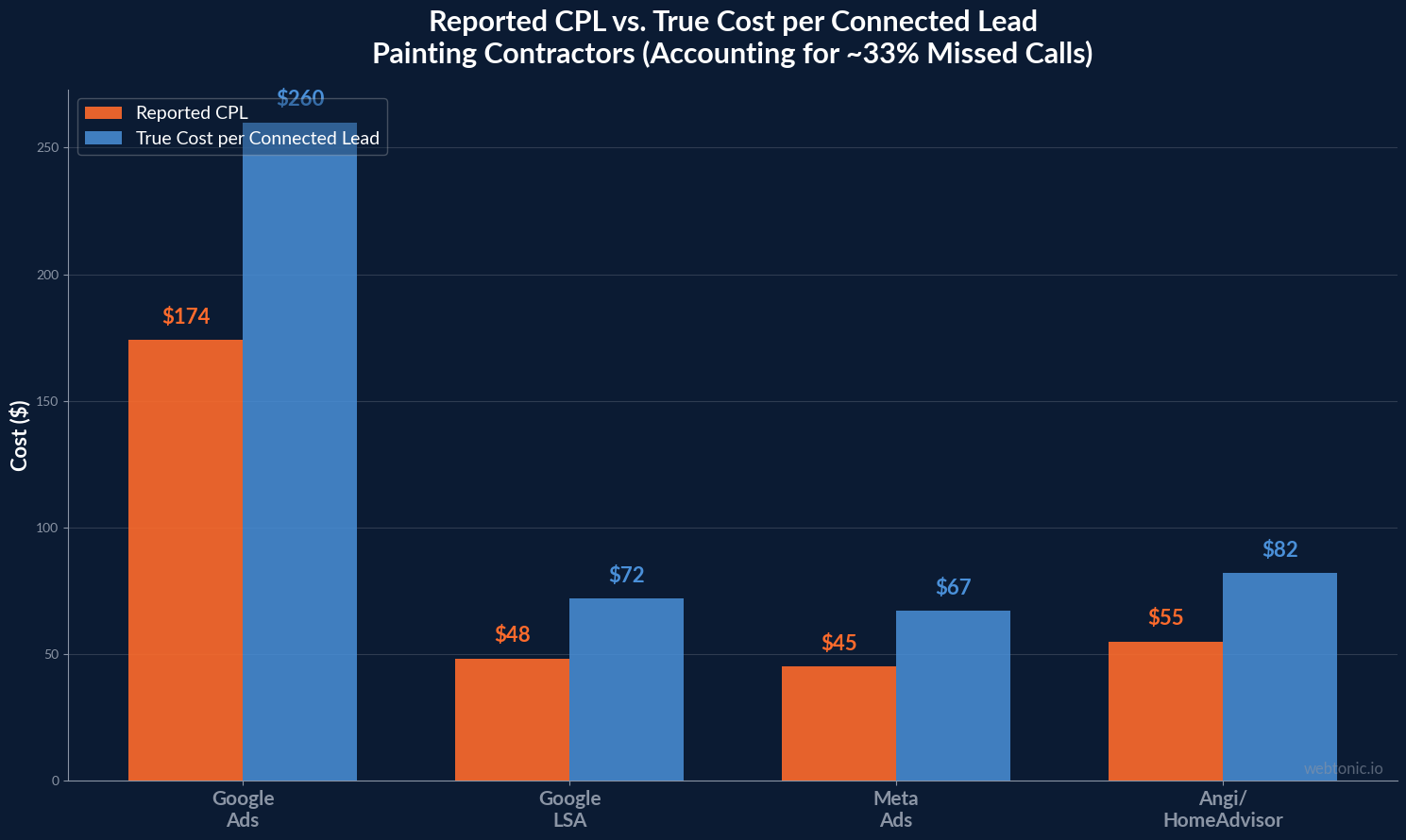
- Painting companies miss roughly one-third of incoming calls, inflating true cost per booked estimate by up to 50% compared to reported CPL (CoreiBytes, 2026).
- The US painting industry is valued at $49.0 billion in 2026, growing at a 2.2% CAGR — intensifying competition and the need for data-driven marketing (IBISWorld).
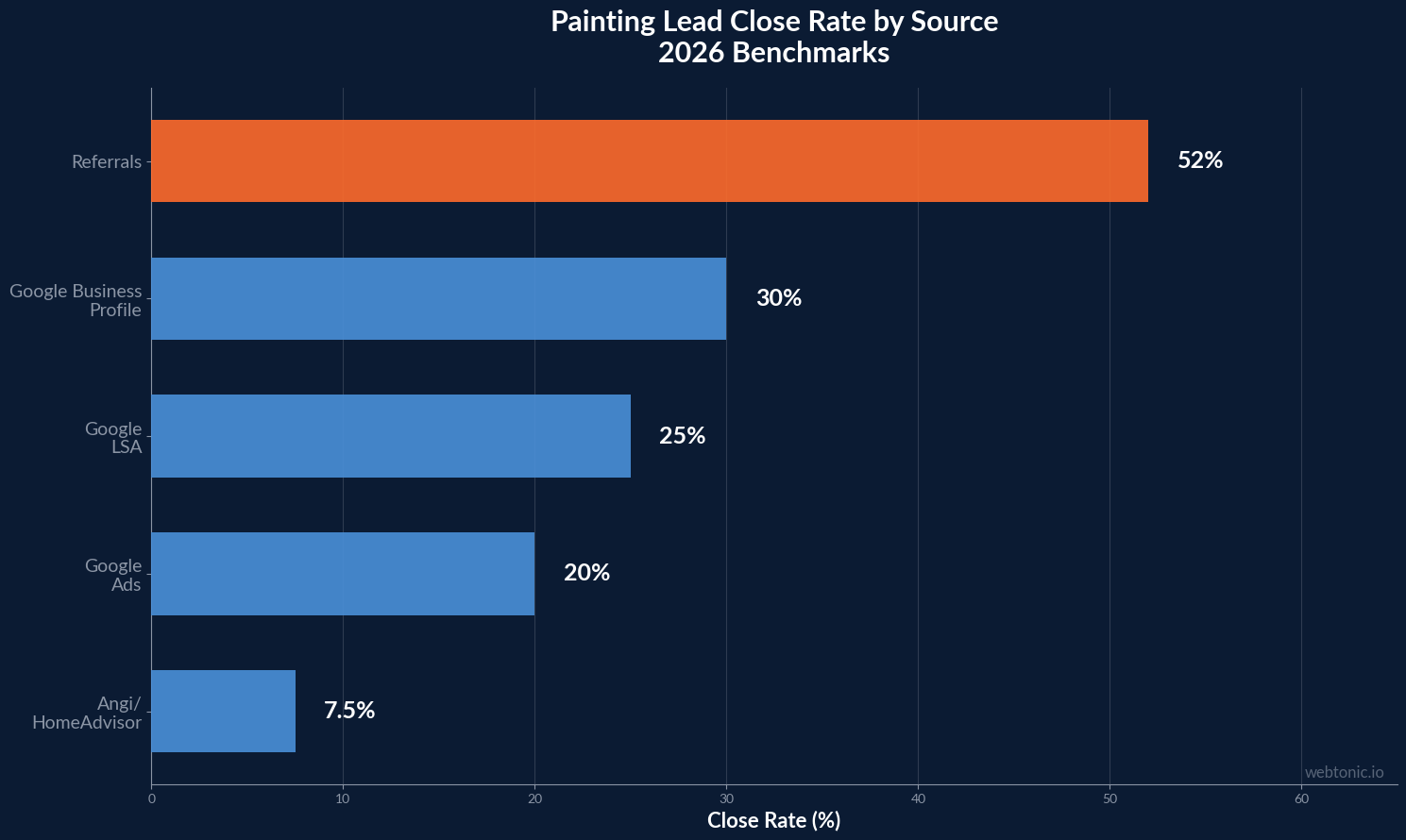
- Ad-generated painting leads close at approximately 20%, while referral leads close above 50%, meaning accurate source attribution directly determines budget allocation strategy (BaaDigi, 2026).
- A healthy contractor marketing dashboard tracks 7 core KPIs: CPL by channel, CAC by channel, CLV by customer type, conversion rate by funnel stage, ad spend pacing, revenue attribution by source, and booked jobs by day-of-week (PipelineOn, 2026).
Painting Marketing Measurement at a Glance
| Metric | Benchmark | Source |
|---|---|---|
| Ad-lead close rate (painting) | ~20% | BaaDigi 2026 |
| Referral-lead close rate | 50%+ | BaaDigi 2026 |
| Avg. Google Ads CPL (painting) | $174 | 99 Calls 2026 |
| Google LSA avg. CPL (painting) | $48.20 | 99 Calls 2026 |
| Home services call-to-lead rate | 38% | Invoca 2026 |
| Lead-to-sale conversion (on-call) | 45% | Invoca 2026 |
| Missed call rate (home services) | 14% | CallRail 2026 |
| Painting contractor missed call rate | ~33% | CoreiBytes 2026 |
| US painting market size (2026) | $49.0 billion | IBISWorld 2026 |
Why Tracking and Measurement Matter More for Painters
Painting contractors operate in one of the most expensive cost-per-click categories in home services, with an average Google Ads CPL of $174 per lead across 1,272+ tracked leads (99 Calls, 2026). At that price point, every untracked dollar is a potential loss — and the data reveals that most painting companies cannot answer the basic question of which channel generates their best jobs. Elev8 Operations reports that only 27% of contractors actively track marketing attribution, a figure that has improved only marginally since 2024.
The US painting industry reached $49.0 billion in 2026 (IBISWorld), growing at a 2.2% compound annual growth rate. With intense local competition and average customer acquisition costs ranging from $175 to $650 depending on market size (BaaDigi), the contractors who measure, attribute, and optimize their spending outperform those who simply increase budgets. Analytics is no longer optional — it is the difference between a data-driven growth strategy and guesswork.
Call Tracking: The Foundation of Painting Company Analytics
Phone calls remain the dominant lead mechanism for painting contractors, which makes call tracking the most critical measurement layer. Invoca's 2026 Home Services Lead Conversion Benchmarks Report provides the most comprehensive call-quality data available:
- 38% of inbound calls answered by a person are genuine leads (vs. spam, existing customers, or vendor calls).
- 45% of those qualified leads convert on the call itself — meaning a significant share of revenue is decided in the first phone conversation.
- Companies with call tracking see 22% higher close rates than those without source-level attribution.
CoreiBytes analysed painting contractor call data and found that painters miss roughly one-third of incoming calls due to being on job sites, driving, or after-hours inquiries. This missed-call gap inflates true cost per booked estimate by up to 50% compared to reported CPL figures. A contractor paying a nominal $174 per Google Ads lead but answering only 67% of resulting calls is effectively paying $260 per connected lead.
CallRail's 2026 survey confirms the broader trend: the average missed call rate across home services is 14%, but painting — a trade where crews are physically on ladders — skews significantly higher. The same study found that 72% of home services businesses plan to increase their marketing budgets in 2026, making attribution accuracy more important than ever as spend scales.
The 7-KPI Dashboard Every Painting Contractor Should Track
PipelineOn's 2026 contractor marketing dashboard guide defines the seven KPIs that separate data-driven painting companies from those flying blind:
| KPI | What It Measures | Painting Benchmark |
|---|---|---|
| CPL by channel | Cost to generate one lead per source | $48–$174 (LSA to Google Ads) |
| CAC by channel | Full cost to acquire one paying customer | $175–$650 (residential to commercial) |
| CLV by customer type | Lifetime revenue per customer segment | $2,500–$15,000+ (interior repaint to commercial) |
| Funnel conversion rate | Lead → estimate → booked job progression | 20% ad leads; 50%+ referrals |
| Ad spend pacing | Daily/weekly budget vs. plan | 5–10% of gross revenue |
| Revenue attribution | Booked revenue by marketing source | Track quarterly (seasonal lag) |
| Booked jobs by day-of-week | Demand patterns for scheduling | Peak: Mon–Wed bookings |
The dashboard framework emphasises that 73% of home services companies that implement marketing dashboards report better budget allocation decisions (PipelineOn, 2026). For painting contractors specifically, the seasonal dimension adds complexity: Hearth Digital recommends tracking ROI quarterly or annually rather than monthly, because winter marketing spend often generates spring bookings, making short-term measurement misleading.
Attribution Models for Painting Contractors
SkillMammoth's 2026 marketing attribution guide for contractors quantifies the impact of proper tracking implementation:
- 30–60% marketing ROI improvement within 90 days from cutting underperforming channels identified through attribution.
- Total cost of a call tracking + CRM attribution stack: $95–$170 per month — covering dynamic number insertion, form tracking, and source tagging.
- Minimum data threshold: 30–60 conversions per keyword before making major budget decisions (fewer than 20–30 conversions per channel produces misleading conclusions).
ResultCalls recommends that painting businesses target a 5:1 marketing ROI as a healthy benchmark, measured as total revenue generated divided by total marketing investment. Multi-touch attribution becomes critical at scale because customers often interact with 3–5 marketing touchpoints before calling — a homeowner may see a yard sign, Google the company name, read reviews, then call three days later. Without attribution, the call gets credited to "direct" rather than the yard sign that initiated the journey.
Close Rate Benchmarks by Lead Source
Understanding which sources produce the highest-quality leads — not just the cheapest ones — is the core analytical advantage for painting companies. BaaDigi's 2026 painting contractor benchmarks break down close rates by lead source:
| Lead Source | Avg. CPL | Close Rate | Effective Cost per Job |
|---|---|---|---|
| Referrals / word-of-mouth | $0–$50 | 50%+ | $0–$100 |
| Google Business Profile (organic) | $0–$15 | 25–35% | $45–$120 |
| Google LSA | $48.20 | 20–30% | $160–$241 |
| Google Ads (search) | $174 | ~20% | $870 |
| Angi / HomeAdvisor (shared) | $30–$80 | 5–10% | $400–$2,000 |
The data makes a compelling case: referral leads close at 2.5× the rate of ad-generated leads and cost a fraction per booked job. However, referrals alone cannot scale a growing painting company. The analytical insight is that blending channel data — cost per lead, close rate, and average job value — reveals effective cost per job, which is the metric that determines profitability. A $174 Google Ads lead that closes at 20% on a $5,000 exterior job produces a very different ROI than a $50 Angi lead that closes at 7% on a $1,500 interior touch-up.
Channel-Level CPL Tracking: Year-Over-Year Trends
99 Calls' longitudinal analysis of painting Google Ads campaigns (1,272+ leads, $231,489 total spend) reveals how lead costs have shifted:
- 2024 average CPL: $126 (lowest in the three-year window).
- 2025 average CPL: $178 (41% increase year-over-year).
- 2026 (Jan–May) average CPL: $174 (slight pullback, but structurally higher than 2024).
The year-over-year CPL increase demonstrates why static budgets erode performance. A painting company spending $3,000 per month on Google Ads generated roughly 24 leads in 2024 but only 17 leads in 2026 at the same budget — a 29% decline in lead volume without any change in spend. Analytics allows informed budget reallocation toward channels where cost efficiency is improving (such as LSAs) while maintaining strategic presence on search.
Website and Conversion Tracking Essentials
Beyond call tracking, painting contractors need proper website analytics to understand the digital customer journey. FacadeColorizer's 2026 painting business software guide recommends that every painting company implement:
- Google Analytics 4 (GA4) with custom events for form submissions, click-to-call actions, and estimate request completions.
- Microsoft Clarity heatmaps for understanding how visitors interact with service pages and project galleries.
- Google Search Console integration to connect keyword-level search data with on-site behaviour.
- CRM-linked attribution to trace the full path from first website visit to booked job to completed payment.
The gap between what most painting companies track and what they should track is significant. Elev8 Operations found that top-performing contractors spend 7–10% of revenue on marketing, compared to the industry average of 5–10%. The difference is not the spend level — it is that the top performers know exactly which portion of that spend produces revenue, allowing them to reallocate confidently toward channels that compound.
Seasonal Tracking Considerations for Painting Businesses
Painting is among the most seasonal home services trades, and this seasonality creates unique measurement challenges. Hearth Digital's budget breakdown for painters identifies the core problem: winter marketing spend often generates spring bookings, creating a multi-month attribution lag that makes monthly ROI calculations unreliable.
The recommended approach is to track performance in quarterly or annual windows rather than monthly snapshots. A painting company investing in Google Ads during January will typically see the highest lead volume in March–May, meaning a January-only ROI assessment would show negative returns on a campaign that is actually performing well. Proper analytics infrastructure captures the full cycle: impression → click → lead → estimate → booked job → completed payment — regardless of how many weeks separate each step.
Marketing Technology Stack Costs for Painters
| Tool Category | Monthly Cost | Primary Function | ROI Impact |
|---|---|---|---|
| Call tracking (DNI) | $30–$75 | Source-level phone attribution | Identifies best/worst channels |
| CRM with pipeline tracking | $25–$99 | Lead → job → revenue tracking | Measures true CAC and CLV |
| Google Analytics 4 | Free | Website behaviour and conversions | Identifies drop-off points |
| Heatmap/session recording | Free–$49 | Visual user behaviour analysis | Improves page conversion rates |
| Reporting dashboard | $0–$50 | Unified KPI visibility | Faster decision-making |
SkillMammoth estimates the total cost of a functional tracking stack at $95–$170 per month, which is less than the cost of a single wasted Google Ads lead at $174. The ROI case is straightforward: if attribution prevents even one misallocated monthly budget shift of $500, the tracking tools pay for themselves 3–5× over. Most painting companies using 3–6 tracking numbers across Google Ads, yard signs, truck lettering, and their website spend $30–$75 per month on call tracking alone (ResultCalls).
Frequently Asked Questions
What is the most important metric for painting contractors to track?
Cost per booked estimate (not cost per lead) is the most actionable metric because it accounts for both lead quality and answer rate. A painting company with a $174 CPL but a 67% answer rate has a true cost per connected lead of $260, and with a 20% close rate, the effective cost per job is $1,300. Tracking this complete funnel — from ad click to completed payment — gives a far more accurate picture than CPL alone.
How much should a painting company spend on marketing tracking tools?
A functional call tracking and CRM attribution stack costs $95–$170 per month (SkillMammoth 2026). This includes dynamic number insertion for 3–6 channels, form tracking, and a CRM pipeline. Given that a single wasted Google Ads lead costs $174, the tracking investment pays for itself if it prevents even one incorrect budget allocation decision per month.
Why do referral leads close at higher rates than ad leads for painters?
Referral leads come with pre-built trust — the referring friend or neighbour has already validated the contractor's quality and reliability. BaaDigi's 2026 data shows referrals close at 50%+ compared to ~20% for ad-generated leads. However, referral volume is inherently limited and inconsistent, which is why the best-performing painters use analytics to optimise paid channels while maximising the referral pipeline through automated post-job review requests and follow-up campaigns.
How often should painting contractors review their marketing analytics?
Weekly for operational KPIs (ad spend pacing, lead volume, answer rate) and quarterly for strategic metrics (ROI by channel, CAC trends, CLV by customer type). Hearth Digital specifically advises against monthly ROI calculations for painting companies because of the seasonal lag between marketing spend and booked revenue — winter campaigns often generate spring jobs, making short-term assessments misleading.
What percentage of painting contractors use marketing attribution?
Only approximately 27% of contractors actively track marketing attribution across all channels (Elev8 Operations, 2026). The remaining majority either use no tracking, rely solely on "How did you hear about us?" questions (which are unreliable for multi-touch journeys), or track only one channel. The adoption gap represents a significant competitive advantage for painting companies willing to invest in proper data infrastructure.
Sources
https://www.baadigi.com/tools/benchmarks/painting
https://99calls.com/blog/painting-lead-costs-google-ads
https://www.elev8operations.com/guides/contractor-marketing-statistics-2026
https://pipelineon.com/blog/contractor-marketing-dashboard/
https://skillmammoth.com/blog/marketing-attribution-for-home-service-contractors
https://www.invoca.com/uk/reports/the-invoca-home-services-lead-conversion-benchmarks-report-2026
https://www.callrail.com/blog/home-services-marketing-statistics
https://blog.coreibytes.com/blog/painting-leads-cost-per-answered-call-capture-problem
https://www.ibisworld.com/united-states/industry/painters/187/
https://www.hearthdigital.co/post/painting-contractor-marketing-budget-breakdown
https://facadecolorizer.com/us/blog/painting-business-software-guide-2026
https://resultcalls.com/blog/best-lead-tracking-strategy-for-painting-business


