



Table of contents
Key Takeaways
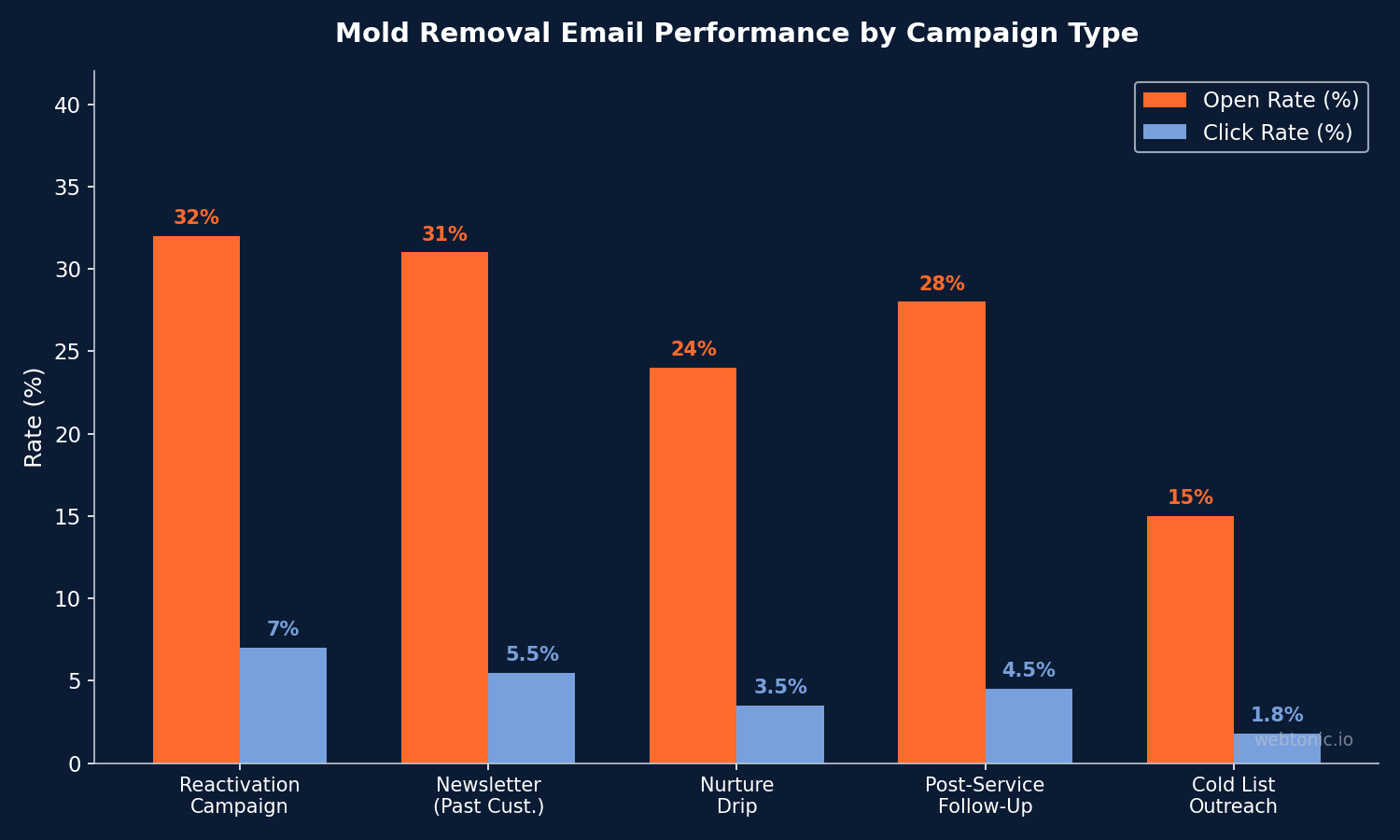
- Restoration email campaigns average a 24% open rate, outperforming the 22.5% construction industry benchmark and approaching the 36.92% all-industry average.
- Contractor newsletters achieve 28–35% open rates and 4–7% click rates, roughly 2–3× typical SaaS email performance when targeting past customers and referral partners.
- 70–85% of paid mold removal leads are never meaningfully followed up, making structured email nurture sequences the highest-ROI investment for companies with existing lead flow.
- Reactivation email segments produce 3–5× the per-send revenue of general lists, with one restoration operator booking $6,800 from a single past-customer reactivation campaign.
- SMS follow-ups generate response rates above 40% in restoration marketing, far exceeding email response rates and creating an ideal complement to email automation workflows.
Email Marketing Performance Benchmarks
Email marketing delivers outsized returns for mold remediation companies because the audience is already qualified — past customers, property managers, and insurance adjusters who have an established relationship with the business. Restoration email campaigns average a 24% open rate (Marketing LTB), which is particularly strong given that email marketing across the construction and home services sector averages just 22.5% open rates (CuFinder).
The all-industry average email open rate sits at 36.92% across platforms (Sendtric), but that figure is inflated by high-engagement sectors like coaching (48.07%) and media publishing (38.87%). For home services businesses with repeat customers or maintenance programs, realistic benchmarks are 20–30% open rates and 2–4% click-through rates (PipelineOn).
The construction sector's average email click-through rate of 2.6% (CuFinder) provides a floor for mold removal businesses. Well-segmented campaigns targeting past customers with seasonal mold prevention content consistently exceed this baseline, with top performers reaching 4–7% click rates on newsletter sends (PipelineOn).
| Email Metric | Mold Removal / Restoration | Home Services Avg. | All-Industry Avg. |
|---|---|---|---|
| Open Rate | 24% | 20–30% | 36.92% |
| Click-Through Rate | 2.6–4% | 2–4% | 2.57% (Prof. Svcs) |
| Newsletter Open Rate | 28–35% | 28–35% | 19.21% |
| Newsletter Click Rate | 4–7% | 4–7% | 2.3% |
| SMS Response Rate | 40%+ | 35–45% | 20–25% |
| Direct Mail Response | 4.4% | 4.4% | 0.12% (email equiv.) |
Lead Nurture and Follow-Up Statistics
The single largest source of recoverable revenue for most mold removal companies is the leads they already paid for but never followed up with. Industry data suggests most restoration companies close 15–30% of inbound leads on the first touch and never meaningfully attempt to recover the rest (Tygart Media). That means 70–85% of paid lead spend produces leads that are simply lost — not because the prospect chose a competitor, but because no one followed up after the initial call or form submission.
Structured email follow-up sequences change that equation dramatically. The three-stage nurture framework includes: immediate follow-up (days 1–7) with same-day callback, 24-hour text, and 48-hour check-in; medium-term nurture (days 8–90) with bi-weekly educational touchpoints on mold prevention and indoor air quality; and long-term reactivation (90+ days) with seasonal maintenance reminders and annual inspection offers (Tygart Media).
Restoration companies implementing structured follow-up sequences for the first time often see measurable lifts in close rates within the first 30 days (Tygart Media). The ROI calculation is compelling: if a mold removal company spends $5,000/month on Google Ads generating 40 leads and closes 10 (25%), adding an email nurture sequence that recovers just 5 additional leads generates $15,000–$25,000 in incremental revenue at typical job values of $3,000–$5,000.
Even in true emergency scenarios, follow-up matters. A homeowner who chose a competitor for the initial mold inspection may still need remediation, reconstruction, or ongoing moisture monitoring. The lead is not lost until the relationship is actively closed — and automated nurture workflows keep the door open.
Email Automation and CRM Impact
Restoration companies using CRM software improve lead follow-up rates by 46% (Marketing LTB). In the mold remediation business — where response time can mean the difference between a $5,000 job and a lost lead — automated email triggers ensure every inquiry receives a professional response regardless of staff availability or after-hours timing.
Only 1 in 4 small businesses use email marketing methods to reach customers (Service Direct). For mold removal companies, this represents a significant competitive advantage: implementing basic email automation puts you ahead of 75% of competitors who are still relying solely on phone callbacks and word-of-mouth referrals.
Platform costs are minimal. Mailchimp Free covers up to 500 contacts at $0/month, ConvertKit Creator starts at $15/month for 300 subscribers, and industry-specific tools like Jobber, Housecall Pro, and ServiceTitan Marketing Pro bundle email into mid-tier plans starting around $129/month (PipelineOn). The cost barrier to entry for email marketing is virtually zero compared to the $1,500–$6,000 monthly investment in paid advertising channels.
| Automation Feature | Impact | Cost Range |
|---|---|---|
| CRM-Triggered Follow-Ups | 46% higher follow-up rates | $0–$129/mo |
| Drip Nurture Sequences | Recovers 15–25% of lost leads | $0–$49/mo |
| Review Request Automation | 2.8× more reviews over time | Included in CRM |
| Reactivation Campaigns | 3–5× per-send revenue | $0–$15/mo |
| SMS Automation | 40%+ response rate | $0.01–$0.05/msg |
| Seasonal Maintenance Alerts | 5–12% monthly revenue lift | $0 (email) or $50/mo (SMS) |
Newsletter and Content Marketing Statistics
Contractor newsletters open at 28–35% and click at 4–7%, well above the 19.21% all-industry average open rate and roughly 2–3× typical SaaS performance (PipelineOn). The format that works for mold removal businesses: one seasonal mold prevention tip, one before-and-after remediation project showcase, one customer story, one maintenance reminder, and one referral incentive.
Top home service operators attribute 5–12% of monthly revenue to newsletter-driven jobs (PipelineOn). For a mold removal company doing $200,000/month, that translates to $10,000–$24,000 in monthly revenue directly traceable to a channel that costs under $50/month to maintain with a clean past-customer list.
Reactivation email segments targeting past customers with no service in 12–24 months produce 3–5× the per-send revenue of the general list (PipelineOn). One restoration operator booked $6,800 from a single past-customer reactivation send. Mold removal companies with seasonal demand patterns — spring moisture, post-hurricane assessments, fall heating-season indoor air quality checks — can time these reactivation campaigns to coincide with peak mold awareness periods.
Direct mail pulls a 4.4% response rate versus 0.12% for email per 2026 ANA/DMA data (PipelineOn). A printed quarterly newsletter mailed to older homeowners — particularly those 55+ who make up a disproportionate share of the mold remediation customer base — remains the highest-ROI physical marketing channel for the segment most likely to own aging homes with moisture issues.
Email List Building and Segmentation
Effective mold removal email marketing starts with list quality, not list size. Clean, segmented email lists consistently outperform larger unsegmented lists in both open rates and conversion (Service Direct). A 200-contact list of engaged past customers will generate more revenue than a 2,000-contact purchased list of cold homeowners.
The key segments for mold remediation email marketing include: past residential customers (highest value — they trust you and may need repeat services), commercial property managers (recurring contract potential), insurance adjusters and agents (referral pipeline), referral partners like plumbers, HVAC technicians, and home inspection companies, and website leads who did not convert (nurture candidates).
List-building tactics proven in the mold removal space: offering a downloadable mold prevention guide in exchange for email addresses, capturing contact information during free inspection requests, collecting emails at community events and home shows, and implementing post-service email capture in the field (Service Direct).
Click rates below 2% typically indicate the CTA is buried, the email is too long, or the audience targeting is wrong. Click rates above 8% signal a high-intent segment — usually recent customers or active property managers — that deserves dedicated messaging and exclusive offers (PipelineOn).
SMS and Multi-Channel Communication
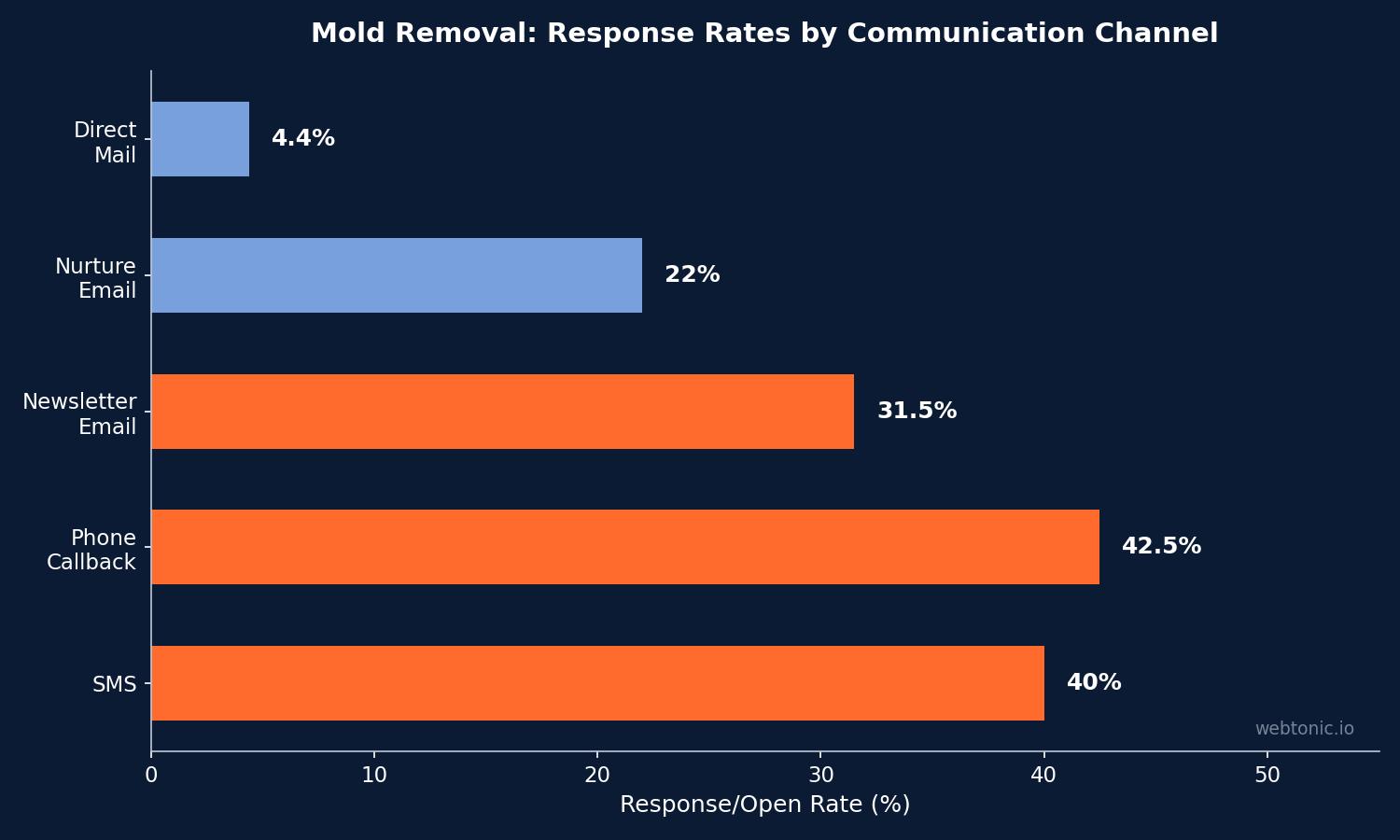
SMS follow-ups generate response rates above 40% in restoration marketing campaigns (Marketing LTB). For mold removal companies, SMS excels in three scenarios: confirming inspection appointments, sending post-service follow-ups, and delivering seasonal mold awareness reminders during high-humidity months.
Phone calls represent 70–80% of all home services leads (The Snow Media), and missed calls waste an estimated $1,500/month for the average contractor. SMS automation bridges the gap — when a call goes unanswered, an automated text response ensures the lead stays engaged until a team member can follow up personally.
69% of restoration consumers choose the first company they contact (Marketing LTB). Combining email and SMS in a unified workflow ensures mold removal companies maintain first-mover advantage across every communication channel — the homeowner who gets a text reply within 60 seconds of submitting a form is far more likely to book than one waiting for a return call that may never come.
| Communication Channel | Response/Open Rate | Best Use Case | Cost Per Message |
|---|---|---|---|
| Email (Newsletter) | 28–35% open | Monthly updates, referral asks | $0.001–$0.01 |
| Email (Nurture Drip) | 20–24% open | Lead follow-up, reactivation | $0.001–$0.01 |
| SMS | 40%+ response | Appointment confirms, missed calls | $0.01–$0.05 |
| Direct Mail | 4.4% response | Quarterly to 55+ homeowners | $0.50–$2.00 |
| Phone Callback | 35–50% connect | Hot leads, estimates | $0 (staff time) |
Related reading
- Mold Removal Marketing Attribution Statistics 2026: The Phone-Call Problem
- Mold Removal Marketing Dashboard Statistics 2026: Margin On The Scoreboard
- How Junk Removal and Dumpster Rental Email Marketing Shifted Since 2024
- Email Marketing services at Web Tonic
Frequently Asked Questions
What is a good email open rate for mold removal companies?
A solid open rate for mold removal email marketing is 24–35%. Standard restoration campaigns average 24%, while well-targeted newsletters to past customers achieve 28–35%. Rates below 20% typically indicate list quality issues, poor subject lines, or delivery problems. The all-industry average is 36.92%, but home services typically falls within the 20–30% range.
How often should a mold remediation company send emails?
Monthly newsletters combined with event-triggered automation performs best. Send a monthly newsletter featuring seasonal tips, remediation project spotlights, and referral incentives. Layer in automated sequences for post-service follow-ups (3–5 emails over 90 days), reactivation campaigns for dormant contacts (every 6–12 months), and seasonal mold prevention reminders during spring humidity and post-storm recovery periods.
What types of emails work best for mold removal businesses?
The highest-performing email types for mold remediation are reactivation campaigns targeting past customers (3–5× per-send revenue), seasonal maintenance reminders (spring moisture checks, post-hurricane inspections), post-service review requests (builds the online reputation that drives 2.8× more calls), and referral partner updates to plumbers, HVAC companies, and insurance adjusters who generate referral business.
Is email marketing worth it for small mold removal companies?
Yes — email marketing is one of the lowest-cost, highest-ROI marketing channels available to mold removal businesses. With free tools supporting up to 500 contacts and past-customer segments producing 3–5× per-send revenue, even a one-person mold removal operation benefits from basic email automation. The key is list quality over quantity — 200 engaged past customers will always outperform 2,000 purchased cold contacts in both open rates and job bookings.
How do SMS and email work together for mold removal marketing?
SMS and email serve complementary roles in the mold remediation customer journey. Use SMS for time-sensitive communications — appointment confirmations, missed call follow-ups, and emergency mold awareness reminders (40%+ response rates). Use email for longer-form content — monthly newsletters, educational mold prevention guides, project showcases, and referral requests. Companies running both channels in a unified CRM workflow capture more leads across every communication preference and maintain the speed-to-lead advantage that drives 391% more emergency bookings.
Sources
Marketing LTB — Restoration Marketing Statistics 2026
PipelineOn — Contractor Newsletter Strategies
Tygart Media — Restoration Lead Nurture and Follow-Up
Service Direct — Mold Remediation Email Marketing Best Practices
Sendtric — Average Email Open Rates by Industry 2026
CuFinder — Construction Industry Marketing Benchmarks 2026
The Snow Media — Home Services Ad Benchmarks


