Table of contents
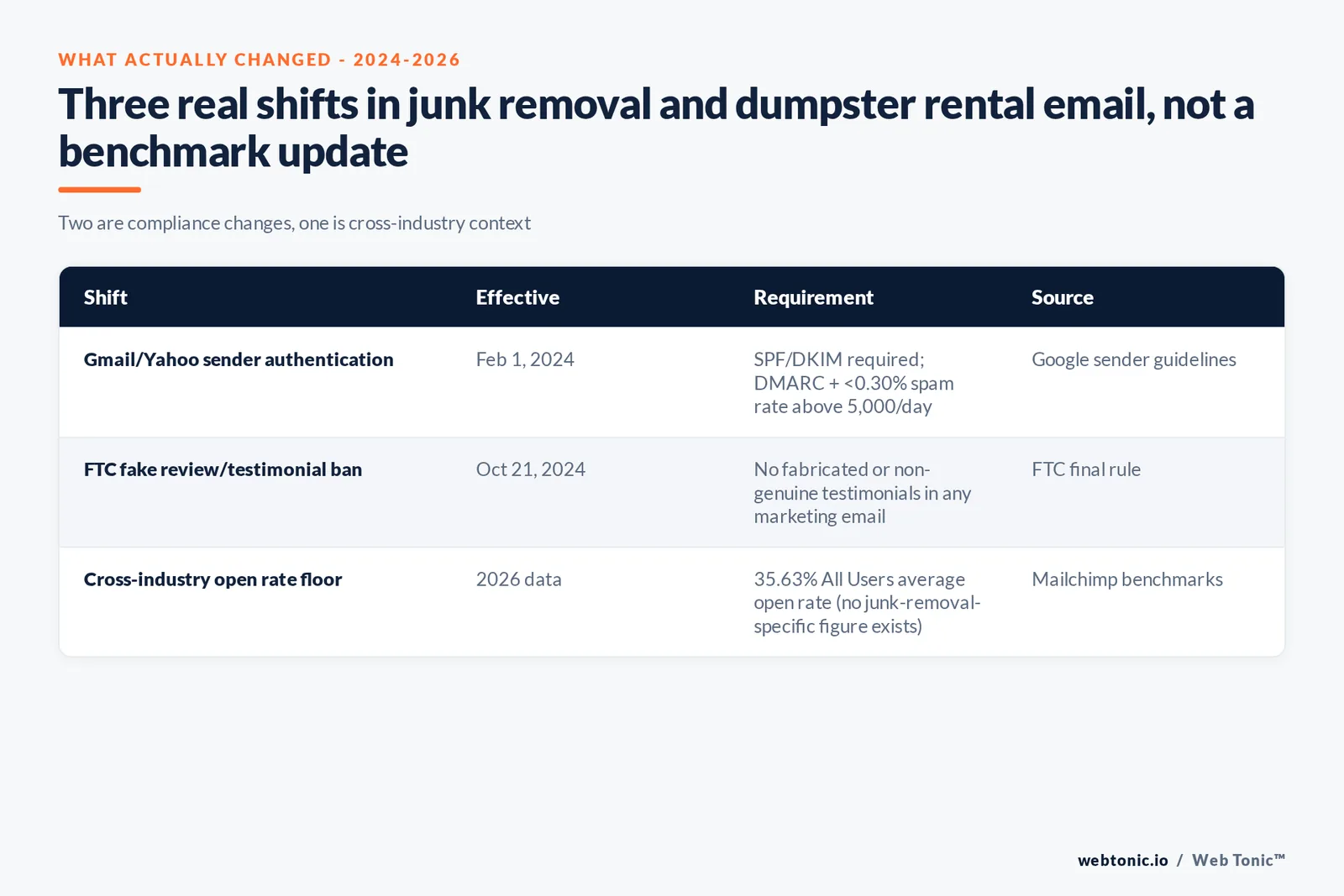
Two real rule changes reshaped email for this industry in 2024, not a shift in open rates: Gmail and Yahoo's bulk-sender authentication mandate took effect February 1, 2024, and the FTC's ban on fake reviews and testimonials took effect October 21, 2024. No vendor tracks a junk-removal-specific open rate, so this page uses labeled cross-industry data as the floor and focuses on what genuinely changed in the rules of the game.
Key Takeaways
- Since February 1, 2024, Gmail requires SPF or DKIM for every sender, and SPF, DKIM and DMARC for anyone sending 5,000-plus messages a day.
- Senders above that volume must also keep spam complaint rates under 0.30% in Google Postmaster Tools or risk bulk rejection.
- The FTC's fake-review and testimonial ban took effect October 21, 2024 and applies to email marketing claims, not just reviews platforms.
- The cross-industry "All Users" average open rate is 35.63% and average click rate is 2.62%, per Mailchimp's benchmark data.
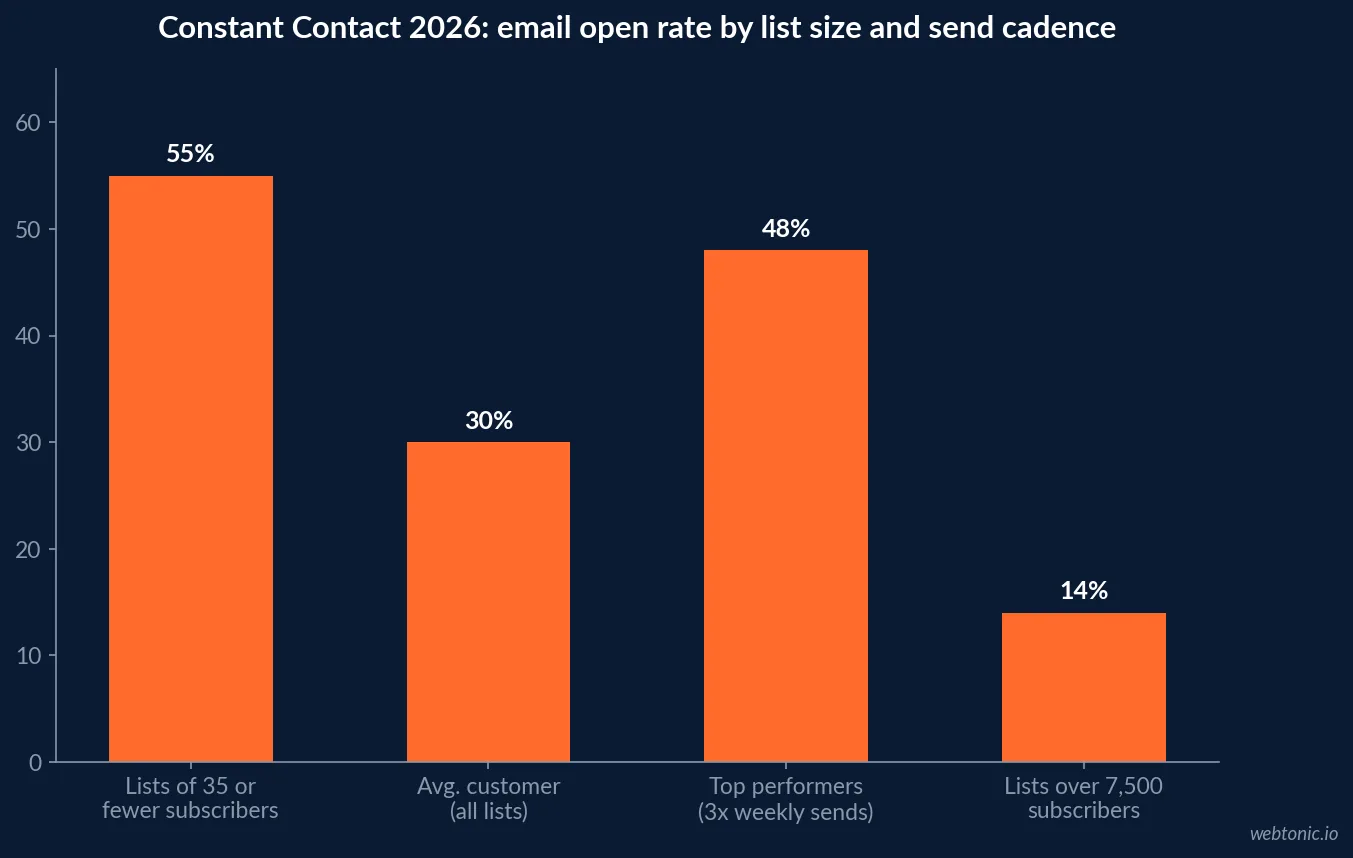
- Constant Contact's own 2026 customer average open rate runs near 30%, while its top performers - sending 3x weekly - average 48%.
- Small, engaged lists (35 subscribers or fewer) average a 55% open rate versus just 14% for lists over 7,500, per Constant Contact's 2026 data.
- 80% of Constant Contact's top-performing customers resend to non-openers, a single tactic with an outsized reported effect.
- Jobber's Q2 2026 Home Service Economic Report draws on 100,000-plus businesses and 400,000-plus professionals - the closest thing to an industry-adjacent operational dataset.
- Every major home service segment returned to revenue growth by June 2026 through pricing discipline, not added volume, per the same Jobber report.
- Google added a dedicated "Junk Removal Service" GBP category the same year as these email rule changes, part of a broader 2024 category-accuracy push.
The real 2024 shift: authentication, not open rates
The change that actually mattered for small-business email in this category was structural. Google's sender guidelines, effective February 1, 2024, require every sender to set up SPF or DKIM authentication, valid forward and reverse DNS records, and a TLS connection - with no exception for list size. Senders pushing 5,000 or more messages a day to Gmail addresses face a stricter tier: SPF and DKIM and DMARC, plus a spam complaint rate held under 0.30% in Google Postmaster Tools. A junk removal or dumpster rental business running quote-follow-up sequences through a marketing platform that never enforced this configuration risks silent inbox rejection, not just a lower open rate.
| Gmail/Yahoo sender requirement (effective Feb 1, 2024) | All senders | 5,000+ msgs/day senders |
|---|---|---|
| SPF or DKIM authentication | Required (either) | Required (SPF AND DKIM) |
| DMARC authentication | Not required | Required (policy can be "none") |
| Valid forward/reverse DNS (PTR) records | Required | Required |
| TLS connection for transmission | Required | Required |
| Spam rate ceiling (Postmaster Tools) | Not specified | Must stay below 0.30% |
Cross-industry benchmarks: the honest floor, clearly labeled
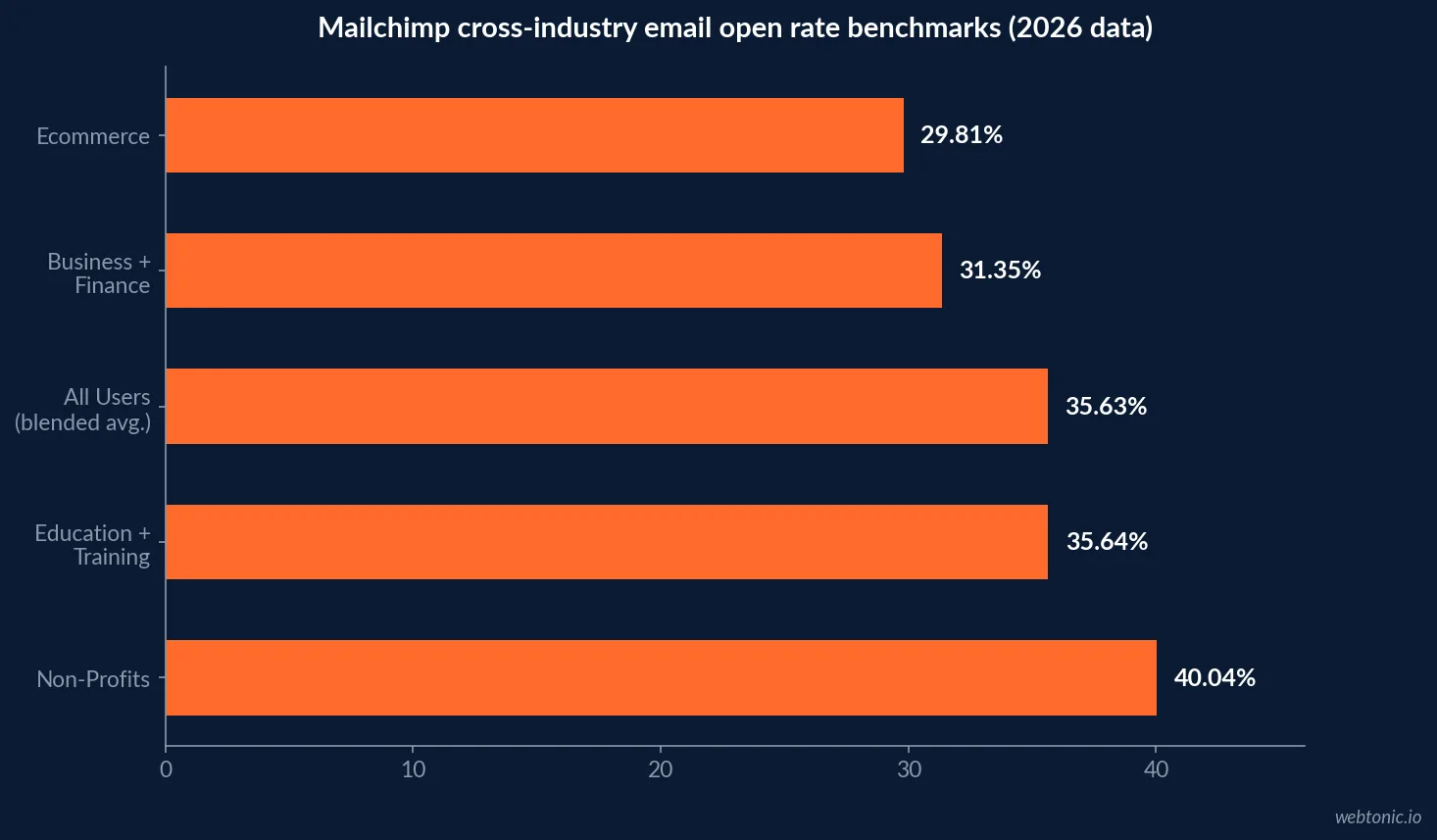
No vendor - not Mailchimp, not Constant Contact, not HubSpot - publishes a junk removal or dumpster rental email benchmark. Mailchimp's own industry table (data last refreshed December 2023) tracks broad categories like Business + Finance, Non-Profits, Education + Training and Ecommerce; the closest usable reference is its "All Users" blended average. Every figure below is explicitly a cross-industry benchmark, not a category-specific one.
| Mailchimp benchmark category (cross-industry) | Avg. open rate | Avg. click rate | Unsubscribe rate |
|---|---|---|---|
| Non-Profits | 40.04% | 3.27% | 0.18% |
| Education + Training | 35.64% | 3.02% | 0.18% |
| All Users (blended average) | 35.63% | 2.62% | 0.22% |
| Business + Finance | 31.35% | 2.78% | 0.15% |
| Ecommerce | 29.81% | 1.74% | 0.19% |
What Constant Contact's own 2026 data shows about list quality
Constant Contact's 2026 customer data puts its average open rate near 30%, but the gap between average and top-performing accounts is almost entirely about list hygiene and send cadence, not industry. Top performers who email their list three times a week average a 48% open rate. More strikingly, campaigns sent to 35 subscribers or fewer averaged 55%, while campaigns to lists over 7,500 averaged just 14% - a gap large enough that a junk removal business with a small, genuinely opted- in customer list may already be outperforming a much larger, less-curated one before any subject- line optimization happens.
| List/behaviour factor (Constant Contact 2026) | Reported figure | What it implies |
|---|---|---|
| Lists of 35 subscribers or fewer | 55% avg. open rate | Small, engaged lists dramatically outperform |
| Lists over 7,500 subscribers | 14% avg. open rate | Size without curation actively hurts open rate |
| Send frequency: 3x weekly (top performers) | 48% avg. open rate | Consistency beats a single monthly blast |
| Resend-to-non-openers (RSNO) usage | 80% of top performers use it | A cheap tactic with outsized reported use among winners |
| Avg. list size, top performers | 13,174 subscribers | Growing ~1,000/year - steady, not explosive, growth |
What the FTC's 2024 testimonial rule means for a drip sequence
The FTC's Trade Regulation Rule on the Use of Consumer Reviews and Testimonials became enforceable October 21, 2024, and it applies to marketing email exactly as it applies to a website or an ad. A common junk removal drip pattern - quote sent, job booked, automated "see what our customers say" email with a review screenshot - has to use a genuine, attributable review under the rule. Fabricated composite quotes, review text that was never actually posted by that customer, or an employee-written testimonial presented as an independent customer's words are all covered.
| Email drip element | FTC 2024 rule status | Safe pattern |
|---|---|---|
| Post-job "leave us a review" request | Unaffected - encouraging real reviews is fine | Keep automating this step |
| "Here's what customers say" nurture email with quotes | Must be genuine, attributable reviews | Pull actual review text with permission, not composites |
| Employee testimonial in a re-engagement email | Must disclose the employment relationship | Add a one-line disclosure |
Where an industry-adjacent operational signal actually helps
Jobber's Home Service Economic Report for Q2 2026 - built from proprietary data across more than 100,000 home and commercial service businesses and 400,000-plus professionals in landscaping, cleaning, contracting and construction - found every major home service segment back to revenue growth by June 2026, driven by pricing work more effectively, not adding job volume. That framing matters for email specifically: a quote-follow-up and repeat-customer sequence that protects margin on existing jobs is a better fit for this data than a volume-chasing acquisition blast.
How many operators are actually building these lists
Sizing the addressable list matters as much as the benchmark itself. IBISWorld's 2026 report values the US Waste Collection Services industry at USD 83.1 billion, and the Census Bureau's County Business Patterns series tracks establishment counts annually under NAICS 562111 (Solid Waste Collection). Republic Services alone - one operator among thousands - posted USD 4.212 billion in total quarterly revenue for Q3 2025, with its residential collection line at USD 754 million, a scale reminder that most email list-building advice aimed at "the industry" is really describing a market with a handful of giants and a long tail of single-truck operators.
| Market backdrop data point | Figure | Source |
|---|---|---|
| US Waste Collection Services industry size (2026) | USD 83.1 billion | IBISWorld |
| Republic Services total quarterly revenue, Q3 2025 | USD 4.212 billion | Republic Services (PR Newswire) |
| Republic Services residential collection revenue, Q3 2025 | USD 754 million | Republic Services (PR Newswire) |
| Establishment counts, NAICS 562111 | Published annually by county/metro | Census County Business Patterns |
What to actually change this quarter
Two of the three real shifts covered here are compliance, not creative: confirm SPF/DKIM/DMARC is configured correctly for the sending domain (free to check, expensive to ignore), and audit any automated review-request or nurture sequence for genuine, attributable testimonials under the FTC's October 2024 rule. The creative work - cadence, list segmentation, subject lines - matters too, but Constant Contact's own data suggests list quality and send consistency move the needle further than any single subject-line trick. Our data and analytics team can audit sender authentication and list health together, and our growth marketing team builds the retention-focused sequences this data actually supports. Talk to us about auditing your current setup.
Frequently Asked Questions
What is the single biggest email change since 2024 for a small operator's list?
Authentication requirements, not open rates. Starting February 1, 2024, Gmail requires SPF or DKIM for every sender, and requires SPF, DKIM and DMARC plus a sub-0.30% spam rate for anyone sending 5,000-plus messages a day to Gmail addresses. A junk removal or dumpster rental business running quote-follow-up sequences through an unauthenticated domain risks landing in spam or being rejected outright - a purely technical change with no exception for small business list size.
Does any vendor publish a junk removal or dumpster rental email benchmark?
No. Mailchimp's industry benchmark table (most recently updated December 2023) and Constant Contact's own 2026 data track broad categories like Business + Finance, Non-Profits and Ecommerce, not waste hauling or home services specifically. This page uses the All Users cross-industry average - 35.63% open rate, 2.62% click rate - as the labeled floor a junk removal list should be compared against, not a category-specific figure.
What does a 'good' open rate actually look like in 2026?
Constant Contact's own 2026 data puts its average customer open rate around 30%, but its top-performing customers - who send at least three times a week - average 48%. The gap is mostly list hygiene and cadence, not industry: Constant Contact found campaigns sent to small, engaged lists of 35 subscribers or fewer averaged a 55% open rate, while campaigns to lists over 7,500 averaged only 14%, evidence that list quality outweighs list size for this kind of business.
Did the FTC's 2024 rule actually change what a lead-nurture email can say?
Yes, directly. The FTC's Trade Regulation Rule on Consumer Reviews and Testimonials, effective October 21, 2024, bans including a fabricated or non-representative testimonial in any marketing material, email included. A drip sequence built around a quote-to-review-screenshot to close-the-loop email has to use a real, attributable review under the rule - there is no small-business exemption and no email-specific carve-out.
Should a junk removal business even bother with email over texting or calling?
Email is best used for the parts of the funnel calls and texts don't cover well: the quote-to-booking gap and the post-job review request. No study measures email's role specifically for this trade, but Jobber's Q2 2026 Home Service Economic Report - drawn from 100,000-plus home and commercial service businesses - found every major home service segment returned to revenue growth by pricing more effectively rather than adding volume, which points toward retention and repeat-job email (not new-lead volume) as the higher-value use case for a list this size.
Sources
Google - Email sender guidelines (Gmail Help, effective Feb 1, 2024)
Federal Trade Commission - Trade Regulation Rule on Consumer Reviews and Testimonials (2024)
Mailchimp - Email Marketing Benchmarks and Industry Statistics
Constant Contact - How to Improve Your Email Open Rate in 2026
Jobber - Home Service Economic Report, Q2 2026 (issuer page)
Federal Trade Commission - CAN-SPAM Act Compliance Guide for Business
IBISWorld - Waste Collection Services in the US Market Size (2026)
Republic Services - Third Quarter 2025 Results (PR Newswire)
US Census Bureau - County Business Patterns Data