Table of contents
X sells the cheapest impressions in social advertising — an average CPM of $5.65, down 38% since 2022 — and carries the lowest brand-safety confidence of any major platform, with roughly 4% of marketers calling it brand safe. For a medical spa the paid case is thin. The 2026 case for being on X at all is that about 45% of Grok’s citations are X posts.
Key Takeaways
- Average X CPC is $0.74 across a $0.27–$1.95 range — one of the cheapest clicks in paid social.
- Average CPM is $5.65 versus $8.15 on Instagram, $9.10 on LinkedIn and $4.10 on TikTok; CPM has fallen 38% since 2022.
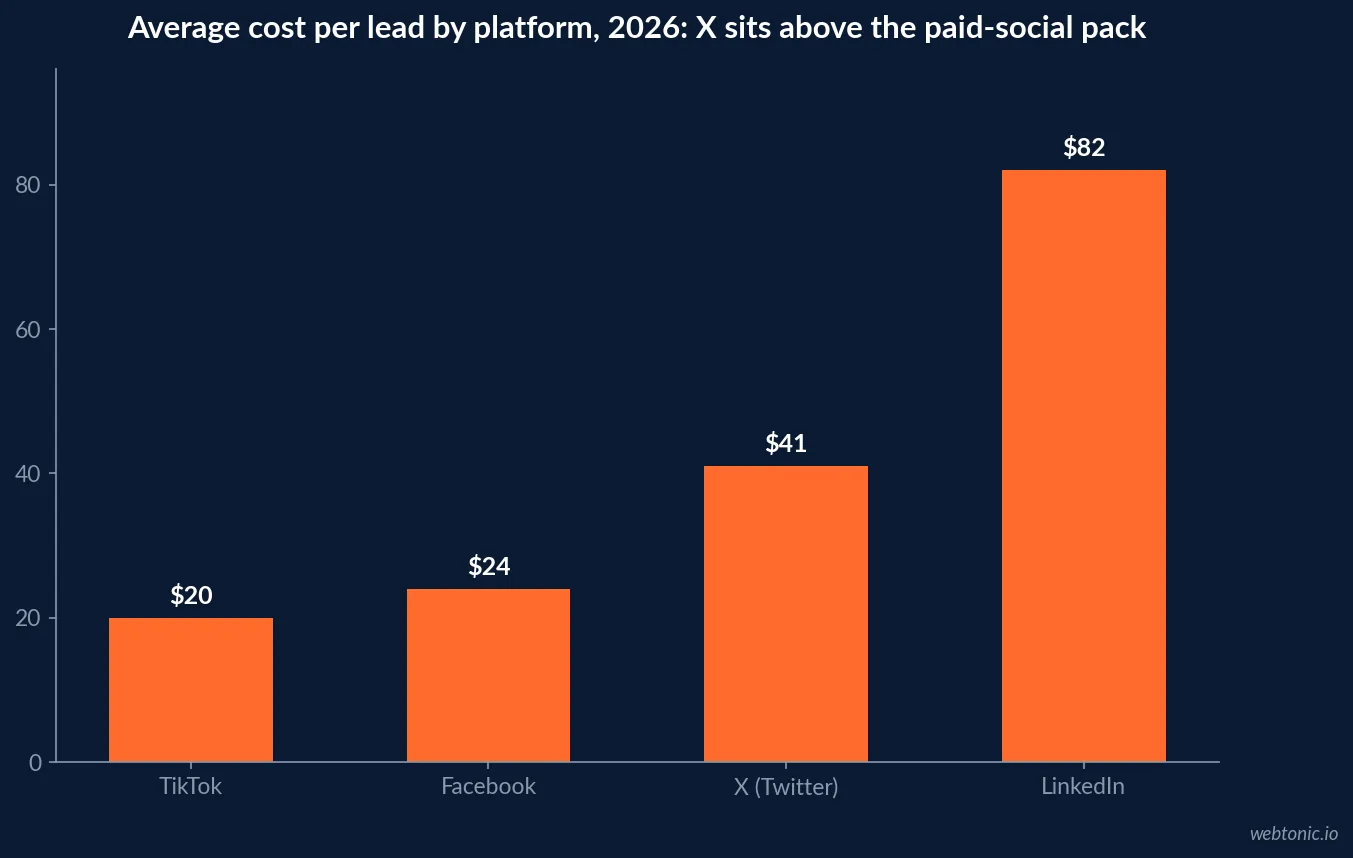
- Average cost per lead is $41 against $24 on Facebook, $20 on TikTok and $82 on LinkedIn — and marketers report 34% lower lead quality than LinkedIn.
- Average CTR is 0.86%, comparable to Facebook’s 0.90%; promoted video leads at 1.24%.
- One independent benchmark set reports a median X CPA of $21.55, CPE of $0.13 and engagement rate of 0.59% against conversion rates as low as 0.02%.
- Promoted Trends cost $100,000–$250,000 per day in the US — irrelevant for practices, useful as an auction-pressure signal.
- Estimated 2026 ad revenue is about $2.5B, a 54% decline from $5.4B pre-acquisition; 2022 revenue was $4.4B.
- 52% of pre-acquisition advertisers have reduced or stopped spending; 18% increased budgets specifically because CPMs fell.
- Only about 4% of marketers believe X is brand safe and roughly 12% trust its ads; GARM classifies the platform high risk for brand adjacency.
- 29% of marketers plan to cut X spend, up from 26% a year earlier, with nearly one in eight planning to exit entirely.
- Scale is still real: roughly 611M monthly active users worldwide, 95.4M in the US, and advertising reach reported at 557.5M.
- Grok citation mix: 34% organic X posts plus 11% verified-account posts — about 45% of all cited sources.
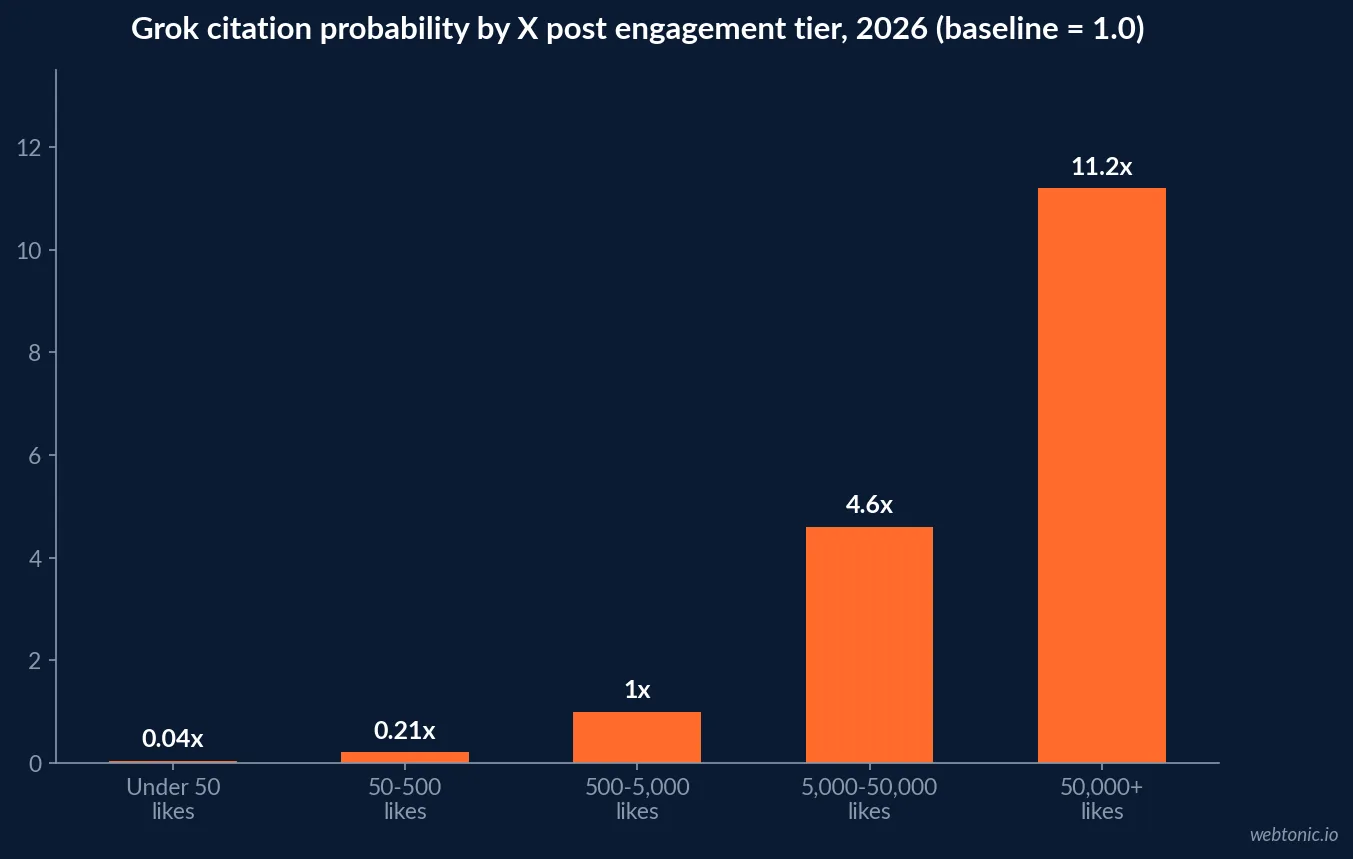
- Grok citation probability is non-linear: 4.6x baseline above 5,000 likes and 11.2x above 50,000; verified accounts get a further 2.8x.
- Grok cites about 4.7 sources per answer, rising to 6.3 on current-events queries.
- Healthcare advertising on X is a prohibition with an exception list: cosmetic procedures approved in South Korea (October 2025), cosmetic aggregator apps in Japan (March 2026), telemedicine in the US and several Gulf markets.
- From 1 March 2026, undisclosed paid promotion carries severe penalties under X’s updated disclosure rules — relevant to any influencer collaboration.
- 61% of US patients research medical spas on social media, with Instagram the dominant platform — X is a listening surface, not a booking surface.
X Ad Cost Benchmarks At A Glance
Searchlab’s 2026 X dataset compiles the platform-level numbers, and the shape is consistent across sources: impressions are cheap, engagement is cheap, qualified leads are not.
| Metric | X (2026) | Comparison | Read for a practice |
|---|---|---|---|
| Average CPM | $5.65 | IG $8.15 / LinkedIn $9.10 / TikTok $4.10 | Cheapest mainstream reach after TikTok |
| Average CPC | $0.74 ($0.27–$1.95) | Meta typically $1.10–$2.00 | Cheap clicks, mixed intent |
| Average CTR | 0.86% | Facebook 0.90% / Pinterest 1.16% | Promoted video best at 1.24% |
| Average cost per lead | $41 | Facebook $24 / TikTok $20 / LinkedIn $82 | Weak on lead economics |
| Reported lead quality | 34% lower than LinkedIn | — | Expect heavier qualification load |
| Promoted Trends | $100,000–$250,000 per day | — | Not a practice-scale product |
A second dataset from Enrich Labs reads differently in an instructive way: a median CPA of $21.55, cost per engagement of $0.13 and a relatively high engagement rate of 0.59%, but conversion rates as low as 0.02%. Both pictures can be true at once because X’s strength is cheap interaction and its weakness is the step from interaction to booking. For an elective, high-consideration purchase like injectables, that step is the entire funnel.
The Trust Discount Is The Price
X’s low CPMs are not a market inefficiency; they are a discount for risk that advertisers priced deliberately. True Interactive’s 2026 review reports 29% of marketers planning to decrease X spend, up from 26% the year before, with nearly one in eight planning to exit entirely, and Kantar ranking X last among global ad platforms for trust. Searchlab’s dataset adds that 52% of pre-acquisition advertisers reduced or stopped spending — while 18% increased budgets precisely because CPMs collapsed.
| Trust signal | Figure | Why it matters in aesthetics |
|---|---|---|
| Marketers calling X brand safe | About 4% | Clinical trust is the product |
| Marketers trusting X ads | About 12% | Down from roughly 22% in 2022 |
| GARM brand adjacency rating | High risk | Adjacency to controversy near medical claims |
| Pre-acquisition advertisers reducing or stopping | 52% | Thinner auction, cheaper inventory |
| Advertisers increasing spend on lower CPMs | 18% | The bargain-buy cohort |
| Consumers naming X least trustworthy platform | 17% | Behind TikTok (21%) and Facebook (20%) |
There is a genuine counter-signal. Digiday reports X’s advertiser base beginning to resemble its pre-2022 profile, with 2026 US top-10 spenders including Comcast (+372% year over year), the NFL (+166%), Google (+175%), AT&T (+226%) and American Express (+469%). Large brands are returning — which means today’s cheap inventory is a window, not a permanent condition.
Platform Scale: Still Large, Differently Measured
Comparing X’s audience across years is a trap because the metric changed. Pre-acquisition Twitter reported 237.8M monetizable daily active users in Q2 2022 — an inventory-focused number. DigitalApplied’s audit of the SpaceX S-1 filing notes the platform now reports 550M MAU, a broader measure, while Onclusive’s 2026 data portrait puts monthly users above 388M and advertising reach at 557.5M. Searchlab lists 611M global monthly actives with 95.4M in the US.
Those figures are not contradictory so much as differently defined, and the practical conclusion is the same either way: reach is not X’s problem. Revenue is. Estimated 2026 ad revenue of about $2.5B represents a 54% decline from $5.4B pre-acquisition, and the S-1 shows the business tilting toward subscriptions and AI compute rather than advertising — which shifts platform incentives away from advertiser satisfaction.
Healthcare Policy: A Prohibition With Exceptions
This is the structural blocker for aesthetics, and it is architectural rather than a matter of creative review. As Accelerated Digital Media’s 2026 policy review describes, X’s healthcare framework reads as a blanket prohibition followed by a short list of country-level exceptions, rather than a permission with restrictions. Categories open where X has explicitly opened them.
| Category | Status | Market and date |
|---|---|---|
| Cosmetic procedure advertising | Approved | South Korea, October 2025 |
| Cosmetic service aggregator apps | Approved | Japan, March 2026 |
| Telemedicine services | Permitted | US, Saudi Arabia, Kuwait, Oman, Qatar |
| General cosmetic / aesthetic treatment ads (US) | Not broadly opened | Verify eligibility before planning spend |
| Undisclosed paid promotion | Penalised | Disclosure rules tightened 1 March 2026 |
Creative constraints layer on top. Across platforms, cosmetic ads get flagged for four recurring reasons: before-and-after imagery implying negative self-perception, claims overstating outcomes, failure to restrict targeting to 18+, and nudity or body-image violations. X’s policy also prohibits targeting users based on perceived physical appearance in ways that read as exploiting insecurity. Assume education-first creative or none.
The Grok Argument — The Only Strong One
X is the only social platform whose posts function as first-class inputs to a major AI assistant. Presenc’s monitoring of 4,400 representative prompts found 34% of Grok citations are organic X posts and a further 11% come from verified accounts — about 45% of all cited sources. MaxAEO’s independent tracking of 6,400 Grok answers over 14 weeks measured an even higher social share at 47%. No other assistant comes close.
| Grok citation factor | Effect | Practical implication |
|---|---|---|
| X posts as share of citations | About 45–47% | X presence is an AI-visibility asset |
| Posts under 500 likes | Rarely cited | Low-engagement posting does nothing here |
| Posts above 5,000 likes | 4.6x baseline citation probability | Concentrate effort on few strong posts |
| Posts above 50,000 likes | 11.2x baseline | One viral post outweighs dozens of average ones |
| Verified account status | 2.8x multiplier | Verification is cheap leverage |
| Sources cited per answer | About 4.7 (6.3 on current events) | Narrow citation set — being one of few matters |
For a single-location practice, the honest read is that clearing 5,000 likes on a clinical post is unlikely, so this is not a growth plan. It is a reason for the practice’s founder or lead injector to hold a verified, active X account — the citation premium accrues to accounts, and aesthetic questions are exactly the kind of consumer query where assistants are increasingly the first stop. Our growth marketing team treats this as an AI-visibility line item rather than a paid-social one.
Where X Fits In A Med Spa Channel Mix
Patient research behaviour settles the priority question. Zipdo’s aesthetics research finds 61% of US patients use social media to research medical spas, with Instagram the top platform; industry surveys consistently put Instagram first for practices and X nowhere in the ranked set. X is where the category is discussed, not where it is booked.
| Channel role | X capability | Verdict for aesthetics |
|---|---|---|
| Booked consultations | $41 CPL, 34% lower lead quality | Weak — not the channel |
| Cheap local awareness | $5.65 CPM, 0.86% CTR | Viable at small always-on budgets |
| Reputation monitoring | Real-time public conversation | Strong — free to do well |
| AI visibility via Grok | About 45% of citations are X posts | Strongest single reason to be present |
| Creator collaboration | Disclosure penalties from March 2026 | Only with explicit paid-promotion labels |
| Brand-adjacency risk | GARM high risk, 4% brand-safe rating | Material for a clinical brand |
The defensible allocation for most practices is organic presence plus monitoring, with paid reserved for reach around a specific local moment — an open house, a new device launch, a provider announcement. For the channels that actually book patients, see our med spa digital marketing statistics; for the measurement layer that keeps a cheap-CPM channel honest, our analytics benchmarks cover how to attribute it, and our social media marketing statistics rank the platforms patients actually use.
If You Do Buy X Ads: An Operating Checklist
- Verify category eligibility in writing for your market before building creative — exceptions are country-specific.
- Buy reach and video, not leads: promoted video CTR of 1.24% is the platform’s best format.
- Cap the budget at brand-defence scale; a $41 CPL cannot carry a patient acquisition target.
- Tighten placement and topic exclusions given a high-risk GARM adjacency rating.
- Never use before-and-after imagery that implies negative self-perception, and keep targeting 18+.
- Label every paid collaboration — disclosure penalties tightened on 1 March 2026.
- Verify the practice and provider accounts for the 2.8x Grok citation multiplier.
- Post to be quotable: concentrated, genuinely useful clinical explainers beat daily filler, since posts under 500 likes are rarely cited.
- Measure with call tracking and hold-outs, not platform conversions — reported CVRs run as low as 0.02%.
- Re-evaluate quarterly: returning large advertisers are already pushing CPMs off their floor.
Frequently Asked Questions
Should a medical spa advertise on X in 2026?
For most practices, no — not as an acquisition channel. X offers the cheapest impressions in social at a $5.65 average CPM and a $0.74 average CPC, but cost per lead runs about $41 versus $24 on Facebook and $20 on TikTok, marketers report roughly 34% lower lead quality than LinkedIn, and healthcare advertising sits under a blanket prohibition with a narrow country-by-country exception list. The defensible use is a small always-on budget for brand defence, reputation and reach around local moments — not booked consultations.
Can you run cosmetic procedure ads on X?
Only where X has explicitly opened the category. X's health policy is structured as a prohibition with an exception list rather than a permission with restrictions, and the exceptions are granted market by market: cosmetic procedure advertising was approved in South Korea in October 2025, cosmetic service aggregator apps in Japan in March 2026, and telemedicine in the US and several Gulf markets. A US med spa should assume treatment-level promotion is not eligible and verify with X before planning spend.
What do X ads cost compared to Meta and TikTok?
X is the cheapest on impressions and the most expensive on qualified outcomes. Average CPM is $5.65 against $8.15 on Instagram, $9.10 on LinkedIn and $4.10 on TikTok; average CPC is $0.74 within a $0.27–$1.95 range; CTR averages 0.86% with promoted video highest at 1.24%. Cost per lead, though, is $41 on X against $24 on Facebook, $20 on TikTok and $82 on LinkedIn — and independent benchmark sets put X conversion rates as low as 0.02% on some campaign types.
Why does Grok matter for a med spa's X strategy?
Because X is the only social platform whose content feeds an AI assistant as a first-class source. Continuous monitoring across 4,400 prompts found roughly 45% of Grok citations are X posts — 34% organic and 11% from verified accounts — far higher than any social share in any other assistant. Citation probability is sharply engagement-weighted: posts above 5,000 likes are cited at 4.6x baseline and above 50,000 likes at 11.2x, with verified accounts earning a further 2.8x. For aesthetics, that makes X a discovery asset rather than an ad channel.
Is X brand-safe enough for a medical practice?
It is the weakest of the major platforms on this measure, which matters more in healthcare than in most categories. Only about 4% of marketers consider X brand safe, roughly 12% trust its ads, GARM classifies the platform as high risk for brand adjacency, and 52% of pre-acquisition advertisers have reduced or stopped spending. A practice whose entire proposition is clinical trust should weigh adjacency risk heavily and, if it does buy, keep placements and topic exclusions tight.
Sources
Searchlab — X (Twitter) Statistics 2026: 80+ Facts on Users, Ads & Trends
Onclusive — Twitter at 20: X Statistics 2026
DigitalApplied — X Platform Statistics 2026: SpaceX S-1 Filing Data
True Interactive — Where Does X Stand With Advertisers in 2026?
Digiday — X's Advertiser Base Resembles Its Pre-Musk Era Profile
Enrich Labs — X (Twitter) Advertising Benchmarks
Presenc AI — Grok Citation Patterns 2026 (4,400 prompts)
MaxAEO — How to Get Cited by Grok (6,400 answers, 14 weeks)
Accelerated Digital Media — 2026 Health Advertising Policies on Social Media
Beluxe Creative — Why Cosmetic Ads Get Flagged
Zipdo — Aesthetics & Medspa Industry Research Statistics 2026
Attest — Social Media Sentiment: Eroding Consumer Trust