Table of contents
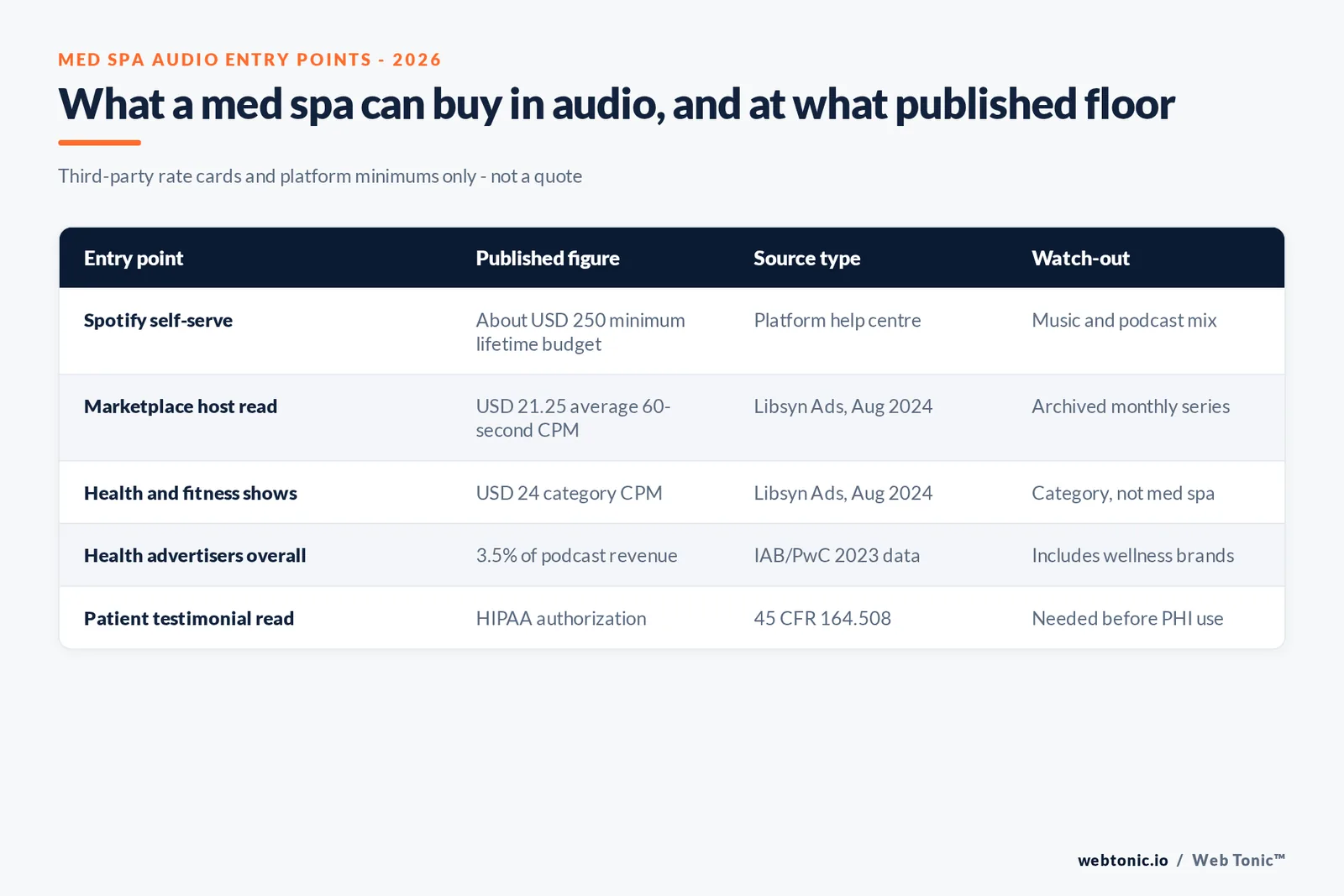
There is no published benchmark for what med spas invest in podcast or audio ads, so the useful numbers are the entry floors: platform minimums, marketplace rate cards and category spend shares. The lowest self-serve door is Spotify, whose Ad Studio help centre puts the minimum lifetime budget at roughly USD 250.
Key Takeaways
- Spotify self-serve campaigns start at roughly USD 250 in lifetime budget.
- Average 60-second podcast CPM was USD 21.25 in August 2024 on Libsyn Ads.
- Health and fitness shows priced at USD 24 CPM in the same month.
- Health and wellness brands took 3.5% of US podcast ad revenue in 2023 (IAB/PwC).
- US podcast ad revenue hit USD 2.9 billion in 2025, up 17.6%.
- Neuromodulator injections reached 9,883,711 procedures in 2024, up 4% (ASPS).
- The med spa industry has eclipsed USD 17 billion, growing by more than USD 1 billion a year (AmSpa).
- 54% of women 12+ consumed a podcast last month in 2026, up from 39% in 2023.
- No named dataset publishes a med spa podcast CPM, CPL or ROI.
Published Entry Points for Med Spa Audio
Each row is a third-party figure a practice can check on the issuer's own page. None is an aesthetics-specific price, and none is a Web Tonic quote.
| Entry point | Published figure | Issuer and date | What it covers |
|---|---|---|---|
| Spotify Ad Studio | About USD 250 minimum lifetime budget | Spotify help centre | Self-serve audio across music and podcasts |
| Marketplace host read | USD 21.25 average 60-second CPM | Libsyn Ads, Aug 2024 | Actual sales across its network |
| Prior month | USD 21.93 (July 2024) | Libsyn Ads | Same series |
| Year earlier | USD 22.10 (August 2023) | Libsyn Ads | Same series |
| Health and fitness shows | USD 24 CPM | Libsyn Ads, Aug 2024 | Show genre, third-highest category |
| Government and technology shows | USD 29 CPM | Libsyn Ads, Aug 2024 | Highest categories that month |
Libsyn notes that the series has been archived and that shorter 10- or 15-second spots carry lower CPMs than 60-second reads. Spotify's podcast ads were opened to self-serve buying in the US and 13 other markets in 2025, and Spotify says it reaches over 115 million monthly US podcast listeners (the company's own claim).
What the Floor Buys: Budget Arithmetic
Rate cards only become useful once they are turned into reach. The table below is simple arithmetic on the published figures above: budget divided by CPM, times 1,000. It is not a forecast of results.
| Budget | At USD 21.25 CPM | At USD 24 CPM | At USD 29 CPM |
|---|---|---|---|
| USD 250 | about 11,800 impressions | about 10,400 | about 8,600 |
| USD 1,000 | about 47,100 | about 41,700 | about 34,500 |
| USD 5,000 | about 235,300 | about 208,300 | about 172,400 |
For a single-location practice, the relevant question is how many of those impressions land in its catchment. Marketplace buyers can target by city, state, zip code or market area on networks that support it, which shrinks wasted reach but usually raises the effective CPM.
How Much Health Brands Spend on Podcasts
The IAB/PwC U.S. Podcast Advertising Revenue Study is the only source that splits podcast revenue by advertiser category. Its latest category breakdown covers 2023, when total revenue was USD 1.9 billion, up 5%.
| Advertiser category (2023) | Share of US podcast ad revenue |
|---|---|
| Consumer packaged goods | 11.7% |
| Brick and mortar / e-commerce retail | 8.7% |
| Health / wellness | 3.5% |
| Pharmaceuticals | 3.4% |
| Home improvement / furnishings | 2.0% |
| 'Other' niche categories (incl. law, tech, pets) | 23.4% |
Health and wellness plus pharmaceuticals add up to 6.9% of podcast revenue in 2023. The market has since grown: the IAB/PwC full-year 2025 report puts podcast revenue at USD 2.9 billion, up 17.6%, inside a USD 8.4 billion digital audio market. The IAB has not published a 2025 category split, so the 2023 shares are the latest available.
The Treatment Demand Behind the Budget
Audio budgets only make sense against demand. The American Society of Plastic Surgeons counted more than 28.5 million minimally invasive procedures in 2024, led by neuromodulator injections at 9,883,711 (up 4%) and hyaluronic acid fillers at 5,331,426 (up 1%).
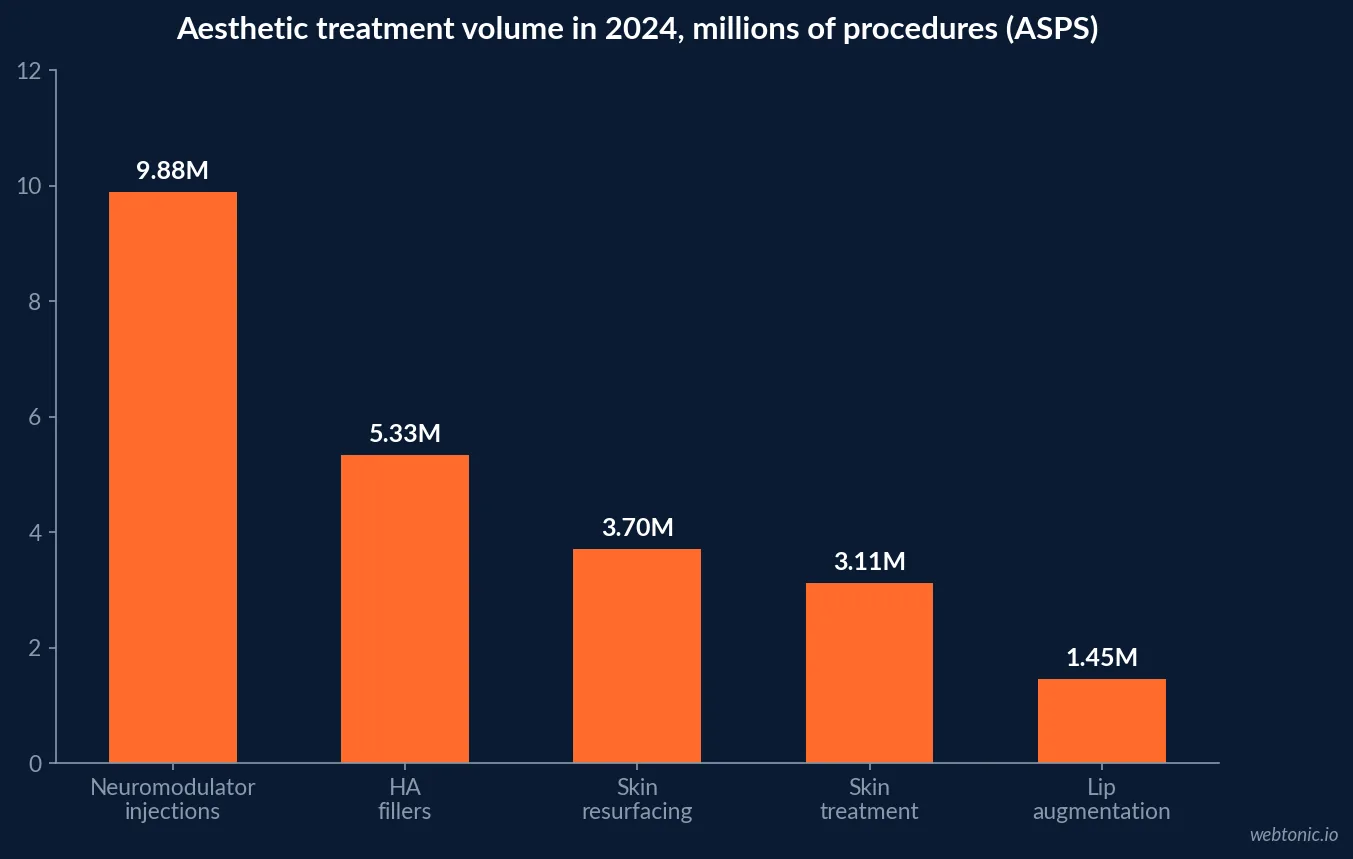
| Treatment (2024) | Procedures | Change vs 2023 |
|---|---|---|
| Neuromodulator injections | 9,883,711 | +4% |
| Hyaluronic acid fillers | 5,331,426 | +1% |
| Skin resurfacing | 3,703,305 | Not stated in release |
| Skin treatment (laser hair removal, IPL) | 3,112,056 | Not stated in release |
| Lip augmentation (injectable) | 1,449,565 | Not stated in release |
The American Med Spa Association describes a medical aesthetics industry that has eclipsed USD 17 billion and grows by more than USD 1 billion a year. Neither body reports how much of that revenue goes to advertising, and AmSpa's full report sits behind a USD 995 paywall, so this page uses only its public summary.
Who Hears the Ads: Women and 35-54 Listeners
Aesthetics buyers skew female and mid-life, and podcast reach has grown fastest in exactly those groups. Edison Research reports 68% of 35-54-year-olds consumed a podcast in the last month in January 2026. Its trend data show monthly podcast consumption among women rising from 39% in 2023 to 54% in 2026, against 62% for men.
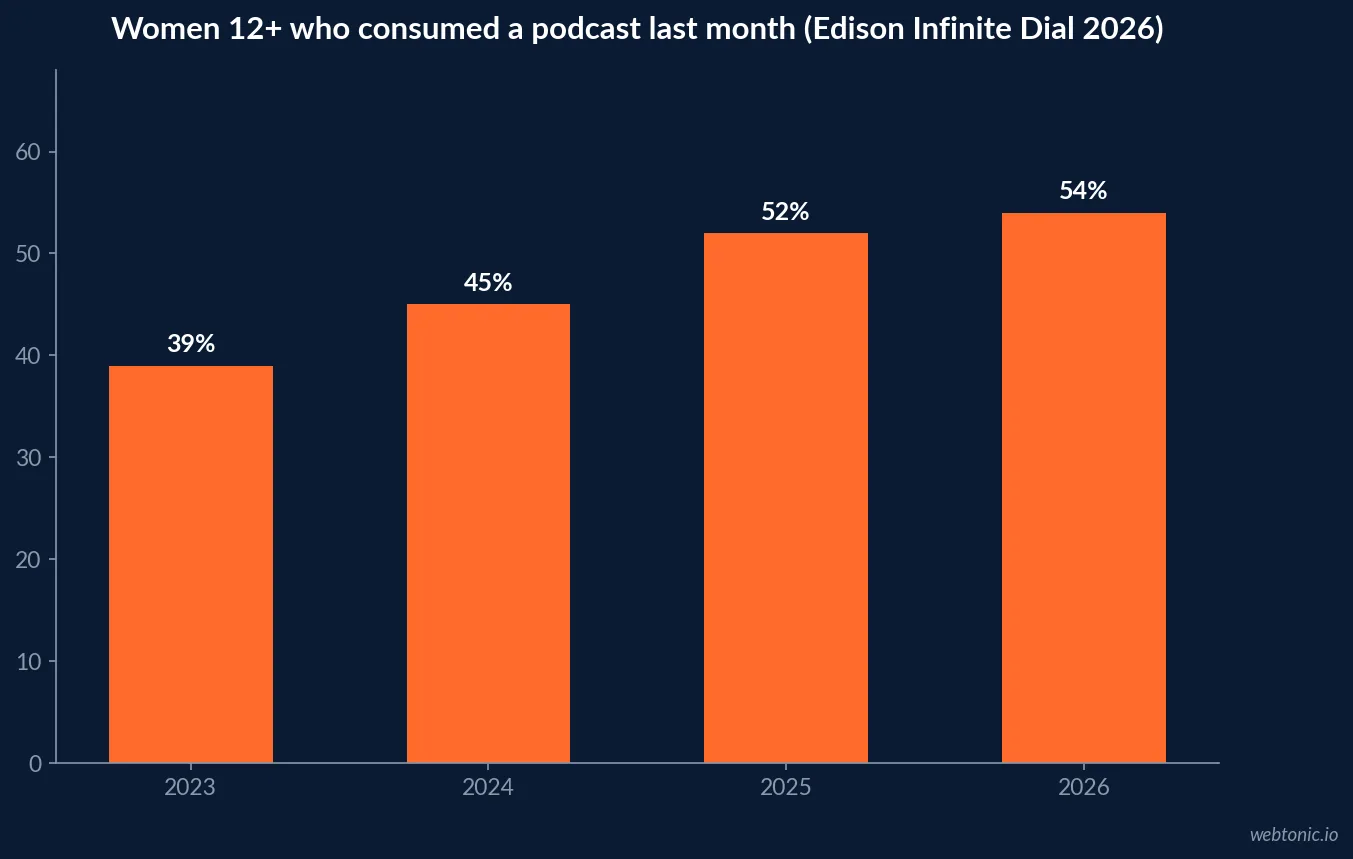
Since 2025 Edison counts listening to or watching a podcast, so part of the rise reflects a wider definition. The direction is still clear, and it is audience data, not evidence that podcast ads fill treatment rooms.
Host Reads, Trust and Near-Term Bookings
Aesthetic treatments are trust purchases, which is where host reads claim their edge. A 2026 Omnicom Media Intelligence and iHeartMedia study (vendor research, more than 3,500 weekly audio listeners, controlled design) found host-read ads drove a 20-point lift in likelihood to purchase within a week and that long-form host reads delivered up to 2x higher recall than shorter ads. Across formats it measured a 22-point rise in unaided ad recall among in-market consumers.
These are brand-lift results across categories, published by a seller of audio. They support testing host reads, not a claim that any med spa will see the same lift.
Compliance Costs That Belong in the Budget
Two federal rules turn into real production time for aesthetics audio.
- HIPAA marketing authorization. 45 CFR 164.508(a)(3) requires a covered entity to obtain an authorization for any use or disclosure of protected health information for marketing, with narrow exceptions. A patient story read on air needs signed authorization first.
- FTC endorsement rules. The Endorsement Guides, 16 CFR Part 255 require disclosure of material connections, such as a host receiving free treatments, and require that results claims reflect what patients can generally expect or clearly disclose it.
- Health-claim caution. Before-and-after language that implies guaranteed outcomes is the most common risk in both host-read and produced spots.
Ad Formats and Lengths Behind the Prices
A CPM is only comparable when the format and length match. The published specs and rate notes below show why a 30-second programmatic spot and a 60-second host read should never share one budget line.
| Format | Length rule | Pricing note | Source |
|---|---|---|---|
| Spotify podcast ad (streaming ad insertion) | Maximum 30 seconds | Self-serve, from about USD 250 | Spotify audio ad specs |
| Spotify music audio ad | Maximum 30 seconds | Auction-based in Ads Manager | Spotify audio ad specs |
| Marketplace host read | 60 seconds (series benchmark) | USD 21.25 average CPM, Aug 2024 | Libsyn Ads |
| Short spot | 10 or 15 seconds | Carries a lower CPM than 60 seconds | Libsyn Ads marketplace notes |
| Long-form host read | Longer than 30 seconds | Up to 2x recall of shorter reads | iHeartMedia / Omnicom 2026 |
For a med spa, the practical split is usually a short self-serve spot to test reach and a longer host read to explain a treatment. The two are bought, priced and measured differently, so they should be judged separately.
What Listeners Say They Do After Podcast Ads
Edison Research, The Podcast Consumer 2026 reports that 76% of weekly podcast consumers 13+ have acted after hearing a podcast ad, where actions include visiting a website, recommending a product, gathering information, buying or using a promo code (Edison Podcast Metrics, Q2 2025 to Q1 2026). Website visits run at 66% of weekly consumers aged 13-34 and 67% of those 35-54, falling to 45% at 55+. Recommending a product follows the same shape: 58%, 56% and 28%.
Creative tone matters too. Asked what makes them pay attention, 52% of weekly consumers say they are much more likely to notice an ad that is honest and transparent, 56% one that makes them laugh and 51% one that is unique. For aesthetics, where overstated results are also a compliance risk, the honesty finding is the one to build around. These are self-reported actions over any time frame, not measured conversions from a campaign.
Where New Advertisers Are Entering
Med spas would not be alone in testing. Magellan AI (vendor data, 94,422 episodes analysed) counted 1,482 brands advertising on podcasts for the first time in Q4 2025, with spend up 32% year on year and average ad load rising to 8.82% from 8.33%. On the buy side, the Advertiser Perceptions survey reported in the Cumulus Media and Signal Hill Podcast Download Fall 2025 report found 78% of agencies and brands currently advertise in podcasts (June 2025, n=302), against 15% in September 2015.
Budget Planning Framework for a Practice
- Start at a platform floor (about USD 250 on Spotify) to test creative and targeting.
- Price host reads from each network's current card; use USD 21.25 to USD 24 CPM only as a sanity check.
- Collect HIPAA authorizations before any patient story is scripted.
- Track bookings with a unique offer code plus a booking-form question.
- Compare audio against your other channels, such as med spa SMS marketing and med spa influencer and UGC data.
For wider context see streaming media statistics, or talk to Web Tonic about an audio test built around your treatment calendar.
Frequently Asked Questions
How much should a med spa budget for podcast advertising?
No survey reports med spa podcast budgets, so start from published floors. Spotify's self-serve tool sets a minimum lifetime budget of roughly USD 250, and the Libsyn Ads marketplace reported an average 60-second podcast CPM of USD 21.25 in August 2024, with health and fitness shows at USD 24. At those rates, USD 250 buys roughly 10,000 to 12,000 impressions. Anything above the floor is a testing decision, not an industry norm.
Is there a podcast CPM benchmark for med spas or aesthetics?
No. The closest published category is health and fitness shows on the Libsyn Ads marketplace, at USD 24 CPM in August 2024. That is a show-genre rate, not an aesthetics-advertiser rate, and Libsyn has since archived the monthly series. Treat it as a reference point and ask each network for its current card.
Can a med spa use patient stories in a podcast ad?
Only with care. Under HIPAA, 45 CFR 164.508(a)(3) requires a covered entity to obtain a written authorization before using protected health information for marketing. The FTC Endorsement Guides add that testimonials implying typical results must reflect what patients can generally expect or disclose it, and material connections must be disclosed.
How big are health and wellness brands in podcast advertising?
Modest. The IAB/PwC podcast revenue study for 2023 puts health and wellness advertisers at 3.5% of podcast ad revenue and pharmaceuticals at 3.4%. Total US podcast ad revenue reached USD 2.9 billion in 2025, up 17.6%, according to the IAB/PwC internet advertising revenue report.
Who does podcast advertising reach for an aesthetics practice?
A broad adult audience. Edison Research's Infinite Dial 2026 found 58% of Americans 12+ consumed a podcast in the last month, including 68% of 35-54-year-olds, and monthly podcast consumption among women rose from 39% in 2023 to 54% in 2026.
Sources
Spotify Advertising, Ad Studio ad creation help
Spotify Advertising, Podcast Ads for Beginners
Libsyn Ads, August 2024 Podcast Ad Rates (vendor)
IAB/PwC U.S. Podcast Advertising Revenue Study, FY2023
IAB/PwC Internet Advertising Revenue Report, Full Year 2025
ASPS 2024 Procedural Statistics release
AmSpa Medical Spa State of the Industry summary
Edison Research, The Infinite Dial 2026
Edison Research, The Podcast Consumer 2026
Spotify audio ad specs
iHeartMedia and Omnicom Media Intelligence, 2026 (vendor)
Magellan AI Q4 2025 Benchmark (vendor)
Cumulus Media and Signal Hill, Podcast Download Fall 2025 (vendor)
45 CFR 164.508
16 CFR Part 255