Table of contents
Worth it, if the job is reminders and rebooking; unproven if the job is promotional blasting. Med spa no-shows run about 5% of booked slots on the best available benchmark, an SMS segment costs under a cent to send, and HIPAA sets real limits on what the message can say. This page prices the channel and states what the data can and cannot support.
Key Takeaways
- Med spa no-show rate averages 5%, the highest of any wellness category tracked by Zenoti's 2025 benchmark data.
- Cancellation rates for med spas run 14% to 16% year over year in the same data.
- EZ Texting reports 25% to 40% fewer no-shows from a three-touch automated reminder sequence, a vendor-reported figure.
- A US SMS segment costs USD 0.0083 to send or receive on Twilio's own pricing page.
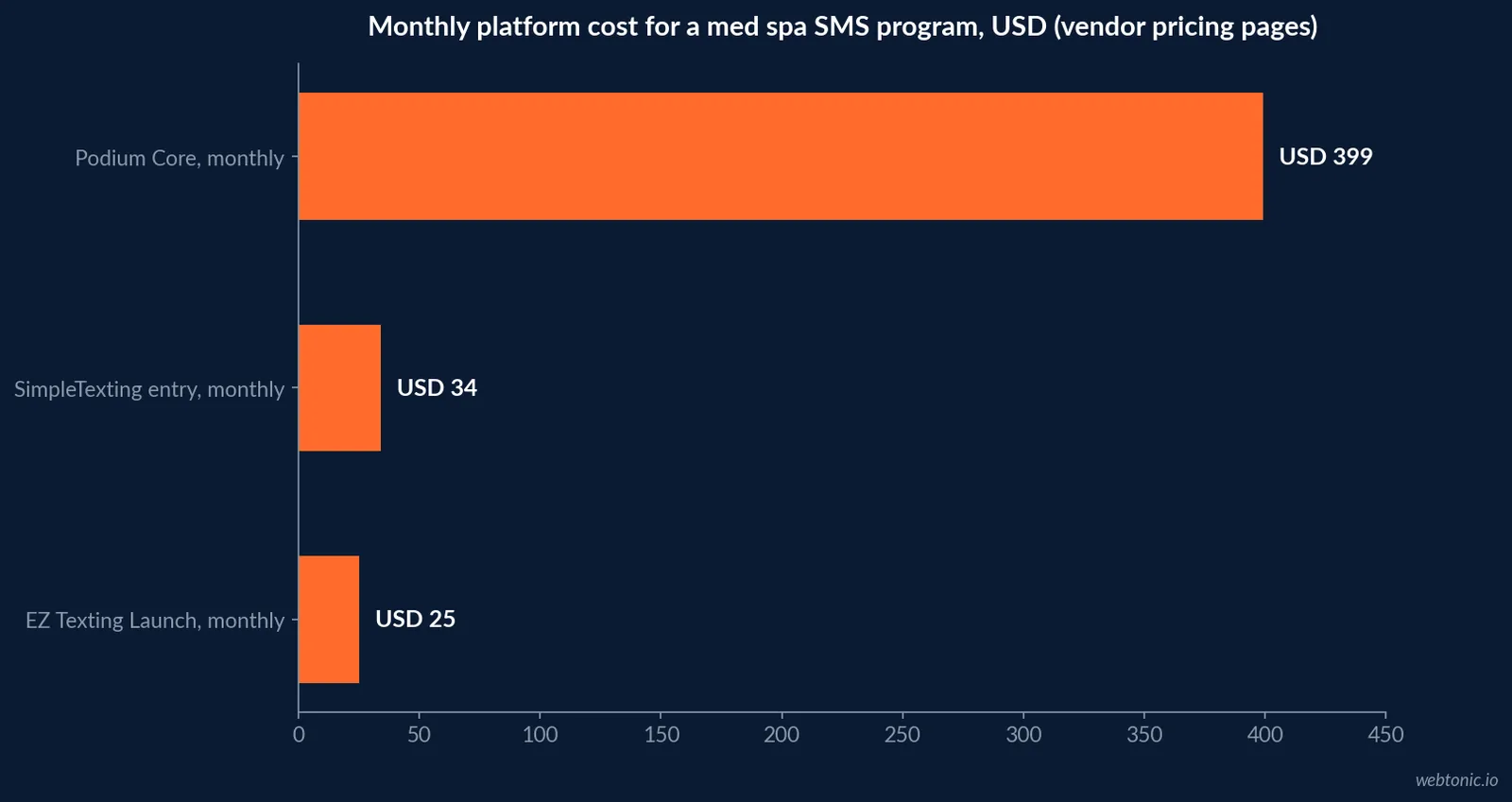
- EZ Texting's entry plan starts at USD 25 a month for up to 500 contacts.
- SimpleTexting's entry tier runs USD 29 to 39 a month for 500 credits.
- Podium's Core plan is USD 399 a month, bundling reviews and payments with texting.
- Klaviyo's SMS click rate benchmarks run 8.9% to 14.9% across its customer base.
- SMS conversion benchmarks run 1.2% to 2.2%, same Klaviyo source.
- HIPAA's Privacy Rule (45 CFR 164) allows treatment-related reminders without a separate authorization in most cases.
- Standard SMS is unencrypted, which is why most compliant reminders omit treatment detail.
- 10DLC brand registration costs USD 4.50 for a for-profit business, per The Campaign Registry's fee schedule.
- A2P marketing campaign vetting costs USD 10.00 one time, same source.
- Telemarketing texts are barred before 8 a.m. or after 9 p.m. local time under 47 CFR 64.1200.
The no-show number that sets the baseline
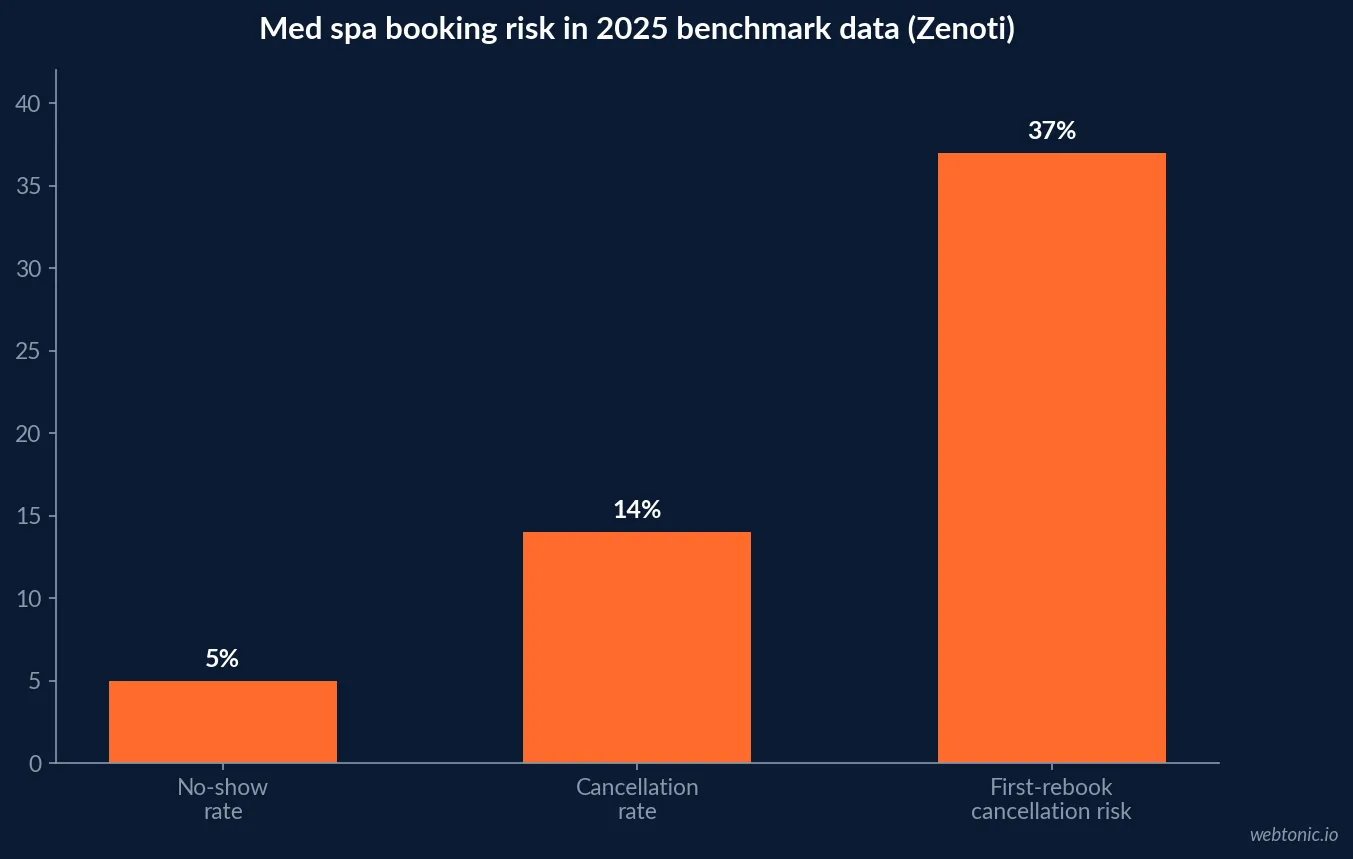
Zenoti's 2026 med spa benchmark analysis, drawn from its 2025 data covering more than 30,000 businesses, puts the medical spa no-show rate at 5% and the cancellation rate at 14%, both improved roughly one to two percentage points from the prior year as more practices added deposits and reminder sequences. Medical spas run the highest no-show rate of any wellness category Zenoti tracks - higher than day spas, hair salons or nail salons - which the source attributes partly to longer average booking lead times for aesthetic treatments.
A 5% no-show rate on a fully booked injector or laser schedule is not trivial: each missed slot is chair time that often cannot be filled same-day. That is the loss an SMS reminder sequence is priced against, not an abstract "engagement" metric.
| Wellness category | No-show rate (2025 data) | YoY change | Source |
|---|---|---|---|
| Medical spa | 5% | -1pp | Zenoti 2026 benchmark report |
| Med spa cancellation rate | 14% | -2pp | Zenoti 2026 benchmark report |
| First-rebook cancellation risk | 37% | Highest-risk booking stage | Zenoti 2026 benchmark report |
What an SMS reminder program is claimed to do about it
EZ Texting's own med spa use-case page states that a three-touch automated reminder sequence - at 48 hours, 24 hours and 2 hours before the appointment, with a one-tap confirm or reschedule - cuts no-shows 25% to 40%. That figure comes from EZ Texting's own customer base rather than an independent audit, so it should be read as a vendor-reported range to validate against a spa's own before/after numbers, not as a guaranteed outcome.
Applied to a 5% baseline no-show rate, even the low end of that range (a 25% reduction) would bring no-shows down to roughly 3.75% of booked slots - a small percentage move that still recovers real chair time across a busy monthly schedule.
| Reminder step | Timing | Purpose | Source |
|---|---|---|---|
| First reminder | 48 hours before | Confirm or trigger early reschedule | EZ Texting med spa use case |
| Second reminder | 24 hours before | One-tap confirm/reschedule link | EZ Texting med spa use case |
| Final reminder | 2 hours before | Last chance to fill the slot if cancelled | EZ Texting med spa use case |
| Claimed outcome | n/a | 25-40% fewer no-shows (vendor-reported) | EZ Texting med spa use case |
What the channel costs, per message and per month
At the carrier level, Twilio's own US pricing page lists USD 0.0083 per segment, sent or received, plus a phone number fee from USD 1.15 a month. Most med spas do not build on raw API pricing; they buy a platform. EZ Texting's Launch tier starts at USD 25 a month for up to 500 contacts, and SimpleTexting's published entry tier runs USD 29 to 39 a month for 500 credits plus a one-time carrier registration fee. Practices that also want reviews and payments in one inbox often price up to Podium's Core plan at USD 399 a month.
| Vendor | Entry price | What it covers | Fit for a med spa | Source |
|---|---|---|---|---|
| Twilio (raw API) | USD 0.0083/segment | Just the message | Only if you build your own reminder logic | Twilio pricing |
| EZ Texting | USD 25/mo | 500 contacts, healthcare use-case templates | Small single-location spa | EZ Texting pricing |
| SimpleTexting | USD 29-39/mo | 500 credits, appointment workflows | Small to mid spa | SimpleTexting pricing |
| Podium | USD 399/mo | Texting + reviews + payments inbox | Multi-provider spa wanting one system | Podium pricing page |
The HIPAA limit most spas get wrong
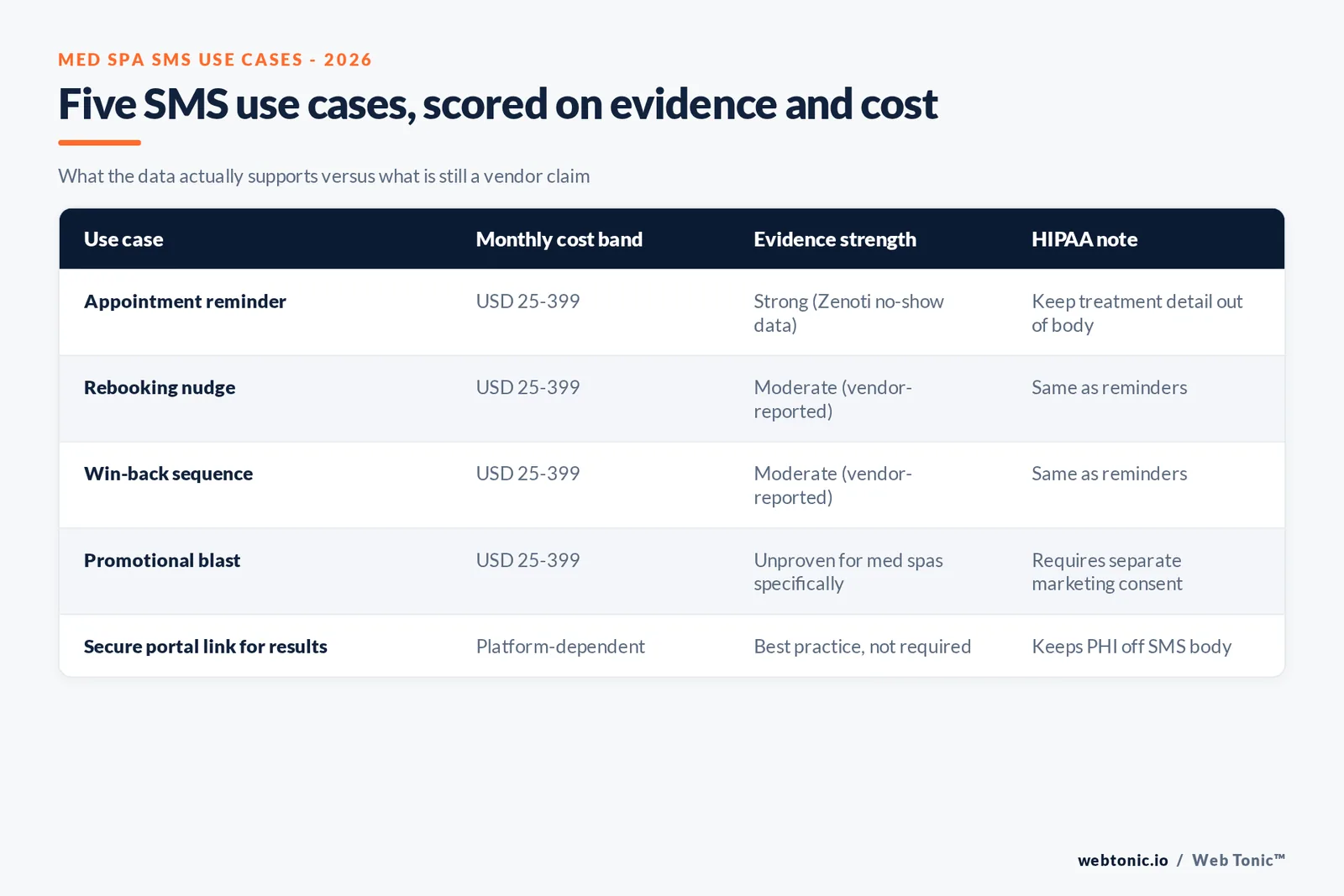
Appointment reminders are generally allowed under the HIPAA Privacy Rule without a separate patient authorization, because they support treatment. But standard SMS is unencrypted, and 45 CFR Part 164 still requires reasonable safeguards for protected health information. In practice that means a compliant reminder states a date, time and a generic business name and callback number, and avoids naming the treatment, injector, or diagnosis in the message body - a phone left unlocked on a counter should not reveal what the visit is for. Practices that want a fuller message (photo of results, treatment-specific aftercare) generally route that through a secure patient portal link instead of the SMS body itself.
Building a reminder sequence that stays HIPAA-safe
A workable three-touch sequence for a med spa reads close to a transactional notification rather than a marketing message: a 48-hour text naming only the date and time with a confirm/reschedule link, a 24-hour follow-up repeating the same detail, and a 2-hour final nudge. None of the three needs to name the treatment, the provider, or the reason for the visit to be effective - the scheduling detail alone is what drives the confirm-or-reschedule action, and keeping treatment detail out of the body is what keeps the message inside HIPAA's safe-harbor framing for incidental disclosure.
Practices layering promotional content - a seasonal offer, a loyalty reward - onto the same number should send those as a separate opted-in campaign registered as a distinct 10DLC use case, not blended into the transactional reminder thread, which several vendors flag as a compliance and deliverability risk.
| Message field | Reminder text (HIPAA-safe) | Avoid in the body | Why |
|---|---|---|---|
| Business name | Generic practice name | Provider's individual name if it signals a specialty | Reduces incidental disclosure risk |
| Date/time | Full detail | n/a - required for the reminder to work | Core function of the message |
| Treatment type | Omit | Naming the procedure or condition | Visible to anyone who reads the phone |
| Action link | Confirm/reschedule link | A link requiring login with PHI pre-filled in the URL | URL parameters can leak PHI |
Comparing med spa SMS to the retail benchmarks it gets compared against
Vendors selling into ecommerce often use retail SMS benchmarks as a stand-in for every vertical, including med spas. Retail-sector SMS campaigns optimize for click-through on a discount code; a med spa reminder optimizes for a confirm-or-reschedule action, which is a different behavior entirely and is not captured by a click-rate benchmark at all. Spas should track confirm-rate and no-show rate directly rather than importing a retail click-rate target that measures a different action.
For a broader look at how SMS engagement is benchmarked outside healthcare, see the cross-industry SMS marketing statistics hub, and for the cost side of a practice's broader digital marketing mix, our Facebook Ads pricing guide covers the paid acquisition channel most spas run alongside SMS retention.
Where the evidence runs out
Nobody publishes a controlled study isolating med-spa promotional SMS blasts as the cause of higher repeat bookings. The evidence this page can stand behind is narrower: no-shows are a documented, quantified cost (Zenoti), reminders are cheap to send (Twilio, EZ Texting, SimpleTexting), and a vendor reports a meaningful reduction from a reminder sequence specifically, not from marketing content. If a spa wants to run promotional SMS beyond reminders, treat it as a test with its own opt-in list and its own before/after measurement, and register the 10DLC campaign as a Marketing use case rather than folding it into a transactional reminder campaign, which carriers can flag and throttle if the content mixes both.
Our growth marketing team builds that kind of test plan around a spa's actual booking data rather than an industry-wide claim. Practices comparing SMS against other retention channels can also read our data and analytics practice overview for how we track confirm-rate and no-show data alongside paid acquisition.
Frequently Asked Questions
Is SMS marketing worth it for a med spa?
On the numbers available, yes for reminders and rebooking, with a caveat on promotional blasts. Zenoti's 2025 benchmark data across 30,000-plus businesses puts the medical spa no-show rate at 5%, the highest of any wellness category it tracks, down from higher levels the year before as more practices added deposits and reminders. A reminder text costs a fraction of a cent in carrier fees (Twilio: USD 0.0083 a segment) against a lost treatment slot that can run into hundreds of dollars. The 'worth it' case for pure promotional texting is weaker: no publisher study isolates a med-spa-specific lift from marketing blasts, so treat that use case as unproven until you run your own A/B test.
What is a normal no-show rate for a med spa to benchmark against?
Zenoti's 2025 data puts the medical spa average no-show rate at 5%, with cancellation rates around 14 to 16%. Regulr's benchmark framing treats under 8% as excellent, 8-12% as good, 12-17% as average, and above 17% as needing intervention. If a spa's no-show rate sits above roughly 8%, the math for adding automated SMS reminders is favorable before any other change.
How much does an SMS reminder cost per patient?
The carrier-level cost is trivial: Twilio prices outbound and inbound SMS at USD 0.0083 per segment. The real cost is the platform: EZ Texting's Launch plan starts at USD 25 a month for up to 500 contacts, SimpleTexting's entry tier starts near USD 29-39 a month for 500 credits, and healthcare-specific platforms like Weave price higher because they bundle HIPAA-oriented workflows, phone and payments into the same system rather than selling raw texting.
Are text appointment reminders HIPAA compliant?
They can be, with limits. Under the HIPAA Privacy Rule (45 CFR Part 164), covered entities may send appointment reminders without a specific authorization because reminders fall under treatment-related communication, but HIPAA guidance on limited-detail voicemail and message content (45 CFR 164.522(b)) means a text should avoid stating the treatment type or provider name where it could reveal sensitive health information to someone else who reads the recipient's phone. Standard SMS is not encrypted, so most HIPAA-focused vendors either use a secure patient-facing portal link or keep the text itself limited to a date, time and a callback number.
Does adding SMS actually reduce no-shows, or is that a vendor claim?
It is a vendor claim backed by directional data rather than an independent controlled study. EZ Texting's own healthcare use-case page states that automated reminder sequences at 48 hours, 24 hours and 2 hours before an appointment, with a one-tap confirm or reschedule, cut no-shows by 25-40% - a figure EZ Texting reports from its own customer base, not from a third-party audit. Treat it as a vendor-reported range, worth testing against your own baseline rather than assuming it will transfer exactly.
Sources
Zenoti - Medspa Cancellation Rate: 2026 Benchmarks
EZ Texting - SMS marketing for med spas
Twilio - US SMS pricing
EZ Texting - pricing
SimpleTexting - pricing
Podium - Pricing
Klaviyo Help Center - SMS click rate benchmarks
HHS.gov - Are appointment reminders allowed under HIPAA without authorization? (FAQ 286)
eCFR - 45 CFR Part 164
The Campaign Registry - TCR Fees and Pricing
eCFR - 47 CFR 64.1200