Table of contents

A med spa can put an ad on streaming TV for a USD 500 lifetime budget, but no public study reports a med-spa CPM, completion rate or return on CTV. The honest budget answer is the set of entry points the platforms publish, the pricing models behind them and the share lost to invalid traffic.
Key Takeaways
- Roku Ads Manager campaigns need a lifetime budget of USD 500 or more.
- Roku says USD 500 to 1,000 is enough for most first-time advertisers to start learning.
- MNTN markets small-business entry from USD 2,000 and states no minimums.
- Tatari cites self-serve TV starts from USD 5K.
- Amazon recommends USD 10K for self-service streaming TV and requires USD 50K managed.
- AmSpa counted 10,488 US med spas in 2023, up from 8,899.
- Average med spa revenue reached USD 1,398,833 in 2023.
- Invalid traffic was 21% of global open programmatic CTV in Q4 2025 (Pixalate).
- Streaming held 48.6% of US TV time in May 2026, up from 44.8% a year earlier (Nielsen).
The published entry points
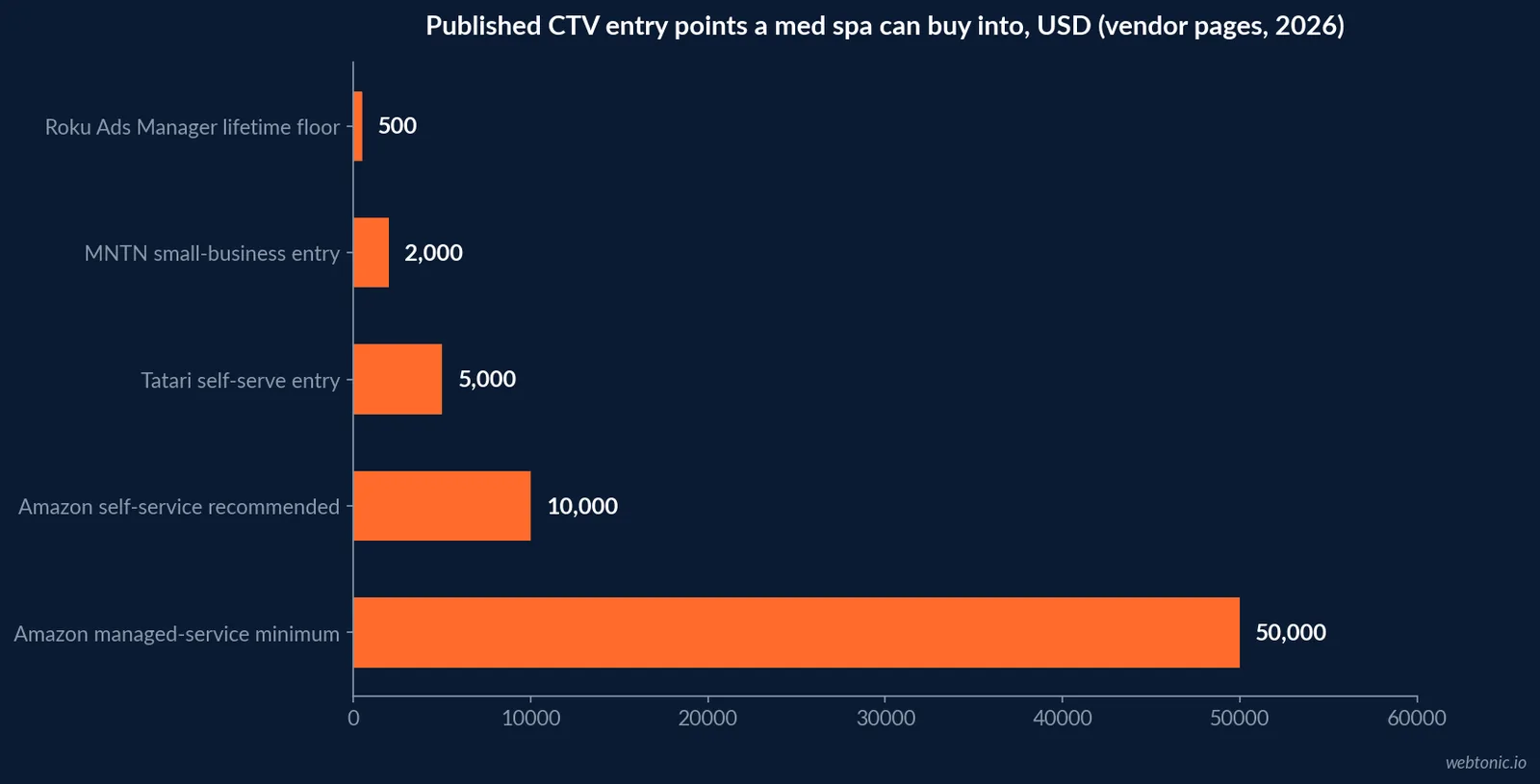
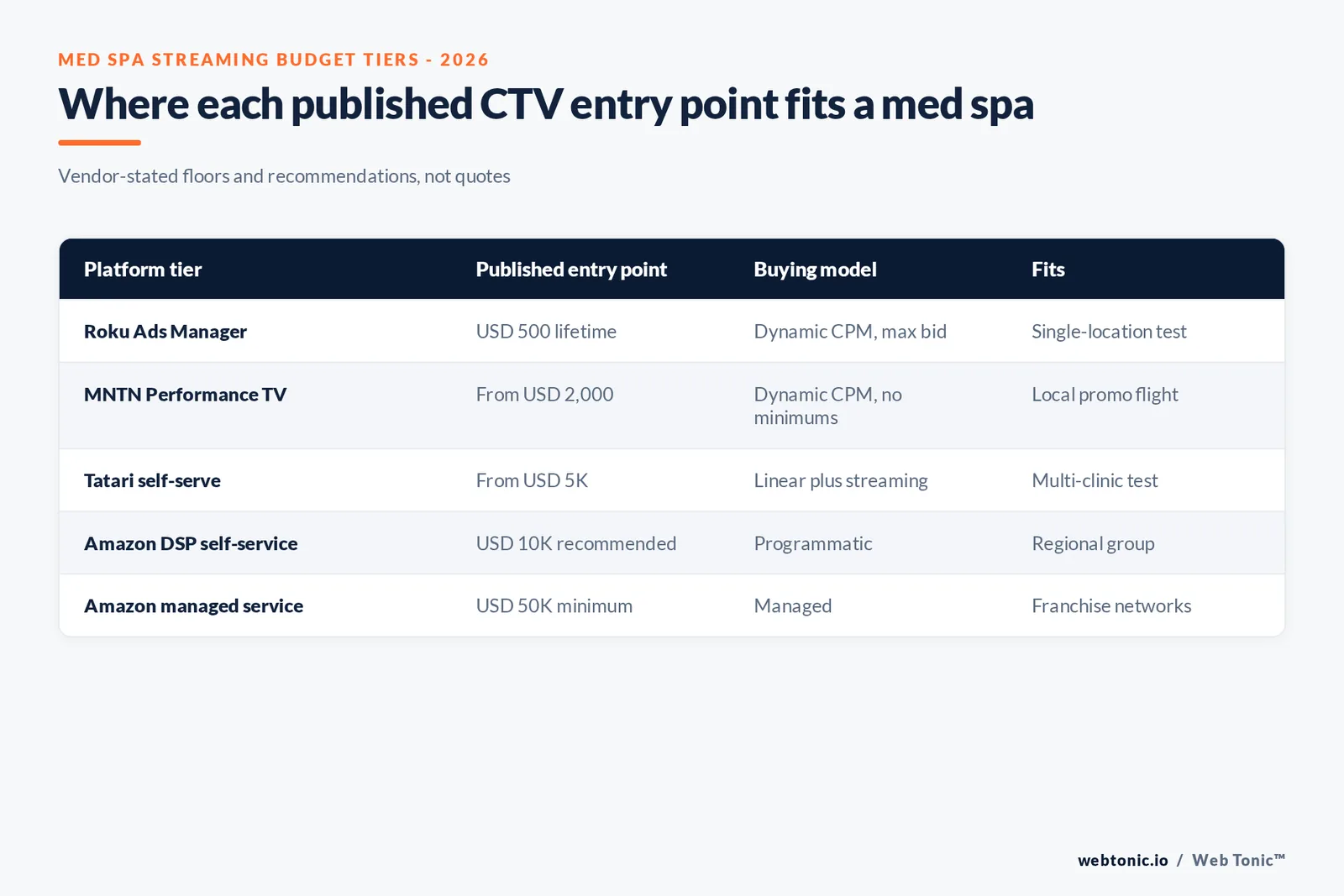
Budget floors come straight from the platforms. Roku's help center requires lifetime budgets of USD 500 or more, and its pricing guide says USD 500 to 1,000 gets most first-time advertisers live with meaningful data. MNTN says any small business can run for as little as USD 2,000. Tatari cites self-serve campaigns from USD 5K. Amazon Ads recommends a USD 10K campaign minimum for self-service streaming TV and requires USD 50K for managed service.
| Platform | Published entry point | Pricing model | Where it is stated |
|---|---|---|---|
| Roku Ads Manager | USD 500 lifetime minimum | Dynamic CPM, optional max bid | Roku help center |
| MNTN Performance TV | As little as USD 2,000 | Dynamic CPM, no minimums | MNTN site |
| Tatari self-serve | As little as USD 5K | Linear and streaming | Tatari insights |
| Amazon streaming TV, self-service | USD 10K recommended | Amazon DSP | Amazon Ads |
| Amazon streaming TV, managed | USD 50K minimum | Managed service | Amazon Ads |
How CTV pricing actually works
Neither Roku nor MNTN publishes a fixed rate card. MNTN's help center describes a dynamic CPM model where the advertiser sets a budget and goal and pays for ads served. Roku's guide says pricing adjusts with audience demand and inventory, bills on delivery and lets advertisers cap CPM with a maximum bid. A med spa's cost per thousand households therefore depends on how narrow the geography is and who else is bidding for the same homes.
For a cross-industry reference, Tatari's client data from 2019 to 2023 put streaming CPMs at about USD 9.50 against USD 2.50 for linear, noting its own rates sit below programmatic market rates. That is one buyer's data, not a med spa benchmark.
| Cost factor | What the platforms say | Effect on a med spa budget |
|---|---|---|
| Dynamic CPM | Price moves with demand and inventory | No fixed cost per household |
| Maximum bid | Roku lets advertisers cap CPM | Protects a small test |
| Billing on delivery | Roku bills only delivered spend | Underdelivery costs nothing |
| Geography | Narrow targeting shrinks available inventory | Small ZIP sets can raise CPM |
| Supply path | Direct deals beat open programmatic per Tatari | Ask where ads actually run |
Why prices in the auction keep moving
Dynamic CPMs respond to how much money is chasing streaming inventory, and that pool is growing. IAB's 2025 Digital Video Ad Spend report estimated US CTV ad spend at USD 26.6 billion for 2025, up 13% and 43% larger than online video. Its 2026 edition projects total digital video past USD 80 billion, with CTV growing 11% and social video 13%, the first time social video has outpaced CTV in IAB's series.
For a med spa, this is context rather than a cost forecast. National brands dominate those totals and bid mostly on broad audiences, while a clinic bids on a handful of ZIP codes. Seasonal peaks still matter: holiday and major sports periods pull more advertisers into the same auctions, which is when a maximum-bid cap on a small local test does the most work. Nielsen's January 2026 report, for example, came after a December in which streaming set a record share of TV time, and aesthetics demand around the New Year and pre-summer windows will overlap with those crowded auctions.
| IAB market signal | Figure | Report | Read-across for a clinic |
|---|---|---|---|
| US CTV ad spend, 2025 estimate | USD 26.6 billion | IAB 2025 video report | Large pool, national buyers |
| CTV growth, 2025 | 13% | IAB 2025 video report | Demand for inventory rising |
| US digital video ad spend, 2026 | More than USD 80 billion | IAB 2026 video report | Video budgets still expanding |
| CTV growth, 2026 projection | 11% | IAB 2026 video report | Slower than social video |
| Social video growth, 2026 projection | 13% | IAB 2026 video report | Competes for the same video budget |
The size of the med spa market
The American Med Spa Association describes an industry that has eclipsed USD 17 billion and grows by more than USD 1 billion a year. Its 2024 report recap counts 10,488 med spas in 2023, up from 8,899 in 2022, with average annual revenue up from USD 1,307,587 to USD 1,398,833. More locations competing for the same patients is the backdrop for any awareness channel.
| AmSpa metric | 2022 | 2023 | Change |
|---|---|---|---|
| US med spa locations | 8,899 | 10,488 | About +18% |
| Average annual revenue per med spa | USD 1,307,587 | USD 1,398,833 | About +7% |
| Industry revenue | - | USD 17 billion-plus | More than USD 1 billion a year growth |
Budget as a share of clinic revenue
Using AmSpa's average revenue as the denominator, simple arithmetic shows scale: a USD 500 Roku test is about 0.04% of USD 1,398,833, a USD 10K Amazon self-service campaign about 0.7%, and a USD 50K managed campaign about 3.6%. These are our calculations on AmSpa's average, not survey data about what med spas actually spend on TV, and no issuer we could verify publishes a med spa marketing budget share for CTV.
| Published entry point | Amount | Share of average 2023 med spa revenue | Basis |
|---|---|---|---|
| Roku lifetime minimum | USD 500 | About 0.04% | Our arithmetic on AmSpa average |
| MNTN small-business entry | USD 2,000 | About 0.14% | Our arithmetic on AmSpa average |
| Tatari self-serve entry | USD 5,000 | About 0.36% | Our arithmetic on AmSpa average |
| Amazon self-service recommended | USD 10,000 | About 0.7% | Our arithmetic on AmSpa average |
| Amazon managed minimum | USD 50,000 | About 3.6% | Our arithmetic on AmSpa average |
The hidden cost: invalid traffic
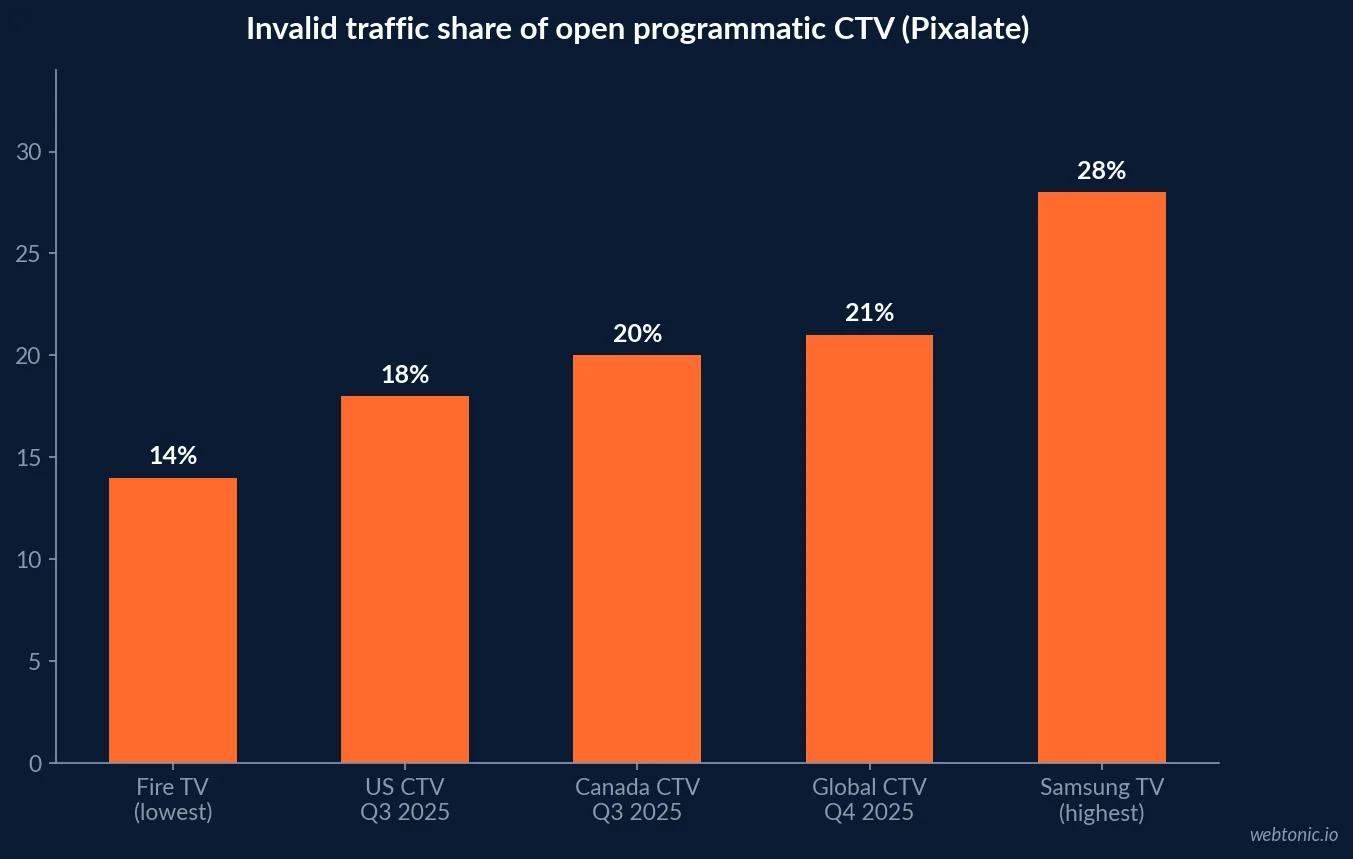
Part of any CTV budget can go to impressions no person saw. Pixalate's Q4 2025 CTV supply chain report measured 21% invalid traffic across global open programmatic CTV, from 14% on Amazon Fire TV to 28% on Samsung Smart TV. Its Q3 2025 North America benchmark put US CTV at 18% and Canada at 20%. Pixalate sells fraud protection, so it is a vendor source, and the numbers apply to open programmatic supply rather than direct publisher deals.
Where the audience is
Nielsen's May 2026 Gauge put streaming at 48.6% of total TV watch time, up from 44.8% a year earlier, with YouTube leading distributors at 13.8%. Nielsen measures viewing time across all households, so it shows where attention sits rather than how any ad performs. None of this is broken out for aesthetics patients, and Nielsen does not publish viewing by treatment interest, so a clinic has to rely on geography and household demographics offered by the platforms rather than a measured aesthetics audience.
Compliance costs that belong in the budget
Creative for a med spa carries legal review time. HIPAA's 45 CFR 164.508 requires a covered entity to get authorization before using protected health information for marketing, which covers identifiable patient photos and stories. The FTC's Endorsement Guides require typical-results disclosure when a testimonial shows unusual results, and its Health Products Compliance Guidance says health-benefit claims generally need randomized, controlled human clinical testing.
| Rule | Requirement | What it means for a CTV spot |
|---|---|---|
| 45 CFR 164.508 | Authorization before PHI is used for marketing | Signed consent for any patient featured |
| 16 CFR 255 | Typical results disclosed for atypical testimonials | On-screen disclosure with before-and-after |
| FTC Health Products Guidance | Competent and reliable scientific evidence | No unsupported treatment claims |
What the data cannot tell you
No verified public source reports med spa CTV completion rates, cost per booked consultation or return on ad spend. Vendors publish case studies, but without sample size and measurement windows they are anecdotes. What the evidence supports is that entry is cheap, that pricing is auction-based, that a fifth of open programmatic supply can be invalid and that patient-facing creative needs authorization and disclosure work before it airs. Treat those four facts as the fixed inputs and your own booking data as the variable that decides whether a second flight is worth buying.
How to stage the spend
- Run a first flight at a published floor in the ZIP codes around one clinic.
- Set a maximum CPM bid so the test cannot overspend on a narrow audience.
- Send viewers to a dedicated booking page and phone number.
- Request device and app delivery reports and exclude supply with high invalid traffic.
- Only move to a USD 10K-plus tier after the first flight shows booking lift against unexposed areas.
- Clear patient authorizations and disclosures before any testimonial airs.
For more context, see our streaming media statistics, the med spa SMS marketing data for converting the enquiries TV generates, the wider advertising statistics roundup, and our data intelligence practice for measuring lift by ZIP code.
Frequently Asked Questions
How much should a med spa budget for CTV advertising?
There is no med-spa-specific benchmark. Published entry points are the best guide: Roku Ads Manager requires at least USD 500 per campaign and says USD 500 to 1,000 is enough for most first-time advertisers to gather data, MNTN markets entry from USD 2,000, Tatari cites self-serve starts from USD 5K, and Amazon recommends USD 10K for self-service and requires USD 50K for managed streaming TV.
What is the CPM for med spa streaming ads?
No verified dataset reports a med spa CTV CPM. Roku and MNTN both price on dynamic CPM, so the rate moves with audience demand and inventory. Tatari's own client data put streaming CPMs at about USD 9.50 against USD 2.50 for linear between 2019 and 2023, which is a cross-industry reference only.
Can a med spa use patient before-and-after photos in a TV ad?
Only with care. Under HIPAA, 45 CFR 164.508 requires a patient's written authorization before protected health information is used for marketing. The FTC's Endorsement Guides and Health Products Compliance Guidance also require typical-results disclosure when a testimonial shows results most patients will not get.
How much of a CTV budget can be lost to invalid traffic?
Pixalate measured 21% invalid traffic on global open programmatic CTV in Q4 2025 and 18% in the US in Q3 2025, ranging from 14% on Amazon Fire TV to 28% on Samsung Smart TV. Direct or curated buys and device-level reporting reduce exposure.
Is CTV worth testing for a single-location med spa?
It can be tested cheaply. AmSpa puts average annual med spa revenue at USD 1,398,833 for 2023, so a USD 500 Roku test is a small share of a typical clinic's revenue. Whether it pays back depends on your own booking data; no public study measures med spa CTV return.
Sources
Roku - Campaign budget and schedule
Roku - How much does it cost to advertise on Roku
MNTN - Go Big small business program
Tatari - Getting started on TV
Tatari - Linear vs streaming CPMs
Amazon Ads - Streaming TV ads
IAB - 2025 Digital Video Ad Spend report
IAB - 2026 Digital Video Ad Spend report
AmSpa - Medical Spa State of the Industry
AmSpa - 2024 executive report recap
Pixalate - Q4 2025 CTV supply chain trends
Pixalate - Q3 2025 North America IVT
Nielsen - May 2026 The Gauge
eCFR - 45 CFR 164.508
eCFR - 16 CFR Part 255
FTC - Health Products Compliance Guidance