



Table of contents

Hiring a marketing leader and buying marketing strategy consulting solve different problems. One builds permanent capability; the other settles the direction that capability is supposed to execute.
Key Takeaways
- Sequence beats comparison. Most companies get better results from a short marketing strategy consulting engagement that defines the mandate, then a hire recruited against it.
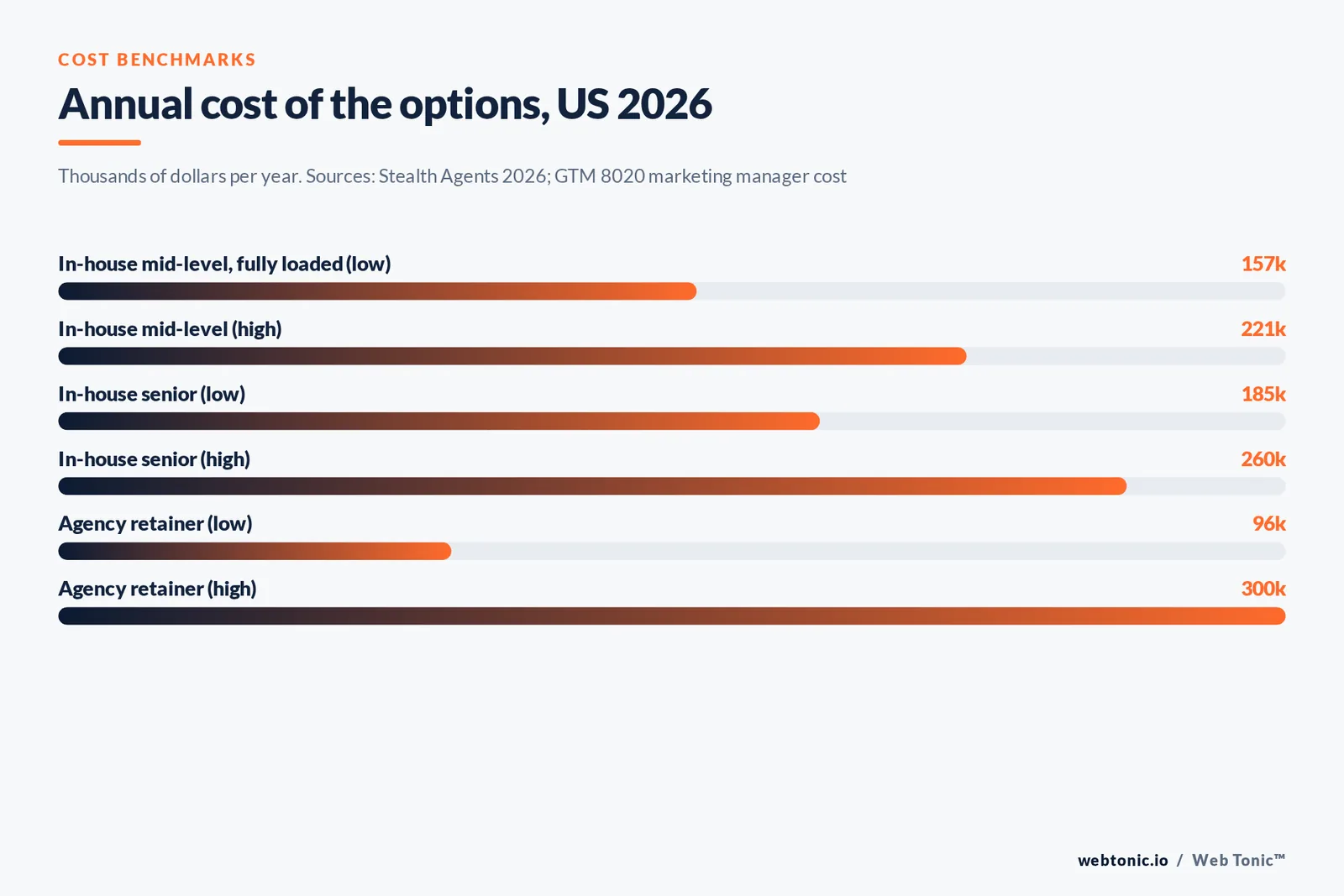
- A hire is a fixed cost with a slow clock: a mid-level in-house marketing manager runs $157,000–$221,000 a year fully loaded, and senior roles $185,000–$260,000.
- Fully loaded cost is the number that matters — benefits, taxes and overhead typically add 40–50% on top of base salary.
- Consulting is a variable cost with a fast clock: strategists commonly bill $150–$300 an hour, and defined projects run $5,000 to $50,000+.
- The evidence says the mandate is usually the gap: only 4% of executives say their value proposition is clear and consistently understood, and firms that have one grew 19% versus 12%.
- Hire when the work is continuous, institutional knowledge matters, and the role is defined. Buy consulting when the question is which direction to take and the answer is needed in weeks.
- Cost per decision, not cost per hour, is the honest comparison — an unfilled or misfilled role costs a quarter of momentum on top of the salary.
The two options are not substitutes
An in-house hire gives you continuous ownership, context that accumulates, and someone accountable in every internal meeting. Consulting gives you concentrated senior judgement for a defined question, with no long-term commitment and no recruitment lag. Comparing them like-for-like on price hides the fact that they deliver different things.
The decision gets easier when you name the gap precisely. If nobody currently owns marketing day to day, that is a capability gap and a hire is likely part of the answer. If someone owns it but the direction keeps changing — new segment every quarter, no agreed message, budget spread across six channels — that is a decision gap, and a new employee will inherit it rather than resolve it.
That distinction is where most of the wasted money sits. Harvard Business Review's research with Egon Zehnder, drawing on more than 500 senior leaders, links stalled growth to unclear priorities and misalignment rather than missing effort. Hiring into an unclear mandate reproduces the problem at a higher fixed cost.
What the hire actually costs
Base salary is the smallest part of the decision. 2026 hiring cost research puts a mid-level in-house marketing manager at $157,000–$221,000 a year all-in, and a senior hire at $185,000–$260,000, against agency retainers of $96,000–$300,000 a year for comparable output. Separate cost analysis puts base salary at $72,000–$142,720 with a fully loaded cost of $110,000–$155,000 once benefits, taxes and overhead are added — a loading of roughly 40–50%.
For leadership roles the load is heavier still. VP of Marketing compensation benchmarks for 2026 show base bands that, once bonus, benefits and search fees are included, put year-one cost well into the mid-six figures. MarketerHire's comparison makes the same point plainly: the gap between advertised salary and fully loaded cost is where in-house budgets break, before tools are counted.
Then there is time. Recruitment, notice periods and ramp routinely consume two quarters before a new leader is making confident calls — a real cost when the plan for the year is already behind.
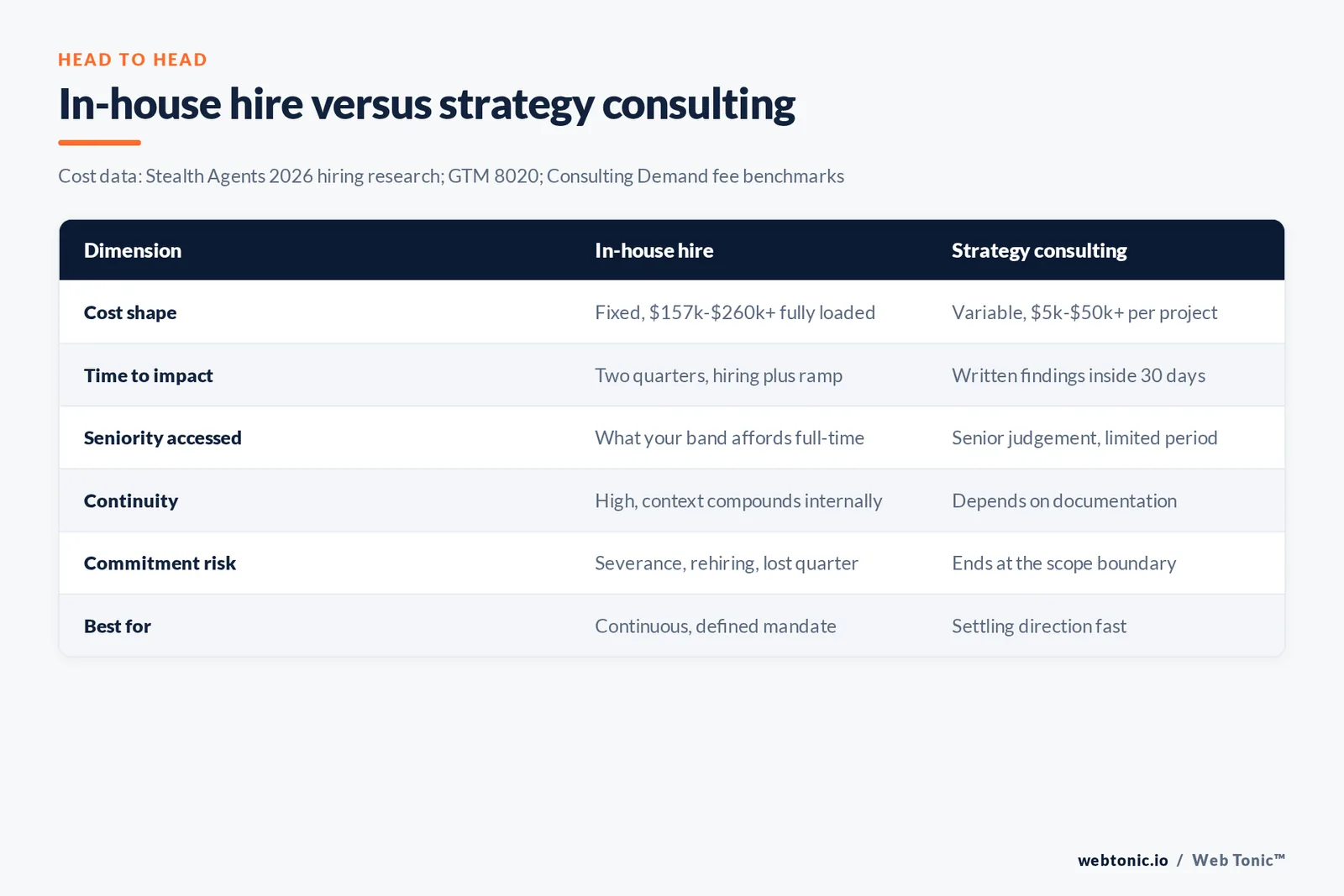
| Dimension | In-house hire | Marketing strategy consulting |
|---|---|---|
| Cost shape | Fixed annual, $157k–$260k+ fully loaded | Variable, $5k–$50k+ per defined project |
| Time to impact | Two quarters including hiring and ramp | Written findings inside 30 days |
| Seniority accessed | What your band affords full-time | Senior judgement for a limited period |
| Continuity | High — context compounds internally | Depends on documentation and handover |
| Commitment risk | Severance, rehiring, lost quarter | Ends at the scope boundary |
| Best for | Continuous ownership of a defined mandate | Settling direction and priorities fast |
What the consulting engagement costs
Published rates are wide because the label spans strategy and execution. Fee data by industry puts marketing strategists at $150–$300 an hour, execution specialists at $75–$175, and the all-marketing survey average at about $142. A 2026 rate report shows $50–$500 an hour with project fees of $5,000 to $50,000+, and independent rate data puts the global median near $188 an hour.
The comparison that matters is cost per decision. A 90-day engagement that settles the segment, the price policy and the funded channels for a business spending $1m a year on marketing is a small fraction of the budget it governs. The same fee against a $60,000 budget is hard to justify — at that scale, buy a narrower audit or a specialist repair.
Why the mandate has to exist before the hire
A job description is a strategy document in disguise. "Own growth marketing" tells a candidate nothing about which segment, which channels or which metric they will be judged on, so interviews turn into a test of general competence and the first six months become a discovery project the company has already paid twice for.
The market evidence is blunt about how often this direction is missing. Bain's 2026 B2B Growth Agenda, based on more than 1,100 senior executives, found 42% of companies missed 2025 revenue targets against 32% in 2024, that only 4% believe their value proposition is strong and consistently understood, and that those who do grew 19% versus 12%. ICP benchmark data adds the cost of vague targeting: a median 31% of B2B SaaS pipeline outside the profile, and CAC payback of 26 months off profile against 14 months on it.
Settle those questions first and the job description writes itself: the segment, the message, the two funded channels, the metric, the budget. Candidates self-select more accurately, interviews get concrete, and the person you hire spends month one executing rather than diagnosing.
The build-or-buy decision in five questions
- Is the work continuous or episodic? Daily channel ownership and team management are continuous. Repositioning, pricing and annual planning are episodic.
- Do you know what you would hire for? If you cannot write the segment, metric and budget into the job description, you are not ready to recruit.
- How fast do you need the answer? Consulting produces written findings within a month; a hire rarely produces confident direction inside two quarters.
- What seniority does the question require? Pricing and portfolio calls need experience your salary band may not buy full-time.
- Who will own the plan afterwards? Every consulting engagement needs an internal owner. If nobody can hold it, hire first and scope the consulting around them.
Two answers point clearly at consulting: episodic work and a fast clock. Two point clearly at hiring: continuous work and an already-defined mandate. Mixed answers usually mean sequence — a short engagement, then the hire.
| Situation | Recommended move | Reasoning |
|---|---|---|
| No marketing owner, unclear direction | Consulting first, then hire | Defines the mandate you recruit against |
| Capable manager, changing priorities | Consulting only | The gap is decisions, not hours |
| Clear plan, no execution capacity | Hire or agency | More analysis will not ship the work |
| Leader just left, plan in flight | Interim or fractional cover | Continuity while the search runs |
| Under $10k monthly marketing spend | Narrow audit, not a full engagement | Fee must stay small against the budget it governs |
How to run both without waste
Where budget allows both, order and scope keep the spend honest. Run the engagement first and require documentation as a deliverable: the ICP, the price policy, the channel plan, the metric tree and the dashboard, each with an owner. Recruit against that document. Then keep a small advisory cadence for one or two quarters while the new hire settles — a monthly review of the metric tree rather than an open retainer.
Insist that knowledge transfer is written into the scope. If the plan lives only in the consultant's head, you will pay for the same thinking again next year. Consulting onboarding practice is a useful minimum standard here: a 60–90 minute kickoff producing a shared goal, an agreed cadence and clear next steps, with everything captured in one place your team can access after the invoice.

Skills, sales alignment and the internal team
Whichever route you take, the plan only works if sales and marketing use the same definitions. Before you compare a strategist's fee to a salary, check whether your organization has a written definition of a qualified lead, an agreed handover point, and one commercial number both teams are judged on. Where those exist, a new hire can build on them; where they do not, an outside strategist can usually get them agreed faster because they have no internal history to defend.
Be honest about the skills mix you actually need for the next four quarters. Positioning, pricing and channel economics are strategic skills used a few times a year. Campaign management, analytics maintenance and content production are operational skills used weekly. Many companies hire a senior strategist and then spend that person's time on weekly operational work, which is the most expensive way to run a calendar. Splitting the two — bought judgement, hired execution — usually produces more impact per dollar for small and mid-sized organizations.
Finally, look at what the choice does to the internal team you already have. A well-scoped engagement gives existing staff clarity and a documented plan to build a career on; an unclear one adds a layer of review meetings. The difference is whether the consultant's mandate is written down, time-boxed and handed over to a named internal owner at the end.
Signals you chose wrong — and what to do
Hired too early: the new leader spends months in discovery, reopens the same strategic questions monthly, and reporting still cannot show which channel produced pipeline. Fix by scoping a short diagnostic alongside them; this supports the hire rather than judging them.
Bought consulting when you needed capacity: the plan is excellent, everyone agrees with it, and nothing has shipped in six weeks. Fix by converting spend into delivery — an internal hire, a freelancer or an agency — and reduce advisory to a monthly review.
Bought both, sequenced badly: a consultant is producing strategy while a new hire is trying to establish authority over the same decisions. Fix immediately by naming the decision owner in writing. Two owners for one decision is slower than none.

Related reading
- Marketing Operations Consulting / RevOps: vs hiring in-house
- Marketing Strategy Consulting Statistics: Hiring vs Outsourcing
- Marketing Audit / Growth Audit: vs hiring in-house
- Marketing Strategy Consulting services at Web Tonic
Frequently Asked Questions
Is consulting cheaper than hiring?
Per year, usually yes, because it is variable and time-boxed. Per hour it is more expensive, and it should be — you are buying senior judgement in concentrated form. Compare cost per decision against the budget the decision governs, not cost per hour.
Can a consultant write the job description for the hire?
That is one of the more valuable outputs. A description grounded in the agreed segment, metric and channel plan attracts candidates who match the actual work, and it gives the new hire a mandate on day one.
What about a fractional marketing leader instead?
Fractional leadership sits between the two: ongoing ownership at part-time cost. It suits companies needing continuous senior direction without a full-time salary, particularly while a permanent search runs.
How small is too small for a strategy engagement?
There is no revenue floor, but there is a spend ratio. If the fee approaches a meaningful share of annual marketing spend, buy a narrower diagnostic — positioning and one channel — rather than a full plan.
How do we protect the investment if the hire leaves?
Documentation and access. The ICP, price policy, plan, metric tree and dashboard should live in shared systems, not in one person's files. Continuity is a contract requirement, not a personality trait.
Where to take this next
If the mandate is not written down yet, define it before you advertise the role. Our marketing strategy consulting engagements produce exactly that document — segments, message, funded channels, metric tree, owners — growth marketing executes against it, the wider services lineup covers delivery, and the blog has more method detail. If you are weighing a hire against an engagement this quarter, talk it through with us.
Sources
Bain & Company — 2026 B2B Growth Agenda survey
Harvard Business Review / Egon Zehnder — Why Some Companies Grow Rapidly While Others Stall
Stealth Agents — Cost of Hiring a Marketing Manager in 2026
GTM 8020 — Marketing Manager Cost Breakdown
GTM 8020 — Marketing Consultant Rates & Comp Report
JRG Partners — VP Marketing Salary Guide 2026
MarketerHire — In-House Marketing vs Agency vs Freelance
Consulting Demand — Consulting Fees & Rates by Industry
Sam Landenwitsch — The 2026 Rate Report
The Starr Conspiracy — ICP Benchmarks for B2B GTM
MyConsultBase — Consulting Client Onboarding Checklist


