



Table of contents
The first 90 days of a marketing strategy engagement should convert your existing data into a plan someone owns. If day 90 arrives without signed decisions, the engagement has produced reading material.
Key Takeaways
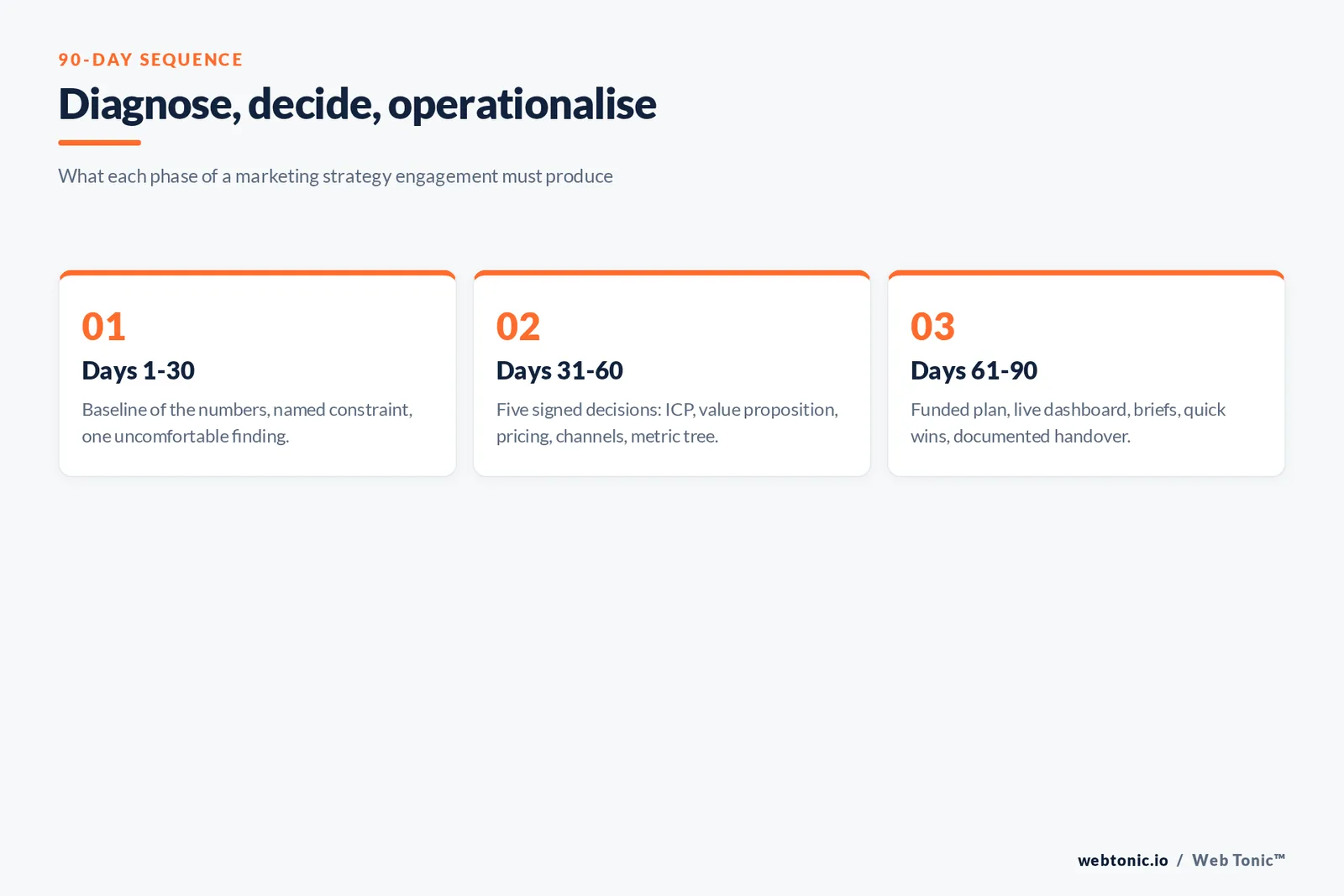
- Three phases, one output: diagnose (days 1–30), decide (days 31–60), operationalise (days 61–90). Marketing strategy consulting that skips phase one is guessing with better slides.
- The kickoff should run 60–90 minutes and produce three things — shared goal, working cadence, immediate next steps. Nothing else belongs in it.
- Aim for a first written finding inside 14 days; onboarding research links time-to-first-value at two weeks or less to engagements that retain well.
- By day 30 you should have a baseline: revenue and margin by segment, cost per qualified opportunity by channel, and one uncomfortable finding you did not already know.
- By day 60 five decisions must be signed: ICP with disqualifiers, value proposition, pricing policy, funded channels with a stop list, and a metric tree.
- Days 61–90 are about execution readiness and handover — owners, dashboard, cadence — not new analysis. Positioning clarity is worth the effort: firms with a clear value proposition grew 19% versus 12%.
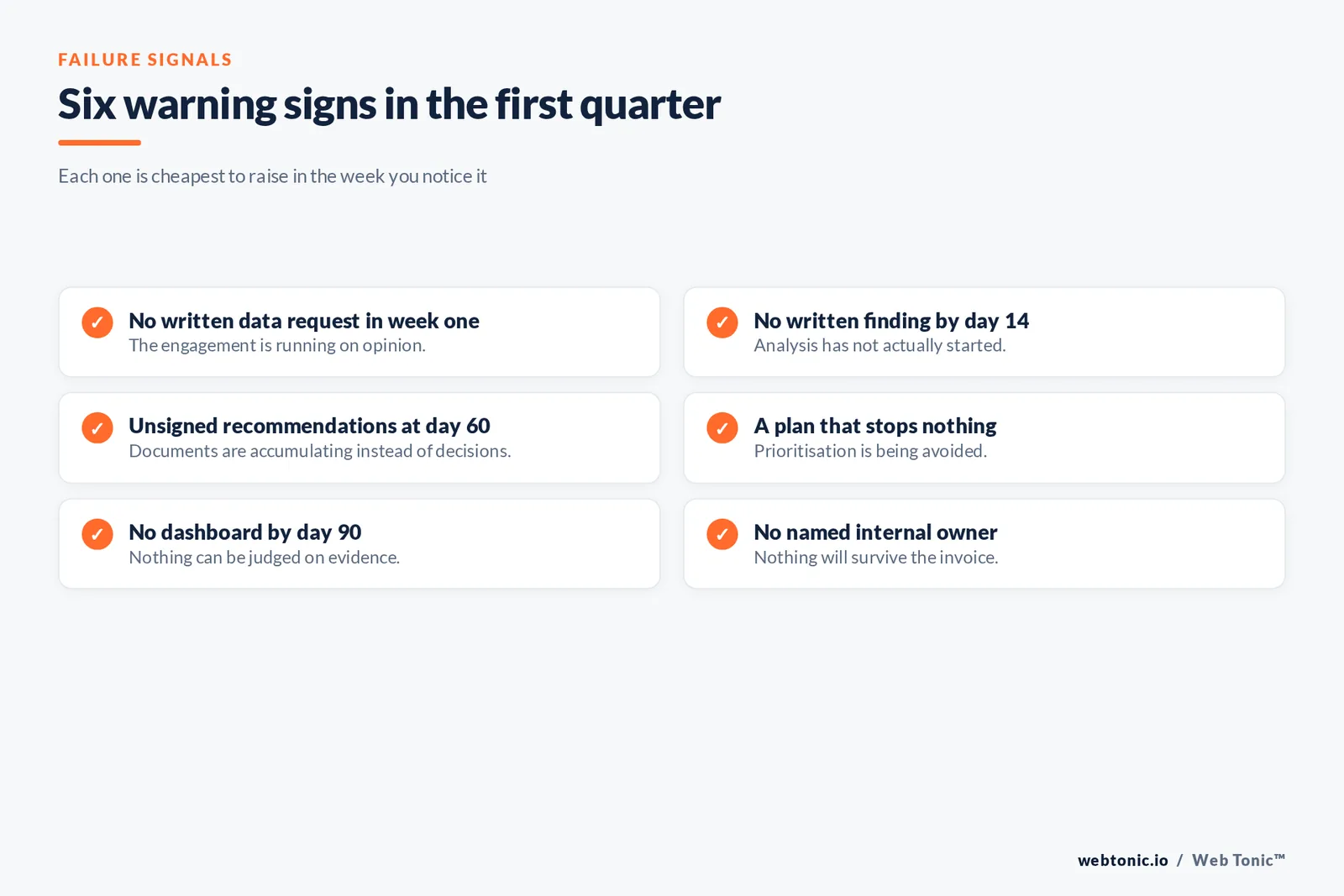
- Watch the failure signals: no data request in week one, no written finding by day 30, unsigned recommendations at day 60, no named owner at day 90.
Week one: access, cadence and the data request
Week one is administrative on purpose. A competent consultant arrives with a written data request — revenue by segment and product, margin where available, CRM export with lead source, win and loss reasons, channel spend and cost per qualified opportunity, pricing and discount history, and the last two quarterly plans. If that request does not exist, the engagement is not evidence-based.
Set the cadence in the same week. Consulting onboarding practice holds the kickoff to 60–90 minutes with three outputs: shared understanding of the goal, agreement on the working cadence, clarity on immediate next steps. Engagement kickoff frameworks add the item most scopes omit — who decides when the consultant and the internal team disagree.
Book the interviews immediately, because calendars are the usual cause of slippage: five to eight customers, two or three lost prospects, the sales team, and whoever owns pricing today. Project kickoff guidance is consistent on this point — the work that gets scheduled in week one is the work that finishes on time.
Days 1–30: diagnose, and say something true
Phase one produces a baseline, not recommendations. Expect revenue and margin by segment, retention or repeat rates, pipeline coverage, cost per qualified opportunity by channel, realised price against list, and an honest note on data quality. Where reporting cannot answer a basic question, that is a finding to fix in this phase: lead source on every record, one definition of a qualified opportunity, one revenue source of truth.
The context explains why the baseline usually surprises people. Bain's 2026 B2B Growth Agenda, based on over 1,100 senior executives across 18 industries, found 42% of companies missed 2025 revenue targets, up from 32%, while 91% stayed confident about the year ahead. Confidence and evidence drift apart quietly, and the first month's job is to close that gap in writing.
One quality test for phase one: does the deliverable contain a finding that is uncomfortable? A baseline that confirms everything leadership already believed has usually been filtered. HBR's work with Egon Zehnder across more than 500 senior leaders traces stalls to unclear priorities and misalignment — which nobody discovers by asking whether the plan feels good.
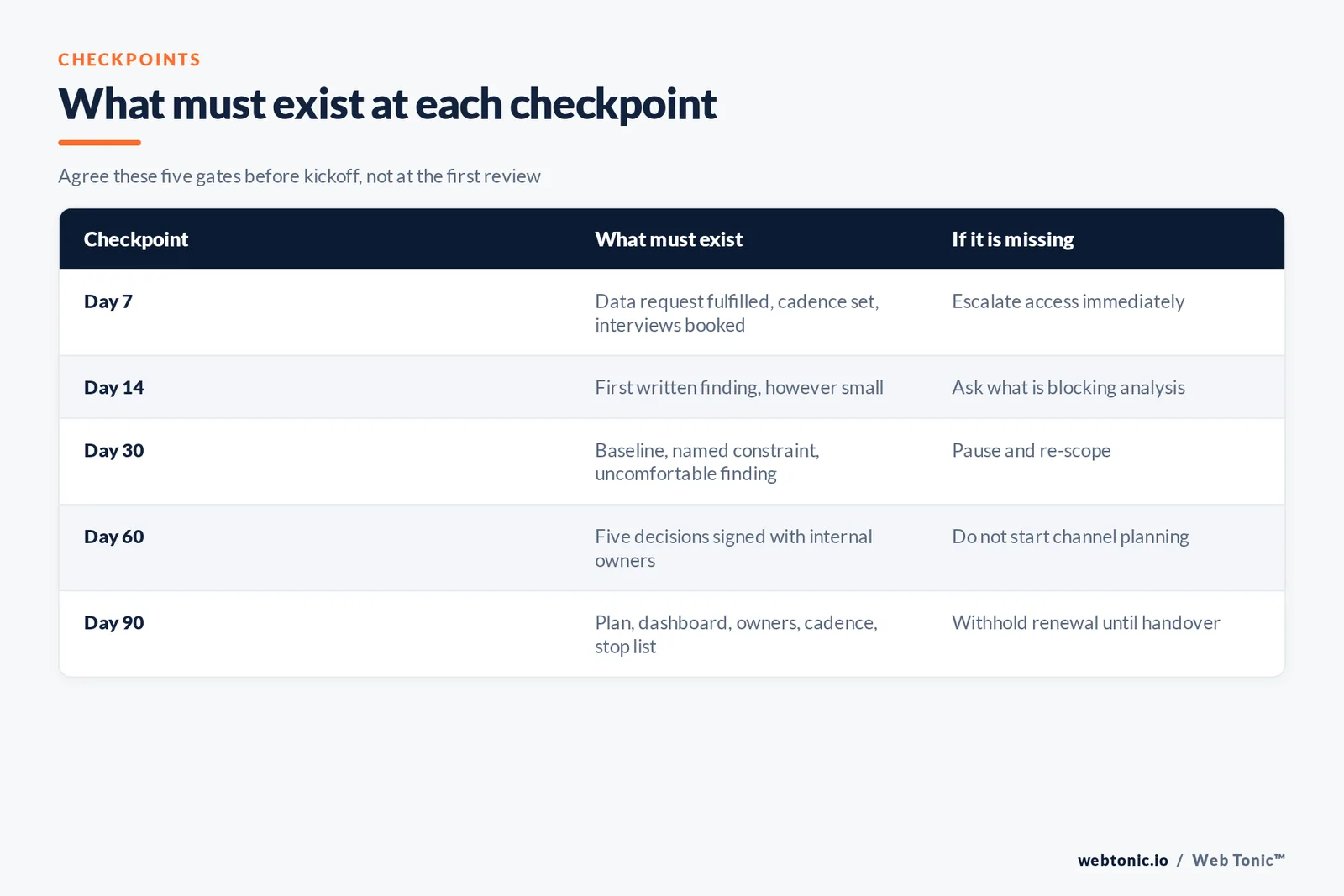
| Checkpoint | What must exist | Owner | If it is missing |
|---|---|---|---|
| Day 7 | Data request fulfilled, cadence set, interviews booked | Internal sponsor | Escalate access; every week of delay moves day 90 |
| Day 14 | First written finding, however small | Consultant | Ask what is blocking analysis, in writing |
| Day 30 | Baseline, named constraint, one uncomfortable finding | Consultant + sponsor | Pause and re-scope before phase two |
| Day 60 | Five decisions signed with internal owners | Internal sponsor | Do not proceed to channel planning |
| Day 90 | Plan, dashboard, owners, review cadence, stop list | Internal owner | Withhold renewal until handover is complete |
Days 31–60: five decisions, signed
Phase two is where value is created or lost, because analysis converts into policy. Five decisions must end the phase in writing, each with a named internal owner who can defend it in a sales meeting.
- ICP with disqualifiers. Not a persona document — a list of who you decline. Benchmark data puts the win-rate lift from a defined profile at 68%, with payback of 14 months on profile against 26 months off it, and a median 31% of pipeline off profile.
- Value proposition and messaging. One hierarchy sales, marketing and leadership use unchanged. Only 4% of executives believe theirs is strong and consistently understood.
- Pricing and discount policy. Including who approves exceptions. McKinsey analysis values a 1% price improvement at roughly 8.7% of operating profit, and it shows up on the next cohort of deals.
- Two or three funded channels and a stop list. The stop list is the part that creates capacity.
- Metric tree. The revenue target broken into four or five drivers, each with a baseline and an owner.
Efficiency, not effort, is what these decisions buy. SBI Growth's study of 300 mid-market firms found leaders returning $0.71 of growth per commercial dollar against $0.54 for the market, while Benchmarkit's 2025 data puts median CAC at $2.00 per $1.00 of new ARR, up 14% year over year.
Days 61–90: make it executable, then hand it over
Phase three should feel less intellectual and more operational. The plan gets budgets, owners and dates. The dashboard goes live with the metric tree on it. Briefs are written for whoever executes — internal team, freelancers or an agency. Two or three quick wins ship, chosen because they are cheap and reversible, not because they are impressive. Each one should help a real customer problem move — a clearer offer page, a faster response step in the sales process, a segment-specific piece of content — so that building momentum and building the plan happen at the same time.
Published 90-day roadmaps follow the same arc: one public consulting roadmap runs diagnosis, then an experiment engine over days 46–75 with weekly tests and documented learnings, then scale and handoff over days 76–90 with playbooks, QA and cadence. Onboarding templates describe the same logic for the client relationship: setup and first deliverable in 30 days, stabilisation by 60, and proof worth renewing by 90.
Handover is the deliverable people forget to demand. By day 90 you should hold the plan, the decision log, the dashboard, the briefs and a named internal owner for each number. If all of that lives in the consultant's files, you will pay for the same thinking next year.
| Phase | Days | Primary output | Success test |
|---|---|---|---|
| Diagnose | 1–30 | Baseline and named constraint | One finding leadership did not already know |
| Decide | 31–60 | Five signed decisions with owners | Sales can state the ICP and message unprompted |
| Operationalise | 61–90 | Funded plan, dashboard, briefs, quick wins | Work is shipping without the consultant in the room |
| Handover | 85–90 | Decision log, documentation, review cadence | A named internal owner presents the plan |
What the client has to supply
Engagements slip for internal reasons far more often than analytical ones. Three commitments prevent most of it. Access in week one: systems, exports and the calendar time of the people who know the history. A sponsor with decision authority who can sign the ICP and the price policy without a committee. And two to four hours a week of internal time for reviews and follow-through.
Protect the stop list especially. Most plans fail not because the new priorities were wrong but because the old activity never stopped, so the team runs both and does neither well. Whoever owns the stop list needs the authority to enforce it, and that authority should be named at kickoff rather than discovered in month three.
Treat it as a transition, not a project
The first 90 days of an engagement behave like any leadership transition: a short window where an outsider can ask naive questions, and a learning curve that has to be deliberately managed. Michael Watkins popularised this framing for new executives in his book on the first 90 days, and the same discipline applies when the person is a consultant rather than a new CMO — build a learning plan early, decide what you will change and what you will leave alone, and secure a few visible wins before the goodwill runs out.
Practically, that means writing a learning agenda in week one. What does the organization believe about its customers that has never been tested? Which operations constraints — fulfilment, onboarding, support capacity — would break if demand doubled? Where does the sales team lose deals it expected to win? A consultant who cannot describe what they are trying to learn will default to a generic playbook, and generic playbooks produce content calendars rather than decisions.
Managing change is the other half of the job. Every plan takes something away from someone: a channel they built, a segment they like, a discount they rely on. The engagements that hold up socialise these calls before they land — the sponsor hears them first, the sales lead second, and nothing appears in a company meeting as a surprise. Where that sequencing is skipped, the plan gets nodded through and quietly ignored, which looks identical to agreement for about six weeks.
Finally, keep the goals visible. One page, four or five numbers, updated monthly, with the owner's name against each. Teams do not lose plans because they disagree with them; they lose them because the plan stops being in front of them and the previous routine resumes.
Failure signals by checkpoint
Four signals justify an immediate conversation. No written data request in week one means the engagement is running on opinion. No written finding by day 14 means analysis has not started. Unsigned recommendations at day 60 mean you are accumulating documents rather than making decisions — usually an authority problem inside your business, not a consultant problem. And no named owner or dashboard at day 90 means nothing will survive the invoice.
The cheapest response to any of these is a re-scope conversation in the week you notice it. Engagements rarely recover in month three from a problem that was visible in week two, and the fee already spent is not an argument for spending the rest.

Related reading
- Marketing Operations Consulting / RevOps: the first 90 days
- Marketing Audit / Growth Audit: the first 90 days
- How to Run the First Marketing Strategy Session
- Marketing Strategy Consulting services at Web Tonic
Frequently Asked Questions
Why 90 days and not six months?
Because 90 days is long enough to gather evidence and settle decisions, and short enough to judge honestly. Longer engagements tend to drift into execution, which is usually cheaper to buy from a delivery team than from a strategist.
Should we see results in the first 90 days?
You should see decisions, leading indicators and quick wins. Revenue depends on your sales cycle: a short-cycle business may see a read by month three, while long enterprise cycles will not show a clean signal until months six to nine.
What if our data cannot support the diagnosis?
Then data hygiene is the first deliverable — lead source on every record, one qualified-opportunity definition, one revenue source of truth. A rough baseline captured in week three is worth more than a perfect dashboard in month four.
Who should be the internal sponsor?
Whoever can approve the ICP, the price policy and the stop list without escalating. In smaller companies that is the founder or CEO; in larger ones a commercial or marketing leader with real budget authority.
What is the sponsor's role step by step?
Week one, grant access and help book the customer conversations. Day 30, challenge the baseline and confirm the constraint. Day 60, sign the five decisions. Day 90, take management of the plan: present it, own the dashboard, and create the review cadence that keeps it alive. The consultant builds the plan; the sponsor's role is to make it the company's plan.
What happens after day 90?
Either the internal team executes with a light review cadence, or you buy delivery capacity to run the plan. The one option to avoid is renewing an open-ended advisory retainer with no new decisions attached to it.
Where to take this next
If you are about to start an engagement, agree the day 7, 14, 30, 60 and 90 checkpoints before kickoff. Our marketing strategy consulting engagements are scoped against exactly those checkpoints, growth marketing executes the resulting plan, the full services lineup covers delivery, and the blog has more method detail. If you want a scope or a 90-day plan reviewed before you sign, send it over.
Sources
Bain & Company — 2026 B2B Growth Agenda survey
Harvard Business Review / Egon Zehnder — Why Some Companies Grow Rapidly While Others Stall
The Starr Conspiracy — ICP Benchmarks for B2B GTM
IndustryWeek / McKinsey — The Payoff from Investing in Pricing Capabilities
SBI Growth — While Growth Slows for Most, Leaders Take a Different Approach
Benchmarkit — 2025 B2B SaaS Performance Metrics
MyConsultBase — Consulting Client Onboarding Checklist
Stratenity — Engagement Kickoff Framework
StrategyCase — How to Kick Off a New Consulting Project
NMS Consulting — Marketing Consulting 90-Day Roadmap
Superdocu — 30-60-90 Client Onboarding Plan Template


