Table of contents

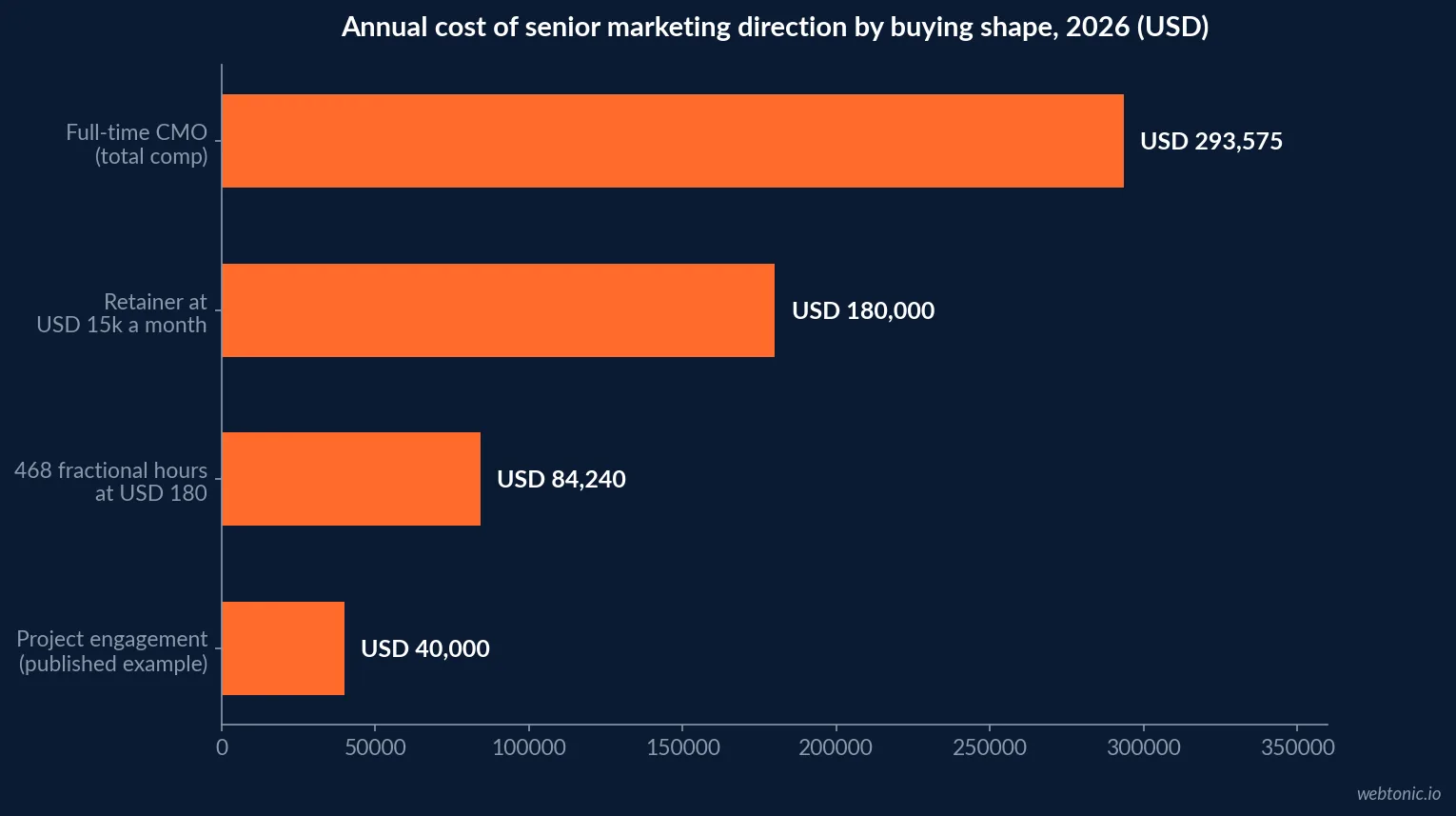
The same marketing strategy advice can cost USD 40,000 or USD 180,000 depending only on how you buy it. Below is what the 2026 fee data actually says, by engagement model, by hour and against the cost of hiring instead.
Key Takeaways
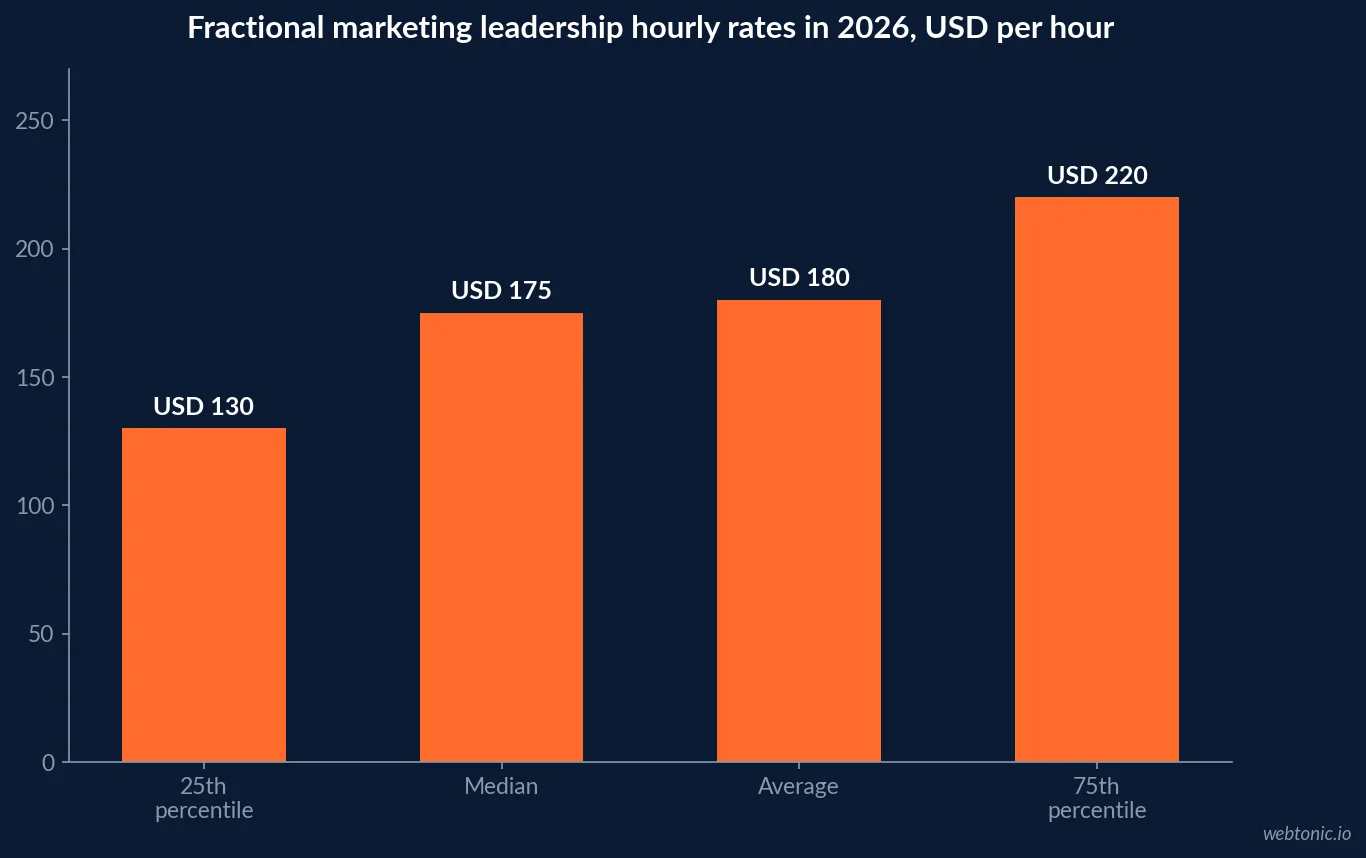
- Fractional marketing leadership averages USD 180 an hour, median USD 175.
- The 25th to 75th percentile band runs USD 130 to USD 220 an hour.
- Retainers commonly run USD 5,000 to USD 25,000 a month.
- Loaded project rates reach USD 300 to USD 700 an hour.
- Buying project scope on a retainer has been costed at 4 to 5 times the price.
- Project pricing leads at 30% of consultants, hourly at 29%.
- Only 16% work on monthly retainers and 15% price on value.
- 79% of consultants say they want to charge more than they do.
- A full-time US CMO costs USD 293,575 in total compensation.
- Bad hires start at 30% of first-year earnings and reach 213% of salary.
- Engagements typically consume about nine hours a week.
- The consulting market reaches USD 1,111.35 billion in 2026.
The hourly band, before anyone quotes you
Published 2026 rate data for fractional marketing leaders puts the average at USD 180 an hour and the median at USD 175, with the middle half of the market between USD 130 and USD 220. The same dataset reports engagements typically running about nine hours a week, roughly 468 hours a year. Those two numbers together are the entire budget conversation: an hourly rate without an hours assumption tells you nothing.
The spread inside that band is not seniority, it is risk transfer. A quoted rate at the bottom of the band usually comes with a narrow deliverable; a rate at the top usually comes with accountability for an outcome you did not have to specify in advance.
| Rate reference point | 2026 figure | What it usually buys |
|---|---|---|
| 25th percentile hourly | USD 130 | Narrow, well-specified deliverable |
| Median hourly | USD 175 | Plan plus a defined review cadence |
| Average hourly | USD 180 | Mixed advisory and execution oversight |
| 75th percentile hourly | USD 220 | Outcome accountability, undefined scope |
| Typical weekly commitment | About 9 hours | Roughly 468 hours a year |
Four buying shapes, four very different totals
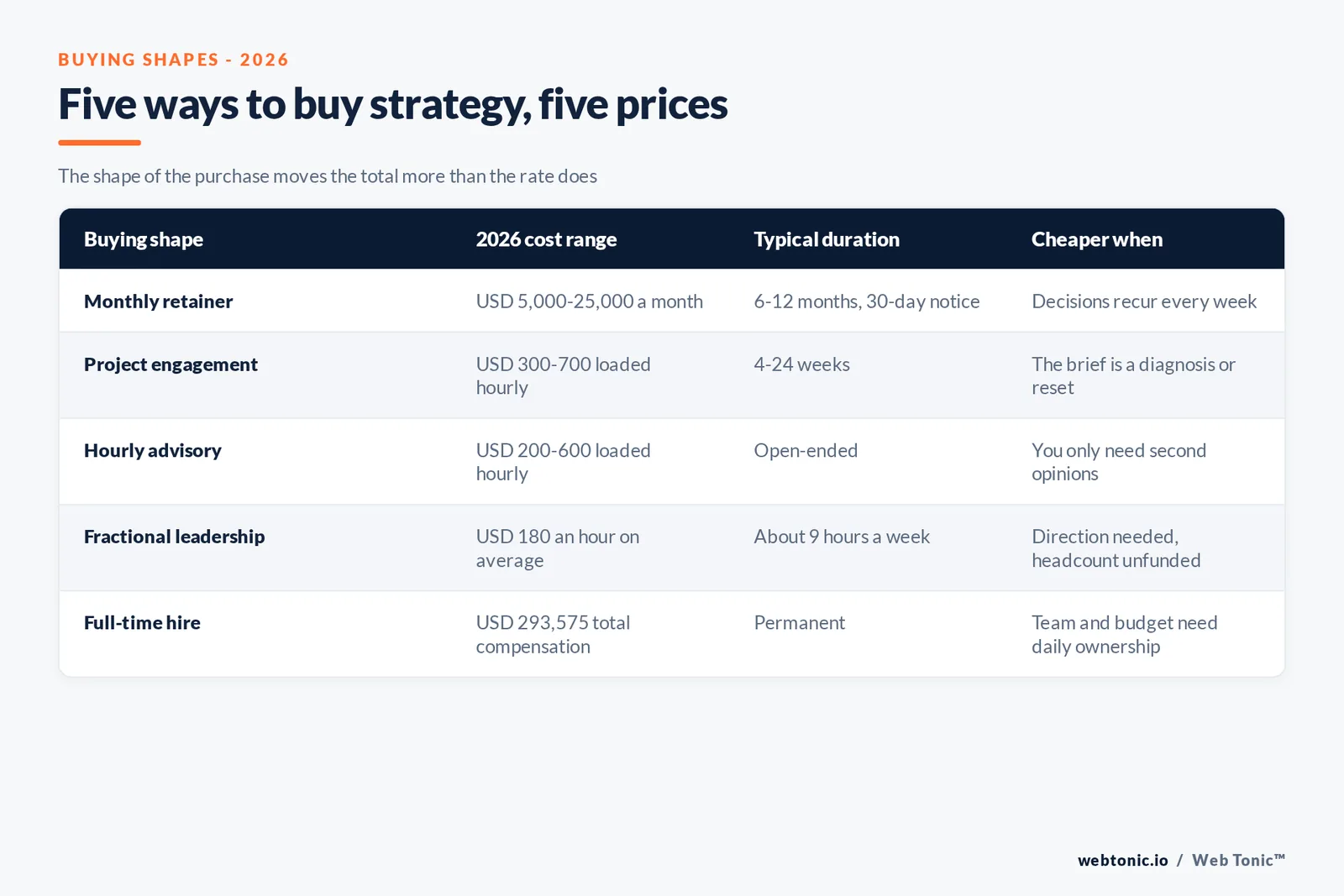
This is where budgets get destroyed. Engagement comparison data for 2026 puts loaded hourly equivalents at USD 200 to 500 on retainer, USD 300 to 700 on project work and USD 200 to 600 on hourly engagements, with retainers typically USD 5,000 to USD 25,000 a month, opening at six to twelve months with 30-day notice, and projects running four to twenty-four weeks.
The headline finding is the mismatch cost: buying a project-shaped piece of work on a retainer has been costed at four to five times the price, USD 180,000 against USD 40,000. If the brief is a diagnosis, a positioning reset or a plan rebuild, it is a project. Only continuous ownership of decisions justifies a retainer.
| Buying shape | Loaded hourly equivalent | Typical duration | Fits when |
|---|---|---|---|
| Monthly retainer | USD 200-500 | 6-12 months, 30-day notice | Continuous decision ownership |
| Project engagement | USD 300-700 | 4-24 weeks | Diagnosis, reset or rebuild |
| Hourly advisory | USD 200-600 | Open-ended | Second opinions and reviews |
| Full-time hire | USD 293,575 total comp | Permanent | Team and budget management |
How consultants price, and why quotes differ so much
A study of roughly 1,000 consultants found project-based pricing at 30%, hourly at 29%, monthly retainers at 16%, value-based pricing at 15% and daily rates at 10%. Two behavioural findings matter more than the split. 79% said they want to charge more than they currently do, which means quoted prices are anchored on adviser confidence rather than on your budget. And 38% earn USD 10,000 or more a month, with 51% of retainer-based consultants landing projects above USD 10,000 against 39% of those without retainers.
Read that as a negotiation asymmetry. When two quotes for the same brief differ by a factor of three, the variable is almost never hours - it is the pricing model behind the number.
| Pricing model | Share of consultants | Budget risk for the buyer |
|---|---|---|
| Project-based | 30% | Low - the number is the number |
| Hourly | 29% | High - scope creep is billable |
| Monthly retainer | 16% | Medium - depends on the exit clause |
| Value-based | 15% | High if the baseline is undefined |
| Daily rate | 10% | Low for short diagnostics |
The hiring comparison, including the failure case
Built In's 2026 compensation data puts a US CMO at USD 225,908 base plus USD 67,667 additional, USD 293,575 in total. Compare that against roughly 468 fractional hours at USD 180 and the cash gap is obvious - but the honest comparison includes the downside. 2026 mis-hire research cites a US Department of Labor floor of at least 30% of first-year earnings for a bad hire, senior mis-hire costs reaching 213% of salary, and retained search fees of 25% to 35%.
That is the real argument for buying advice before buying a person: a strategy engagement that defines the role, the scorecard and the first ninety days reduces the probability of the most expensive outcome in the table. We build that definition into growth marketing engagements rather than treating it as an afterthought.
| Cost line | 2026 figure | Often left out of the quote |
|---|---|---|
| CMO base salary | USD 225,908 | Benefits and equity |
| Additional compensation | USD 67,667 | Bonus timing |
| Total compensation | USD 293,575 | Ramp time before impact |
| Retained search fee | 25-35% of salary | Paid whether or not it works |
| Bad-hire floor | 30% of first-year earnings | Team disruption |
| Senior mis-hire ceiling | Up to 213% of salary | Lost year of execution |
What a budget actually has to cover
Fees are only part of the number. The CMO Survey's 2026 report puts marketing budgets at 9.0% of company revenue and 9.6% of total company budgets, with marketing spend growth of just 1.7% and training down to 3.8% of marketing spend from a pre-pandemic 5.8%. Meanwhile Hinge's High Growth Study 2026 shows high-growth professional services firms spending 12.0% of revenue on marketing against 5.0% at no-growth firms.
The practical implication: if the advice recommends work the internal team has no capacity or training budget to absorb, the fee was only the deposit. Price the implementation in the same conversation as the strategy, or the plan becomes an unfunded document.
Questions that move a quote more than negotiating the rate
Rate negotiation moves a number by ten or fifteen per cent. Scope definition moves it by multiples. The five questions below are the ones that changed the price most often in our own client conversations.
| Question to ask before signing | Why it changes the number |
|---|---|
| Is this a project or an ongoing role? | Retainer-for-project costs 4-5x |
| How many hours a week is assumed? | 9 hours is the published norm |
| What is the notice period? | 30 days is standard; longer is a cost |
| Who implements the recommendations? | Implementation is a separate budget |
| What does the first deliverable look like? | Undefined output prices at the 75th percentile |
Why fees are not falling
Buyers keep expecting AI-driven fee deflation in advisory work. The market data does not show it. Management consulting services were valued at USD 1,063.77 billion in 2025, forecast at USD 1,111.35 billion in 2026 and USD 1,407.09 billion by 2030. Demand for senior judgement is growing at roughly the same pace as supply, so the band holds.
What has changed is what falls inside the fee. Production work - research synthesis, first-draft documents, competitor scans - is now cheap enough that paying advisory rates for it is indefensible. The defensible fee covers the decision: what to stop doing, what to fund, and in what order. If a proposal reads like a deliverables list rather than a decision list, the price is wrong regardless of the rate. Ask for the decision list before you compare quotes.
Budget tiers, and what each one realistically buys
Buyers rarely start from a rate card; they start from a number they can approve. Mapping that number to a realistic scope avoids the most common failure in this category - commissioning a strategy that assumes resources the budget never contained. The tiers below use published 2026 rate bands, and the same logic applies to channel budgets in our Google Ads cost guide.
One caution on the top tier: at USD 5,000 to USD 25,000 a month, a twelve-month retainer approaches the cash cost of a senior hire without the permanence. That is defensible when ownership genuinely has to sit outside, and expensive when it does not. It is also why hybrid arrangements lead B2B outsourcing structures: an internal owner carrying the plan, with senior judgement rented by the quarter rather than by the month.
| Budget tier | Published 2026 rate basis | Realistic scope |
|---|---|---|
| Under USD 10,000 | USD 200-600 hourly advisory | Diagnosis, second opinion, plan review |
| USD 10,000-40,000 | USD 300-700 project loaded rate | Positioning reset or full plan rebuild |
| USD 5,000-15,000 a month | Lower retainer band | Plan ownership plus monthly review cadence |
| USD 15,000-25,000 a month | Upper retainer band | Leadership plus programme oversight |
| USD 293,575 a year | Average CMO total compensation | Permanent ownership of team and budget |
Related reading
- Marketing Operations Consulting Statistics: Cost and Pricing
- Marketing Strategy Consulting Statistics: Benchmarks and KPIs
- How to Scope a Marketing Strategy Consulting Engagement
- Marketing Strategy Consulting services at Web Tonic
Frequently Asked Questions
What does marketing strategy consulting cost in 2026?
It depends far more on the buying shape than on the adviser. Published 2026 rate data puts fractional marketing leadership at an average of USD 180 an hour, with a median of USD 175 and a 25th to 75th percentile band of USD 130 to USD 220. Retainers commonly run USD 5,000 to USD 25,000 a month, and loaded hourly equivalents sit at USD 200 to 500 on retainer, USD 300 to 700 on project work and USD 200 to 600 on pure hourly engagements. The same scope bought as a retainer instead of a project has been costed at four to five times the price - USD 180,000 against USD 40,000 in one published comparison.
How do consultants actually structure their fees?
A study of roughly 1,000 consultants found project-based pricing leading at 30% of respondents, hourly at 29%, monthly retainers at 16%, value-based pricing at 15% and daily rates at 10%. Nearly four in five consultants - 79% - said they wanted to charge more than they currently do, and 38% reported earning USD 10,000 or more a month. Retainer-based consultants were more likely to land large projects: 51% against 39% for those without retainers.
Is a fractional adviser cheaper than hiring a CMO?
On cash cost, usually yes, but the comparison has to include the failure case. Built In's 2026 data puts an average US CMO at USD 225,908 base plus USD 67,667 additional, or USD 293,575 total. Fractional engagements typically consume about nine hours a week - roughly 468 hours a year - which at the USD 180 average is a fraction of that. The other half of the maths is mis-hire risk: the US Department of Labor floor for a bad hire is at least 30% of first-year earnings, and senior mis-hire estimates run as high as 213% of salary, on top of retained search fees of 25% to 35%.
What is a realistic engagement length?
Published 2026 engagement norms show fractional retainers starting at six to twelve months with a 30-day notice period, and project engagements running four to twenty-four weeks. That matters for budgeting: a diagnosis, a positioning reset or a plan rebuild is a project-shaped purchase, and paying retainer rates for project-shaped work is the single most expensive mistake in this category.
How big is the market setting these prices?
The global management consulting services market was valued at USD 1,063.77 billion in 2025 and is forecast at USD 1,111.35 billion in 2026, reaching USD 1,407.09 billion by 2030. That growth is why fee pressure has not materialised: supply of senior advisers is expanding, but so is demand, and rates in the fractional segment have held their band rather than collapsing.
Sources
GoFractional - Fractional CMO Rates 2026
Fractional Pulse - Fractional Executive Engagement Comparison 2026
Consulting Success - Consulting Fees Study
Built In - CMO Salary Data 2026
Talentfoot - The Cost of a Leadership Mis-hire, 2026 Data
The CMO Survey - Highlights and Insights Report 2026
Hinge Research Institute - High Growth Study 2026
The Business Research Company - Management Consulting Services Global Market Report