



Table of contents

Every provider will promise findings. The difference between a useful audit and an expensive document is decided before you sign, in what you insist the scope contains.
Key Takeaways
- Score every shortlisted provider on the same five pillars: diagnostic method, measurement competence, evidence standard, deliverable shape, and handover.
- Ask for the week-one data request in writing before you sign. A provider who can list exactly what they need has done this before.
- Measurement competence is non-negotiable. Reviews find conversion tracking errors in 60–70% of newly audited accounts, and an audit that misses this grades every channel on bad data.
- Insist on ranked findings with evidence and severity plus a 90-day plan naming owners and dates — the standard components of a real audit deliverable.
- Match scope to spend. Published ranges are $2,500–$7,500 for single-channel and $8,000–$25,000 for comprehensive multi-channel reviews.
- Judge the sample audit, not the pitch deck. If the sample contains no uncomfortable finding, it is a sales document.
- Write the implementation question into the contract: who owns each finding afterwards, and how implementation rate will be reported.
Decide what you are buying first
"Marketing audit" covers everything from a two-hour ad account skim to a four-week multi-channel diagnostic. Choosing a provider before defining the scope means comparing quotes for different products, which is why the price spread looks irrational.
Three scopes are worth distinguishing. A single-channel review examines one system in depth — paid media or organic search — and suits a specific, localised symptom. A measurement audit examines only the tracking and reporting layer, and is the right first purchase when nobody trusts the numbers. A comprehensive growth audit covers measurement, paid, organic, funnel, lifecycle, offer and competitive position, and suits a company that cannot explain its own results.
Published audit checklists give a good sense of what "comprehensive" should mean in practice: goal and strategy alignment, brand and messaging, SEO and organic search, paid media efficiency, sales and marketing alignment, dashboards and KPI review, competitive landscape. If a provider's comprehensive scope covers three of those areas, it is a channel review with a broader name.
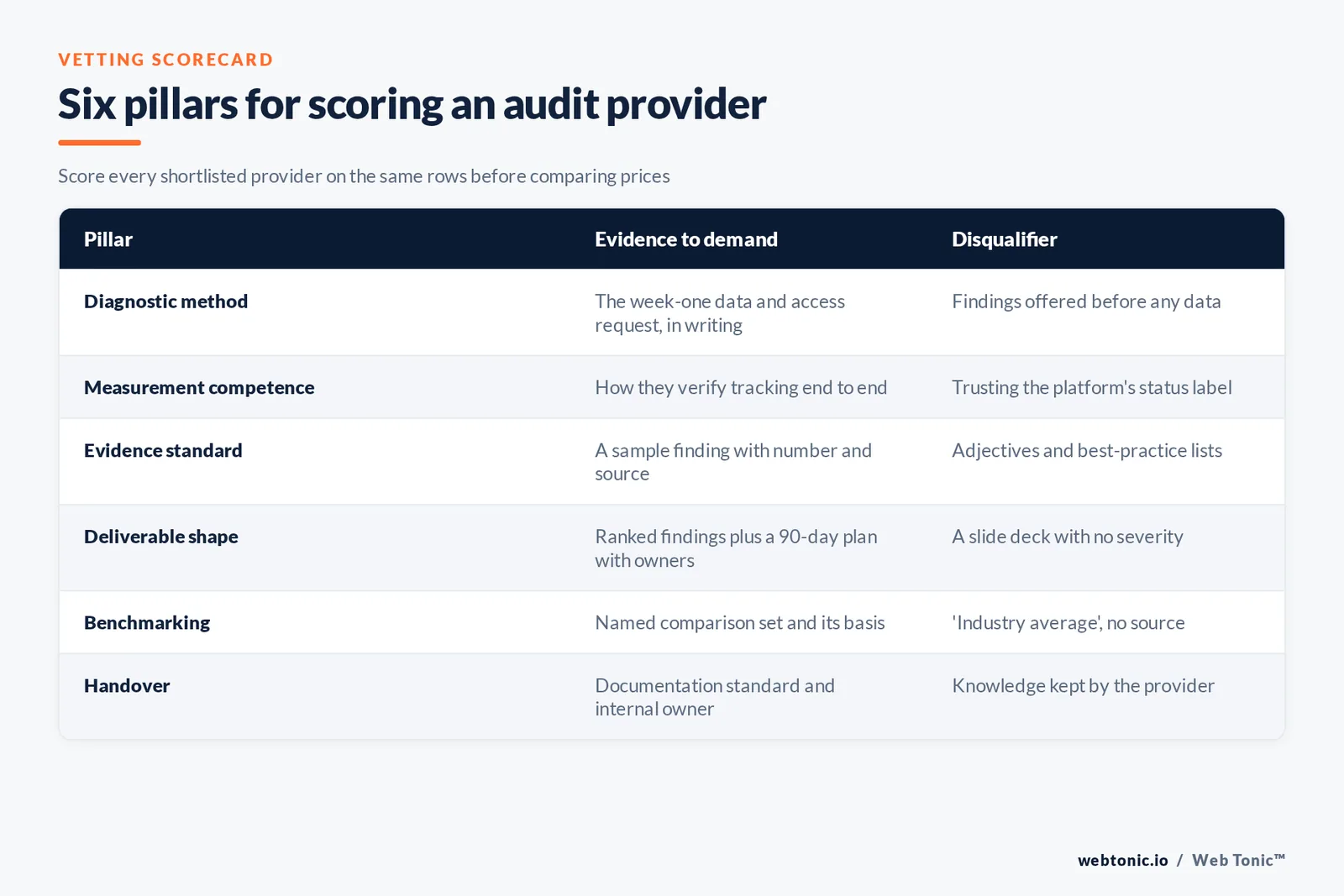
| Pillar | Evidence to demand before signing | Disqualifier |
|---|---|---|
| Diagnostic method | A written week-one data and access request | A findings summary offered before any data |
| Measurement competence | How they verify conversion tracking end to end | Trusting the platform's own status label |
| Evidence standard | A sample finding with the number and its source | Adjectives and best-practice lists |
| Deliverable shape | Ranked findings plus a 90-day plan with owners | A slide deck of observations, no severity |
| Benchmarking | Named comparison set and its basis | "Industry average" with no source |
| Handover | Documentation standard and internal owner named | Knowledge that stays with the provider |
Pillar one: does the method start with data?
A provider who can produce their week-one data request in writing — account access, spend exports, CRM stages, tag configuration, sales definitions — has run audits before. One who leads with conclusions is selling a template.
Audit guidance on sequencing describes the right order plainly: establish a baseline of which channels and campaigns drive conversions and at what cost, then layer attribution to understand assists, then compare against benchmarks. Ask a prospective provider to describe their sequence unprompted. If attribution modelling comes before baseline hygiene, expect a sophisticated report built on unverified inputs.
Also ask what they will do when the data is bad, because it often is. The useful answer names the specific checks: duplicate conversion actions, platform tag plus analytics import double counting, consent handling, definition mismatches between marketing and sales.
Pillar two: measurement, the part most audits get wrong
This pillar deserves separate weighting because everything else depends on it. Practitioner audit data reports conversion tracking errors in roughly 60–70% of newly reviewed accounts, with 73% of failures clustering into five repeatable categories. An analysis of more than 2,000 account audits found 57.7% of accounts had tracking installed and only about half of those tracked anything meaningful — roughly 29% with data good enough to judge a campaign.
The loss side matters too. 2026 server-side tracking benchmarks report recovery of 20–40% of previously lost conversions in typical e-commerce implementations. A provider who cannot discuss both over-counting and under-collection will hand you channel grades derived from numbers nobody validated.
A practical test: ask how they would prove a single conversion event is correct, from click to CRM record. The answer should describe a trace, not a screenshot of a dashboard.
Pillar three: what the deliverable must contain
Deliverable shape is where most disappointment originates, and it is entirely negotiable before signing. Require ranked findings, each with the measured number, its source, a 0–5 or severity-band rating based on cost of inaction, and a fix expressed as a finished state. Require a 90-day plan where every action names one owner, a date and an acceptance test. Require a corrected measurement baseline.
Scored audit templates are a good structural benchmark: each section rated 0–5 against a defined standard, where 0 is absent or actively harmful and 5 is a competitive asset, with a written description of what "good" looks like. That format lets your own team re-run the same scoring next quarter — which is exactly what you want, and exactly what a provider selling annual dependency may resist.
Benchmarks belong in the deliverable too. HubSpot's audit framing makes the case: a 3% conversion rate looks fine alone and looks poor when a direct competitor converts at 7%. Ask which comparison set will be used and where it comes from before you accept "industry average" in a report.
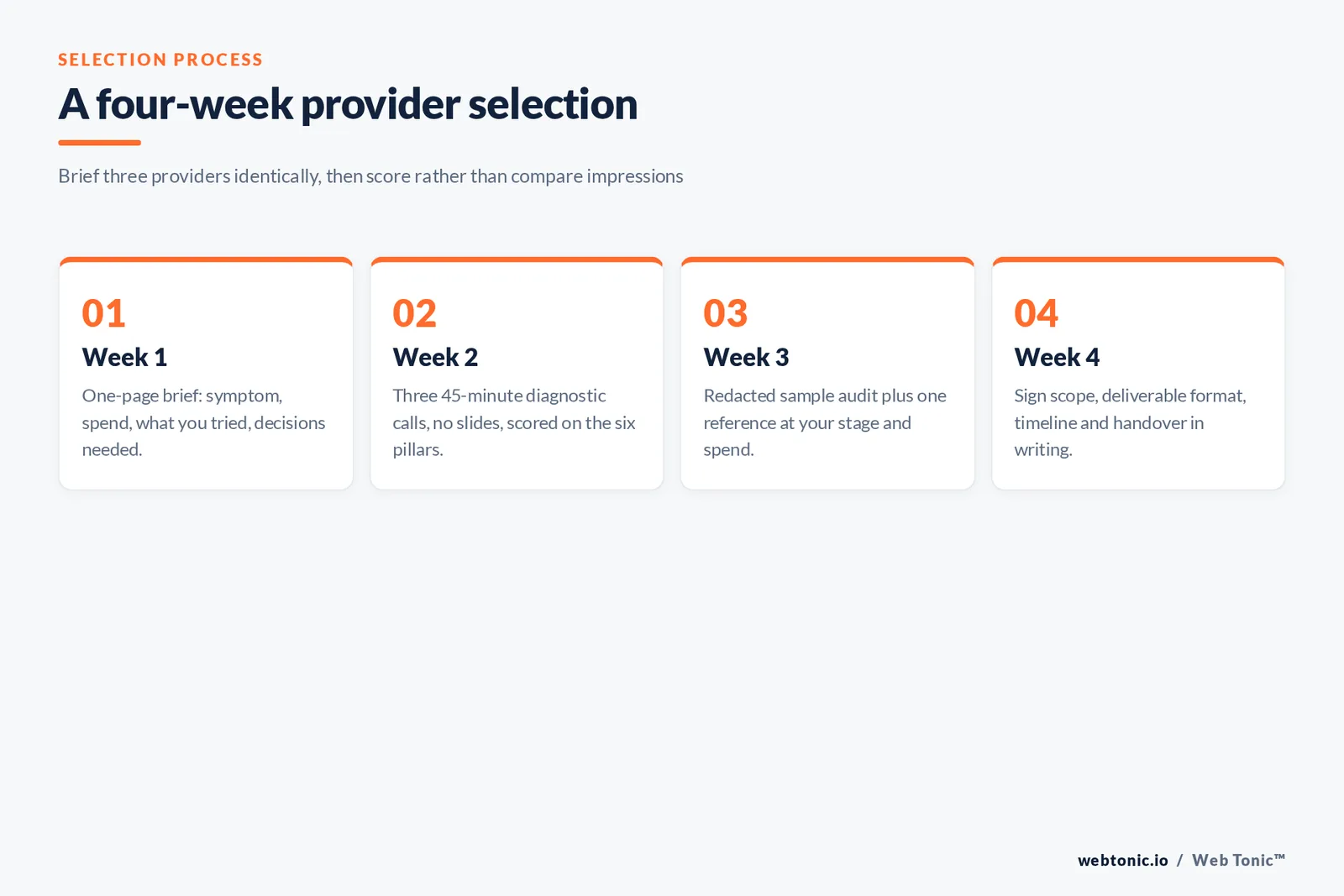
| Week | Action | Output |
|---|---|---|
| Week 1 | Write a one-page brief: symptom, spend, what you have tried, decisions needed | A brief three providers can quote against identically |
| Week 2 | Three 45-minute diagnostic calls, no slides, scored on the five pillars | A comparable scorecard, not three pitch impressions |
| Week 3 | Request a redacted sample audit and one reference at your stage | Evidence of uncomfortable findings and what changed after |
| Week 4 | Agree scope, deliverable format, timeline and handover in writing | A contract naming owners, acceptance tests and reporting |
Match the scope to the spend
Fee proportionality is the fastest sanity check available. 2026 pricing research puts single-channel reviews at roughly $2,500–$7,500 and comprehensive multi-channel audits at $8,000–$25,000 or more. Agency cost benchmarks put a standalone technical SEO audit at $1,500–$5,000 for small-business scope, rising steeply with company size. The market is reasonably coherent once you compare like scopes.
The ratio that matters is fee against the spend the audit governs. A comprehensive audit examining $1m of annual marketing spend is a rounding error; the same fee examining $60,000 is not defensible, and the honest provider will say so and sell you a narrower review instead. That answer, offered unprompted, is one of the better signals you will get in a sales conversation.
Beware quotes at both extremes. A very low fee usually buys a checklist run by a junior; a very high one often bundles implementation you have not yet decided to buy. Ask explicitly which parts of the quote are diagnosis and which are execution, and price them separately.
Pillar five: handover, and the question about afterwards
An audit's value is realised by whoever implements it, so the last selection question is about the quarter after delivery. Audit KPI frameworks track recommendation implementation rate — implemented divided by total recommendations — as a core metric. Ask each provider what implementation rate their audits typically achieve and how they know. Vague answers are informative.
Insist on three handover conditions in the contract: documentation lives in your systems, one internal person is named as owner of the plan, and implementation rate will be reported at day 90 against the original findings. Published audit ROI guidance makes the same point about durability — ongoing KPI and tracking frameworks are what sustain returns, not the report itself.
Decide the implementation question deliberately rather than by default. Having the auditor implement is efficient and keeps context, provided severity and scope were agreed in writing first; keeping the roles separate protects the objectivity of findings that might reduce someone's own retainer. Either is defensible. Drifting into it unexamined is not.
Red flags worth walking away from
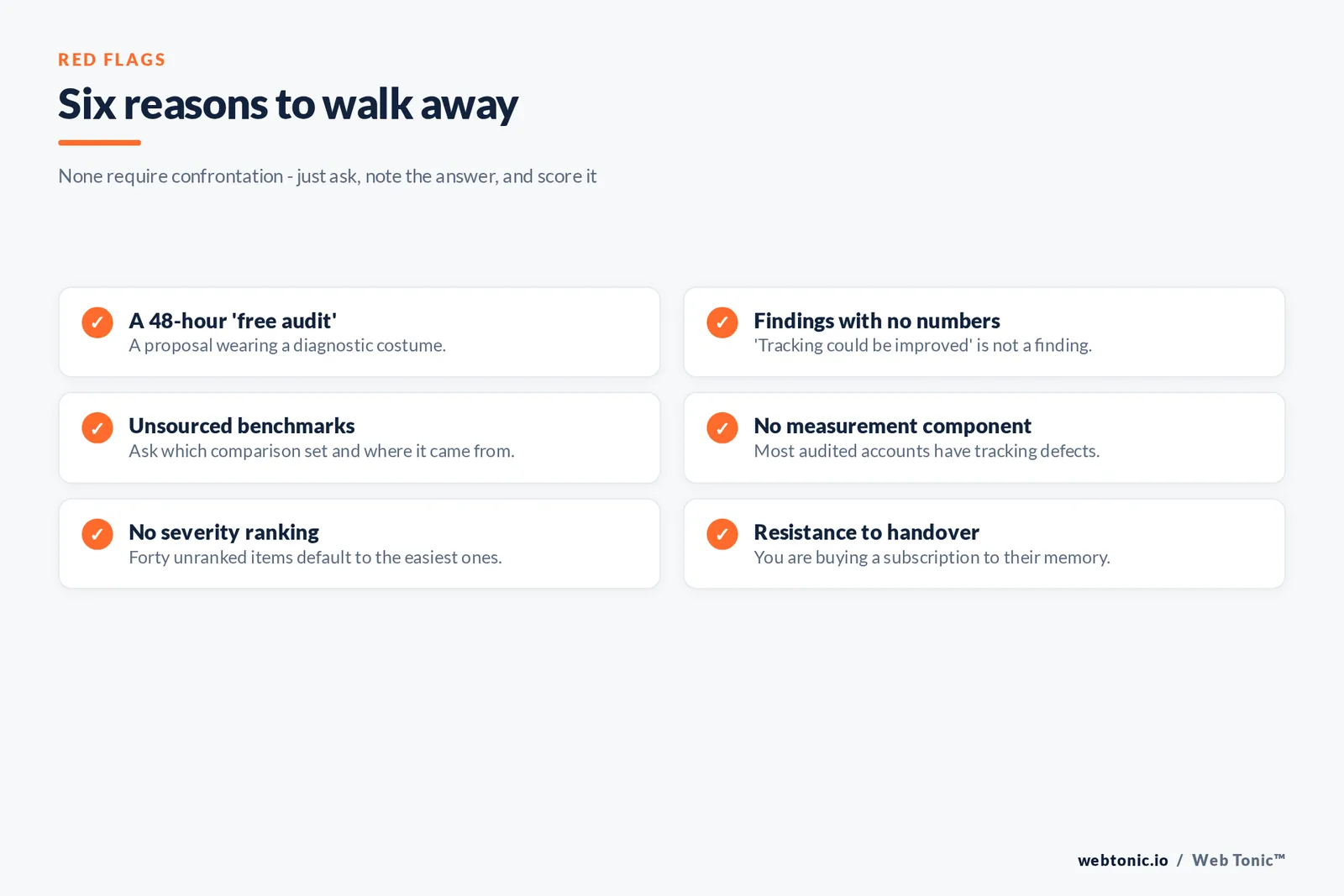
A "free audit" that arrives within 48 hours and recommends the provider's own retainer is a proposal wearing a diagnostic costume — sometimes useful, never a substitute. Findings with no numbers are the second flag: "your tracking could be improved" is not a finding, "two conversion actions are double counting checkout, inflating reported conversions by X%" is. Third, refusal to name the comparison set behind any benchmark.
Fourth, a scope with no measurement component in a market where a majority of accounts have tracking defects. Fifth, no severity ranking — an unranked list of 40 items defaults to whatever is easiest and, per wasted-spend research, the expensive problems tend to be structural and maintained rather than easy. Sixth, resistance to handover: a provider who will not document their method in your systems is selling a subscription to their own memory.
None of these require confrontation. Ask the six questions, note the answers, and score them consistently across three providers. The scorecard usually decides itself.
Two questions that separate finalists
When two providers score similarly, two questions usually break the tie. The first: "which of our channels would you expect to be the least profitable, and what evidence would change your mind?" A strong answer commits to a hypothesis and names the data that would refute it, which is what analytical honesty sounds like in a sales meeting. A weak answer restates that everything needs reviewing.
The second: "what will you tell us that we will not want to hear?" Good auditors have a ready answer, usually about measurement quality, an over-funded channel with flattering attribution, or an offer that is being asked to do work a price change should be doing. A provider who cannot name a single uncomfortable category will not produce one in the report either, and an audit with no uncomfortable findings is the most expensive kind of reassurance you can buy.
Finally, ask both finalists to state the scope they would sell you if your budget were half the quoted fee. The narrowing they choose tells you what they believe matters most, and that judgement is the thing you are actually hiring.
Expertise, coverage and the report you will actually use
Ask each provider which channels their team can review to a professional standard in-house: SEO and content, paid campaigns, email and lifecycle, social, website and conversion, analytics and reporting. Breadth claimed on a services page is not the same as expertise on the review team, and a systematic audit needs a named person accountable for each area rather than one generalist writing every section.
Then look at how insights are presented. The reports teams actually use share a shape: a short executive summary naming the single biggest constraint and the top three priorities, then one section per area with the measured number, the benchmark, the recommendation and the expected impact — measurable, with an owner. Ask for a redacted example and read it as a working document. If you cannot tell within two minutes what to do on Monday, your team will not either, however strong the analysis underneath it is.
Finally, check the practical resources that come with the report: the dashboard or spreadsheet the findings live in, the checklist your team can re-run each quarter, and clear documentation of how each number was produced. Providers who hand those over are confident their value lies in judgement rather than in withholding method — and that is the expertise you want reviewing your marketing.

Related reading
- Marketing Strategy Consulting: how to choose a provider
- AI Marketing Advisory / AI Readiness: how to choose a provider
- Fractional CMO: how to choose a provider
- Marketing Strategy Consulting services at Web Tonic
Frequently Asked Questions
How many providers should we compare?
Three, briefed identically from a one-page document, and scored on the same five pillars. Fewer gives no comparison; more turns a four-week selection into a quarter, which costs more than the difference between the quotes.
Are free audits worth taking?
They are worth reading as sales documents and worth nothing as diagnostics. If one produces a specific, evidenced finding with a number and a source, treat that as a positive signal about the provider and then buy a properly scoped review.
Should the audit provider also implement the fixes?
Either arrangement can work, but decide it explicitly. If they implement, agree findings and severity in writing before implementation starts so scope cannot quietly expand. If they do not, budget internal or external capacity for the 90 days that follow.
What if we do not have an internal owner for the plan?
Then solve that before buying the audit. Every published audit framework tracks implementation, and implementation without a named owner who controls budget and calendar does not happen. Interim or fractional leadership can hold the role temporarily.
Does industry specialisation matter?
Less than diagnostic rigour and measurement competence. Sector experience helps with benchmarks and channel norms, but the audit's value comes from method and comparative data. Ask for one reference at your stage and spend level rather than in your exact niche.
Where to take this next
Write the brief before you take the calls: symptom, spend, what you have tried, and the decisions the audit must settle. Our marketing audit is scoped that way — ranked findings with evidence and severity, a corrected measurement baseline and a 90-day plan with owners — data intelligence handles the measurement layer, growth marketing implements the plan, the wider services lineup covers delivery, and the blog has more method detail. To compare scopes against your own spend, talk it through with us.
Sources
MarkCMO — How to Run a Marketing Audit
The Agency Auditor — Marketing Audit Checklist
The Agency Auditor — Marketing Audit ROI
Improvado — Marketing Audit Guide 2026
Improvado — Wasted Marketing Spend
MarqOps — Google Ads Conversion Tracking: The 2026 Audit Method
Disruptive Advertising — Lessons from 2,000+ Account Audits
SignalBridge — 2026 Server-Side Tracking Benchmark Report
Sivon HQ — Marketing Audit Template
HubSpot — What's a Marketing Audit?
The it Crowd — What a Marketing Audit Actually Costs
Searchlab — Marketing Agency Cost: 2026 Reality Check
KPI Depot — Process Audit KPI Benchmarks


