



Table of contents

A marketing audit is delivered in days. What it is worth is decided over the following 90. This is the calendar that turns ranked findings into changed numbers.
Key Takeaways
- The audit is week one. The value is in days 8–90, where findings become owned actions with acceptance tests.
- Audit programmes are judged on recommendation implementation rate — implemented recommendations divided by total recommendations. Anything unimplemented is a cost, not an insight.
- Fix measurement before anything else. Practitioner reviews find tracking errors in 60–70% of new accounts, and 73% of failures cluster into five repeatable categories.
- Days 1–30 are for repair and reallocation, where the observed 13.2%–49.8% waste range across audited accounts is recovered fastest.
- Days 31–60 are for the structural fixes an audit exposes: offer, funnel, landing pages, lifecycle. These need build time, so they cannot start on day 1.
- Days 61–90 are for proof and handover — a re-scored audit, a working dashboard and a named internal owner for every open item.
- One documented case puts recovered value at $10,000–$50,000 in the first 90 days against a $3,000 external audit fee. Your number depends on spend and on how much you implement.
Why the first 90 days are the real deliverable
Most audits fail after delivery, not during it. The document is accurate, everyone agrees with it, and nine weeks later the same defects are live. Audit KPI frameworks treat implementation rate as a primary metric precisely because report quality and report impact are unrelated variables.
So the sequencing question is not "what did we find" but "what can be closed, in what order, by whom". A useful marketing audit hands over three things on day one of the 90: a findings list carrying evidence and severity, a plan where every action names an owner and an acceptance test, and a measurement baseline you are willing to be judged against. Audit methodology guidance is explicit that the deliverable ends in a 90-day action plan with owners and dates — not a channel-by-channel commentary.
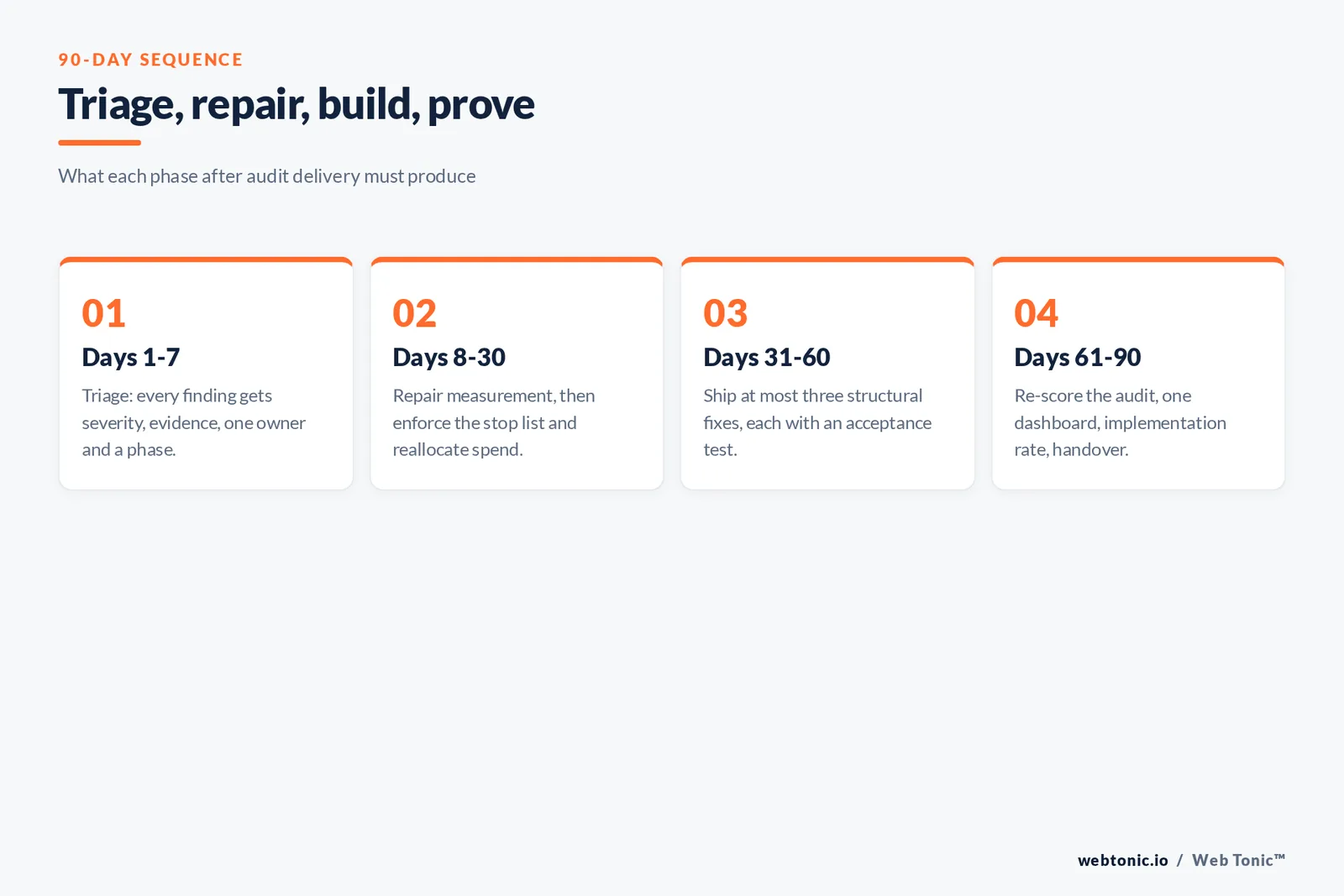
Three phases work because the fixes have genuinely different lead times. Reallocation and tag repair can happen in a fortnight. A new offer or a rebuilt funnel step cannot. Pretending otherwise is how 90-day plans become 9-month plans.
| Phase | Focus | What must exist at the end |
|---|---|---|
| Days 1–7 | Findings handover and triage | Every finding has a severity, an owner and a phase |
| Days 8–30 | Measurement repair and waste removal | Trusted conversion data and a reallocated budget |
| Days 31–60 | Structural fixes — offer, funnel, lifecycle | At least two shipped changes with before/after numbers |
| Days 61–75 | Testing and consolidation | One dashboard everyone reads, agreed definitions |
| Days 76–90 | Re-score and handover | Re-run audit scores, implementation rate, next quarter's plan |
Days 1–7: triage, not action
Resist the urge to start fixing on day two. The first week converts a document into a work queue. Every finding gets four attributes: severity, evidence, one named owner, and the phase it belongs to. Findings with no owner do not exist, and findings with two owners move slower than findings with none.
Severity should be defined by cost of inaction, not by effort. Structured audit checklists cover thirteen or more areas — strategy alignment, brand and messaging, SEO, paid efficiency, sales alignment, dashboards — and a real audit will return dozens of findings across them. Without ranking, the team defaults to whatever is easiest, which is rarely what is bleeding.
Finish the week with an explicit stop list. Campaigns, tools and reports that the audit showed are producing nothing should be switched off in week one, before anyone debates the sophisticated fixes. It is the cheapest action available and it funds the rest of the quarter.
Days 8–30: repair the measurement, then the spend
Every later judgement inherits your tracking errors, so this is first. Practitioner audit data reports conversion tracking errors in roughly 60–70% of newly reviewed accounts, with 73% of failures falling into five repeatable categories. An analysis of over 2,000 account audits found 57.7% of accounts had tracking installed and only about half of those tracked anything meaningful — roughly 29% with usable data. Duplicate counting through a platform tag plus an analytics import running simultaneously is the classic case, and it can inflate reported conversions two- to three-fold.
With numbers you trust, remove waste. A 2026 study of 104 B2B accounts covering $78m of spend measured average waste of 34%, about $255,000 per account, ranging from 13.2% in the best-managed quartile to 49.8% in the worst. Wasted-spend analysis reinforces that this is a maintained condition rather than an anomaly, which is why month one is the highest-return month of the whole quarter.
Reallocation beats reduction. Move budget from the campaigns the corrected data shows are unprofitable into the ones that were already efficient and capped, and record the before and after in writing. That record is what makes the day-90 conversation about evidence rather than opinion.
Days 31–60: the structural work
Month two handles the findings that need building. Typically that means the offer and its proof, the landing pages behind your best-performing terms, the lead-qualification definitions shared with sales, and the lifecycle sequences nobody has touched in a year. Audit guidance on baselines and attribution is a useful reference point here: start from which channels drive conversions and at what cost, then layer attribution to see assists, then compare against benchmarks — in that order, not the reverse.
Two rules keep month two honest. First, ship at most three structural changes; a quarter that attempts eight finishes none. Second, every change carries an acceptance test written before work starts — "cost per qualified opportunity on brand search below X", "form completion above Y%", not "improve the landing page".
Expect friction here, because these fixes cross departments. HubSpot's audit framing is a useful negotiating tool in those conversations: performance means little without a competitive benchmark, and a 3% conversion rate stops being defensible when a direct competitor converts at 7%. Benchmarks depersonalise the argument.
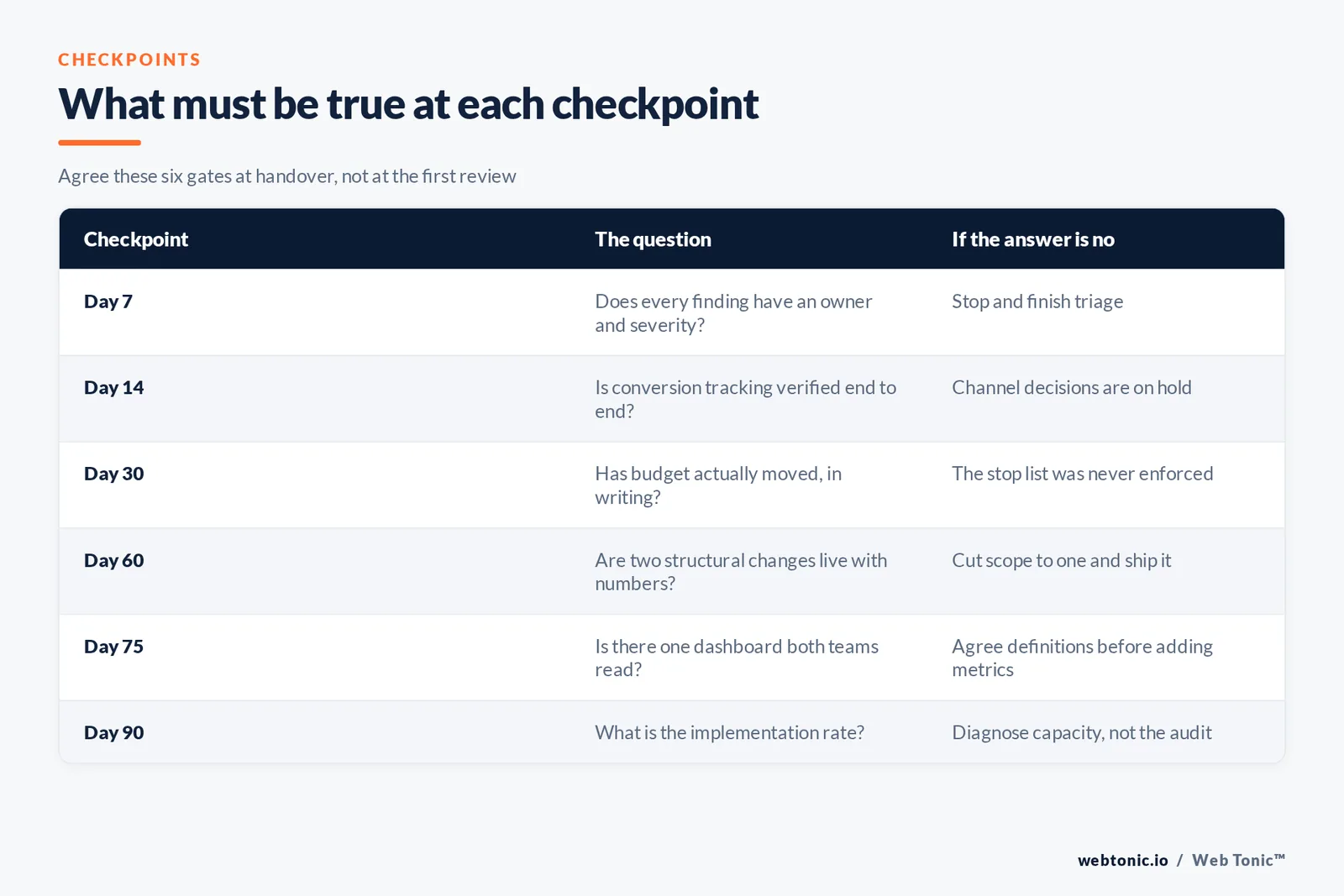
| Checkpoint | The question | If the answer is no |
|---|---|---|
| Day 7 | Does every finding have an owner and a severity? | Stop and finish triage — nothing else will land |
| Day 14 | Is conversion tracking verified end to end? | Escalate; all channel decisions are on hold |
| Day 30 | Has budget actually moved, in writing? | The stop list was never enforced |
| Day 60 | Are two structural changes live with numbers? | Cut scope to one and ship it |
| Day 75 | Is there one dashboard both teams read? | Agree definitions before adding metrics |
| Day 90 | What is the implementation rate? | Diagnose capacity, not the audit |
Days 61–90: prove it, then hand it over
The final month is not for new analysis. It consolidates: one dashboard, agreed metric definitions, and a re-score of the same audit criteria you started with. Scored audit templates make this trivial — if each section was rated 0–5 at the start, re-rating the same sections at day 90 gives an unarguable delta and a ready-made agenda for the next quarter.
Report three numbers, not thirty. Implementation rate against the original findings. Movement in the two or three commercial metrics the plan claimed it would move. And the reallocation total — how much spend was shifted out of proven waste. Published audit ROI guidance uses the same simple structure: recovered value against audit investment, expressed as a ratio.
Then hand over. Documentation, dashboard access, and one internal owner per open finding. An audit whose knowledge lives only with the provider guarantees you will buy the same thinking again next year.
Who owns the quarter
The strongest predictor of a successful first quarter is a named internal owner with real authority — a marketing lead, an operations manager, a founder, or a fractional CMO brought in to hold the plan while a permanent search runs. That person's role is not to do the work but to protect the sequence: they set goals in writing, keep the cadence, and decide what gets cut when capacity runs short.
Give them a simple operating rhythm. A 30-minute weekly review of the open findings, a monthly written update to leadership covering progress against goals, and a single place where the current plan lives so the team, the agency and the sales side are all reading the same document. Most 90-day plans stall because three people each hold a different version of the priority list, not because anybody misunderstood the strategy.
Make the customer-facing work visible in that rhythm too. When a fix lands on the website, in email or in a campaign, note what customers now see differently and what you expect that to change. It keeps the quarter grounded in the product and the market rather than in the internal task board, and it builds the habit that turns a one-off audit into an operating routine your team keeps after the engagement ends.
What the numbers can plausibly look like
Be careful with ROI claims, including your own. One published worked example puts an external audit at $3,000 — or 40 hours of senior internal time valued at $4,000–$6,000 — against recovered value of $10,000–$50,000 in the first 90 days, a 2–10x return in the first quarter, explicitly dependent on ad spend and on how much was broken to begin with (worked example). Treat that as a shape, not a promise: at low spend with clean tracking, the recoverable pool is small.
The credible way to forecast your own case takes two inputs. Apply a conservative waste percentage to your actual spend — the best-managed quartile figure of 13.2% rather than the 34% average — and multiply by the share of findings you honestly expect to implement. Companies that implement a third of an audit get a third of the value, and that is a capacity problem to solve before the audit, not after it.
Cost benchmarks help set the ratio. 2026 pricing data puts single-channel reviews at roughly $2,500–$7,500 and comprehensive multi-channel audits at $8,000–$25,000. If the fee is a large fraction of the quarterly spend it examines, narrow the scope until it is not.
The failure signals to watch for
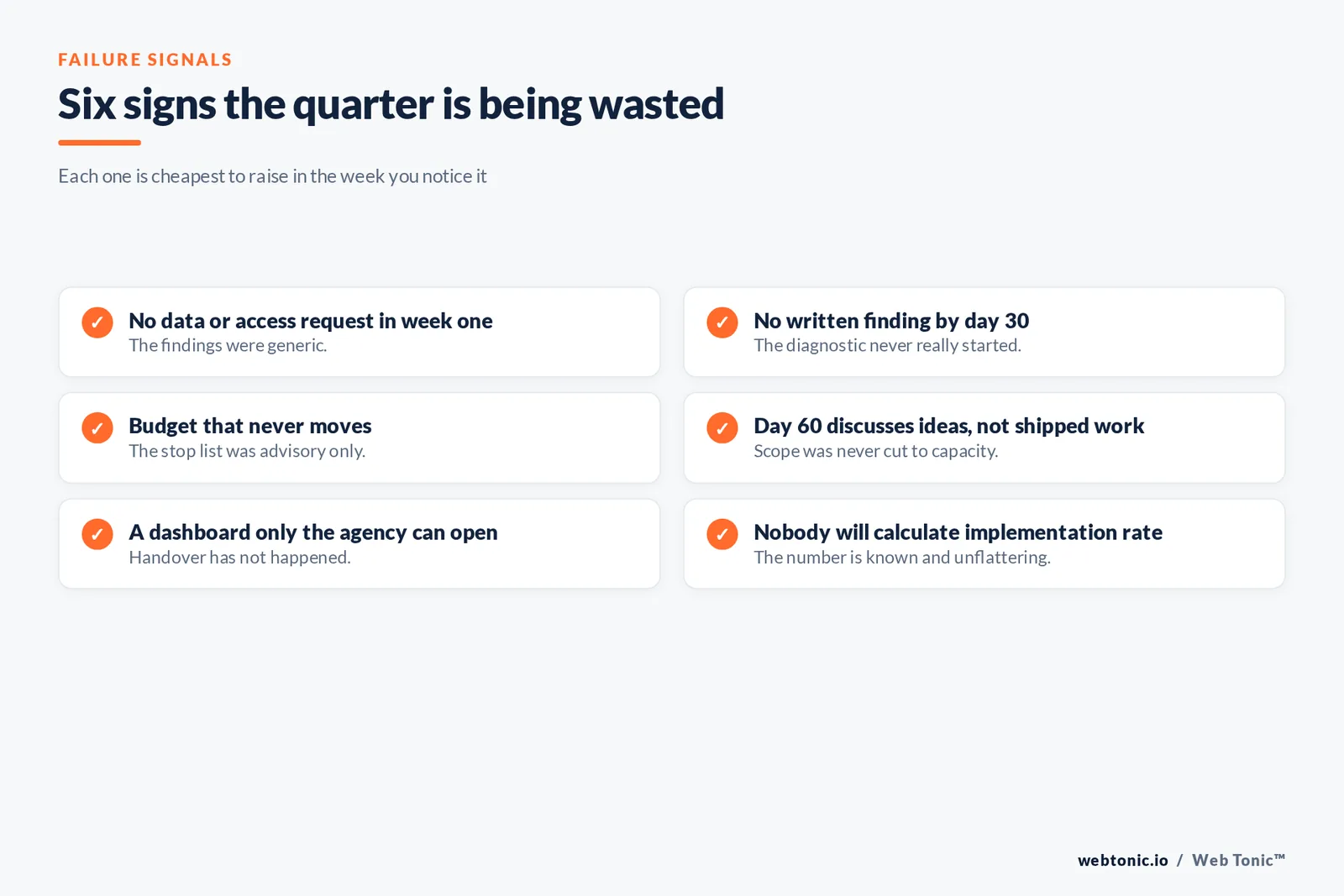
Six patterns predict a wasted quarter, and all of them are visible early. No data or access request in week one, which means the findings were generic. No written finding by day 30 in an audit sold as diagnostic. Budget that never moves, because the stop list was advisory. A day-60 review that discusses new ideas rather than shipped changes. A dashboard that only the agency can open. And an implementation rate nobody is willing to calculate.
Each has the same remedy: name a decision owner in writing and shrink the scope until it fits the team you actually have. Most 90-day plans fail on capacity, not on insight — which is why the plan should be built around three or four owned actions rather than a comprehensive backlog.
If you reach day 90 with a corrected measurement baseline, a reallocated budget, two shipped structural changes and a re-scored audit, the quarter worked, whatever the report looked like on day one.

Related reading
- Marketing Operations Consulting / RevOps: the first 90 days
- Fractional CMO for SaaS: the first 90 days
- Marketing Strategy Consulting: the first 90 days
- Marketing Strategy Consulting services at Web Tonic
Frequently Asked Questions
How long does the audit itself take?
A focused single-channel review runs in about a week; a full multi-channel audit takes two to four weeks depending on how quickly account access is granted. The 90-day clock in this article starts when findings are handed over, not when the engagement is signed.
What if we cannot implement everything?
Nobody can. That is why findings are ranked by cost of inaction and phased. Choose depth over coverage: three closed critical findings beat twenty acknowledged ones, and implementation rate is the metric that reflects it.
Should the auditor also implement the fixes?
It is efficient, but keep the boundary explicit. The audit's credibility depends on findings that would be uncomfortable for the implementer too, so agree severity and scope in writing before implementation work begins.
When should we re-audit?
Re-score the same criteria at day 90 and run a light quarterly review after that. A full external audit is worth repeating annually, or sooner after a major change — new market, new site, new leadership, a step change in spend.
What single thing most often decides the outcome?
Whether one internal person owns the plan. Engagements with a named owner who controls budget and calendar close findings; engagements owned by a committee produce well-attended review meetings.
Where to take this next
If you have a report nobody has implemented, the next 90 days matter more than the next audit. Our marketing audit ends in ranked findings and a 90-day plan with owners and acceptance tests, data intelligence repairs the measurement layer month one depends on, growth marketing ships the structural work, the wider services lineup covers delivery, and the blog has more method detail. To plan a quarter that actually closes findings, talk it through with us.
Sources
KPI Depot — Process Audit KPI Benchmarks
MarkCMO — How to Run a Marketing Audit
The Agency Auditor — Marketing Audit Checklist
The Agency Auditor — Marketing Audit ROI
MarqOps — Google Ads Conversion Tracking: The 2026 Audit Method
Disruptive Advertising — Lessons from 2,000+ Account Audits
Growth Spree — B2B Google Ads Waste Report 2026
Improvado — Wasted Marketing Spend
Improvado — Marketing Audit Guide 2026
HubSpot — What's a Marketing Audit?
Sivon HQ — Marketing Audit Template
Konabayev — Marketing Audit: Find and Fix Problems
The it Crowd — What a Marketing Audit Actually Costs


