Table of contents
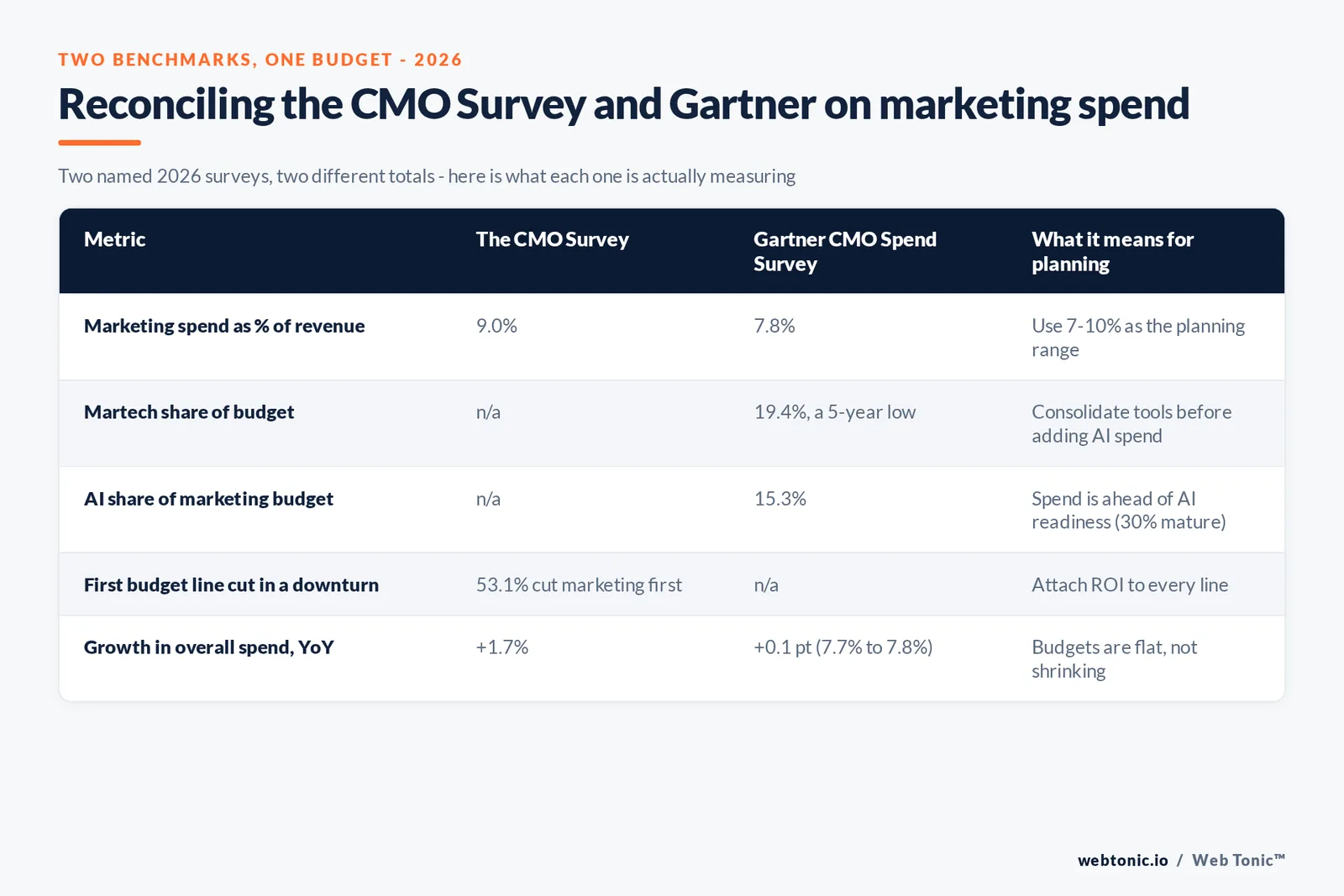
Two of the most-cited 2026 benchmarks put marketing spending at different levels — 9.0% of revenue from The CMO Survey against 7.8% from Gartner — and both are right for the population they measured. This page reconciles the two, breaks spending down by business model and channel, and flags where the money is actually moving in 2026.
Key Takeaways
- The CMO Survey puts marketing spend at 9.0% of revenue in January 2026.
- Gartner puts the figure at 7.8% of revenue, up from 7.7% in 2025.
- Overall marketing spending grew just 1.7%, the smallest increase since 2021.
- Martech fell to 19.4% of the marketing budget, a five-year low.
- That is down from 26.6% of the budget in 2021.
- 62% of CMOs still plan to increase martech investment despite the falling share.
- CMOs allocate 15.3% of budget to AI in 2026.
- Only 30% report mature or fully developed AI capability to spend it well.
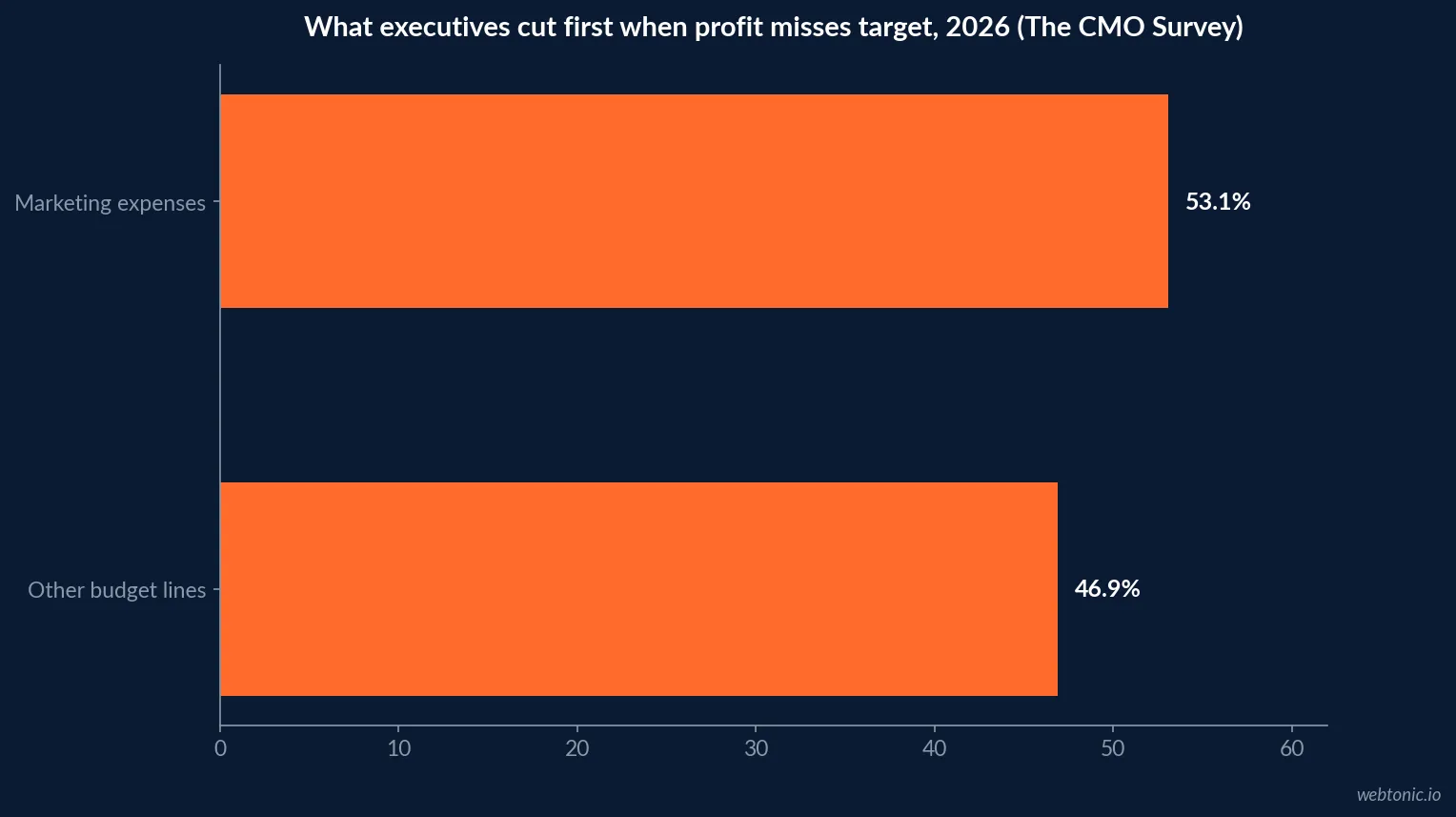
- 53.1% of executives cut marketing first when profits miss target.
- B2B services firms budget 10.1% of revenue, the highest segment measured.
- B2B product firms budget just 7.0% of revenue, the lowest segment.
- B2C product firms allocate 13.8% of their overall budget to marketing.
- Global ad spend is forecast to grow 9.1% to 11.5% in 2026, to USD 1.30-1.39 trillion.
- 83% of B2B marketing leaders expect higher investment over the next 12 months.
- 90% of large B2B tech firms spend USD 1M+ a year on marketing.
- 49% of firms at USD 50M revenue have already crossed that line.
- Organic social content is used by 40.3% of brands, the top budgeted channel.
- Email marketing follows at 39.6% of brands allocating budget to it.
- Website, blog and SEO work is a 2026 priority for 35.4% of marketers.
Why two respected surveys give two different numbers
The CMO Survey, run by Duke University's Fuqua School of Business with Deloitte and the American Marketing Association, reports marketing budgets at 9.0% of revenue and 9.6% of overall company budgets for its January 2026 wave, with total marketing spending growing just 1.7% over the prior 12 months — the smallest increase since 2021. Gartner's 2026 CMO Spend Survey, run independently across 401 CMOs, reports budgets flat at 7.8% of company revenue, up only a tenth of a point from 7.7% in 2025.
Neither number is a typo. The surveys sample different company mixes and phrase the question differently, which is precisely why quoting one figure as universal is the mistake — the useful range for planning is 7 to 10% of revenue, and where a given company sits inside that range depends heavily on its business model, covered below.
| Business model | % of revenue | % of overall budget | Source |
|---|---|---|---|
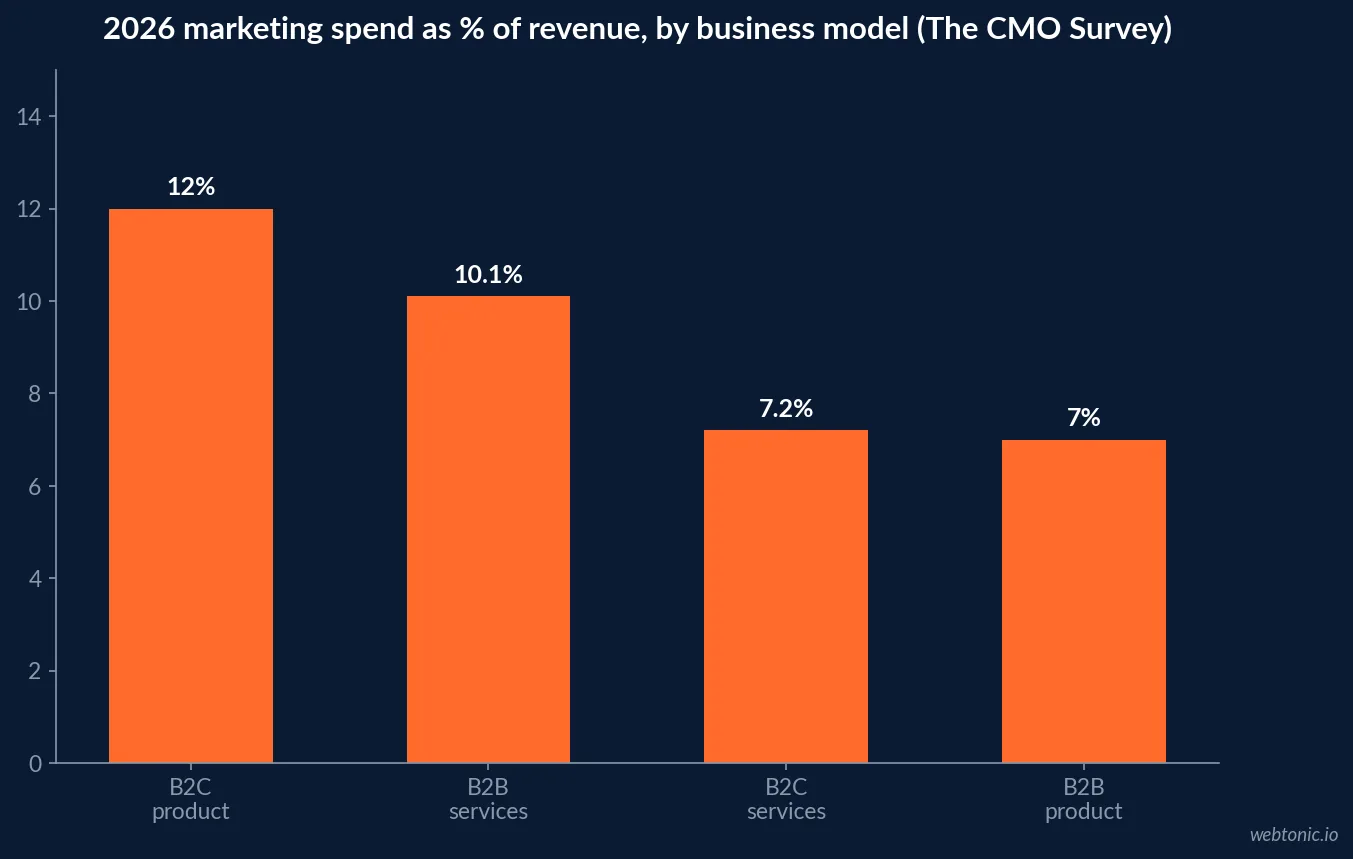
| B2C product | 12.0% | 13.8% | The CMO Survey / CMO.Works |
| B2C services | 7.2% | 11.5% | The CMO Survey / CMO.Works |
| B2B services | 10.1% | 9.2% | The CMO Survey / CMO.Works |
| B2B product | 7.0% | 7.0% | The CMO Survey / CMO.Works |
| Company average (Gartner panel) | 7.8% | n/a | Gartner CMO Spend Survey |
What the budget line actually funds
CMO.Works's breakdown of the same Spring 2026 CMO Survey data shows B2B services firms committing the largest share of revenue to marketing at 10.1%, while B2B product firms sit at the low end at 7.0%. B2C product firms budget the largest slice of their overall company budget to marketing, at 13.8%, because customer acquisition is the entire growth engine rather than one input among several.
The pattern holds across years: services businesses, which sell judgment rather than a shippable unit, spend more of every revenue dollar convincing a buyer that the judgment is worth paying for.
The martech line is shrinking while AI spend grows
Gartner's data shows martech's share of the marketing budget falling to 19.4% in 2026 — a five-year low — down from 26.6% in 2021. That decline is happening even as 62% of CMOs say they plan to increase martech investment, which points to consolidation: fewer platforms doing more, not abandonment of the category. At the same time, CMOs report allocating 15.3% of their marketing budget to AI initiatives specifically, while only 30% say their organization has mature or fully developed AI readiness. Spend is running ahead of the capability to use it well.
| Martech / AI metric (2026) | Figure | Direction vs. prior year | Source |
|---|---|---|---|
| Martech share of marketing budget | 19.4% | Down from 26.6% in 2021 | Gartner CMO Spend Survey |
| CMOs planning to increase martech spend | 62% | n/a | Gartner CMO Spend Survey |
| Marketing budget allocated to AI | 15.3% | n/a | Gartner CMO Spend Survey |
| CMOs with mature AI capability | 30% | n/a | Gartner CMO Spend Survey |
| CMOs calling AI leadership a critical 2026 goal | 70% | n/a | Gartner CMO Spend Survey |
Global ad spend is growing faster than marketing budgets
Company-level budgets are barely moving, but total global ad spend is not standing still. WARC's January 2026 forecast put global advertising spend at USD 1.30 trillion, up 9.1%; by its June 2026 update, reported by MediaNews4u, WARC had revised that upward to USD 1.39 trillion and 11.5% growth. That gap between forecasts six months apart is a reminder that ad-market totals move faster than any single company's budget line, largely because a handful of platforms are absorbing most of the incremental spend.
The demand side backs this up directly. Forrester's own 2026 Budget Planning Guide found 83% of B2B marketing decision-makers expect higher investment over the next 12 months, and 10Fold's 2026 Marketing Budget Blueprint, surveying 400 senior marketing leaders across the US and Europe, found a majority planning to raise budgets outright for the year ahead.
| Ad-spend forecast (2026) | Figure | Change | Source |
|---|---|---|---|
| Global ad spend, January forecast | USD 1.30 trillion | +9.1% | WARC (via MediaBrief) |
| Global ad spend, June revision | USD 1.39 trillion | +11.5% | WARC (via MediaNews4u) |
| B2B leaders expecting higher investment | 83% | n/a | Forrester |
| B2B tech firms above USD 100M spending USD 1M+ on marketing | 90% | n/a | 10Fold |
| Mid-size firms (USD 50M revenue) at the USD 1M+ level | 49% | n/a | 10Fold |
Seven-figure budgets are becoming the B2B baseline
10Fold's research adds a scale dimension the survey percentages miss: 90% of B2B technology companies with USD 100 million or more in revenue now operate with at least USD 1 million in annual marketing spend, excluding salaries, and 49% of firms at the USD 50 million revenue mark have already crossed that same threshold. A seven-figure marketing budget has stopped being an enterprise-only signal and become the expected baseline once a B2B technology company clears roughly USD 50 million in revenue — a useful checkpoint for any growth-stage company benchmarking its own spend against peers rather than against a single percent-of-revenue rule of thumb.
Where the money is actually being spent by channel
HubSpot's 2026 budgeting research finds organic social content budgeted by 40.3% of brands, ahead of email marketing at 39.6%, paid social content at 39.4%, brand awareness work at 35.7% and content marketing at 35.6%. Its companion State of Marketing report adds that AI chatbots are now a channel priority for 37.7% of marketers, ahead of website, blog and SEO work at 35.4% — the first year AI tooling has out-ranked owned-content investment in that survey.
| Channel | Share of brands budgeting for it | Source |
|---|---|---|
| Organic social content | 40.3% | HubSpot 2026 |
| Email marketing | 39.6% | HubSpot 2026 |
| Paid social content | 39.4% | HubSpot 2026 |
| AI chatbots (ChatGPT, Gemini, etc.) | 37.7% | HubSpot 2026 |
| Brand awareness campaigns | 35.7% | HubSpot 2026 |
| Website, blog and SEO | 35.4% | HubSpot 2026 |
The five-year martech trend, year by year
Gartner's own year-over-year tracking shows the martech share of budget did not fall in a single cliff-edge year — it declined steadily across five consecutive surveys, from a high point in 2021 through the 19.4% low point reported in 2026, as tracked by Christoph Olivier Consulting's year-over-year compilation of Gartner's own figures. That steadiness matters for planning: a one-year drop could be a blip, but a five-year decline is a structural reallocation toward paid media and AI tooling that any budget built on 2021-era martech assumptions needs to catch up with.
| Year | Martech share of marketing budget | Source |
|---|---|---|
| 2021 | 26.6% | Gartner CMO Spend Survey |
| 2025 | 22.4% | Gartner CMO Spend Survey (via Christoph Olivier Consulting) |
| 2026 | 19.4% | Gartner CMO Spend Survey |
How to set a number instead of quoting one
Start from the business-model range (7% for B2B product, up to 10%+ for B2B or B2C services), not from a single headline figure. Then check the martech line for redundant tools before adding an AI budget on top of it — Gartner's data shows the market is already consolidating there. Finally, name what the marketing budget is expected to produce before the next downturn, since 53.1% of executives will cut it first if there is no attached number to defend.
Our growth marketing practice builds that channel-by-channel case before a budget is finalized, and our guide to what paid search actually costs is a useful next stop if search is one of the lines being sized.
The AI-spend gap is the number to watch next
The widest gap in this year's data is not between the two survey totals — it is between the 15.3% of budget already committed to AI and the 30% of CMOs who say their organization is ready to use it well. That 45-point gap is where next year's "we overspent on AI tools" post-mortems will come from, and it is worth auditing before, not after, the next budget cycle renews on autopilot.
If AI tooling is the next line item under review, our team can help price it against what the rest of the market is actually paying — talk to us about a budget review, or read how our data and analytics practice ties spend to a measurable return before the number gets locked in.
Frequently Asked Questions
What percentage of revenue should a company spend on marketing in 2026?
There is no single correct number because the two leading benchmarks disagree. The CMO Survey, run by Duke's Fuqua School of Business with Deloitte and the American Marketing Association, puts marketing spend at 9.0% of revenue in its January 2026 wave. Gartner's CMO Spend Survey, run independently across 401 CMOs, puts the figure at 7.8% of company revenue. The honest answer is a range of roughly 7 to 10% of revenue for a typical company, with B2B services and B2C product businesses sitting at the high end and B2B product businesses at the low end.
Why do the CMO Survey and Gartner report different marketing budget percentages?
The two surveys sample different populations and ask the question differently. The CMO Survey draws from roughly 300 marketing leaders skewed toward larger, established firms; Gartner's panel of 401 CMOs weights differently by sector and includes more consumer-facing brands. Neither is wrong — they are measuring overlapping but not identical universes, which is exactly why a single quoted number should always be checked against its source before it becomes a budget target.
Is the marketing technology budget shrinking in 2026?
Yes, on Gartner's data. Martech's share of the total marketing budget fell to 19.4% in 2026, a five-year low, down from 26.6% in 2021. That is happening even as 62% of CMOs say they plan to increase martech investment, which points to consolidation of tools rather than abandonment of the category — fewer platforms, each doing more.
How much of the marketing budget is going to AI in 2026?
Gartner's 2026 CMO Spend Survey found CMOs are allocating 15.3% of their marketing budget to AI initiatives, yet only 30% of those same CMOs say their organization has mature or fully developed AI capability. Spend is running ahead of readiness, which is the pattern to watch before committing a bigger AI line item next budget cycle.
What is the first thing to get cut when marketing budgets are squeezed?
Marketing itself. The CMO Survey found that when profits fall short of expectations, 53.1% of company executives say their first move is to cut marketing expenses ahead of other budget lines. That is the strongest argument for building a spending plan with a named ROI story attached to each line, since the alternative is having the whole budget treated as the flexible one.
Sources
The CMO Survey - Highlights and Insights Report, January 2026
Chief Marketer - Gartner 2026 CMO Spend Survey coverage
CMO.Works - Marketing budget benchmarks by business type and stage
MediaBrief - WARC global advertising spend forecast, January 2026
MediaNews4u - WARC global ad market forecast revision, June 2026
HubSpot - Marketing budget by channel, 2026
HubSpot - 2026 State of Marketing report
Forrester - 2026 B2B Marketing Budget Planning Guide
10Fold - 2026 Marketing Budget Blueprint
Deloitte - The CMO Survey program page
Christoph Olivier Consulting - CMO and marketing budget statistics 2026 (Gartner data)