Table of contents

Short answer: Use the 2026 evidence to frame a test, not to copy a universal benchmark. The statistics below separate measured outcomes from survey opinions and put investment decisions in context.
Key Takeaways
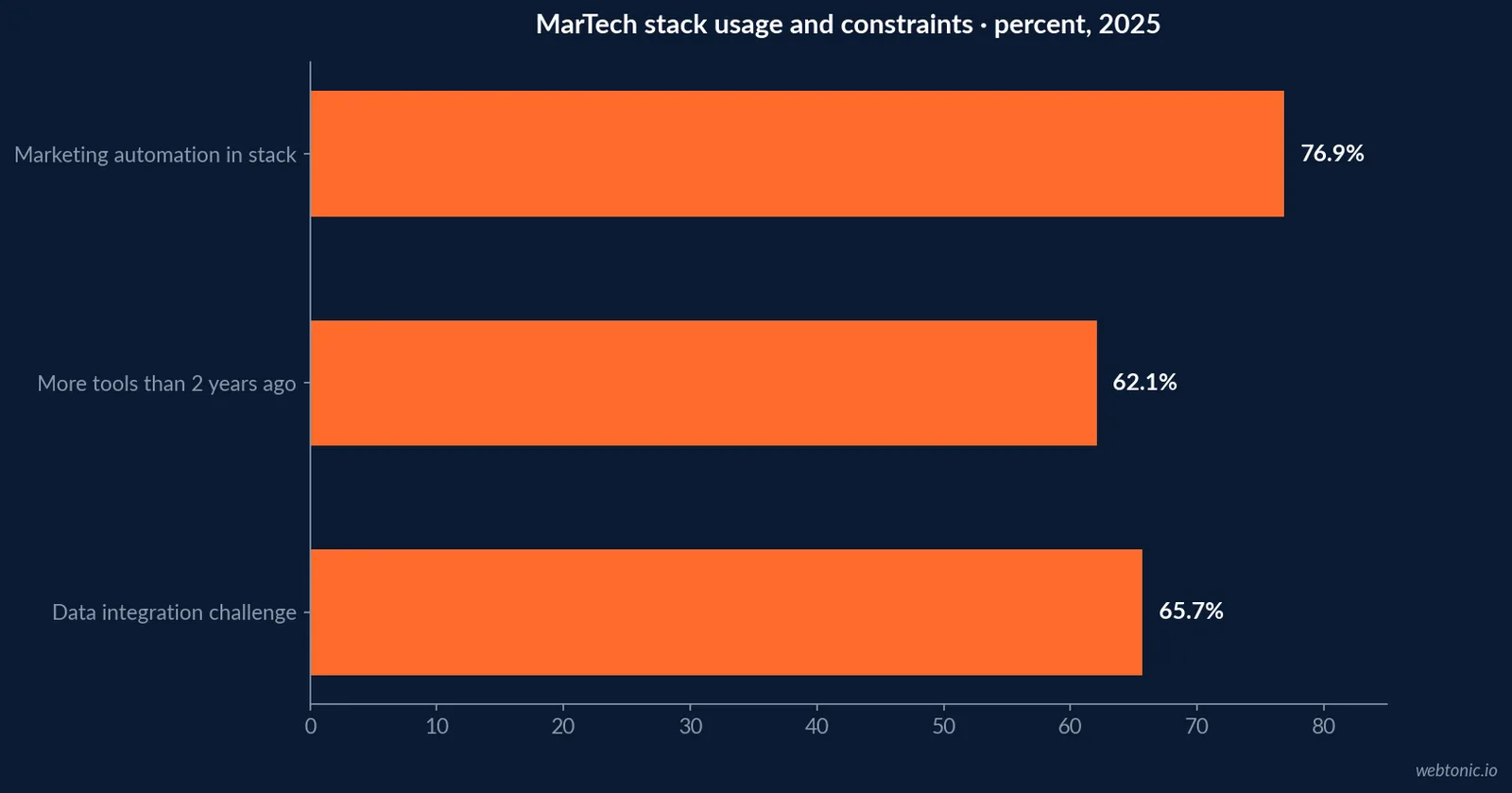
- 76.9% of respondents had marketing automation platforms in their stack in MarTech’s 2025 survey.
- 65.7% named data integration a major stack challenge.
- Deloitte’s 24% and 8.4x findings describe associations, not guaranteed ROI.
- Budget licenses, implementation, data, operation and measurement separately.
Benchmarks at a glance
| Metric | Value | Source / year | Budget implication |
|---|---|---|---|
| Marketing automation in stack | 76.9% | MarTech 2025 State of Your Stack | Usage does not equal effectiveness |
| More tools than two years earlier | 62.1% | MarTech 2025 survey | Review stack overlap |
| Data integration challenge | 65.7% | MarTech 2025 survey | Budget integration work |
| Martech share of marketing budget | 31.4% | LXA 2025, large enterprises | Do not transfer to smaller teams |
| Clear martech effectiveness view | 73% | LXA 2025, large enterprises | Measurement affects budget control |
Budget the workflow outcome, not the software label
“Marketing automation” can mean triggered lifecycle email, lead routing, campaign orchestration, audience synchronization, nurture sequences, scoring or increasingly AI-assisted work. The budget depends on which process changes, the systems it touches and the volume it handles. A monthly software subscription is only one cost. Include data preparation, consent rules, CRM integration, migration, workflow design, copy and creative, QA, training, deliverability and maintenance. Specify who owns exceptions and updates when products or regulations change. The available research indicates broad martech adoption and growing investment attention, but it does not produce one comparable average price for a company’s automation stack. Treat published figures as a context for the business case, then request quotes at a defined contact, event, seat and integration volume. This avoids underfunding implementation and mistaking a license for an operating capability.
Research source: MarTech, 2025 State of Your Stack Survey
Adoption is broad; adoption is not effectiveness
MarTech’s 2025 State of Your Stack survey reported marketing automation platforms in the stacks of 76.9% of its respondents, with CRM at 86.4% and CMS at 73.4%. The survey also found 62.1% used more tools than two years earlier, while 65.7% named data integration among their biggest stack-management challenges. These are survey responses, not audited market-wide usage totals. The practical signal is that another tool can add value only if the organization can connect it to systems and people already in place. Ask whether the team uses core functionality, whether automation overlaps with current CRM features and whether data ownership is clear. Calculate cost per workflow and active user, not cost per licensed seat alone. A stack inventory can reveal redundant subscriptions or capabilities already included in current contracts.
Research source: MarTech, 2025 State of Your Stack Survey
Read the relevant comparison below alongside the section above; definitions and populations matter.
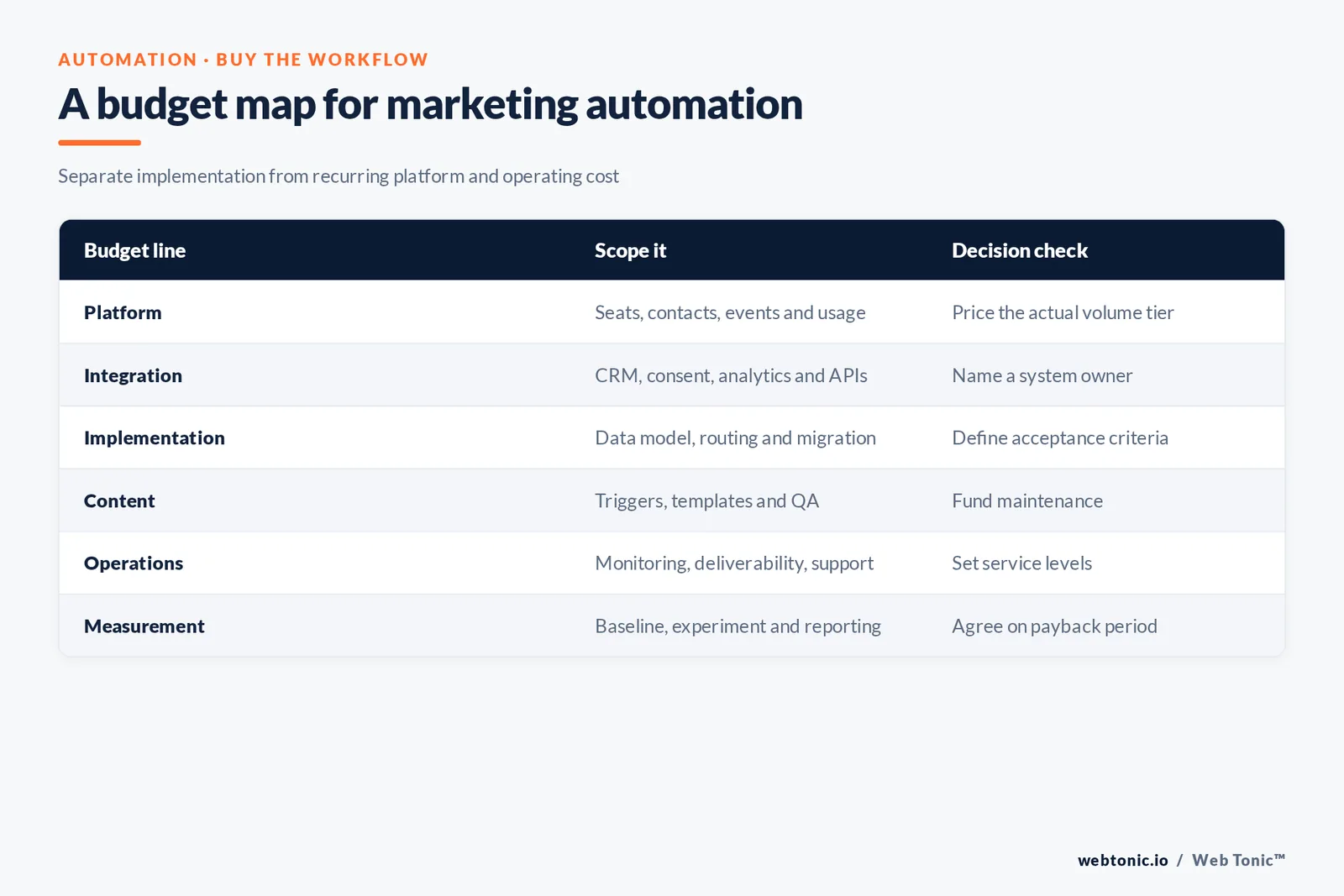
| Budget component | Include | Quote / model question |
|---|---|---|
| Platform | Seats, contacts, events, usage | What triggers an overage? |
| Implementation | Discovery, design, configuration | What counts as accepted delivery? |
| Data and integration | Mappings, APIs, monitoring | Which system owns each field? |
| Content and QA | Templates, copy, testing | Who refreshes and checks it? |
| Operations | Training, support, changes | Who owns exceptions? |
Investment patterns: budget pressure and productivity ambitions
Deloitte Digital’s 2025 Marketing Investment Trends surveyed 1,395 US marketing leaders at midsize and large B2B and B2C companies. It reports that highly automated marketing organizations were 24% more likely to meet content demand and organizations combining high automation with extensive generative AI use were 8.4 times as likely to deliver most content ahead of demand. These are associations in Deloitte’s analysis, not a causal promise or a direct automation ROI. LXA’s 2025 report found martech represented 31.4% of total marketing budgets among senior executives at large organizations; it is not a general-purpose target for smaller teams. Use these data points to ask whether capacity is a real bottleneck. Do not assume every team can replicate the results: workflow maturity, staff skills and content demand may differ.
Research source: Deloitte Digital, 2025 Marketing Investment Trends
An enterprise martech budget is broader than a platform fee
LXA’s 2025 State of Martech and Marketing Operations report describes martech at 31.4% of total marketing budget among its senior executive respondents, with an average enterprise stack of 62 tools. Its survey covered 201 senior marketing or technology leaders at organizations with revenue above £150 million. This is a specific large-organization sample; it should not be used as a budget allocation target for a small business. Its 73% reporting a clear and accurate view of martech effectiveness highlights measurement as a budget-management concern. In the Act-On Marketing Technology Insights report summarized by the American Marketing Association in May 2026, more than 100 marketers discussed automation strategy, performance and efficiency; reported themes included simplifying stacks and the importance of integration and ROI reporting. This is an industry-vendor survey, useful for questions but not an independent price benchmark. For planning, separate costs under owned platforms, integration and data, operating staff, service support, content and measurement. When reporting a share of budget, show numerator and denominator and explain whether internal labour is included.
Research source: LXA, State of Martech 2025
Read the relevant comparison below alongside the section above; definitions and populations matter.
| Research finding | Value | Population | Interpretation |
|---|---|---|---|
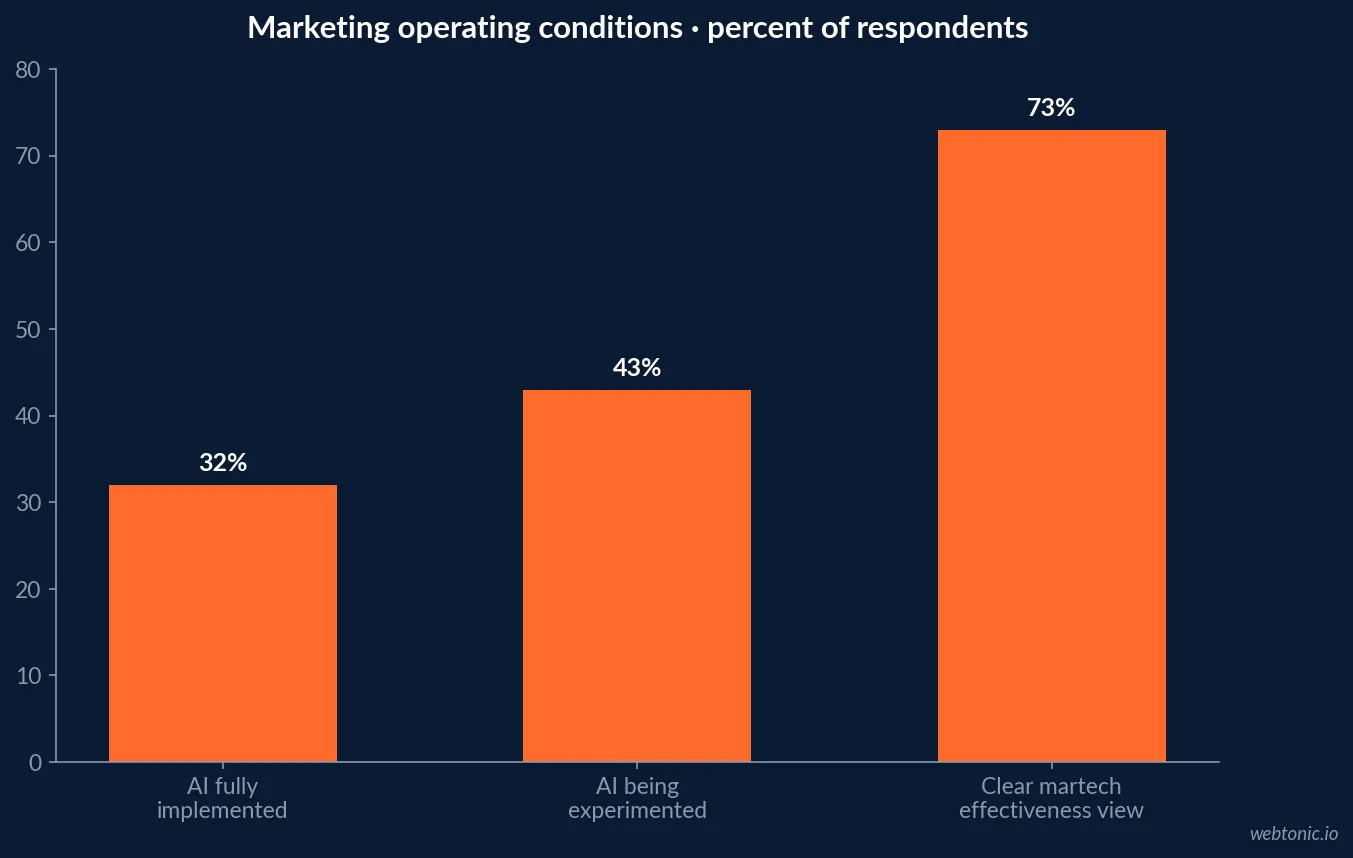
| AI fully implemented | 32% | Salesforce 2024 survey | AI workflow adoption |
| AI experimenting | 43% | Salesforce 2024 survey | AI workflow exploration |
| Automation linked to content demand | 24% more likely | Deloitte 2025 analysis | Association, not causal ROI |
| High automation + GenAI, ahead of demand | 8.4x as likely | Deloitte 2025 analysis | Deloitte-defined outcome |
| Clear martech effectiveness view | 73% | LXA 2025, senior leaders | Large enterprise sample |
A workflow-level cost model
Build a simple model per workflow. First, estimate the number of sends, contacts, decisions or handoffs per month. Second, document the current manual time, delay, rework and failure rate. Third, list each implementation requirement: triggers, data fields, systems, content, consent and escalation. Fourth, obtain vendor pricing at realistic usage levels and include onboarding, add-ons, overages and renewal terms. Fifth, estimate internal work for testing, monitoring and changes. Sixth, identify the outcome that could improve, such as fewer missed leads, faster follow-up or reduced manual workload. Do not turn minutes saved directly into cash savings unless capacity is redeployed or cost removed. Run a pilot with an owner and baseline. For business cases, show conservative, expected and upside cases with assumptions visible. A data intelligence foundation can help teams understand what outcome data they can actually observe.
Research source: Ascend2, State of Marketing Automation 2024
AI is not a synonym for automation
Salesforce’s 2024 State of Marketing surveyed 4,850 marketing decision makers across 29 countries. It said 32% of marketing organizations had fully implemented AI in workflows and another 43% were experimenting. This refers to AI, not solely marketing automation software. The report frames data unification, integration and trust as challenges alongside adoption. Teams should distinguish deterministic workflows (if an event occurs, perform an action) from predictive or generative functions. Each can have different data, governance and evaluation needs. AI features may be bundled into existing subscriptions or priced by usage; include quality review, privacy, error handling and human escalation. Define a task where automation can improve consistency or speed, then compare human-reviewed output with an agreed standard. Avoid budgeting for a vague “AI transformation” without named workflow, operator, input data and decision rights.
Research source: Salesforce, 2024 State of Marketing findings
Read the relevant comparison below alongside the section above; definitions and populations matter.
| Cost class | Examples | Control |
|---|---|---|
| Initial | Discovery, integration, migration | Acceptance tests and scope |
| Recurring | License, usage, support | Renewal and overage check |
| Internal | Owner, QA, training | Named capacity allocation |
| Risk | Consent, security, deliverability | Review before launch |
| Measurement | Baseline, experiment, reporting | Define outcome before pilot |
Integrations and data quality are budget lines
A workflow can be technically active yet fail because customer identity is duplicated, consent is stale, events arrive late or field definitions differ across systems. MarTech’s survey finding that 65.7% face data integration challenges puts this operational issue in context. Budget data mapping, cleaning, testing, monitoring and maintenance before launch. Decide which system is the source of truth for each field, who can edit it and how records are reconciled. Test edge cases: opt-outs, invalid addresses, duplicate events, missing fields, service failures and handoffs between teams. Require logs and alerts for broken automations. Document rollback paths if the workflow sends the wrong message or routes a lead incorrectly. These efforts may seem unglamorous beside a new platform, but they protect both customer trust and the value of the platform.
Research source: MarTech, 2025 State of Your Stack Survey
Measure results without promising vendor-study outcomes
HubSpot’s 2025 ROI report cites vendor customer data and surveys, including claims about customer outcomes among HubSpot users. Those results describe selected customers and product use, and should not be represented as a neutral estimate of what another company will achieve. Salesforce and Deloitte likewise publish research with specific respondent groups and definitions. Use vendor studies to generate hypotheses, not to guarantee a payback period. Choose a metric tied to the workflow: response latency, qualified leads accepted, reactivation, error rate, time per task or revenue contribution. Establish a baseline and comparison where feasible. Deduct software, implementation and ongoing labour, and account for any displaced expenses. Report confidence and limitations. If a sample is small or a workflow is seasonal, continue observation rather than dressing a short-term fluctuation as annual ROI.
Research source: HubSpot, 2025 State of Marketing
Read the relevant comparison below alongside the section above; definitions and populations matter.
| Stage | Evidence to collect | Decision |
|---|---|---|
| Select | Volume, cost, error and delay | Choose a specific workflow |
| Pilot | Adoption, exceptions, quality | Fix before expanding |
| Evaluate | Outcome vs baseline; full cost | Scale only on evidence |
| Operate | Monitoring, updates, opt-outs | Fund ongoing owner |
| Review | Usage and overlap each quarter | Remove unused capability |
What to include in a realistic implementation budget
Budget items normally split into initial and recurring cost. Initial work may include process discovery, architecture, data cleanup, migration, integrations, security and consent review, templates, testing and training. Recurring costs include license, contacts or usage, technical support, staff ownership, content refresh, monitoring, deliverability and analytics. Include implementation contingency for legacy system quirks and scope changes. Contracts deserve scrutiny: renewal dates, price escalators, overage rates, data export, support response and termination access. Define acceptance tests before paying for completion: correct triggers, suppression logic, handoffs, reporting and rollback. If a partner supports delivery, scope the work and ownership explicitly; do not assume the subscription provider will configure every business process. Request references for similar workflows and integration complexity, not merely a feature demonstration.
Research source: Ascend2, State of Marketing Automation 2024
A 90-day decision sequence for marketing teams
Weeks one to two: map candidate workflows and measure current effort, volume, errors and customer friction. Weeks three to four: select one high-frequency, lower-risk use case with usable data, then confirm consent, ownership and vendor requirements. Month two: implement a bounded pilot, establish alerts and train operators. Month three: review adoption, exceptions, quality and cost against the baseline. Expand only if the workflow is reliable and the expected benefit can be measured. If data or ownership is not ready, budget the remediation first. Do not automate a broken process simply because the tool can reproduce it faster. Revisit the stack quarterly to identify redundant tools and features that are paid for but unused. Connect the plan to a wider growth marketing roadmap and reserve budget for the work that keeps automation useful after launch.
Research source: American Marketing Association, Act-On 2026 report summary
Related planning: growth marketing, data intelligence, performance creative, campaign strategy, and talk with Web Tonic.
Useful next steps: growth marketing, data intelligence, performance creative, and contact Web Tonic.
Frequently Asked Questions
How much should a company budget for marketing automation?
There is no universal defensible figure in these studies. Estimate platform and usage fees, integration, implementation, data cleanup, content, training, security and ongoing operation against your actual workflows and vendor quotes.
What is included in a marketing automation budget?
Common lines include platform licensing, contact or event volume, CRM and data integrations, workflow design, content and templates, migration, consent and deliverability, training, reporting and maintenance.
Does marketing automation guarantee a return?
No. Benefits depend on workflow volume, data quality, adoption and whether saved capacity or improved outcomes are measured. Vendor studies are directional evidence, not guaranteed results for another company.
How widely is marketing automation used?
MarTech’s 2025 State of Your Stack survey reported 76.9% of respondents used marketing automation platforms in their stack. This is self-reported tool presence among survey respondents, not proof that tools are used effectively.
What should teams measure before expanding automation?
Baseline workflow time, volume, error rates, response speed and outcome quality; include platform and operating costs. Compare an appropriate pilot or cohort, then monitor adoption, exceptions, deliverability and customer experience.
Sources
Deloitte Digital, 2025 Marketing Investment Trends
LXA, State of Martech 2025
MarTech, 2025 State of Your Stack Survey
Salesforce, 2024 State of Marketing findings
Salesforce, 9th State of Marketing report
HubSpot, 2025 State of Marketing
HubSpot, 2025 ROI report
The CMO Survey, results and reports
Ascend2, State of Marketing Automation 2024
Ascend2, Q1 2025 research highlights
American Marketing Association, Act-On 2026 report summary