



Table of contents
Key Takeaways
- WordPress powers 59.1% of all websites with a known CMS and 41.2% of all websites globally (W3Techs).
- 76% of UK advanced manufacturing companies with a detectable CMS use WordPress — 9,127 out of 12,006 sites (Firmbase).
- Manufacturing websites average a 2.6% overall conversion rate with RFQ form submissions at 2.8% (CuFinder).
- WordPress sites with 50+ employee manufacturers show 80.4% adoption, increasing with company size (Firmbase).
- 56.4% of manufacturing website traffic comes from desktop, with mobile growing to 39.2% (CuFinder).
- 48.5% of manufacturing website traffic comes from organic search — the #1 traffic source (CuFinder).
- WordPress with WooCommerce is used by 19.8% of all WordPress sites, powering B2B ecommerce for manufacturers (W3Techs).
Manufacturing WordPress Adoption at a Glance
| Metric | Value | Source |
|---|---|---|
| WordPress global CMS share | 59.1% | W3Techs 2026 |
| WordPress global website share | 41.2% | W3Techs 2026 |
| UK mfg companies on WordPress | 76.0% (9,127) | Firmbase 2026 |
| Mfg WordPress (50+ employees) | 80.4% | Firmbase 2026 |
| Second-place CMS (Wix) | 9.0% (1,075) | Firmbase 2026 |
| Manufacturing website CVR | 2.6% | CuFinder 2026 |
| Organic search traffic share | 48.5% | CuFinder 2026 |
| Desktop traffic share | 56.4% | CuFinder 2026 |
| WooCommerce on WordPress sites | 19.8% | W3Techs 2026 |
| Elementor page builder usage | 31.4% | W3Techs 2026 |
WordPress Dominance in Manufacturing CMS Market Share
WordPress holds an uncontested lead in the manufacturing sector's CMS landscape. According to W3Techs (July 2026), WordPress powers 59.1% of all websites with a known CMS, representing 41.2% of all websites globally. In the manufacturing vertical specifically, the dominance is even more pronounced.
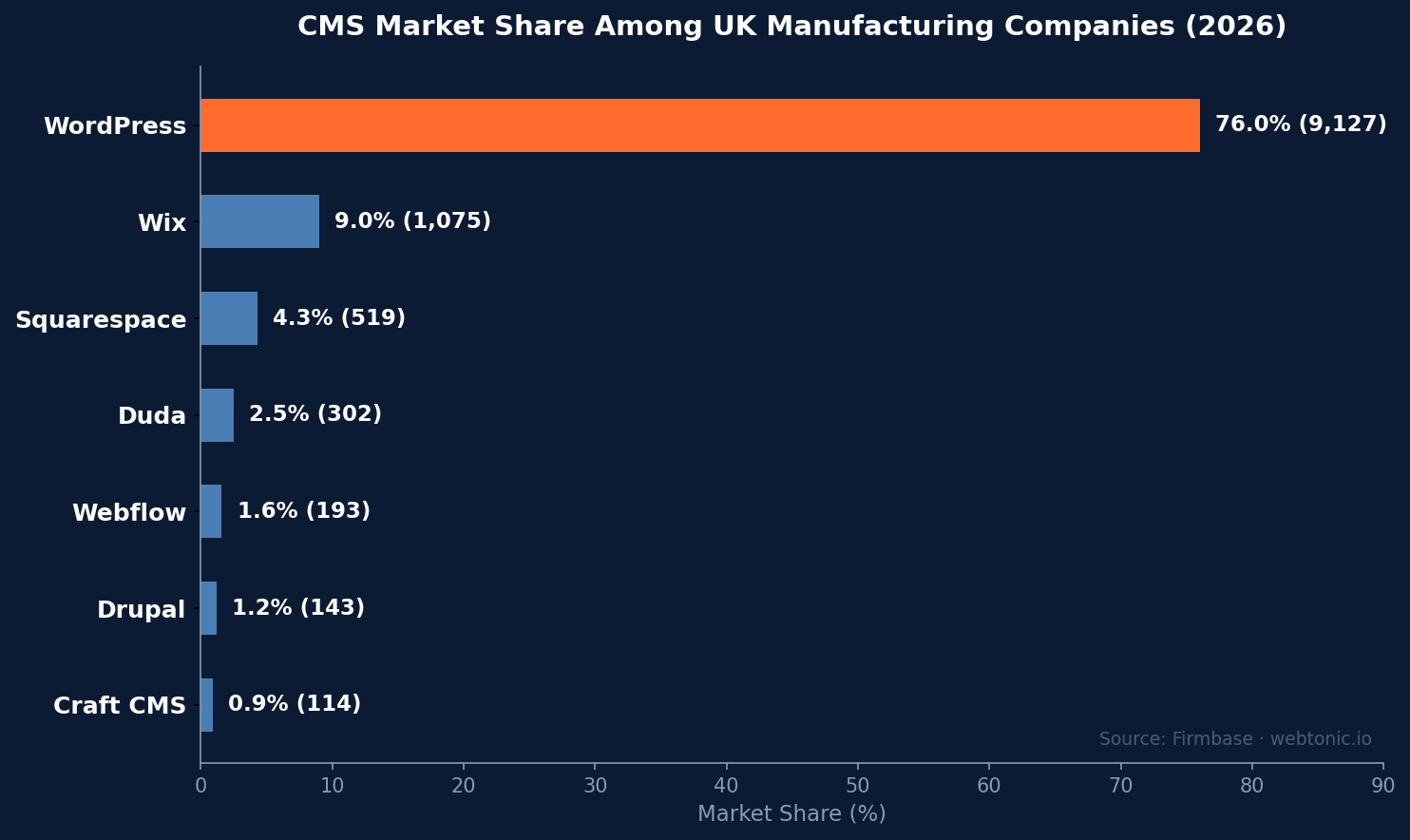
Firmbase's June 2026 analysis of 50,406 UK advanced manufacturing companies found that among the 12,006 with a detectable CMS, 76.0% (9,127 companies) use WordPress. The second-place platform, Wix, holds just 9.0% (1,075 companies), followed by Squarespace at 4.3% (519), Duda at 2.5% (302), and Webflow at 1.6% (193). This distribution reveals a market where WordPress is not just the leader — it is the default industrial web platform. Our growth marketing services help manufacturers maximize the performance of their WordPress infrastructure.
WordPress Adoption by Manufacturing Company Size
One of the most striking findings from Firmbase's dataset is that WordPress adoption actually increases with company size in manufacturing, contradicting the assumption that larger firms migrate to enterprise CMS platforms:
| Company Size | Companies with CMS | WordPress Share | WordPress Count |
|---|---|---|---|
| Under 10 employees | 7,270 | 75.4% | 5,482 |
| 10–50 employees | 4,175 | 76.4% | 3,190 |
| 50+ employees | 561 | 80.4% | 451 |
The data shows that 80.4% of manufacturers with 50+ employees use WordPress, the highest rate across all size bands. As PERC Engage notes, this is because WordPress has evolved far beyond a blogging platform — modern manufacturing WordPress sites handle complex product catalogs, ERP integrations, quote request systems, and technical documentation management. The plugin ecosystem supports manufacturing-specific needs including advanced product filtering and CAD file hosting.
Manufacturing Website Performance and Conversion Benchmarks
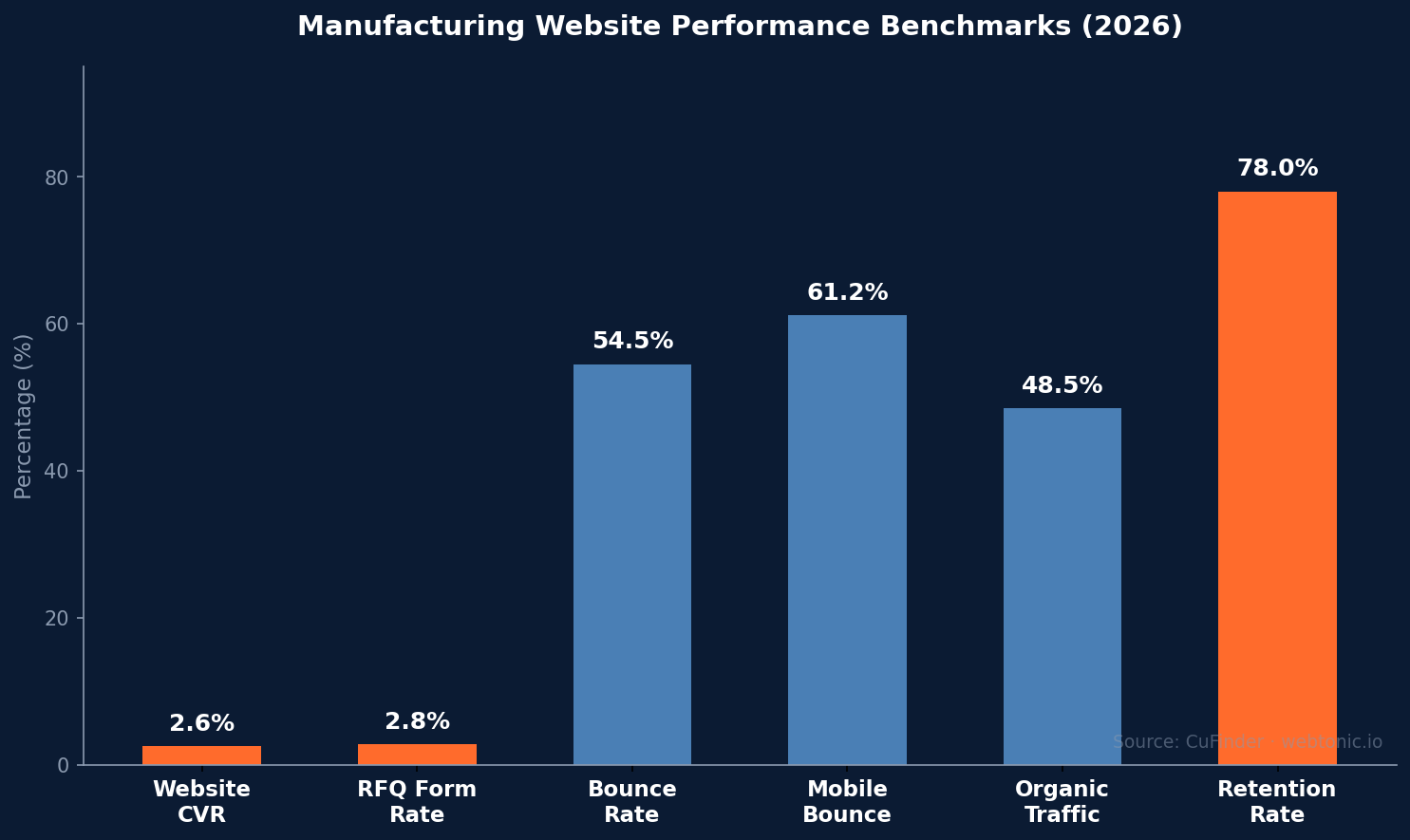
CuFinder's 2026 benchmark study of 80+ specialized manufacturers provides the most comprehensive performance data available for the sector:
| Metric | Manufacturing Benchmark | Context |
|---|---|---|
| Overall website CVR | 2.6% | CNC, custom fabrication, precision engineering |
| RFQ form submission rate | 2.8% | Primary lead capture mechanism |
| Pages per session | 3.8 | High engagement with product specs |
| Avg. time on page | 2 min 15 sec | Technical content drives longer visits |
| Bounce rate (overall) | 54.5% | Lower than B2C average |
| Mobile bounce rate | 61.2% | Mobile experience still lags desktop |
| Monthly unique visitors (SME) | 4,500–12,000 | Small/mid manufacturing companies |
| Customer retention rate | 78% | Industry average across manufacturing |
The 2.6% overall conversion rate is competitive for B2B manufacturing, where deal values are significantly higher than B2C. With an average Google Ads CPC of $6.85 and search CPA of $135 in manufacturing (CuFinder), website conversion optimization directly impacts cost-per-acquisition. For manufacturers looking to improve these metrics through paid channels, our Google Ads cost guide provides detailed budgeting frameworks.
Traffic Sources and SEO Performance for Manufacturing WordPress Sites
Understanding where manufacturing website traffic originates is essential for WordPress optimization priorities. CuFinder's 2026 data shows a clear organic-first traffic pattern:
- 48.5% from organic search — the dominant traffic source, reinforcing why SEO-optimized WordPress sites are critical for manufacturers.
- 18% from paid search (U.S.) — Google Ads drives targeted leads with 3.15% conversion rate and $6.85 CPC.
- 56.4% desktop / 39.2% mobile / 4.4% tablet — desktop still leads but mobile is growing rapidly.
- Email marketing: 23.5% open rate, 2.9% CTR — a strong retention channel for manufacturing.
- Social media: 1.45% average engagement rate, with video content driving 2.8% engagement.
The heavy organic search dependency means WordPress's SEO capabilities — clean URL structures, meta tag management, mobile responsiveness, and schema markup support — are the primary reasons manufacturers choose the platform. As Nopio notes, WordPress holds over 60% of the CMS market share, and that market dominance translates into a massive pool of qualified developers and SEO specialists familiar with the platform. Our data intelligence services help manufacturers track which traffic sources drive the highest-value RFQs.
WordPress Ecosystem and Plugin Stack for Manufacturing
W3Techs' July 2026 data reveals the WordPress subtechnology landscape that manufacturers rely on:
- Elementor: 31.4% of all WordPress sites — the most popular page builder, used heavily for product catalog pages.
- WooCommerce: 19.8% — the dominant ecommerce plugin, enabling B2B ordering, quote requests, and industrial parts catalogs.
- WPBakery: 7.5% — legacy page builder still present in older manufacturing sites.
- Version 7: 51.5% of WordPress sites now run on the latest major version, showing strong update adoption.
PERC Engage cautions that the plugin ecosystem is both WordPress's greatest strength and its most common weakness. Inexperienced developers often stack 30–50+ plugins, creating cascading issues for manufacturing websites: performance degradation, security vulnerabilities, and plugin conflicts. Nopio recommends an engineering-first approach — using custom development for product catalog architecture, ERP integration layers, and quote request workflows while reserving plugins for well-maintained, focused tools.
Core Web Vitals and Technical Performance for Industrial WordPress Sites
Manufacturing websites carry unique technical challenges that impact Core Web Vitals scores. Manufacturing SEO Agency identifies the primary performance bottlenecks for industrial WordPress sites:
- Hi-resolution machinery photos and CAD assets increase Largest Contentful Paint (LCP) — manufacturers must implement lazy loading, WebP/AVIF format conversion, and responsive image serving.
- JavaScript-heavy quote forms and product configurators impact Interaction to Next Paint (INP) — breaking long JavaScript tasks and deferring third-party scripts is critical.
- Late-loading banners and web fonts cause Cumulative Layout Shift (CLS) — reserving space for images, videos, and iframes prevents layout shifts on catalog pages.
- PDF spec sheets and downloadable CAD files require CDN configuration for efficient serving — caching rules must account for large technical documents.
For manufacturers using WordPress, the balance between rich technical content (product specifications, 3D renders, interactive configurators) and page speed is the defining challenge. Companies that solve this gain a measurable SEO advantage, as Core Web Vitals are a confirmed Google ranking factor, particularly relevant when manufacturers compete for high-CPC industrial keywords. Explore our Meta Ads services for paid channels that complement organic WordPress performance.
WordPress Alternatives for Manufacturing: Competitive Landscape
| CMS Platform | Mfg Market Share | Best For | Key Limitation |
|---|---|---|---|
| WordPress | 76.0% | Most manufacturers, SEO, plugins | Plugin bloat if poorly managed |
| Wix | 9.0% | Small shops, quick launch | Limited ERP integrations |
| Squarespace | 4.3% | Design-forward brands | Lacks B2B ecommerce depth |
| Webflow | 1.6% | Design control, no-code | Smaller developer pool |
| Drupal | 1.2% | Complex enterprise needs | Higher development cost |
| Craft CMS | 0.9% | Developer flexibility | Niche community |
As PERC Engage summarizes: WordPress remains a solid choice for most manufacturing companies, but it is not automatically the best choice for everyone. Companies with complex ERP integrations, massive product catalogs (100,000+ SKUs), or real-time inventory requirements may benefit from headless CMS or custom solutions. For the vast majority of manufacturers, however, WordPress's cost-effectiveness, developer availability, and SEO foundation make it the pragmatic choice.
WordPress Cost-Effectiveness for Manufacturing Operations
The financial case for WordPress in manufacturing is rooted in three factors: platform cost (free and open-source), developer availability, and long-term maintenance economics. According to Nopio, WordPress development costs focus on building what you actually need rather than licensing fees for features you do not use. This model appeals to manufacturing companies watching capital expenditure, where a WordPress site can be launched for a fraction of the six-figure price tag of custom enterprise development.
PERC Engage highlights that the developer ecosystem is a critical advantage: when 41.2% of all websites run on WordPress, finding qualified developers becomes significantly easier than sourcing specialists for niche platforms. This reduces vendor dependency and gives manufacturers leverage in agency negotiations. For manufacturing companies with annual IT budgets under $50,000, WordPress's ecosystem economics make enterprise-grade features accessible — from advanced product filtering to ERP integration plugins — without enterprise-grade costs.
Best Practices for Manufacturing WordPress Websites
- Prioritize an engineering-first approach. Use custom development for critical systems (product catalogs, ERP integrations, quote forms) rather than stacking plugins. Nopio recommends limiting plugin dependencies to well-maintained tools only.
- Optimize Core Web Vitals for industrial content. Implement lazy loading, WebP conversion, and CDN configuration specifically for CAD files, PDF spec sheets, and hi-res machinery photography (Manufacturing SEO Agency).
- Target the 2.6% CVR benchmark. Use RFQ forms as the primary conversion mechanism with clear calls-to-action on every product page (CuFinder).
- Invest in SEO since 48.5% of traffic is organic. Clean URL structures, meta tag management, and schema markup should be standard on every manufacturing WordPress site.
- Address mobile experience gaps. With 61.2% mobile bounce rate vs. 54.5% overall, mobile optimization remains the largest untapped opportunity for manufacturers. Learn more in our Google Ads strategy guide.
- Update WordPress aggressively. With 51.5% now on Version 7, manufacturers on older versions face security and performance risks.
Related reading
- Surrogacy Wordpress Statistics
- Veterinary WordPress Statistics: CMS Share, Speed & Conversion Data (2026)
- Webflow for Manufacturing Websites: 2026 Statistics & Benchmarks
- Custom Web Development services at Web Tonic
Frequently Asked Questions
What percentage of manufacturing companies use WordPress?
According to Firmbase's June 2026 analysis, 76.0% of UK advanced manufacturing companies with a detectable CMS use WordPress — 9,127 out of 12,006 sites. This percentage increases with company size, reaching 80.4% among manufacturers with 50+ employees. Globally, WordPress powers 59.1% of all websites with a known CMS (W3Techs).
What is the average conversion rate for manufacturing WordPress websites?
CuFinder's 2026 benchmark study of 80+ specialized manufacturers found an overall website conversion rate of 2.6%, with RFQ form submissions averaging 2.8%. Manufacturing visitors spend an average of 2 minutes 15 seconds on page and view 3.8 pages per session, indicating high engagement with technical content.
Is WordPress still the best CMS for manufacturers in 2026?
For the majority of manufacturers, yes. WordPress offers the best combination of cost-effectiveness, developer availability (60%+ CMS market share), SEO capabilities, and plugin ecosystem. However, manufacturers with complex ERP integration needs, 100,000+ SKU catalogs, or real-time inventory requirements may benefit from headless CMS or custom solutions.
What are the main competitors to WordPress for manufacturing websites?
Wix holds 9.0% of the manufacturing CMS market, followed by Squarespace at 4.3%, Duda at 2.5%, Webflow at 1.6%, and Drupal at 1.2%. No single alternative comes close to WordPress's 76% share. Drupal and Craft CMS offer more technical flexibility but require larger development budgets.
How much does a manufacturing WordPress website cost?
WordPress itself is free and open-source. Development costs for a professional manufacturing website typically range from $5,000 to $30,000+ depending on complexity. The engineering-first approach — custom product catalogs, ERP integration layers, and quote request workflows — costs more upfront but reduces long-term maintenance expenses from plugin conflicts and security patches.
Sources
w3techs.com – WordPress usage statistics July 2026
firmbase.co – CMS used by UK advanced manufacturing 2026
cufinder.io – specialized manufacturing benchmarks 2026
percengage.com – WordPress for manufacturing 2026
nopio.com – WordPress for manufacturers
manufacturing-seo.agency – Core Web Vitals for industrial sites


