



Table of contents
WordPress powers the majority of surrogacy and fertility clinic websites, leveraging its 59.1% CMS market share and extensive healthcare plugin ecosystem. However, performance varies widely — from clinics achieving 62% SEO growth after a redesign to sites struggling with average LCP times of 9.7 seconds (nearly 4 times Google's threshold). These statistics cover everything from CMS adoption and Core Web Vitals to security vulnerabilities and conversion benchmarks to help you assess your growth marketing services WordPress investment and identify where your site falls relative to the competition.
Key Takeaways
- WordPress powers 59.1% of all websites using a CMS as of July 2026 (W3Techs).
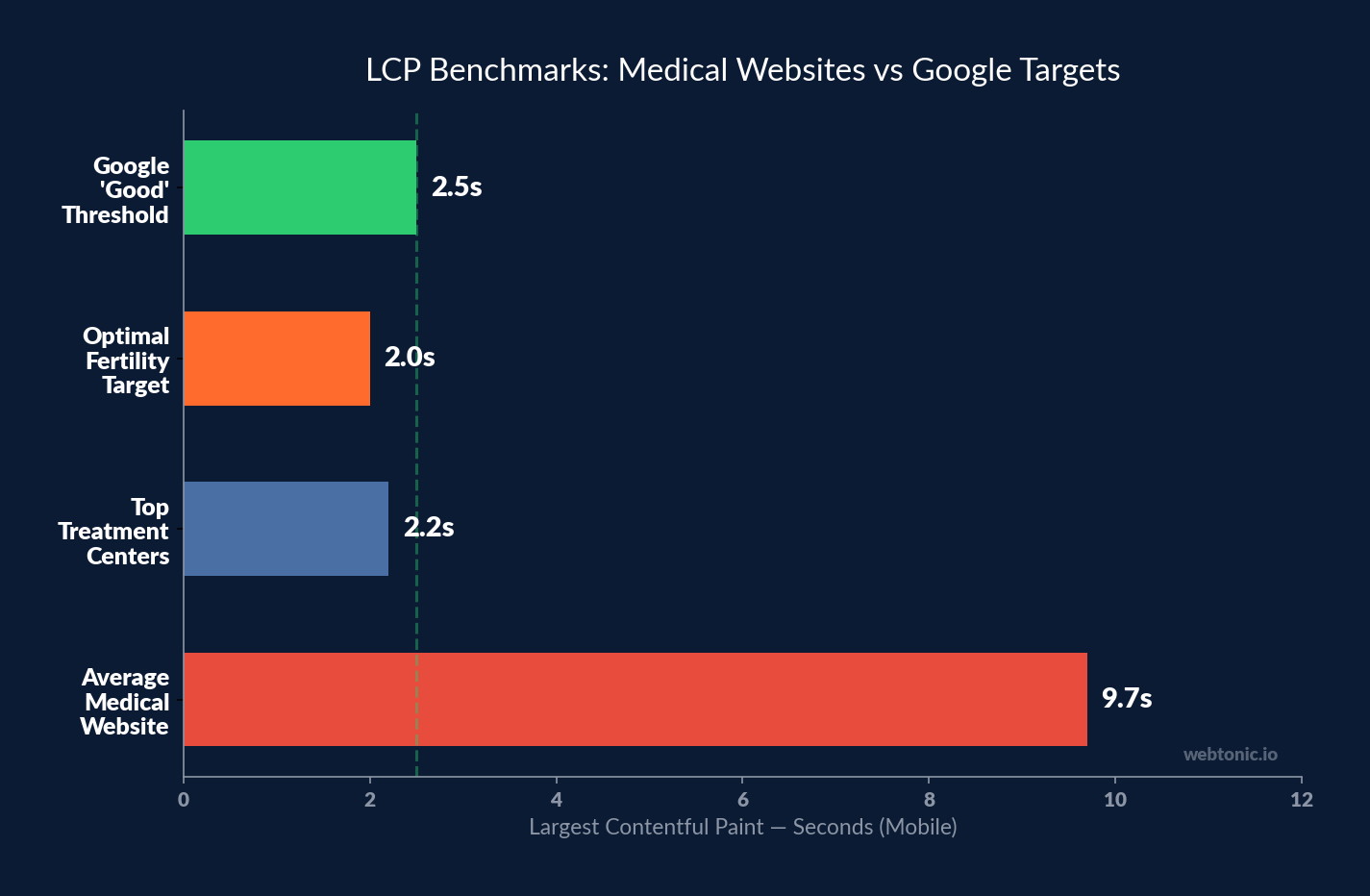
- The average medical website takes 9.7 seconds for LCP — nearly 4 times Google's 2.5-second "Good" threshold (Borah Labs).
- Treatment center LCP targets should be 1.8–2.2 seconds at the 75th percentile on mobile for competitive ranking signals (Webserv).
- WordPress has 18,005 known CVEs, making security hardening critical for healthcare sites handling patient data (Adyog).
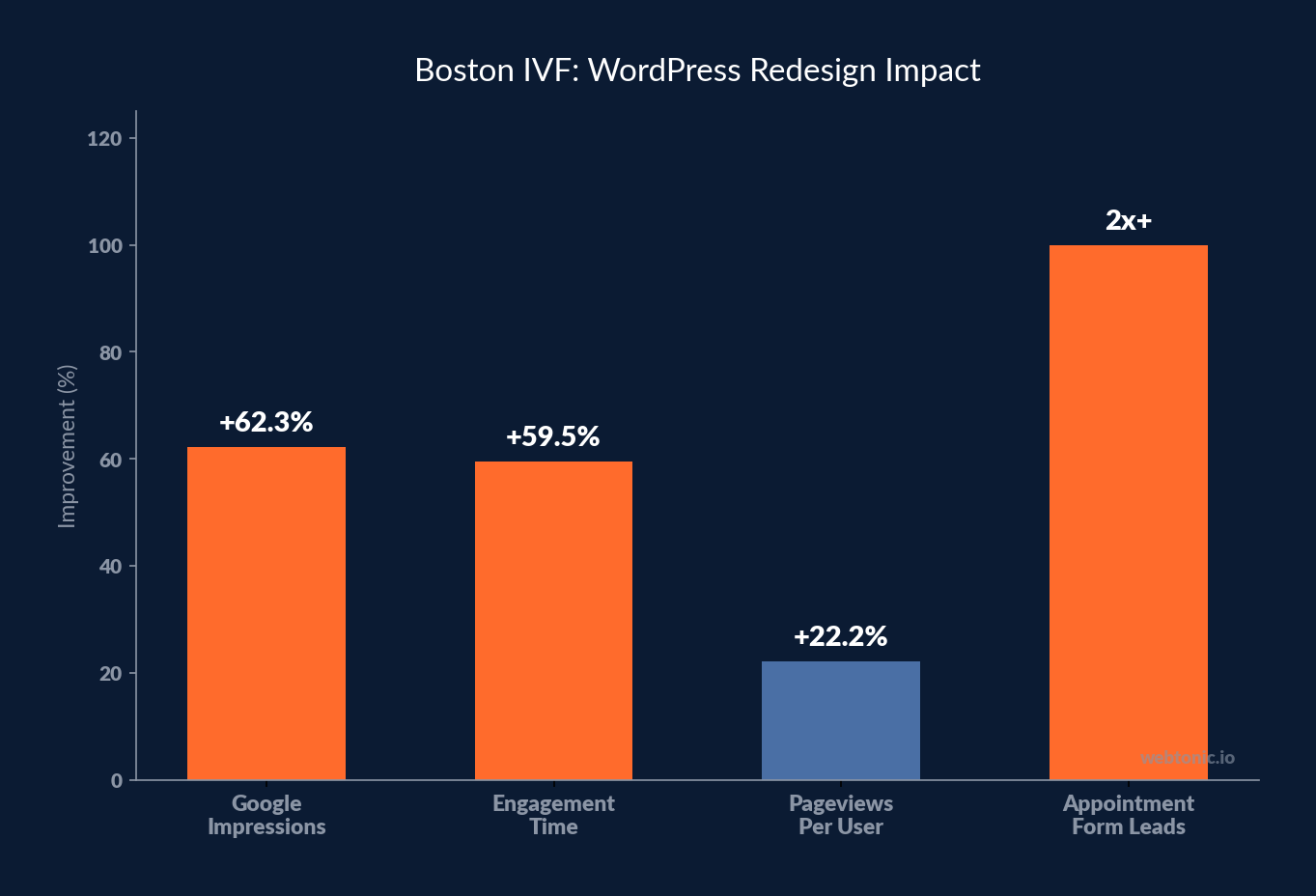
- Boston IVF saw 62.3% SEO growth in Google impressions and 59.5% engagement time increase after a WordPress redesign (eDesign Interactive).
- Organic search drives 45–60% of fertility clinic website traffic, with the top 3 organic results capturing 25–35% of clicks (Authority Specialist).
- Top technologies on medical sites are jQuery (55.1%), PHP (53.2%), and MySQL (47.7%) — WordPress's native stack dominates the healthcare web (Borah Labs).
WordPress & CMS Market Data for Healthcare
WordPress remains the dominant content management system for healthcare and fertility websites, powering the majority of clinic sites through its flexible plugin architecture and SEO capabilities. The following data from W3Techs and Borah Labs' medical website benchmarks provides the current landscape for CMS adoption, technology stacks, and performance baselines in the healthcare and fertility sectors.
| Metric | Value | Source | Context |
|---|---|---|---|
| WordPress CMS Market Share | 59.1% of CMS-using sites | W3Techs (Jul 2026) | Dominant platform globally |
| Top Tech Stack (Medical) | jQuery 55.1%, PHP 53.2%, MySQL 47.7% | Borah Labs | WordPress's native technology stack |
| Avg Medical Site LCP | 9.7 seconds | Borah Labs | 3.9 times the 2.5s Good threshold |
| Target Treatment Center LCP | 1.8–2.2 seconds (75th percentile) | Webserv | Material ranking and UX improvement |
| WordPress Known CVEs | 18,005 | Adyog | Ongoing security hardening required |
| Mobile Search Share (Fertility) | 65–80% of queries | Authority Specialist | Mobile-first design is non-negotiable |
Core Web Vitals & Page Speed for Fertility Sites
Page speed directly impacts both search rankings and patient conversion rates for fertility clinic websites. Google's Core Web Vitals thresholds set the bar at 2.5 seconds for Largest Contentful Paint (LCP), yet the average medical website falls far short of this standard. WordPress sites can achieve competitive speeds, but only with intentional optimization of hosting, images, plugins, and caching.
- The average general medical website takes 9.7 seconds for LCP — nearly 4 times the Good threshold. If your LCP exceeds 2.5 seconds, you face ranking penalties in Google Search results (Borah Labs).
- The realistic LCP target for treatment center sites is 1.8–2.2 seconds at the 75th percentile on mobile. Hitting 1.8 seconds produces materially better user experience and a stronger ranking signal than the 2.5-second minimum (Webserv).
- Well-tuned WordPress sites outperform poorly-built custom builds routinely — platform choice matters less than how it is configured for speed, caching, and image optimization (Borah Labs).
- Mobile search accounts for 65–80% of fertility clinic queries, making mobile LCP, responsive design, and touch-friendly navigation the top priority for data intelligence services investments (Authority Specialist).
- Organic search traffic declined 19.5% industry-wide during a recent tracking period, making page speed optimization even more critical for clinics competing for shrinking organic visibility (Fertility SEO Expert).
WordPress Security Statistics for Healthcare
Security is a critical concern for surrogacy and fertility websites that handle sensitive patient data, intake forms, and HIPAA-adjacent information. WordPress's extensive plugin ecosystem introduces significant attack surface that requires active management. According to Adyog's healthcare WordPress analysis, healthcare organizations are running their websites on a framework with thousands of known vulnerabilities, often with minimal PHP security hardening in place.
| Security Metric | Value | Implication for Fertility Sites |
|---|---|---|
| Known WordPress CVEs | 18,005 | Ongoing patching and quarterly plugin auditing required |
| Primary Vulnerability Source | PHP vulnerabilities, plugin exposure | Third-party plugins are the number one risk vector |
| Patient Portal Approach | Custom-built (React or Node) | Surrogacy portals increasingly built outside WordPress |
| HIPAA Compliance Risk | High without hardening | Default WordPress installation is not HIPAA-ready |
| Security Plugin Market | Active (specialized healthcare) | Nubivio and similar plugins add healthcare-specific hardening |
Fertility Website SEO & Conversion Performance
WordPress sites in the fertility space can deliver strong SEO results when properly optimized for content depth, technical performance, and user experience. The following data covers organic traffic distribution, conversion rates, and the impact of strategic website redesigns for fertility clinic WordPress sites. These benchmarks illustrate both the opportunity and the gap that most fertility clinics face in their digital presence.
| Metric | Value | Source |
|---|---|---|
| Organic Search Traffic Share | 45–60% of total website traffic | Authority Specialist |
| Top 3 Organic Click Share | 25–35% of all clicks | Authority Specialist |
| Organic-to-Consultation CVR | 3–8% depending on content depth | Authority Specialist |
| Boston IVF Impressions Growth | +62.3% after WordPress redesign | eDesign Interactive |
| Engagement Time Increase | +59.5% per user post-redesign | eDesign Interactive |
| Pageviews Per User Increase | +22.2% post-redesign | eDesign Interactive |
| Appointment Form Leads | More than doubled post-redesign | eDesign Interactive |
| Organic Traffic Decline (Industry) | -19.5% during tracking period | Fertility SEO Expert |
The Boston IVF redesign case study is especially instructive for surrogacy agencies considering a WordPress refresh. By focusing on user experience, mobile performance, and content organization, the redesign delivered 62.3% more Google impressions, 59.5% higher engagement time, 22.2% more pageviews per user, and more than doubled appointment form leads. The investment in a modern WordPress build paid for itself through measurably higher patient acquisition rates from existing organic traffic — a reminder that CMS platform choice matters less than execution quality.
WordPress vs Custom Builds for Surrogacy Websites
The choice between WordPress and custom-built platforms depends on clinic size, budget, technical requirements, and data sensitivity. Here is a data-informed comparison based on the latest benchmarks and industry practice:
- WordPress is the default for most fertility clinics — its 59.1% CMS market share means extensive plugin support, widespread developer availability, and mature SEO tooling out of the box for content-driven sites.
- Platform choice matters less than configuration quality — Borah Labs found that well-tuned WordPress sites routinely outperform poorly-built custom builds on Core Web Vitals and SEO performance metrics.
- Patient portals are increasingly custom-built outside WordPress using React and Node stacks to avoid the 18,005 known CVE exposure and meet stricter data security and HIPAA compliance requirements for sensitive patient information.
- Healthcare SEO benchmarks across 427 sites show WordPress-dominant stacks performing competitively when optimized for speed, mobile responsiveness, and structured data markup.
- Surrogacy agency websites benefit from WordPress's content flexibility — blog posts, surrogate profiles, intended parent resources, and legal information pages all leverage WordPress's CMS architecture effectively for SEO and user engagement.
Surrogacy-Specific WordPress Considerations
Surrogacy agency websites have unique requirements that differ from general healthcare or even general fertility clinic sites. The dual-audience nature of surrogacy marketing (intended parents and potential surrogates) creates specific WordPress architecture and content requirements.
- Separate content pathways for intended parents and surrogates — surrogacy sites need distinct navigation, landing pages, and conversion funnels for each audience, which WordPress handles well through custom post types and page templates.
- Legal compliance content varies by state and country — WordPress's content management capabilities make it straightforward to maintain jurisdiction-specific surrogacy law pages, which are critical for SEO and user trust.
- A surrogacy agency SEO case study from Website Design Digital showed that effective SEO techniques on a WordPress site led to significant increases in user engagement rates and corresponding reductions in bounce rates for Surrogacybypons.com.
- Intake forms and application workflows require careful security considerations — plugins for multi-step forms are convenient but must be audited for data handling compliance, especially for surrogacy agencies processing personal health information.
WordPress Best Practices for Surrogacy & Fertility Sites
Based on the benchmarks and case studies above, here are the data-backed recommendations for running a surrogacy or fertility WordPress site in 2026:
- Target LCP under 2.2 seconds on mobile. The average medical site is 9.7 seconds — achieving 1.8–2.2 seconds provides a material ranking and UX advantage over the vast majority of competitors in the fertility space.
- Audit plugins quarterly for CVEs. With 18,005 known WordPress vulnerabilities, third-party plugin security is the number one risk vector for fertility sites handling sensitive patient and surrogate data.
- Prioritize mobile-first design. With 65–80% of fertility search queries on mobile devices, responsive design and mobile page speed are non-negotiable for competitive visibility.
- Invest in content depth for organic SEO. Organic search drives 45–60% of fertility traffic, and organic-to-consultation conversion ranges from 3–8% depending on content quality and depth.
- Consider a redesign if performance metrics lag. Boston IVF's WordPress redesign delivered 62.3% more impressions, 59.5% higher engagement, and doubled appointment form leads — the ROI of a modern build is measurable.
- Separate patient portals from the main WordPress site. Use custom-built portals for sensitive data to avoid HIPAA exposure and leverage WordPress for about Web Tonic content, SEO, and marketing pages where its CMS strengths shine.
Related reading
- Locksmith WordPress Stats & Data
- 25+ Manufacturing WordPress Statistics Every Marketer Should Know
- Medical Spa WordPress Statistics (2026): Benchmarks & Trends
- Custom Web Development services at Web Tonic
FAQ
Is WordPress good for surrogacy agency websites?
Yes. WordPress powers 59.1% of all CMS-based websites and offers extensive SEO and plugin support for content-driven sites. Well-tuned WordPress sites outperform poorly-built custom builds on Core Web Vitals and search performance. However, patient portals with sensitive data should use custom-built platforms for security compliance.
What is a good page speed for a fertility clinic website?
Target LCP under 2.2 seconds at the 75th percentile on mobile. The average medical website takes 9.7 seconds for LCP — nearly 4 times Google's 2.5-second Good threshold. Hitting 1.8 seconds provides a material ranking and user experience advantage over competitors.
How secure is WordPress for healthcare websites?
WordPress has 18,005 known CVEs, primarily from PHP vulnerabilities and third-party plugins. Default WordPress is not HIPAA-ready without hardening. Fertility sites must implement security hardening, regular plugin audits, and should separate patient data handling from the main WordPress installation.
How much traffic do fertility clinic websites get from organic search?
Organic search typically drives 45–60% of total website traffic for high-performing fertility clinics. The top 3 organic results for high-intent fertility keywords capture 25–35% of all clicks, and organic-to-consultation conversion rates range from 3–8% depending on content depth.
Does a website redesign improve fertility clinic leads?
Yes. Boston IVF saw a 62.3% increase in Google impressions, 59.5% higher engagement time, 22.2% more pageviews per user, and more than doubled appointment form leads after a WordPress redesign focused on UX and SEO fundamentals.
Sources
W3Techs — WordPress Usage Statistics July 2026
Borah Labs — General Medical Website Benchmarks
Webserv — Core Web Vitals for Treatment Center Websites 2026
Authority Specialist — IVF Clinic SEO Benchmarks 2026
Adyog — Healthcare Websites on WordPress: 18,005 CVEs
eDesign Interactive — Boston IVF Website Redesign Case Study
Website Design Digital — Surrogacy Agency SEO Case Study
Fertility SEO Expert — Patient Discovery in 2025


