Table of contents
Manufacturing buyers do not leave star ratings the way restaurant or retail customers do, so a supplier chasing a five-star aggregate is optimizing for a signal its own buyers rarely use. Named B2B buyer research shows the inbound trust signal that actually moves a shortlist is closer to a checkable reference than a review count - this page treats that distinction as the whole story, not a footnote.
Key Takeaways
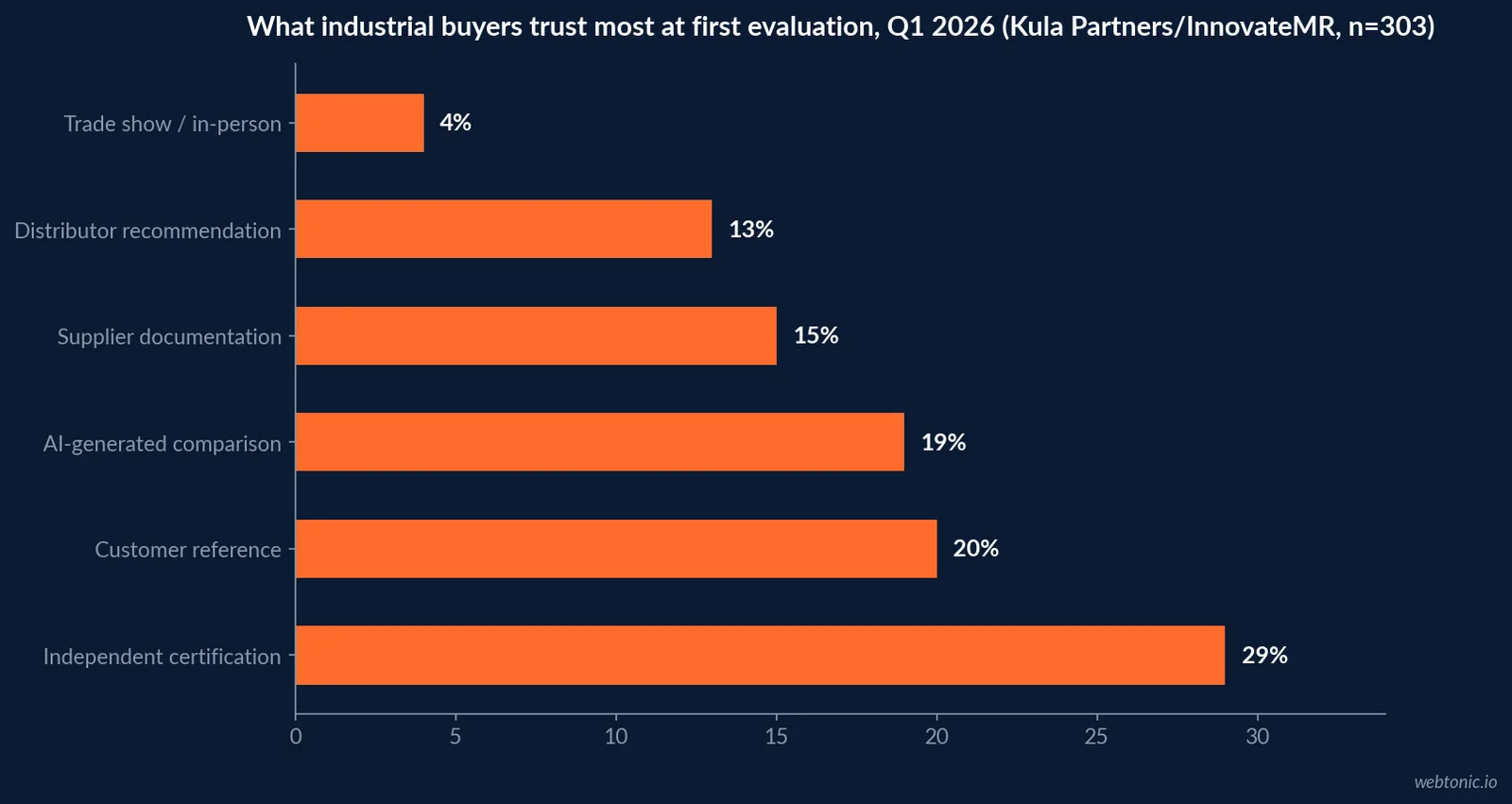
- 29% of industrial buyers trust independent third-party validation or certification first (Kula Partners/InnovateMR, Q1 2026, n=303).
- 20% trust a customer reference from their own industry as the top proof type.
- 19% trust an AI-generated comparison - now ahead of supplier-authored documentation.
- 15% trust supplier technical documentation, placing fourth.
- Only 4% trust a trade show or in-person discussion as their top proof type.
- 76% of buyers shortlist at least one supplier before any live contact, down from 83% in Q4.
- Among C-level/VP buyers, pre-contact shortlisting stays above 90%.
- Thomasnet's platform sees over 1.5 million monthly sourcing sessions across 80,000+ categories (2025 Annual Sourcing Activity Report).
- Thomasnet connects buyers with more than 500,000 suppliers.
- Contract and private-label manufacturing was the top-sourced service category on Thomasnet in 2025.
- The FTC's fake-review rule (16 CFR Part 465, 2024) covers B2B testimonials, not only consumer reviews.
- G2's 2025 Buyer Behavior Report and TrustRadius' 2025 research are software-buying data, not manufacturing-sector data - cited here only as labeled B2B SaaS context.
Why "reputation" means something different on the plant floor
Consumer reputation research (BrightLocal, Yelp, Trustpilot) measures star ratings, review recency, and response rate on public platforms. None of that maps cleanly onto industrial procurement, where a single purchase can run into six or seven figures, a buying committee rather than one consumer makes the call, and the deciding evidence is rarely a five-star aggregate. Kula Partners' Industrial Buyer Pulse (fielded with InnovateMR, n=303 North American manufacturing buyers across operations, engineering, and procurement roles, Q1 2026) is one of the few named surveys asking manufacturing buyers directly what they trust and when.
Its finding: at the earliest stage of supplier evaluation, when forced to name the single proof type they trust most, buyers picked independent third-party validation or certification (29%) over a customer reference from their own industry (20%), an AI-generated comparison (19%), and supplier-authored documentation (15%).
| Proof type at first evaluation | Share of buyers naming it top trust signal | Consumer-review equivalent |
|---|---|---|
| Independent third-party validation/certification | 29% | No direct equivalent - closer to a trust badge than a review |
| Customer reference from own industry | 20% | A single named, checkable testimonial, not an aggregate rating |
| AI-generated comparison/summary | 19% | Resembles an AI review summary, but built from spec data, not star ratings |
| Supplier technical documentation | 15% | Has no consumer-review parallel |
| Distributor/channel recommendation | 13% | Closer to a referral than a public review |
| Trade show or in-person discussion | 4% | No digital review equivalent |
The shortlist happens before any conversation - and seniority changes the pattern
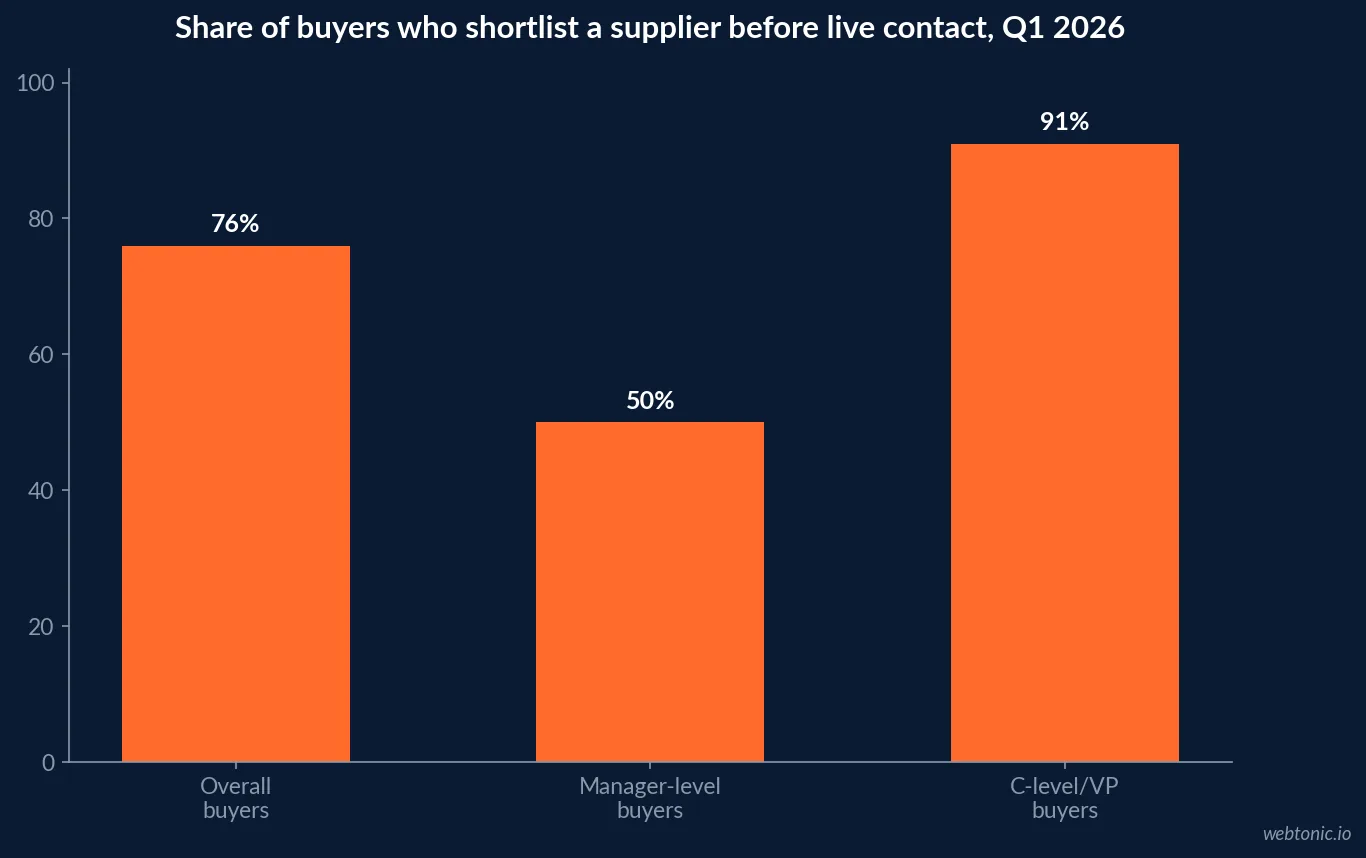
The same survey found 76% of respondents placed at least one supplier on a shortlist before any live interaction, down from 83% the prior quarter, but the aggregate hides a sharp seniority split: among C-level and VP respondents, pre-contact shortlisting stays above 90%, while only about half of managers shortlist before speaking with a supplier at all. That split matters for where a manufacturer's inbound reputation work should concentrate - the buyers most likely to form an opinion before ever calling are also the most senior ones in the room.
This is the practical translation of "reputation management" for a manufacturer: making sure the third-party certifications and named references senior buyers say they trust most are visible and current before that pre-contact shortlist gets built, not after.
Where discovery actually happens: sourcing platforms, not review sites
Thomasnet's 2025 sourcing reporting describes a platform built for discovery and category search - over 1.4 to 1.5 million monthly buyers sourcing across more than 80,000 industrial categories, connected to a network of more than 500,000 suppliers. A follow-up analysis of the full-year 2025 data found contract and private-label manufacturing services emerged as the top-sourced category for the year, ahead of traditional product categories, as procurement teams increasingly outsourced formulation, production, and packaging work.
None of that reporting includes a star-rating layer comparable to Yelp or Google reviews. A manufacturer's "reputation" on Thomasnet is closer to category visibility and completeness of a supplier profile than to an aggregated customer sentiment score.
| Sourcing-platform metric (Thomasnet 2025) | Figure | What it substitutes for in a consumer-review model |
|---|---|---|
| Monthly buyer sessions | 1.4-1.5 million+ | Traffic, not review volume |
| Supplier network size | 500,000+ suppliers | Market size, not competitive review count |
| Categories tracked | 80,000+ | Category depth, not review categories |
| Top-sourced 2025 category | Contract/private-label manufacturing | Demand signal, not a rating |
Where G2 and TrustRadius fit - and where they don't
Manufacturers that also sell or license software (ERP modules, IoT monitoring, CAD licensing) do face a genuine review layer, just not on the factory-floor side of the business. G2's 2025 Buyer Behavior Report found enterprise software buyers now rely more on review sites and AI search than traditional vendor websites, with two-thirds preferring to engage sales only after independent research. TrustRadius' 2025 research found 72% of B2B tech buyers now encounter AI Overviews during their research, and 90% of those click through to the underlying cited source to verify it.
Label this correctly: it is B2B software-buying data, useful only for the software division of a manufacturing business, not evidence about how buyers evaluate the manufacturer's physical products or contract-manufacturing services.
| Data set | What it measures | Applies to manufacturing reputation? |
|---|---|---|
| Kula Partners Industrial Buyer Pulse (n=303) | How industrial buyers evaluate suppliers | Yes - this is the primary source for this page |
| Thomasnet Annual Sourcing Activity Report | Discovery/sourcing behavior on one platform | Yes, for visibility not sentiment |
| G2 2025 Buyer Behavior Report | Enterprise software purchase research behavior | Only for a manufacturer's own software products |
| TrustRadius 2025 B2B tech buying research | AI's role in software buying journeys | Only for a manufacturer's own software products |
| BrightLocal/Yelp/Trustpilot consumer review data | Consumer star-rating behavior | No - wrong buyer population entirely |
The FTC's fake-review rule still applies to B2B testimonials
The FTC's 2024 final rule, at 16 CFR Part 465, bans fake or misrepresented consumer reviews and testimonials broadly - it is not written narrowly for B2C. A manufacturer publishing a "case study" attributed to a customer who did not actually experience the claimed result, or compensating a customer specifically for a favorable quote without disclosure, sits inside the same enforcement exposure a consumer brand would face. Given that customer references are the second most-trusted proof type in industrial buying (20%, per Kula Partners), the integrity of those references is not a compliance afterthought - it is the credibility of the second-best lever a manufacturer has.
Where a Google Business Profile still fits for a manufacturer
Most industrial manufacturers do operate at least one physical, in-person location - a headquarters, a plant with a visitor entrance, or a regional sales office - and those addresses are fully eligible for a Business Profile under Google's own eligibility rules, the same rules covered in depth on our Google Ads pricing guide when the topic is paid search rather than organic listings. A profile there captures direction requests from site visitors, auditors, and job candidates - a narrower, B2B-relevant version of the consumer discovery job a Business Profile performs for a retail storefront.
What it will not capture is the pre-contact shortlist decision the Kula Partners data describes, because that decision runs through certifications and references, not through a map pin.
| Manufacturer touchpoint | Right channel | What it is graded on |
|---|---|---|
| Physical HQ or plant with visitors | Google Business Profile | Address accuracy, hours, direction requests |
| Supplier discovery for RFQs | Thomasnet / sourcing platforms | Category completeness, profile depth |
| Pre-contact trust signal | Certifications + named references | Currency and checkability, per Kula Partners |
| Software division's own product | G2 / TrustRadius | Buyer reviews of the software specifically |
Why AI-generated comparisons already outrank supplier documentation
The Kula Partners survey's third-place finding deserves its own line: 19% of industrial buyers now name an AI-generated comparison or summary as their most trusted proof type at first evaluation, ahead of supplier-authored technical documentation at 15%. That ranking did not exist in this form a few years ago, and it means a manufacturer's technical spec sheets - long the default sales collateral - are being outranked by a synthesis a buyer generated independently, often without the manufacturer's knowledge or input. The practical implication is that the underlying data behind those specs (certifications, standards compliance, verified capacity figures) needs to be structured and publicly available enough for an AI tool to summarize accurately, not just formatted for a human reading a PDF.
| Proof-type trend (Kula Partners Q1 2026) | Rank among six options | What it displaced or is displacing |
|---|---|---|
| Independent third-party certification | 1st (29%) | Sales-team assertions and glossy brochures |
| Customer reference from own industry | 2nd (20%) | Generic testimonials without a named contact |
| AI-generated comparison/summary | 3rd (19%), rising | Supplier-authored technical documentation |
| Supplier technical documentation | 4th (15%), falling relative rank | Was historically the default proof type |
What a manufacturer should actually track
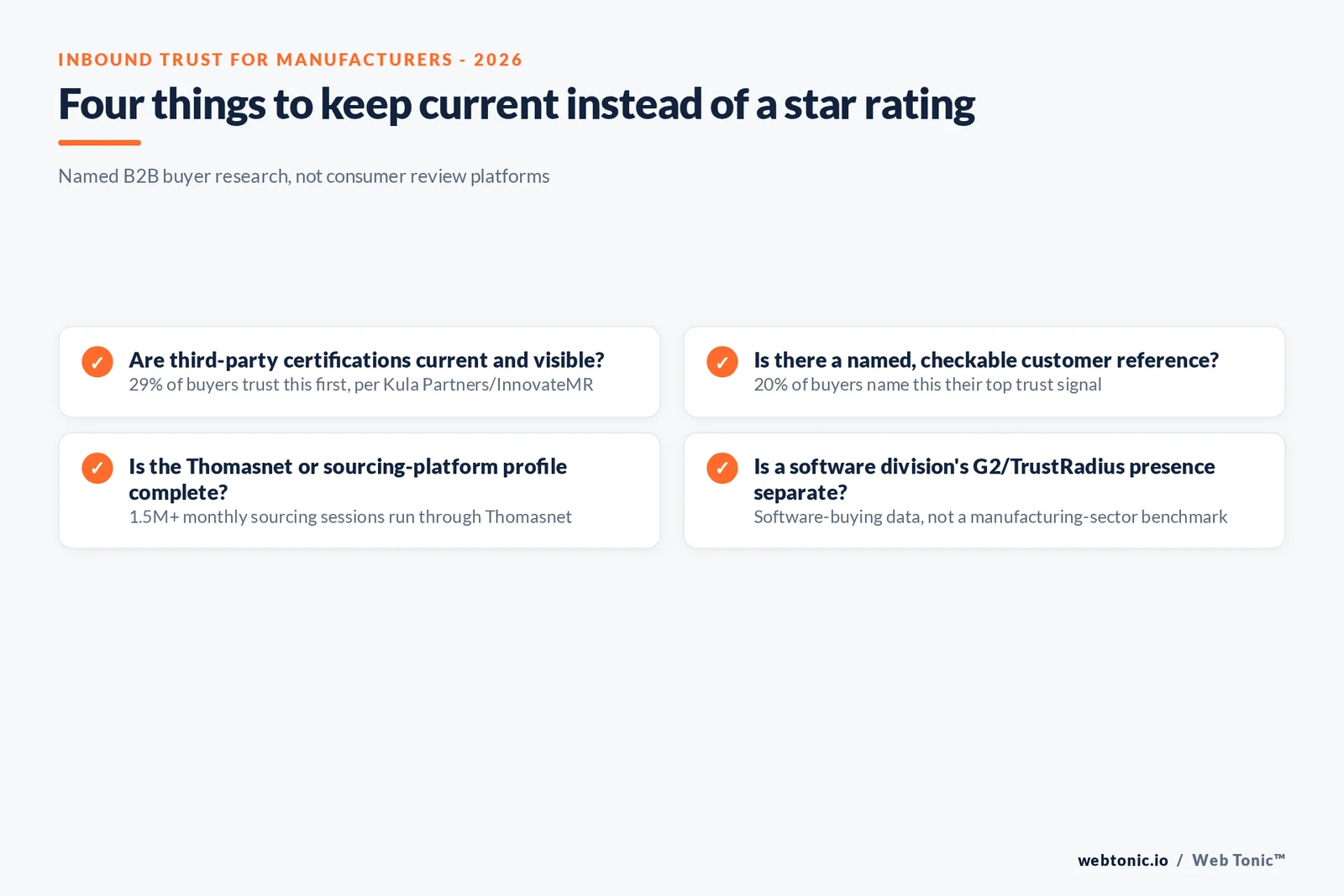
Given the data, a manufacturing reputation scorecard should prioritize: currency of third-party certifications and audits (the top-trusted signal at 29%), a maintained list of customers willing to serve as checkable references (20%), completeness and category accuracy of sourcing-platform listings like Thomasnet, an accurate Business Profile for any physical location with in-person visitors, and - only for a software division that sells through the software-buying journey - a monitored G2/TrustRadius presence. Chasing a Google star rating for the plant itself is optimizing for a signal the buyer data says matters far less than these four.
Our data and analytics practice builds this kind of buyer-stage-specific scorecard, our growth marketing team maps it to the sales funnel a shortlist actually follows, and our team can walk through what that looks like for a specific supplier catalog.
Frequently Asked Questions
Do manufacturing buyers read online reviews the way consumers do?
Not in the star-rating sense. Kula Partners' Industrial Buyer Pulse survey (with InnovateMR, n=303 North American manufacturing buyers, Q1 2026) found that when forced to pick the single proof type they trust most at the earliest stage of supplier evaluation, 29% chose independent third-party validation or certification, 20% chose a customer reference from their own industry, and only 15% trusted supplier-authored documentation. Consumer-style star ratings were not the dominant signal in this buyer population; named references and certification were.
So does that mean reviews are irrelevant to a manufacturer's inbound pipeline?
No - it means the review surface shifts from a public star rating to a named, checkable reference. The same Kula Partners survey found 76% of buyers place at least one supplier on a shortlist before any live contact, rising above 90% among C-level and VP respondents, which means digital discovery and public trust signals (certifications, case studies, third-party audits) still shape the shortlist before a sales conversation happens.
Is Thomasnet a review platform for manufacturers?
No - Thomasnet is a sourcing and discovery platform, not a review platform. Its own 2025 Annual Sourcing Activity Report describes over 1.5 million monthly sourcing sessions and more than 500,000 suppliers on the platform, tracking what buyers search for and source, not star ratings on individual suppliers. Manufacturers should not expect a Yelp-style review volume metric to apply here; discoverability and category presence matter more.
Do G2 or TrustRadius apply to industrial manufacturers?
Only for the software those manufacturers buy, not for the physical goods or contract manufacturing services themselves. G2's 2025 Buyer Behavior Report and TrustRadius' 2025 B2B tech buying research both cover software purchase decisions specifically - citable as B2B SaaS buyer data, not as a manufacturing-sector benchmark. A plant sourcing CNC machining services will not find its supplier rated on G2.
What should a manufacturer actually track instead of a star rating?
Shortlist inclusion rate (is the company appearing in the 76% who shortlist before contact), named reference availability (can a prospect be handed a checkable customer name in the same industry), and certification/audit currency (is the third-party validation buyers say they trust most actually up to date and visible). None of these map to a five-star aggregate, which is exactly why treating manufacturing reputation like consumer reputation misses the point.
Sources
Kula Partners / InnovateMR - Industrial Buyer Pulse, Q1 2026 (n=303)
Thomasnet - 2025 Mid-Year Sourcing Report
G2 - 2025 Buyer Behavior Report
TrustRadius - Bridging the Trust Gap: B2B Tech Buying in the Age of AI, 2025
Federal Trade Commission - Final rule banning fake reviews and testimonials, 2024
eCFR - 16 CFR Part 465, Trade Regulation Rule on the Use of Consumer Reviews and Testimonials