Table of contents
A franchise brand's star rating is a blended average across every unit carrying its name, and that average hides more than it reveals. The unit of analysis that matters to a franchisor's reputation program is the single location, not the brand page - because that is the review surface a nearby customer actually reads before choosing which unit to visit.
Key Takeaways
- 851,000 US franchise establishments are projected for 2025 (IFA/FRANdata).
- 2.5% unit growth is projected for 2025, adding roughly 20,000 locations.
- 63% of consumers expect a review response within a week (BrightLocal 2025).
- 36% of consumers recall no review-incentive offer in the past year, up 10 points on 2024.
- 27% of consumers now check only one review site before deciding, up 4 points on 2024.
- 40% of consumers use at least two review sites on average (BrightLocal 2025).
- 20% of consumers say reviews as recent as two weeks old still influence them, down from 27% in 2024.
- 4% of consumers say they never read online business reviews at all.
- 68% of local agencies offer Google Business Profile management as a service (BrightLocal Agency Survey 2024).
- 49% of local agencies offer online review management specifically.
- The FTC's fake-review rule (16 CFR Part 465) took effect in 2024 and applies per location, not just per brand.
- Yelp removed over 185,100 reported reviews in 2024, 26% for not reflecting a firsthand experience.
- Trustpilot removed 4.5 million detected fake reviews in 2024, 90% caught automatically.
- A location with mostly negative written reviews risks losing 63% of prospective customers' trust (BrightLocal, 2023 Local Business Discovery & Trust Report).
The unit of analysis is the location, not the brand
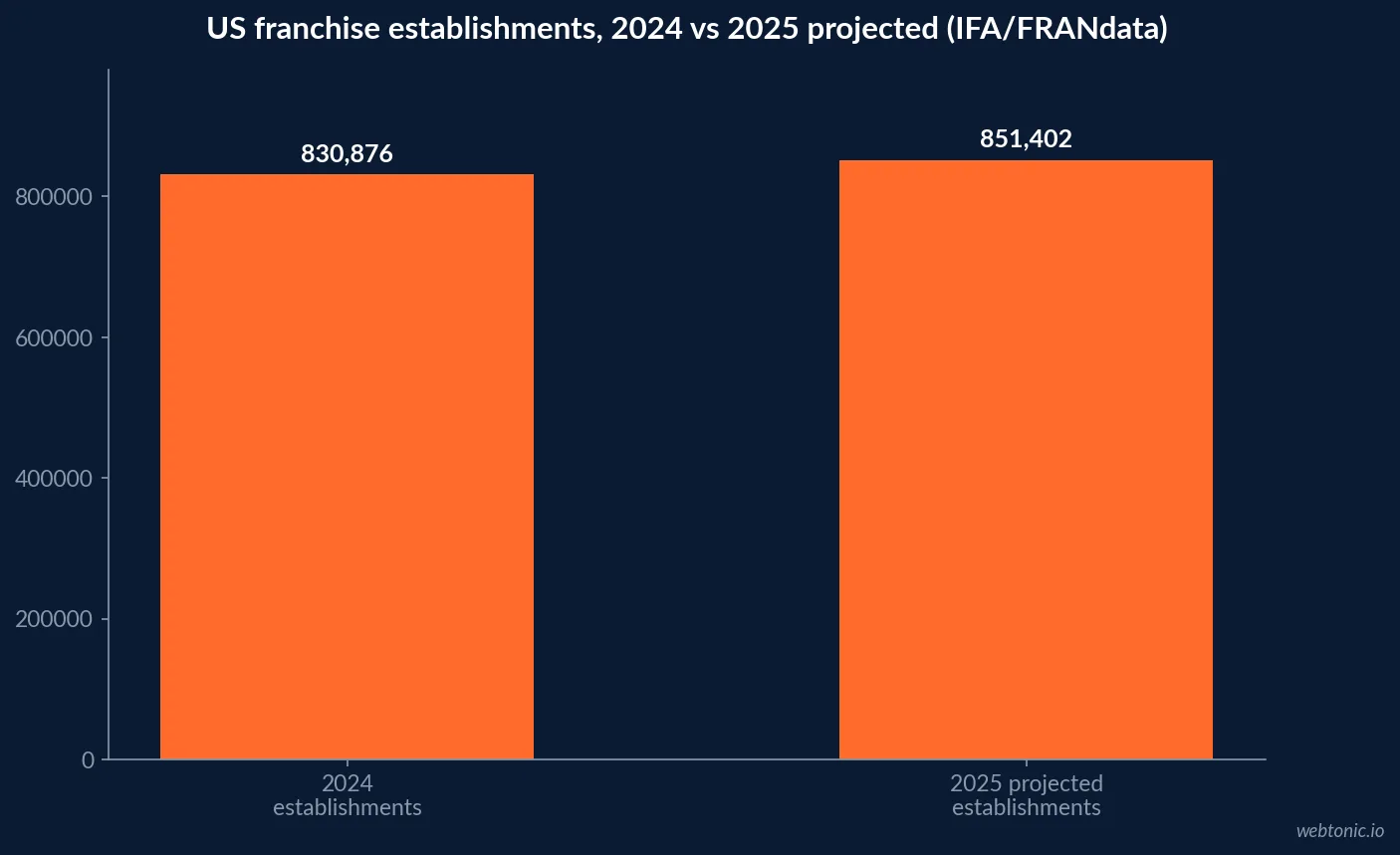
The International Franchise Association's 2025 Franchising Economic Outlook, prepared by FRANdata, projects 851,000 franchise establishments operating in the US in 2025, up 2.5% (roughly 20,000 units) on 2024's 830,876. Every one of those units carries the same brand name into a Google search result, and every one of them accumulates its own separate review history, response rate, and photo set.
A brand-level dashboard that reports "4.3 stars average" is reporting a statistic no customer ever sees. The customer sees one location's profile, at one address, with whatever review count and recency that specific unit has earned.
| Network-level metric | What it actually measures | Why it misleads a customer | Location-level fix |
|---|---|---|---|
| Brand average star rating | Mean across all units | Hides units below the network floor | Rank locations by rating, flag bottom quartile |
| Total network review count | Sum across all units | One flagship location can carry the total | Track review count per location per month |
| Brand-wide response rate | Aggregate of all replies | A handful of engaged managers skew it up | Report response rate per location, not blended |
| National NPS or CSAT | Survey sample, not review platform data | Doesn't map to what Google or Yelp shows | Pair survey data with per-location public review data |
What consumers are actually judging at the location level
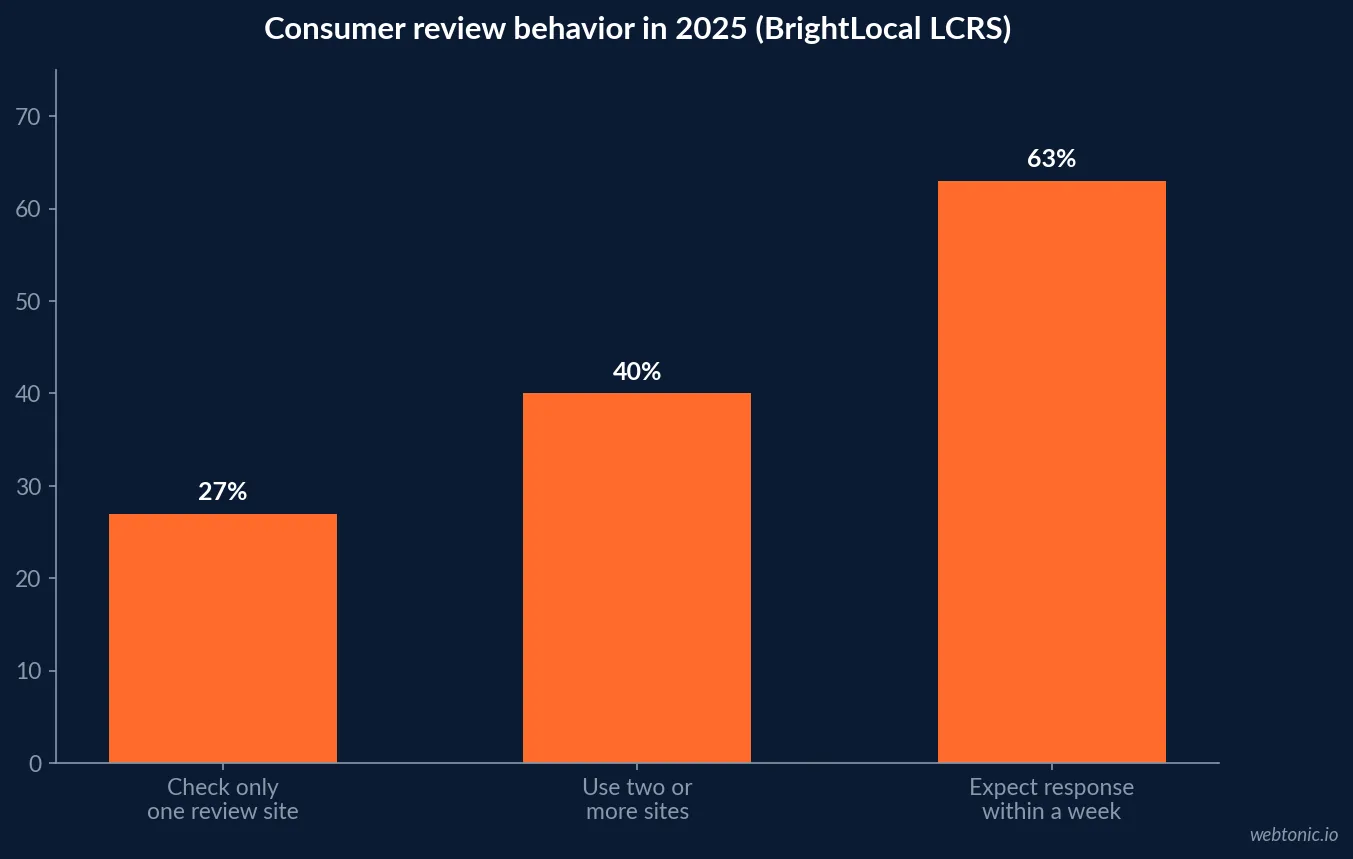
BrightLocal's 2025 Local Consumer Review Survey finds consumer behavior easing in some respects and tightening in others. 27% of consumers now say they check only one review site before deciding to use a business, up 4 points on 2024, while 40% use at least two sites on average. Expectations around review recency have also relaxed: 20% of consumers say a review as recent as two weeks old still influences them, down 7 points from 2024's 27%, while a slightly larger share now accept reviews from six months to a year back as still relevant.
For a franchise operator, that single-site behavior is the risk. If 27% of shoppers commit to one platform, a location with a thin or stale profile on that one platform loses the comparison before a second chance exists.
| Consumer behavior (BrightLocal 2025) | 2025 figure | Change vs 2024 | Location-level implication |
|---|---|---|---|
| Check only one review site before deciding | 27% | +4 pts | Every platform a location is on must look current |
| Use two or more review sites on average | 40% | n/a | Consistency across platforms, not just Google, matters |
| Reviews 2 weeks old still feel impactful | 20% | -7 pts | Recency pressure has eased slightly but not disappeared |
| Never read online business reviews | 4% | n/a | The vast majority still factor reviews into the decision |
| Recall no review incentive offered in past year | 36% | +10 pts | Fewer consumers report seeing incentivized asks |
Response rate and response time are the metrics a franchisor can actually enforce
Star rating and review count are largely a function of customer volume and local management quality - hard for a head office to standardize. Response behavior is different: it is a process, and processes can be enforced network-wide. BrightLocal's 2025 data shows a substantial trust gap between businesses that respond to all types of feedback (positive and negative) versus those that respond selectively, and finds 63% of consumers expect a response within a week of posting.
A franchise reputation program that sets one measurable rule - respond to every review, within seven days, at every location - is enforcing the one lever that BrightLocal's own data says moves trust, without needing to control how many reviews a location generates in the first place.
Fake-review risk sits at the location, and the FTC rule applies there
The FTC's August 2024 final rule, codified at 16 CFR Part 465, prohibits creating, buying, selling, or knowingly disseminating reviews that misrepresent a real customer's experience, and allows the agency to seek civil penalties against knowing violators. A franchise network runs this risk unit by unit: if one location's manager incentivizes only positive reviews or suppresses negative feedback from public view, that location - and potentially the franchisor - is exposed under the rule, regardless of what other locations in the network are doing correctly.
Platform enforcement backs the same point up at scale. Yelp's 2024 Trust & Safety Report states the platform removed over 185,100 reported reviews in 2024, with 26% found not to reflect a firsthand experience, and warned consumers about nearly 550 businesses for review manipulation. Trustpilot's 2025 Trust Report states it removed 4.5 million detected fake reviews in 2024, with 90% caught by automated detection, out of 61 million reviews written that year.
| Enforcement source | 2024 figure | What it targets | Franchise-level takeaway |
|---|---|---|---|
| FTC 16 CFR Part 465 | Rule effective 2024, civil penalties for knowing violations | Fake/incentivized reviews and testimonials | Applies per location running the review program |
| Yelp Trust & Safety Report | 185,100+ reviews removed, 26% non-firsthand | Manipulated or fabricated content | One flagged location can trigger a business-page consumer alert |
| Trustpilot Trust Report 2025 | 4.5M fake reviews removed, 90% automated | Fake reviews across all industries | Automated detection is now the norm, not a manual spot-check |
Where review-request programs earn - or spend - trust
BrightLocal's 2025 data shows 36% of consumers say they don't recall being offered an incentive to leave a review in the past year, an increase of 10 points on 2024 - a sign that more review-request programs are running clean asks rather than incentivized ones. For a franchise network, the review-request script itself is one of the few touchpoints that can be centrally written, distributed to every location, and audited for compliance with the FTC's fake-review rule before a single unit sends it to a customer.
The mechanics that matter operationally: timing the ask close to service completion, using a neutral request (not "leave us 5 stars"), and routing negative feedback to a private channel first rather than suppressing it from the public review platform entirely - the latter is the practice the FTC rule and platform policies both treat as manipulation, not moderation.
| Review-request practice | Compliant with FTC 16 CFR 465? | What good execution looks like |
|---|---|---|
| Neutral, all-customer ask after service | Yes | Same script sent regardless of expected sentiment |
| Ask targeted only at happy customers | Risk area | Selectively filtering who gets asked skews the public record |
| Incentive tied to leaving any review | No | Rule bans review sale/purchase and incentivized fake content |
| Private feedback channel plus public review request | Yes | Catches service issues without hiding them from public view |
| Deleting or hiding negative reviews from the profile | No | Platforms and the FTC both treat this as manipulation |
Where agencies and platforms already sit in this market
BrightLocal's 2024 Local Marketing Industry Survey: Agency Edition, a survey of almost 400 local agency marketers, found 68% of agencies offer Google Business Profile optimization/management as a client service and 49% offer online reviews management specifically - both sit below broader SEO services like audits (65%) and content optimization (65%), which signals reviews management is treated as an add-on rather than a standalone deliverable at most agencies serving multi-location brands.
That gap is relevant to a franchisor deciding whether to run reputation management in-house per location, centralize it at the brand level, or buy it from an agency: the service exists in the market, but is not yet the default line item most local agencies lead with.
| Service (BrightLocal Agency Survey 2024) | Share of agencies offering it |
|---|---|
| Google Business Profile optimization/management | 68% |
| SEO audits and analysis | 65% |
| Content creation/optimization | 65% |
| Citation building/cleanup | 53% |
| Online reviews management | 49% |
The Google Business Profile layer sits underneath every location's reviews
A location's review history lives on its Google Business Profile, and Google's own review policy documentation prohibits owners from offering incentives in exchange for reviews or posting reviews of their own business, on top of the FTC's separate federal rule. For a franchisor, that means a single non-compliant location can trigger a platform-level review suspension independent of anything head office does at the brand level - another reason the tracked unit has to be the profile, not the brand.
The full 2025 Franchising Economic Outlook report also breaks out unit growth by state and sector, which is the same level of granularity a reputation program needs: state-level and sector-level review benchmarks, not one national number.
| Franchising Economic Outlook metric (FRANdata 2025) | 2024 figure | 2025 projected |
|---|---|---|
| Total US establishments | 830,876 | 851,402 |
| Annual establishment growth | 2.4% | 2.5% |
| Franchise sector GDP contribution | ~USD 551B (5% growth trend) | USD 578B |
| Franchise sector output | USD 896.9B | USD 936.4B (+4.4%) |
What a franchisor's reputation scorecard should actually contain
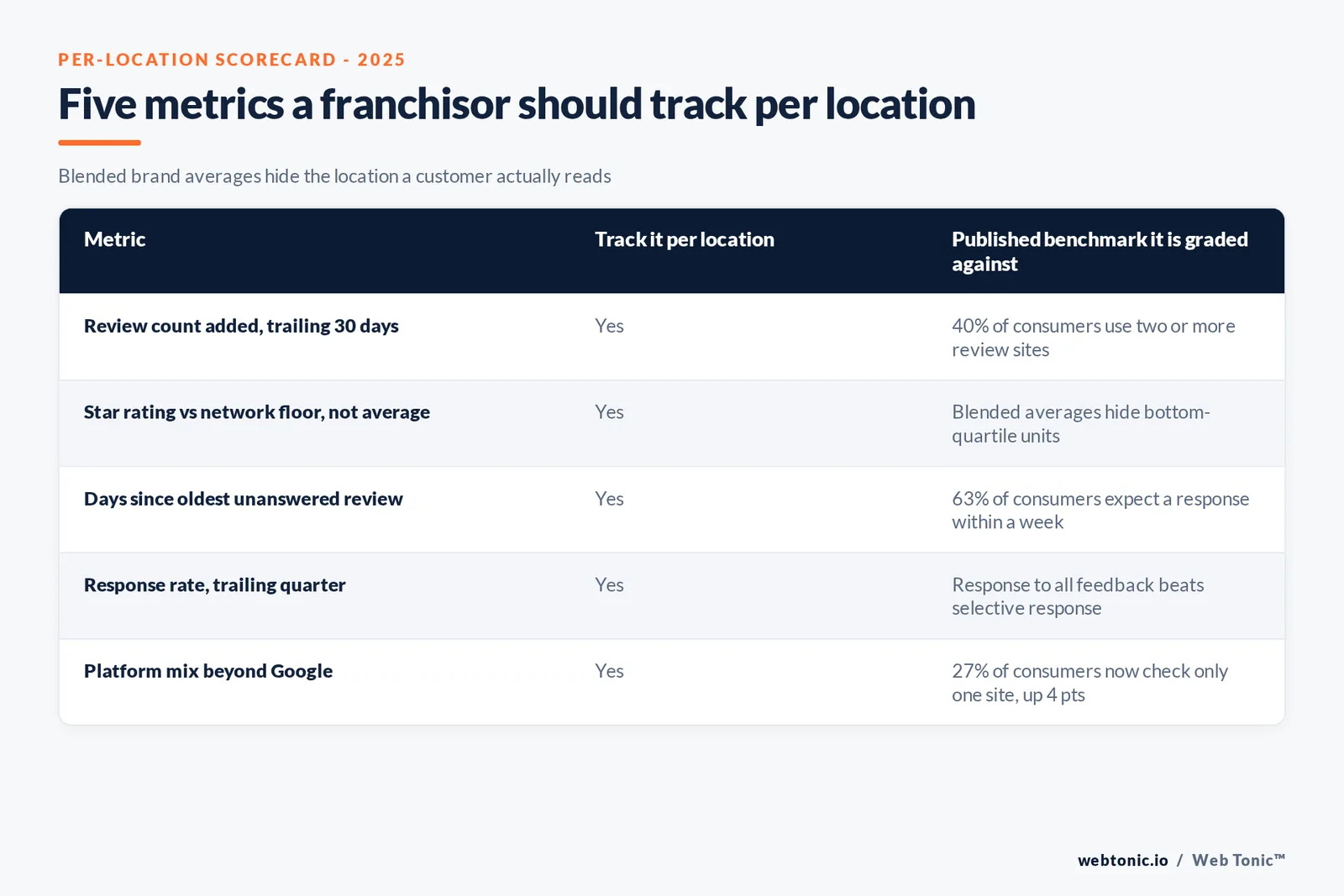
Five metrics, tracked per location rather than blended into a network average: review count added in the trailing 30 days, star rating against a network floor (not a network average), days since the oldest unanswered review, response rate over the trailing quarter, and platform mix (Google plus at least one alternative, since BrightLocal's 2025 data shows 40% of consumers check two or more sites). A location failing two or more of these is a location a customer is silently choosing not to visit, well before a mystery shopper or a sales dip would surface the problem.
Our growth marketing practice builds this kind of per-location scorecard for multi-unit clients, our data and analytics practice instruments the per-location reporting behind it, and our team can walk a franchisor through what a rollout looks like across a network rather than one flagship unit.
Frequently Asked Questions
Why can't a franchise brand manage reputation from head office alone?
Because the unit of consumer trust is the location, not the brand. BrightLocal's 2025 Local Consumer Review Survey finds consumers now expect a business to have earned reviews recently and respond to them directly - both are location-specific behaviors a head-office dashboard cannot fake. A brand can carry a strong national average while individual units sit on stale, unanswered review pages that a nearby shopper actually sees.
How many reviews does a single location need?
BrightLocal's 2025 survey shows consumer expectations for review count have relaxed: a growing share of consumers say they don't have a minimum count in mind, and the share content with 0-49 reviews has risen year over year. That is a floor, not a target - a location with a visibly thin review count next to network peers still reads as newer or less trusted, which matters when a shopper is comparing two locations of the same brand in different neighborhoods.
Does responding to reviews actually move location-level trust?
BrightLocal's 2025 data shows a large gap in likelihood to use a business between brands that respond to all feedback versus only positive or only negative feedback, and finds 63% of consumers expect a response within a week. For a franchise network, response rate and response time are two of the few reputation metrics a head office can enforce as a standard across every unit, regardless of local management quality.
What does the FTC's 2024 rule change for franchise review programs?
The FTC's final rule, effective under 16 CFR Part 465, bans buying, selling, or disseminating reviews known to be fake or written by someone with no real experience of the business, and allows civil penalties against knowing violators. A franchise review-request program that incentivizes only positive reviews, or funnels negative feedback away from public platforms, sits inside that enforcement risk at every location running it, not just at head office.
Should review software costs be centralized or budgeted per location?
Centralize the license, budget the labor. Review-management platforms are typically sold as a per-location or per-seat subscription, but the recurring cost that actually determines whether a program works is the weekly time a location manager spends requesting reviews and answering them - a cost a single head-office subscription line does not capture.
Sources
International Franchise Association / FRANdata - 2025 Franchising Economic Outlook
BrightLocal - Local Consumer Review Survey 2025
BrightLocal - Local Marketing Industry Survey: Agency Edition 2024
BrightLocal - Local Business Discovery & Trust Report 2023
Federal Trade Commission - Final rule banning fake reviews and testimonials, 2024
eCFR - 16 CFR Part 465, Trade Regulation Rule on the Use of Consumer Reviews and Testimonials
Yelp Inc. - 2024 Trust & Safety Report
Trustpilot - Trust Report 2025
Google Business Profile Help - Review policy documentation
International Franchise Association - 2025 Franchising Economic Outlook (full report)