Table of contents
Google, not Yelp, is where most HVAC homeowners actually check reviews - 56% versus 43%, per a Clear Seas Research survey for ACHR NEWS. But Yelp is the platform that publishes its own annual fraud-enforcement numbers, which changes what "managing reputation" means on each one.
Key Takeaways
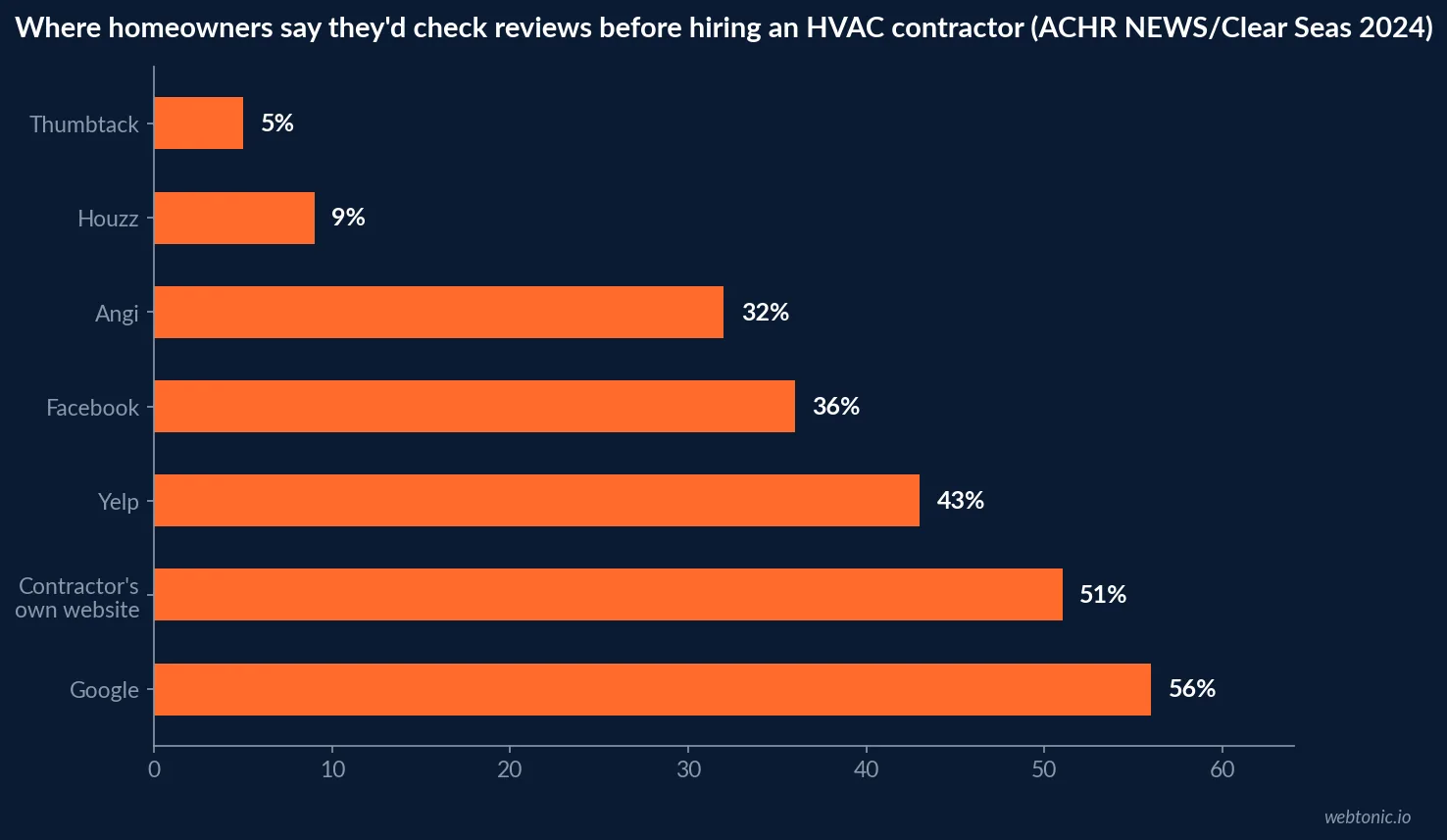
- 56% of homeowners say they'd check Google reviews before hiring an HVAC contractor.
- 43% say they'd check Yelp - the second-largest third-party platform.
- 51% say they'd check the contractor's own website.
- 36% would check Facebook, 32% Angi, and single digits for Houzz and Thumbtack.
- 91% of homeowners rate online reviews important, extremely, very or somewhat, when hiring an HVAC contractor.
- Only 61% of HVAC contractors currently post reviews on their own websites.
- Yelp filtered out nearly 500,000 suspected AI-generated reviews in 2025.
- Yelp rejected 50,700+ new business pages for spammy behavior, a 29% increase over 2024.
- Yelp closed more than 889,800 fake phone-support accounts in 2025.
- Yelp's total account closures more than doubled year over year.
- Yelp names plumbing alongside locksmiths, garage door repair, and roadside assistance as high-risk emergency-service scam categories.
- Google's Maps policy treats paid or incentivized reviews as Fake Engagement and can restrict new reviews on a violating profile.
- The FTC's fake-review rule, 16 CFR Part 465, has been enforceable since October 21, 2024.
- A one-star rating increase causes a 5-9% revenue increase in causally identified research (Harvard/Luca).
- Businesses that respond to reviews earn up to 18% more revenue than non-responders.
Where HVAC homeowners actually look
A survey run by Clear Seas Research, the research division of BNP Media, on behalf of The ACHR NEWS asked 400 homeowners where they'd look for reviews before hiring an HVAC contractor. 56% named Google, ahead of 51% for the contractor's own website, 43% for Yelp, 36% for Facebook, 32% for Angi, and single-digit shares for Houzz (9%) and Thumbtack (5%). The same survey found 91% of homeowners rate reviews important in some degree, with 26% calling them "extremely important."
Yelp's 43% is not trivial - it is the second-largest third-party platform in the mix - but treating Google and Yelp as interchangeable review destinations for HVAC misreads the data by 13 points.
| Platform (2024 homeowner survey) | Share who'd check it | Type | HVAC implication |
|---|---|---|---|
| 56% | Free Business Profile + reviews | Primary destination - claim and complete it | |
| Contractor's own website | 51% | Owned channel | Only 61% of HVAC contractors currently do this |
| Yelp | 43% | Third-party review platform | Secondary but still material |
| 36% | Social platform | Worth monitoring, lower priority | |
| Angi | 32% | Home-services marketplace | Relevant where contractors are listed |
| Houzz / Thumbtack | 9% / 5% | Niche marketplaces | Low priority for most HVAC contractors |
What Yelp actually publishes about fraud - and Google doesn't
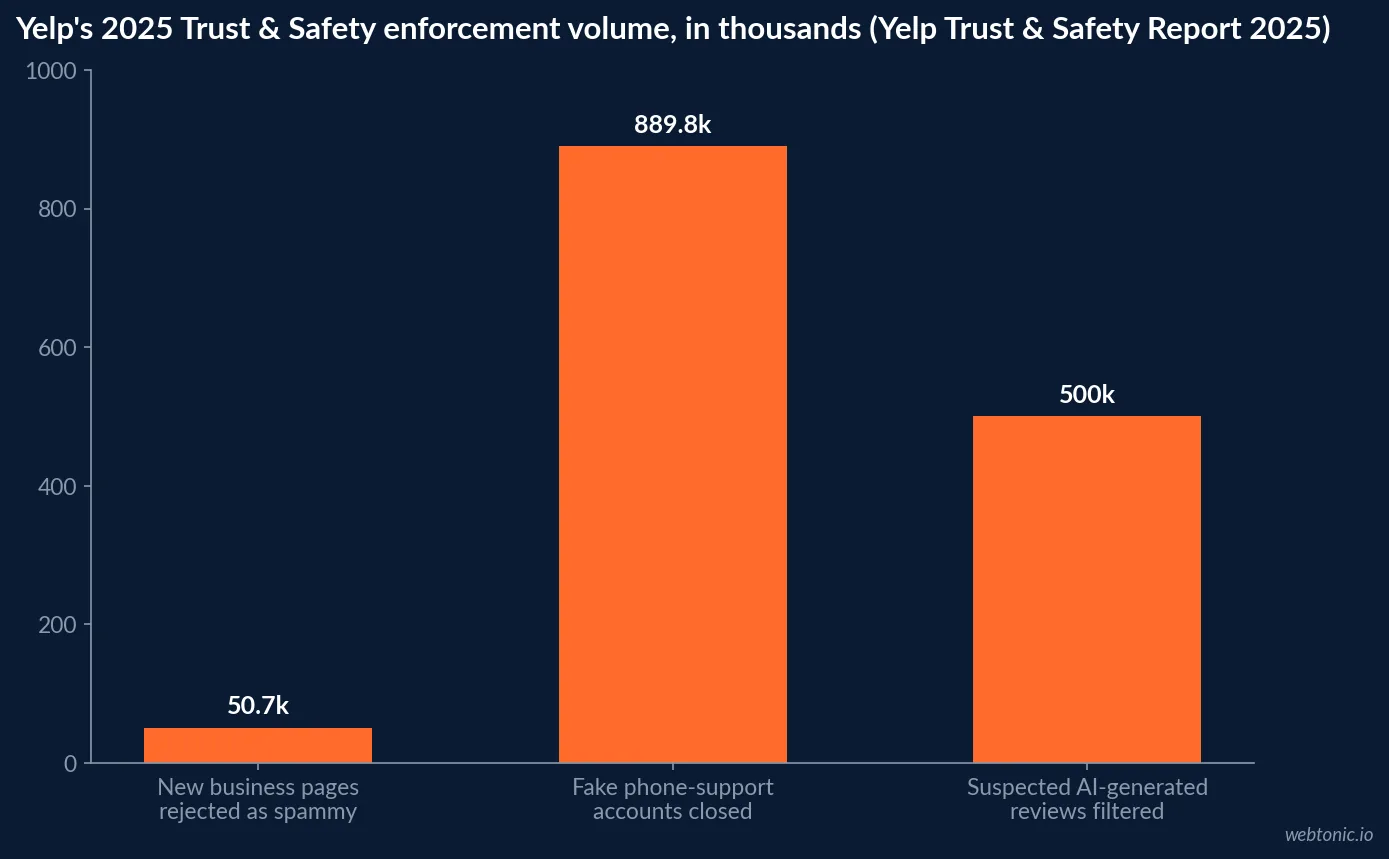
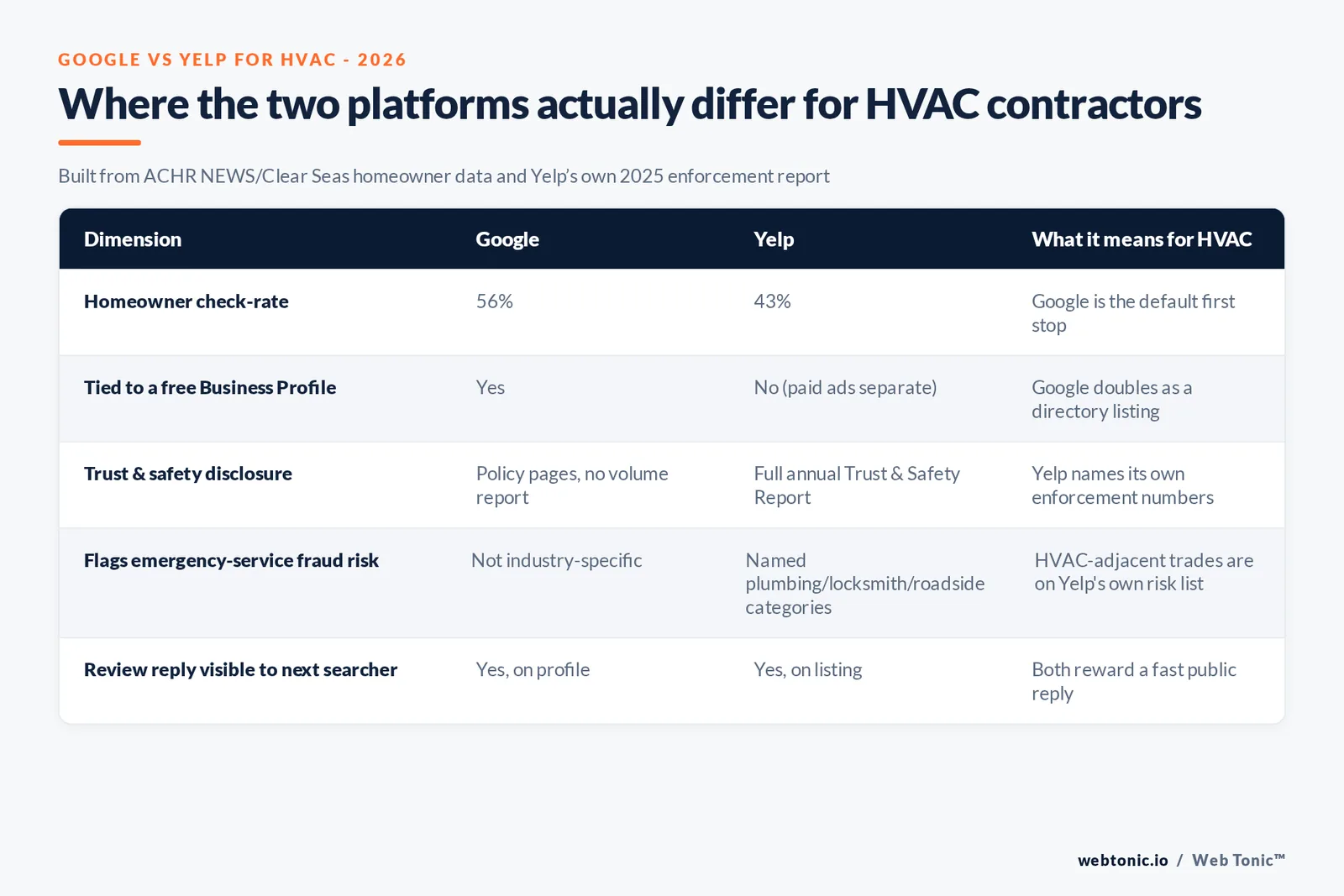
The biggest structural difference between the two platforms is disclosure. Yelp's 2025 Trust & Safety Report states its systems filtered out nearly 500,000 suspected AI-generated reviews, rejected 50,700+ new business pages for spammy behavior (a 29% increase over 2024), and closed more than 889,800 fake phone-support accounts - more than doubling total account closures year over year. Yelp's report specifically calls out plumbing, alongside locksmiths, garage door repair, and roadside assistance, as high-risk emergency-service categories where scam accounts target vulnerable consumers - the same on-demand, distressed -call dynamic that drives HVAC no-cool and no-heat emergencies.
Google publishes policy, not a comparable transparency report. Its Maps User Generated Content Policy defines Fake Engagement - paid reviews, multi-account posting, and posting on a competitor's business to undermine it - as prohibited, and a confirmed violation can lead Google to restrict a profile from receiving new reviews for a set period. There is no published figure for how many reviews Google removes per industry, which makes Yelp's numbers the only publicly quantified enforcement data available in this comparison.
| 2025 enforcement figure | Platform | Number | Category relevance to HVAC |
|---|---|---|---|
| Suspected AI-generated reviews filtered | Yelp | ~500,000 | Review authenticity broadly |
| New business pages rejected as spammy | Yelp | 50,700+ (up 29%) | Fake HVAC listings/duplicates |
| Fake phone-support accounts closed | Yelp | 889,800+ | Scam call-forwarding schemes |
| Named high-risk emergency categories | Yelp | Locksmiths, garage doors, roadside, plumbing | Adjacent trade to HVAC no-heat/no-cool calls |
| Comparable published enforcement figure | Not published | Policy exists; no transparency report |
The legal backdrop applies to both platforms equally
Neither platform operates in a vacuum - the FTC's Trade Regulation Rule on the Use of Consumer Reviews and Testimonials (16 CFR Part 465), effective October 21, 2024, bans buying or selling fake reviews and undisclosed insider reviews across every platform an HVAC contractor might use, Google and Yelp alike. An HVAC contractor that solicits a technician's family member to post a five-star Yelp review, or pays for positive Google reviews, is exposed to the same federal rule regardless of which platform hosted the violation.
| FTC/legal exposure | Applies on Google? | Applies on Yelp? | Basis |
|---|---|---|---|
| Buying fake reviews | Yes | Yes | FTC 16 CFR Part 465 |
| Undisclosed insider reviews | Yes | Yes | FTC 16 CFR Part 465 / Endorsement Guides |
| Review suppression (hiding negatives) | Yes | Yes | FTC 16 CFR Part 465 |
| Platform-level Fake Engagement penalty | Profile review-lock | Account closure / content removal | Google Maps UGC policy / Yelp enforcement |
The website is the channel HVAC contractors leave emptiest
The gap between homeowner attention and contractor effort is largest on the owned channel, not on either third-party platform. 51% of surveyed homeowners said they'd check the contractor's own website for reviews - second only to Google - yet the same survey found only 61% of HVAC contractors currently post reviews there. That leaves roughly four in ten HVAC contractors with an empty review section on the one channel they fully control and can format however they choose, including highlighting the specific reviews that mention emergency response time.
| Channel | Homeowner check-rate | Contractor adoption | Gap |
|---|---|---|---|
| Google Business Profile | 56% | Near-universal claim rate expected | Small - mostly a completeness gap |
| Contractor's own website | 51% | 61% currently post reviews | ~39% of contractors show nothing |
| Yelp | 43% | Varies, largely unclaimed by choice | Secondary priority, not urgent |
What a working platform-mix policy looks like
None of this data argues for abandoning either platform - it argues for sequencing effort correctly. A policy grounded in the numbers above claims and completes the Google profile first, publishes a rotating set of real reviews on the owned website second, and checks Yelp on a fixed monthly cadence rather than daily, reserving daily attention for whichever platform a specific negative review actually lands on.
Reading Yelp's category flag correctly, not defensively
Yelp naming plumbing, alongside locksmiths, garage door repair, and roadside assistance, as a high-risk scam category in its own Trust & Safety Report is not a knock against HVAC or plumbing businesses themselves - it is a description of the fraud pattern Yelp is actively fighting: scammers creating fake listings or fake phone-support accounts that impersonate real emergency-service businesses to intercept distressed calls. For a legitimate HVAC contractor, the practical takeaway is that Yelp's enforcement is actively working in the contractor's favor by making it harder for a fake competitor listing to sit next to the real one, not a reason to avoid the platform.
The same distressed-call dynamic that makes HVAC no-heat and no-cool emergencies attractive to scammers is also what makes a complete, verified Google Business Profile valuable in the first place - homeowners searching for emergency service are choosing fast, and the fastest-verified option on the map wins the call regardless of which review platform they checked first.
Why the revenue case still favors an active response program on both
The causal evidence on ratings is platform-agnostic. Harvard economist Michael Luca matched Yelp ratings to audited restaurant revenue data and found that a one-star rating increase causes a 5-9% revenue increase - the same underlying consumer-trust mechanism that BrightLocal's 2026 Local Consumer Review Survey shows driving the 68% of consumers who now require a 4-star average before using any local business. Separately, Google/Wiser Review research found that businesses actively responding to reviews earn up to 18% more revenue than non-responders, regardless of which platform hosts the review being answered.
What this means for an HVAC contractor's channel mix
The honest read of this data is a priority order, not an either/or choice: claim and complete the Google Business Profile first since it captures the largest single share of homeowner attention, publish reviews on the owned website second since 51% of homeowners check it and only 61% of contractors currently do, and treat Yelp as a maintained secondary channel worth monitoring for the fraud patterns its own Trust & Safety Report flags in adjacent emergency-service trades.
For the cross-industry benchmark behind the star-rating and revenue figures cited above, see our reputation management statistics hub, and for the broader local visibility picture, our HVAC local SEO statistics. Our growth marketing practice builds the review-request cadence that keeps both channels current.
Frequently Asked Questions
Do more HVAC homeowners check Google or Yelp?
Google, by a meaningful margin. A Clear Seas Research survey run for ACHR NEWS found 56% of homeowners said they would likely check Google for reviews before hiring an HVAC contractor, against 43% for Yelp, 51% for the contractor's own website, 36% for Facebook, and 32% for Angi. Google's lead is partly structural: it is also the free Business Profile every contractor is expected to claim, so it captures both direct review-checkers and people who land there for the map listing itself.
Is Yelp still worth managing for an HVAC contractor?
Yes, but as a secondary channel, not a primary one. 43% of surveyed homeowners said they'd check Yelp, and Yelp's own 2025 Trust & Safety Report shows the platform actively invests in weeding out fraud in exactly the trades HVAC sits next to - the report names locksmiths, garage door repairs, roadside assistance and plumbing as high-risk emergency-service categories where scam accounts specifically target vulnerable consumers. That enforcement effort is a reason genuine Yelp reviews on an HVAC listing still carry weight, even at lower check-rates than Google.
How many fake reviews is Yelp actually removing?
A large volume. Yelp's 2025 Trust & Safety Report states its automated systems filtered out nearly 500,000 suspected AI-generated reviews in 2025, rejected 50,700+ new business pages for spammy behavior (a 29% increase over 2024), and closed more than 889,800 fake phone-support accounts, more than doubling total account closures year over year. None of those figures are published by Google in comparable form - Yelp's willingness to publish an annual enforcement report is itself a difference between the two platforms, not just a marketing choice.
What does Google publish about fake reviews on HVAC listings?
Policy, not statistics. Google's Maps User Generated Content Policy defines Fake Engagement - paid reviews, multi-account posting, and posting on a competitor's listing to damage its reputation - as prohibited, and a confirmed violation can restrict a Business Profile from receiving new reviews for a set period on top of removing the offending content. Google does not publish a Yelp-style transparency report naming how many reviews it removes industry by industry, so HVAC contractors have to rely on the policy text rather than a published enforcement number.
Should an HVAC contractor's own website carry reviews too?
Yes - it is the second most-checked source. 51% of surveyed homeowners said they'd look for reviews on the contractor's own website, just five points behind Google itself and ahead of Yelp. But only 61% of HVAC contractors currently post reviews on their own sites, per the same survey, which means roughly four in ten contractors are leaving the second-most-checked channel empty.
Sources
ACHR NEWS / Clear Seas Research - 91% of Homeowners Rely on Online Reviews Before Picking Contractors
ACHR NEWS / Clear Seas Research - The Importance of Online Reviews for HVAC Contractors
Yelp - Trust & Safety Report 2025
Google - Maps User Generated Content Policy: prohibited & restricted content
Google Business Profile Help - Restrictions for policy violations
Federal Trade Commission - 16 CFR Part 465 final rule
BrightLocal - Local Consumer Review Survey 2026