Table of contents

The median personal injury law office carries 191 tracked Google reviews at a 4.79/5 weighted rating, and the highest-performing profiles reply to three in four of them. That benchmark comes from a 1,130-office dataset built specifically for this practice area - not a cross-industry average - and it sets a far higher bar than the review-count floor most local businesses are judged against.
Key Takeaways
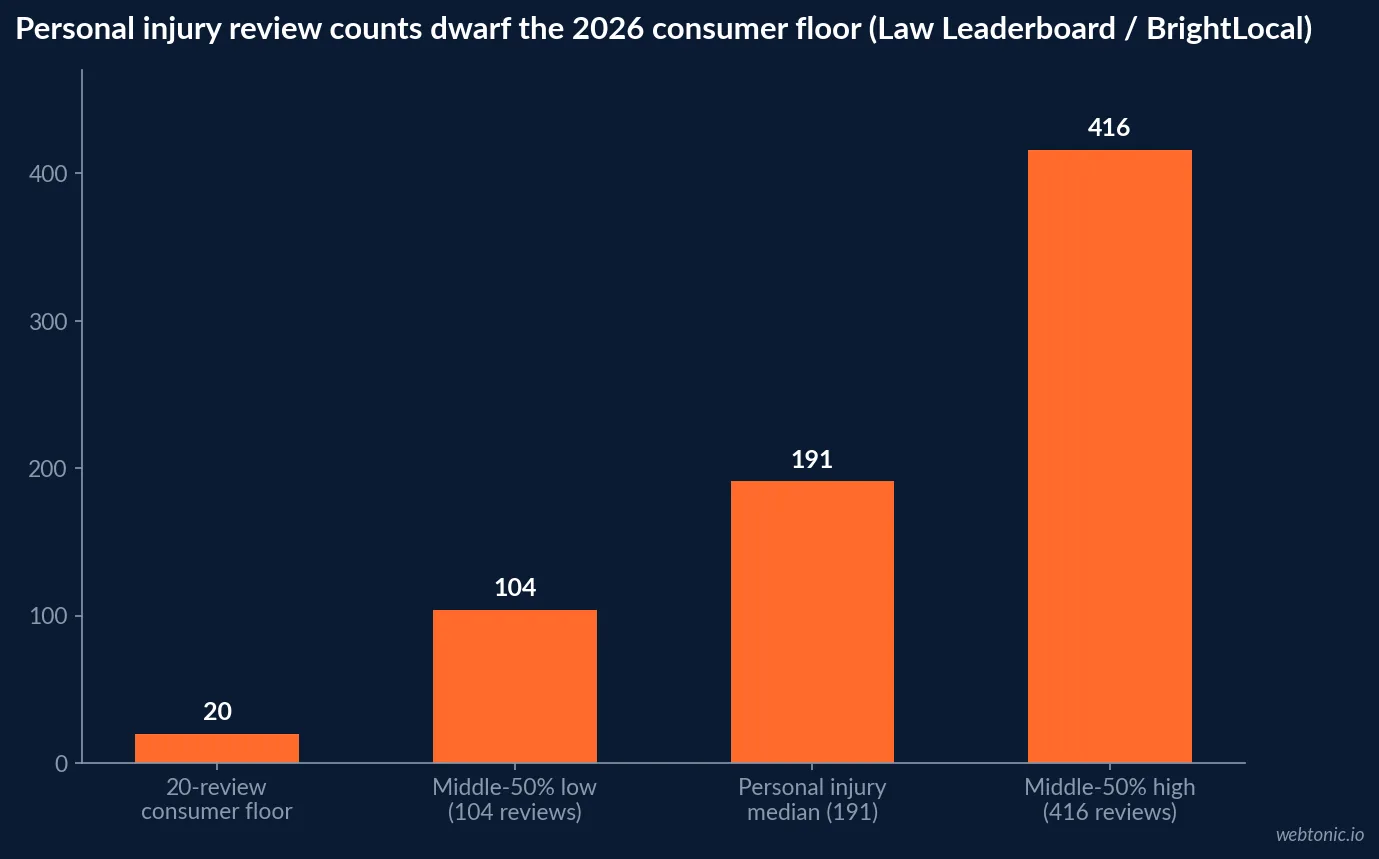
- 191 reviews is the median tracked Google review count across 1,130 personal injury office profiles.
- The middle 50% of offices span 104 to 416 tracked reviews.
- 4.79/5 is the review-count-weighted public rating; the profile-level median is 4.9/5.
- Owner-reply rate runs 65% weighted, 75% at the median profile.
- Across all industries, 47% of consumers won't use a business under 20 reviews.
- 31% of consumers will only use a business rated 4.5 stars or higher, up from 17% a year earlier.
- 74% of consumers only weigh reviews written in the last three months.
- 89% of consumers expect a reply to their review at all.
- 80% are more likely to use a business answering every review; 42% are unlikely to use one that never replies.
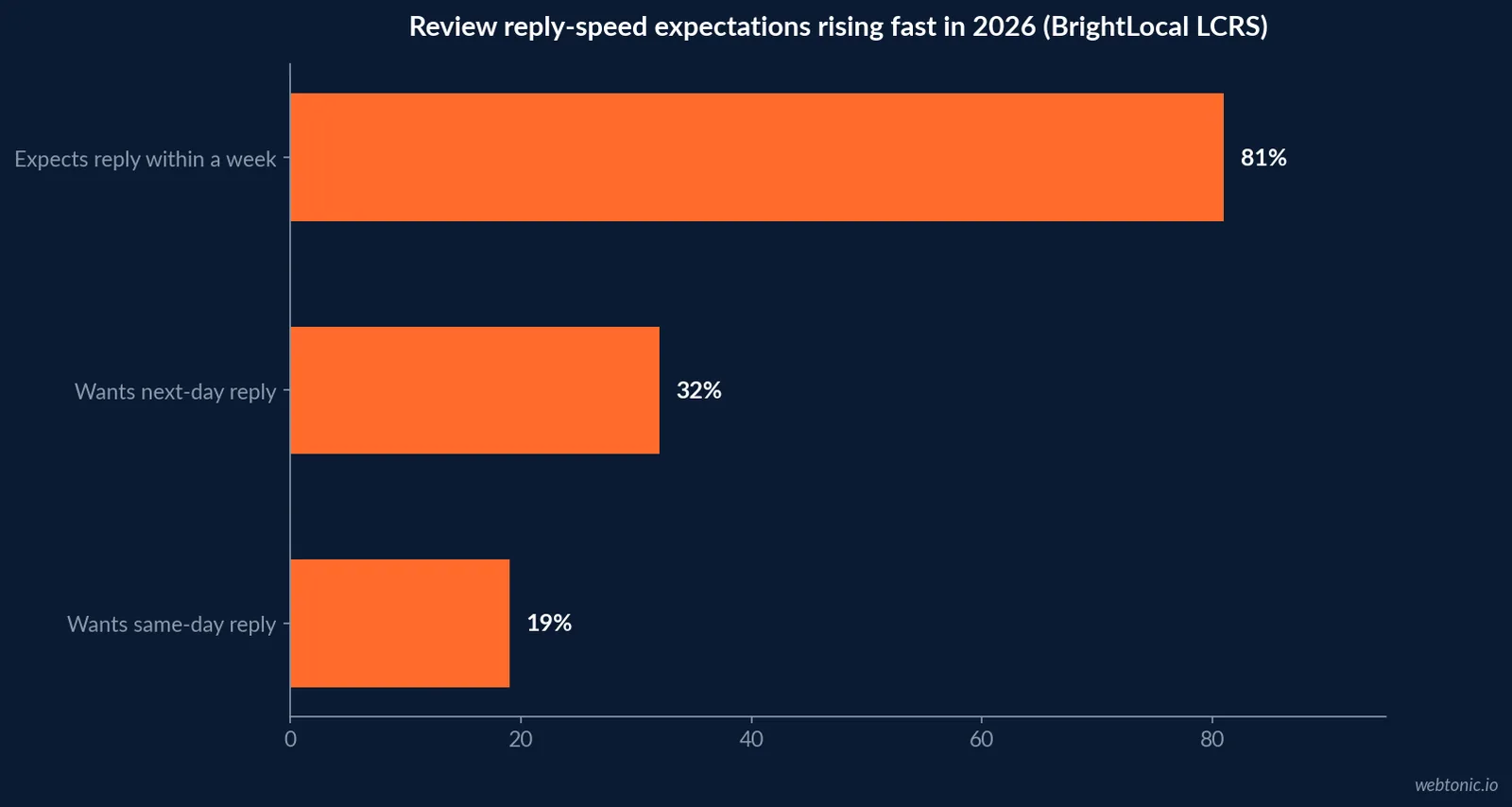
- 19% now expect a same-day reply, up from 6% the year before.
- 50% of consumers are turned off by generic, templated replies.
- New Jersey's Attorney Advertising Opinion 49 (issued 2025-09-30) reset the testimonial rule for the state.
- Florida's 2025 Advertising Handbook requires informed consent under Rule 4-1.6(a) for case-referencing testimonials.
- The FTC's fake-review rule, 16 CFR Part 465, took final effect in August 2024.
- Google's own Prohibited and Restricted Content policy governs every review on a firm's profile.
Benchmarks at a glance: personal injury vs. the general consumer bar
Two data sets, read together, show how much higher the personal injury bar sits than the cross-industry norm BrightLocal's 2026 Local Consumer Review Survey describes.
| Metric | Personal injury benchmark | Cross-industry consumer bar | Source |
|---|---|---|---|
| Review count, median | 191 tracked reviews | 47% reject under 20 reviews | Law Leaderboard / BrightLocal 2026 |
| Review count, middle 50% | 104-416 tracked reviews | Not measured at this depth | Law Leaderboard 2026 |
| Star rating, weighted | 4.79/5 | 31% require 4.5+ stars | Law Leaderboard / BrightLocal 2026 |
| Star rating, profile median | 4.9/5 | 68% require at least 4 stars | Law Leaderboard / BrightLocal 2026 |
| Owner reply rate, weighted | 65% | 89% expect some reply | Law Leaderboard / BrightLocal 2026 |
| Owner reply rate, median profile | 75% | 80% favor full-reply businesses | Law Leaderboard / BrightLocal 2026 |
Where the 1,130-office benchmark comes from
Law Leaderboard's 2026 release tracks 527,168 public Google reviews across 1,130 identity-matched personal-injury-adjacent office profiles in 121 city/practice markets, and analyzes 365,756 of the review texts for sentiment while keeping the raw content private. It is explicit about coverage limits: the release is not a census, and practice/city cells need at least eight qualified offices before they are scored - 29 cells were withheld below that gate. Read as a stated-method vendor dataset rather than a definitive industry census, it is still the most granular public review-behavior benchmark this practice area has.
Individual market rows underline the spread: qualified Personal Injury cells in Denver, San Diego, Orlando, and Austin post median tracked review counts from 172 to 322 and median scored ratings of 4.9 to 5.0, so a firm should benchmark against its own metro, not only the national median.
| Practice / market (sample) | Qualified offices | Median tracked reviews | Median rating |
|---|---|---|---|
| Personal Injury, Denver CO | 32 of 50 discovered | 244 | 4.9/5 |
| Personal Injury, Orlando FL | 32 of 50 discovered | 322 | 4.9/5 |
| Personal Injury, San Diego CA | 25 of 50 discovered | 202 | 4.9/5 |
| Personal Injury, Austin TX | 25 of 50 discovered | 172 | 4.9/5 |
| Personal Injury, San Antonio TX | 33 of 50 discovered | 214 | 4.1/5 |
Recency and reply speed: the newer front of the same fight
BrightLocal's 2026 survey finds 74% of consumers only weigh reviews from the last three months, and rank factor testing inside the same study rates "review posted within the last month" as the third-strongest signal behind sentiment consistency and positive-experience language. For a personal injury firm, that means a strong rating built two years ago on volume alone is not the same asset it was - a stalled review pipeline reads as a stalled firm to a consumer scanning the map pack today.
Reply speed has compressed just as fast: 19% of consumers now expect a same-day reply, up from 6% a year earlier, and 32% want a reply by the next day, up from 18%. Eighty-one percent still expect an answer within a week. Firms whose review-response step sits inside the intake team's daily workflow, rather than a monthly batch job, are answering to 2026 expectations; a monthly batch answers to 2023's.
Reply quality, not just reply rate
Answering every review is only half the signal. BrightLocal finds 50% of consumers are put off by generic or templated replies, and that responding selectively barely helps: answering only positive reviews scores 45% on likelihood-to-use, and answering only negative reviews scores 47%, both far below the 80% businesses earn by replying to everything. For a firm working through Law Leaderboard's 65% weighted reply rate gap, the fix is not only volume of replies but a rotation of genuinely different response language per review, which is also the harder half of the workflow to templatize.
| Reply pattern | Consumer likelihood to use the business | Source |
|---|---|---|
| Replies to every review | 80% | BrightLocal LCRS 2026 |
| Replies to negative reviews only | 47% | BrightLocal LCRS 2026 |
| Replies to positive reviews only | 45% | BrightLocal LCRS 2026 |
| Never replies | 42% unlikely to use | BrightLocal LCRS 2026 |
| Uses generic/templated replies | 50% put off | BrightLocal LCRS 2026 |
What clients praise, and what triggers a one-star review
Law Leaderboard's NLP-derived theme labels across its analyzed review texts show the strongest recurring praise clustering around recommendation, professionalism, and results, while the strongest recurring complaint labels are unprofessional conduct, hidden fees, and poor communication. None of that is a legal-outcome measurement - Law Leaderboard is explicit that its labels summarize public ratings and review themes, not case results or legal skill - but it is a direct map of what a firm's intake and billing-transparency process needs to get right before a settlement even closes, since those are the words showing up in the reviews that follow.
Testimonials sit under a different rulebook than reviews
A five-star Google review a client leaves unprompted is consumer speech. A testimonial the firm selects and republishes - on its own site, in an ad, or as a pull-quote - is attorney advertising, and several state bars have tightened the rule on exactly that distinction in the last year.
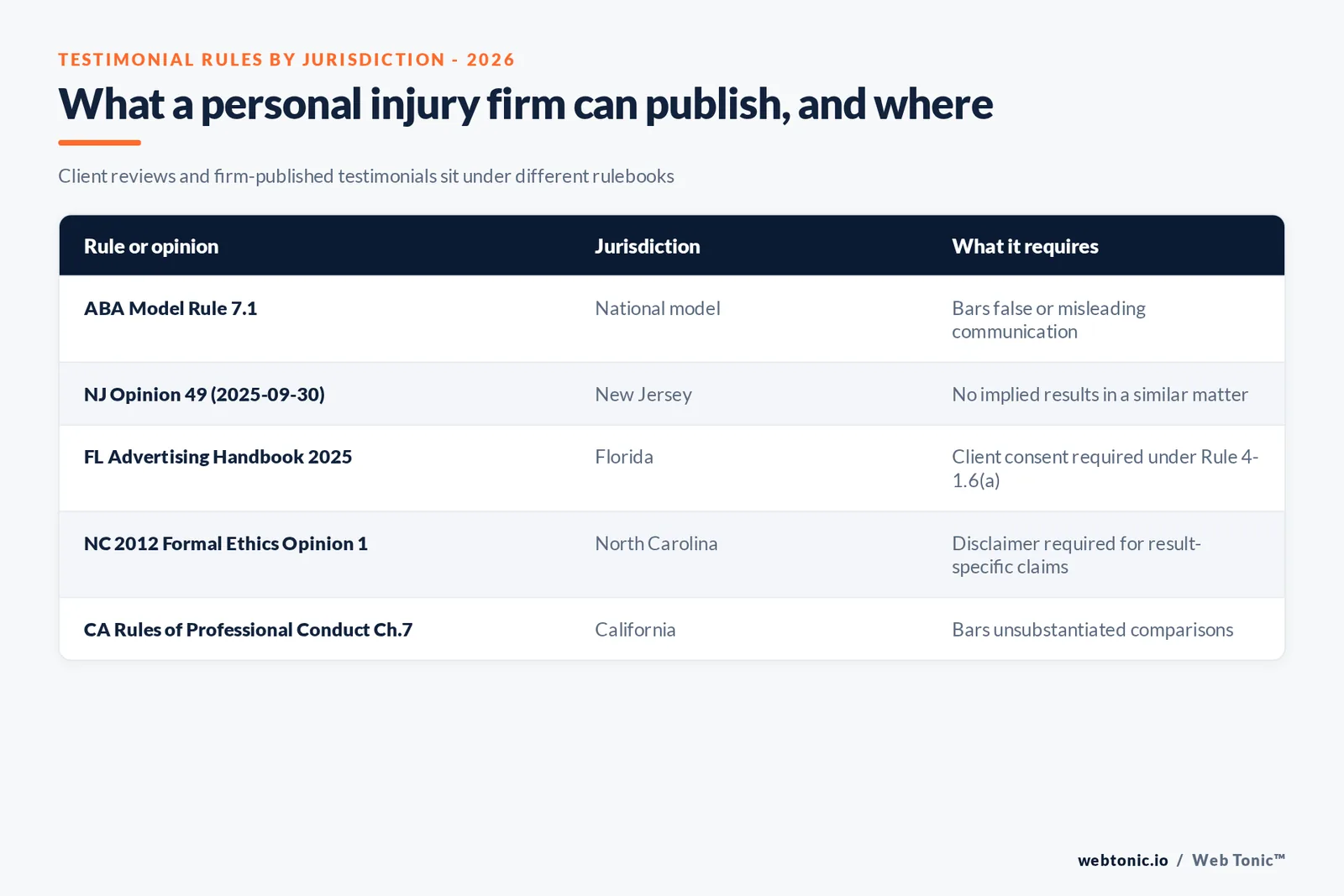
New Jersey's Committee on Attorney Advertising issued Opinion 49 on 2025-09-30, superseding its earlier Opinions 15 and 33, to clarify that client endorsements and testimonials remain permitted in attorney advertising but may not create an unjustified expectation about results in a similar matter. Florida's 2025 Advertising Handbook (approved by the Supreme Court of Florida, effective December 2025) requires the lawyer to obtain the client's informed consent under Rule 4-1.6(a) before using a testimonial that references that client's matter, and requires any required disclaimer to run at the same volume, tone, and speed as the testimonial itself when spoken. North Carolina's 2012 Formal Ethics Opinion 1 similarly permits general testimonials about client service without a disclaimer, but requires a disclaimer when the testimonial references specific results. The common thread across all three: a testimonial about client service is lower-risk than one that implies a predictable case outcome.
| Rule / opinion | Jurisdiction | What it requires for testimonials |
|---|---|---|
| ABA Model Rule 7.1 | National model (adopted by most states) | Bars any false or misleading communication about a lawyer's services |
| NJ Attorney Advertising Opinion 49 (2025-09-30) | New Jersey | Permits endorsements; bars implying results in a similar matter |
| FL Advertising Handbook 2025, Rule 4-1.6(a) | Florida | Requires informed client consent before using a matter-referencing testimonial |
| NC 2012 Formal Ethics Opinion 1 | North Carolina | General service testimonials need no disclaimer; result-referencing ones do |
| CA Rules of Professional Conduct, Ch. 7 | California | Bars unsubstantiated comparisons that could mislead a reasonable person |
The FTC's fake-review rule applies to law firms too
The Federal Trade Commission's 16 CFR Part 465 rule, finalized in August 2024 after a 2022 advance notice and a 2023 proposed rule, prohibits businesses of any kind from creating, selling, or knowingly disseminating reviews that misrepresent an actual customer's experience - including AI-generated reviews attributed to people who do not exist, and reviews procured from undisclosed company insiders. It also bars conditioning compensation on a review being positive. For a personal injury firm running a review-request program off its case-management system, the safe pattern is the one BrightLocal and the FTC agree on: ask every settled client, disclose any incentive, and never route only satisfied clients to the public review link while quietly diverting the rest.
Google's own review policy is the ceiling above every state rule
Regardless of what a state bar allows, every review still has to survive Google's own Prohibited and Restricted Content policies, which apply to every Business Profile format including reviews. Google's reporting tool only removes reviews that violate those policies - a legitimate one-star review about a bad experience is not eligible for removal just because a firm disputes it. That makes the reply, not the removal request, the firm's actual lever on a negative but policy-compliant review.
A working review-management checklist for a personal injury firm
- Ask every settled client for a review inside a fixed post-settlement window, disclosed and unconditioned per the FTC rule.
- Track the 90-day recency window BrightLocal's data says 74% of consumers actually weigh, not just lifetime volume.
- Reply to 100% of reviews, not a selective subset - the 80% vs. 45-47% gap is the single largest lever in this data.
- Route review responses through the intake team on a same-day/next-day cadence, matching the 2026 consumer expectation, not a monthly batch.
- Keep site-published testimonials generic-service language unless the client has given informed consent for a matter-specific quote, per the state bar rule that applies.
Web Tonic's personal injury law local SEO statistics page covers the visibility side of this same map-pack fight; the cross-industry reputation management statistics benchmark is the general-consumer baseline this page compares against. Firms weighing whether to bring review-request workflows in-house or hire it out can start from our growth marketing services page, or get in touch directly.
Frequently Asked Questions
How many Google reviews does a personal injury law firm typically have?
Law Leaderboard's 2026 benchmark of 1,130 identity-matched personal-injury-adjacent office profiles (527,168 tracked public Google reviews, 365,756 analyzed review texts) puts the median tracked review count at 191, with the middle 50% of offices spanning roughly 104 to 416 reviews. That is well above BrightLocal's 2026 cross-industry finding that 47% of consumers will not use a business with fewer than 20 reviews - personal injury is a category where the floor is already much higher than the general-consumer minimum.
What star rating do personal injury firms need to compete?
The same Law Leaderboard release puts the review-count-weighted public Google rating across its 1,130-office dataset at 4.79/5, with a profile-level median of 4.9/5. Read against BrightLocal's 2026 Local Consumer Review Survey finding that 31% of consumers will only use a business rated 4.5 stars or higher, a firm sitting below roughly 4.5 is competing for the 69% of consumers with a lower bar, not the full market.
How often do personal injury firms reply to reviews, and does it matter?
Law Leaderboard's retrieved-review-weighted owner-reply signal is 65%, with a median profile-level rate of 75% - both well above BrightLocal's 2026 cross-industry response-rate norms. BrightLocal separately finds 89% of consumers expect a business to respond to reviews and that 80% are more likely to use a business that answers every review, against 42% who are unlikely to use one that never replies. In a category compared side by side on Google's map pack, a missing reply is a visible gap.
Can a law firm publish client testimonials about case results?
Only with care. ABA Model Rule 7.1 bars any communication that is false or misleading, and several state bars regulate testimonials specifically: New Jersey's Committee on Attorney Advertising Opinion 49 (issued 2025-09-30, superseding Opinions 15 and 33) permits client endorsements but requires they not create unjustified expectations about results, and Florida's 2025 Advertising Handbook requires a client's informed consent under Rule 4-1.6(a) before a testimonial referencing that client's matter is used. A five-star review is consumer speech; a firm-authored case-result testimonial is regulated attorney advertising, and the two are checked under different rules.
Does the FTC's 2024 fake-review rule reach law firm marketing?
Yes - the FTC's 16 CFR Part 465 Trade Regulation Rule, finalized August 2024, applies across industries and prohibits businesses of any kind from creating, buying, or disseminating reviews that misrepresent an actual customer's experience, including reviews that are undisclosed and compensated. A personal injury firm soliciting reviews from settled clients is on the compliant side of that line as long as no review is fabricated, incentivized without disclosure, or selectively suppressed through a gating tool that only sends unhappy clients to a private channel.
Sources
Law Leaderboard - Personal Injury Law Firm Review Benchmark, 2026
BrightLocal - Local Consumer Review Survey 2026
NJ Committee on Attorney Advertising, Opinion 49 (2025-09-30)
ABA - Model Rule 7.1, Comment
Federal Trade Commission - Fake Reviews Final Rule, 2024
Google Business Profile Help - Prohibited and Restricted Content Policies
Google Business Profile Help - Report Inappropriate Reviews