Table of contents
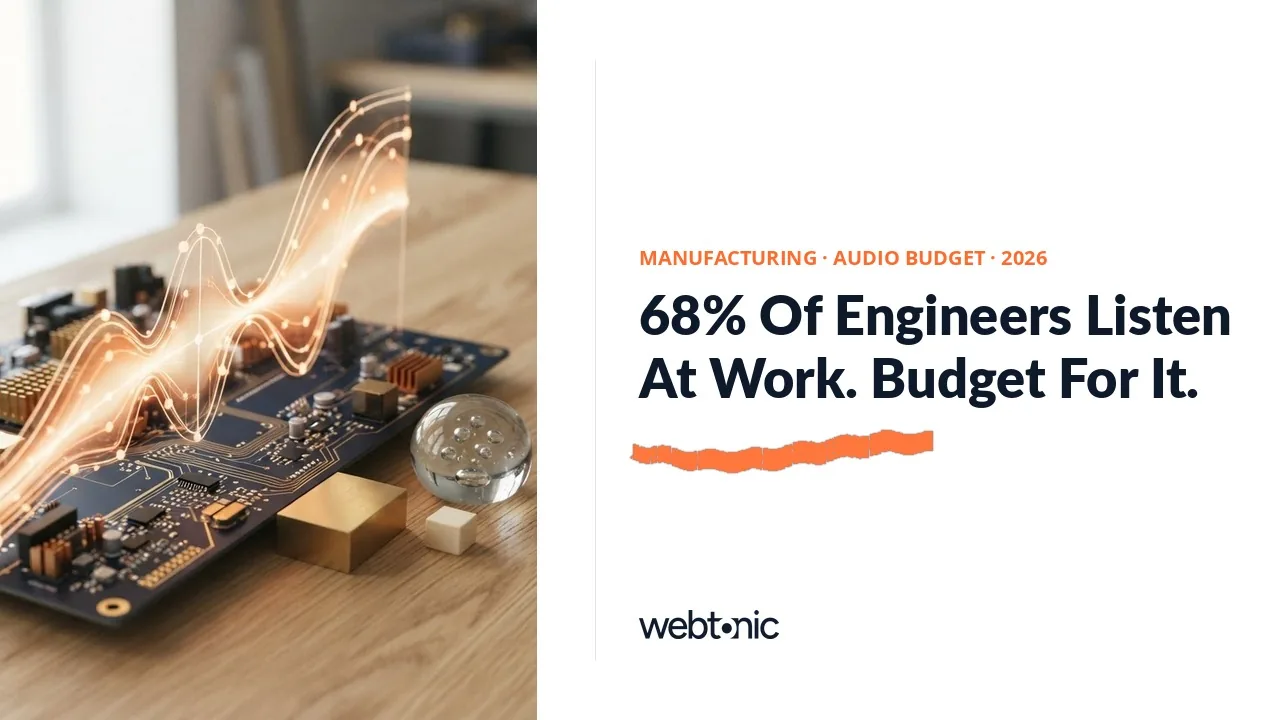
A manufacturer can test podcast advertising from a published self-serve floor of about USD 250, and Technology-category podcast CPMs averaged USD 29 in Libsyn's last monthly rate report - the harder budget line is the team time, because 48% of manufacturing marketers work in teams of one or two. Every figure below is a third-party rate, minimum or benchmark median; none is a Web Tonic price.
Key Takeaways
- 68% of technical buyers listen to work-related podcasts (TREW 2026).
- Technical buyers spend 62% of the buying process online before talking to sales.
- 53% say brand familiarity influenced their most recent purchase.
- Technology podcast CPMs averaged USD 29 in September 2024 (Libsyn).
- The all-category 60-second average was USD 21.37.
- Self-serve audio floors start around USD 250 (Spotify, SiriusXM AudioGo).
- B2B mid-market podcast CPA median: USD 278 (Podscribe Q3 2026).
- B2B enterprise cost per visitor: USD 29.02.
- 93.1% of US manufacturing firms have fewer than 100 employees (NAM).
- 48% of manufacturing marketers work in teams of one or two.
- US podcast ad revenue reached USD 2.9 billion in 2025.
- Technology was just 0.6% of 2023 podcast revenue by genre.
Do technical buyers listen at all?
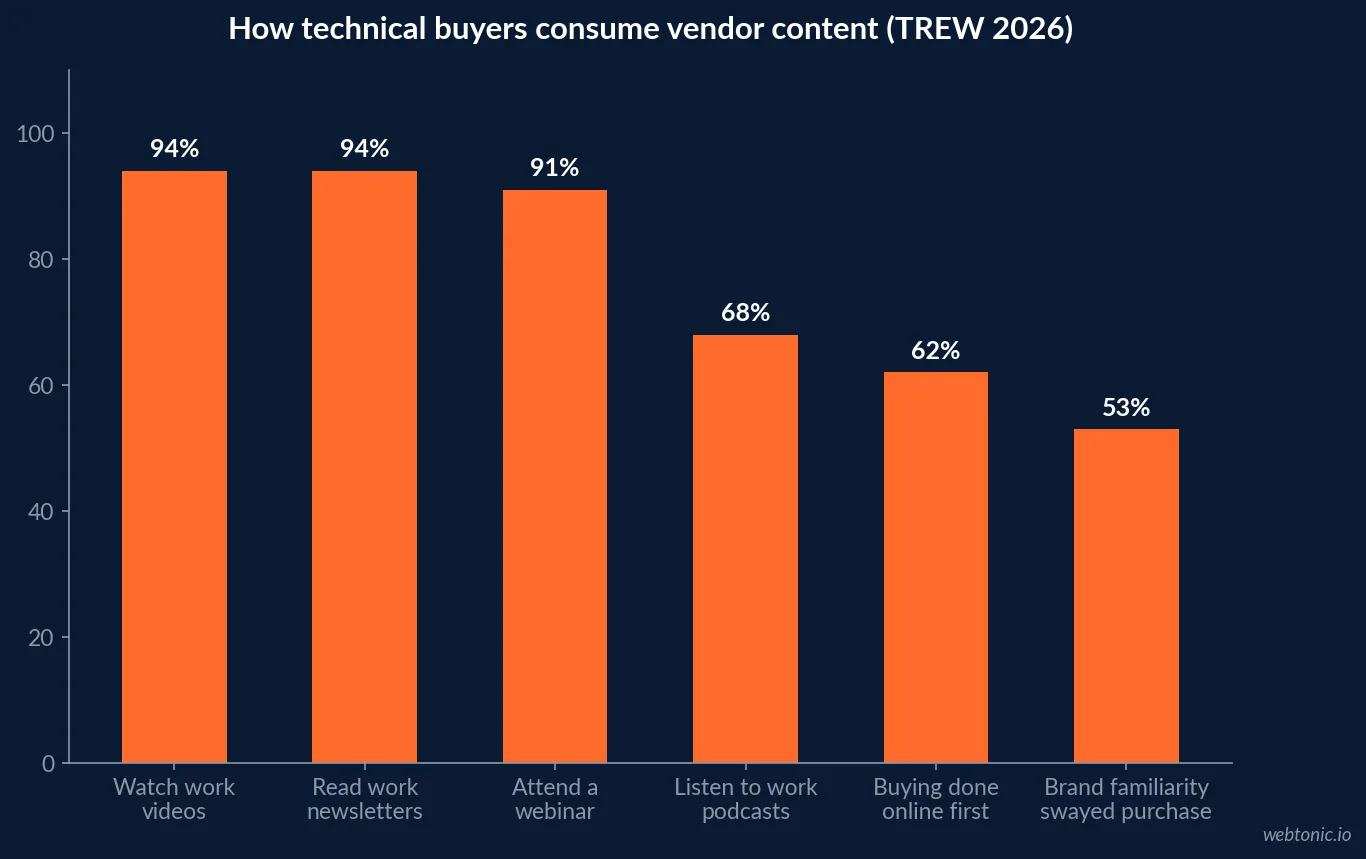
The question that decides the budget is audience, not price. TREW Marketing and GlobalSpec's 2026 State of Marketing to Engineers report found 68% of technical buyers listen to work-related podcasts, with more time spent by younger engineers. The same study found technical buyers complete 62% of the buying process online before engaging sales, that 53% say brand familiarity shaped their most recent purchase, and that 69% now use generative AI during purchasing.
Audio competes with channels engineers rate highly. In the same report 94% watch work-related videos, 94% subscribe to work-related newsletters and 91% attend at least one webinar a year. Podcasts are one of several owned-and-sponsored channels, not a replacement for them.
| Technical buyer behaviour (TREW 2026) | Share | Budget implication |
|---|---|---|
| Listen to work-related podcasts | 68% | Audio reaches most of the engineering audience |
| Watch work-related videos | 94% | Repurpose episodes as video clips |
| Subscribe to work-related newsletters | 94% | Newsletter sponsorship is the competing line |
| Attend at least one webinar a year | 91% | Podcast guests convert to webinar speakers |
| Buying process completed online first | 62% | Audio builds familiarity before the RFQ |
| Brand familiarity influenced last purchase | 53% | Awareness has measurable purchase weight |
| Prefer email for first vendor contact | 59% | Route podcast listeners to email capture |
Published rate cards to budget against
Libsyn's September 2024 podcast ad rate report - the last in its monthly series - put the average 60-second CPM at USD 21.37, with Government at USD 31, Technology at USD 29 and Health and Fitness at USD 24 as the three highest-priced categories. Industrial and B2B technology campaigns generally sit in or near that Technology line.
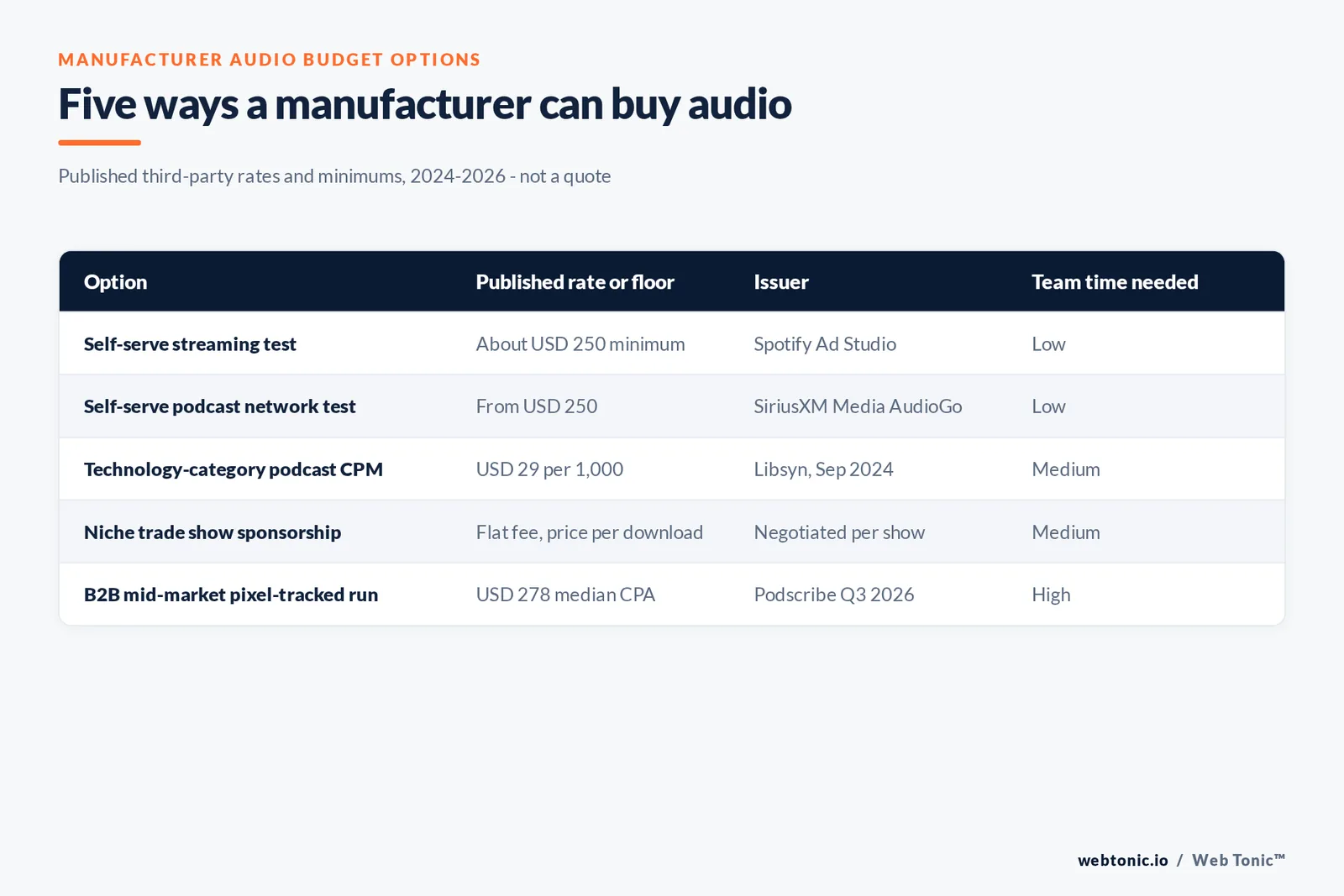
Self-serve floors are low. The Spotify Ad Studio help centre (Netherlands page) sets a minimum lifetime budget of roughly USD 250 equivalent, and SiriusXM Media's podcast cost guide describes AudioGo campaigns starting at USD 250.
| Published price point | Value | Issuer | What it buys |
|---|---|---|---|
| Technology category CPM, Sep 2024 | USD 29 | Libsyn | 1,000 delivered impressions |
| Government category CPM, Sep 2024 | USD 31 | Libsyn | Highest-priced category that month |
| All-category 60-second CPM, Sep 2024 | USD 21.37 | Libsyn | Network-wide average |
| All-category 60-second CPM, Sep 2023 | USD 22.84 | Libsyn | Year-earlier comparison |
| Self-serve minimum lifetime budget | about USD 250 | Spotify Ad Studio (NL page) | Entry test |
| Self-serve campaign start | USD 250 | SiriusXM Media AudioGo | Entry test |
Turning rate cards into a test budget
Arithmetic is the honest way to size a first test. At the USD 29 Technology CPM, 100,000 impressions cost about USD 2,900; at the USD 21.37 all-category average the same volume costs about USD 2,137. Neither figure includes production, a host-read premium or the time to build a landing page and tracking.
Those numbers are illustrations of published rates, not industrial benchmarks. Niche trade shows with small, senior audiences often sell flat-fee sponsorships rather than CPM inventory, so ask for downloads per episode and price per thousand yourself.
| Illustrative test size | At USD 21.37 CPM | At USD 29 CPM | Note |
|---|---|---|---|
| 25,000 impressions | about USD 534 | about USD 725 | Near the USD 250 floors x2-3 |
| 50,000 impressions | about USD 1,069 | about USD 1,450 | One trade show, several episodes |
| 100,000 impressions | about USD 2,137 | about USD 2,900 | Minimum for a readable pixel test |
| 250,000 impressions | about USD 5,343 | about USD 7,250 | Multi-show run-of-network |
What B2B podcast results cost in 2026
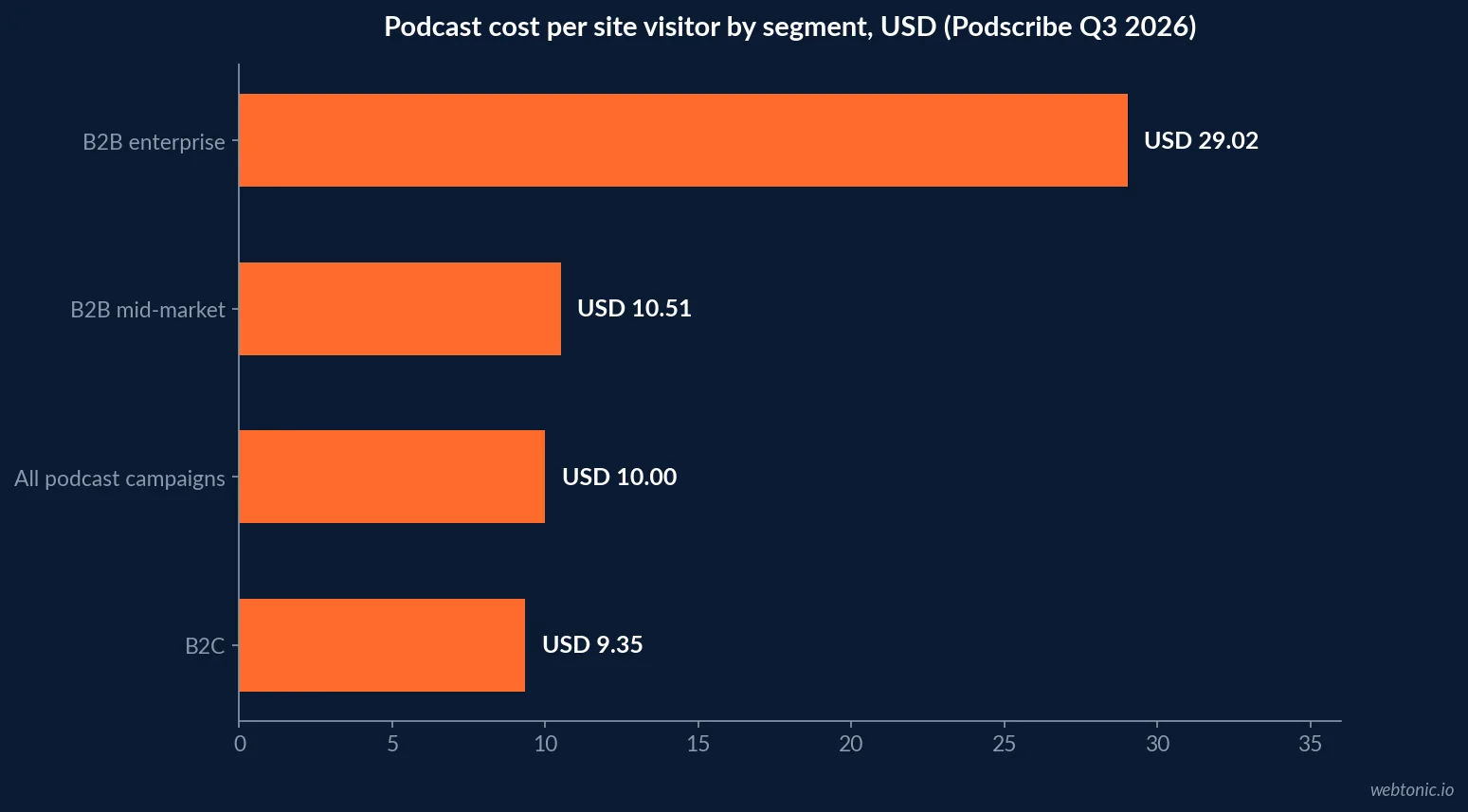
Podscribe's Q3 2026 Performance Benchmark Report (vendor data, 105K+ campaigns) splits results by business model. B2B mid-market campaigns show a 0.20% visitor rate, USD 10.51 per visitor, a 0.014% purchase rate and a USD 278 cost per acquisition. B2B enterprise campaigns show a 0.09% visitor rate and USD 29.02 per visitor, with no purchase CPA reported. B2C sits at USD 162 per acquisition.
Long industrial sales cycles make a "purchase" pixel almost meaningless, so the visitor and lead metrics matter more. Podscribe measures podcast conversions over a 30-day window, which is still short for a capital-equipment decision.
| Podscribe Q3 2026 segment | Visitor rate | Cost per visitor | Cost per acquisition |
|---|---|---|---|
| B2B enterprise | 0.09% | USD 29.02 | Not reported |
| B2B mid-market | 0.20% | USD 10.51 | USD 278 |
| B2C | 0.12% | USD 9.35 | USD 162 |
| All podcast campaigns | 0.20% | USD 10.00 | USD 168 |
Which buy type fits an industrial audience
Buy type changes both reach precision and cost. In Podscribe's Q3 2026 benchmark, direct show buys delivered a 0.25% visitor rate and a 0.027% purchase rate at a USD 98 median CPA, run-of-network 0.28% and 0.017% at USD 64, and programmatic 0.32% and 0.021% at USD 74. Host-read and producer-read spots were close: purchase rates of 0.018% and 0.016%, CPAs of USD 137 and USD 123.
For a manufacturer the trade-off is audience definition. Programmatic and run-of-network buys are cheaper per result across all advertisers, but they rarely reach a narrow engineering discipline; a direct buy on a trade show costs more per acquisition and puts the message in front of the exact specifiers the company needs. Budget the direct buy as the core and treat network inventory as reach extension.
| Podscribe buy type (all advertisers) | Visitor rate | Purchase rate | Median CPA |
|---|---|---|---|
| Direct show buy | 0.25% | 0.027% | USD 98 |
| Run of network | 0.28% | 0.017% | USD 64 |
| Programmatic | 0.32% | 0.021% | USD 74 |
| Host-read spots | - | 0.018% | USD 137 |
| Producer-read spots | - | 0.016% | USD 123 |
The team-size constraint
The National Association of Manufacturers counts 239,265 US manufacturing firms (2022 Census data), all but 4,177 of them small, with 93.1% employing fewer than 100 people. Straight North's 2026 manufacturing marketing survey (agency-run, marketer respondents) found 60% of respondents at companies under 100 employees and 48% in marketing teams of one or two.
That survey also shows where attention already goes: 46% are actively investing in SEO, 25% name lead quality as their top challenge and 16% name proving ROI. Audio has to earn a slot against those priorities, which argues for one well-chosen sponsorship over a broad programmatic buy.
| Manufacturer profile metric | Value | Source |
|---|---|---|
| US manufacturing firms (2022) | 239,265 | NAM, Census data |
| Firms with 500+ employees | 4,177 | NAM, Census data |
| Firms with fewer than 100 employees | 93.1% | NAM, Census data |
| Manufacturing value added, Q1 2026 | USD 3.0 trillion annual rate | NAM, BEA data |
| Marketers in 1-2 person teams | 48% | Straight North 2026 survey |
| Top challenge: lead quality | 25% | Straight North 2026 survey |
How small industrial is in podcast spend today
The IAB FY2023 podcast revenue study shows the Technology genre at just 0.6% of podcast revenue, and B2B-type advertisers are folded into an "Other" category of 23.4%. The market overall is large and growing: the IAB and PwC FY2025 report puts US podcast ad revenue at USD 2.9 billion, up 17.6%, and Magellan AI's Q4 2025 benchmark counted 1,482 new brands advertising and spend up 32% year on year.
Low category share cuts both ways. Industrial buyers hear fewer competing ads on trade shows, but there is also little public data on what works for them, so a manufacturer's own test is the benchmark.
Owner and decision-maker reach
For smaller manufacturers the buyer is often an owner. Edison Research's Podcast Consumer 2025 reports that 18% of weekly podcast consumers are business owners and 56% are homeowners, and that monthly consumers skew toward higher income and education than the general population. That profile suits distributors and component makers selling to owner-operated shops.
Disclosure on sponsored technical content
Industrial podcasts often blur into sponsored interviews with a vendor's engineer. When a host or guest endorses equipment, the FTC Endorsement Guides, 16 CFR Part 255 require material connections - payment, free product, employment - to be disclosed clearly. Say "sponsored by" on air and in show notes.
A budget checklist for manufacturers
- Start at the floor: a USD 250 self-serve test proves tracking before a sponsorship.
- Price niche shows yourself: ask for downloads per episode and convert to CPM.
- Plan on a 30-day read at least; industrial cycles run far longer.
- Measure visitors and leads, not purchases, as in Podscribe's B2B segments.
- Budget team hours: 48% of manufacturing marketers work in teams of one or two.
- Repurpose every episode into video and newsletter content for the 94% who use both.
Related data
For the cross-industry picture, see our podcast and audio advertising statistics. Manufacturers weighing video should read our manufacturing CTV data and industrial influencer statistics. If you need the creative built, our performance creative team produces audio and video ads.
Frequently Asked Questions
What should a manufacturer budget for a first podcast test?
There is no manufacturing-specific benchmark, so start from published floors and rates. Spotify's Ad Studio help page for the Netherlands lists a minimum lifetime budget of roughly USD 250, SiriusXM Media's AudioGo guide also starts at USD 250, and Libsyn's September 2024 report put Technology-category podcast CPMs at USD 29. At USD 29 CPM, 100,000 impressions cost about USD 2,900 before production - simple arithmetic, not a quote.
Do engineers and technical buyers actually listen to podcasts?
Yes. TREW Marketing and GlobalSpec's 2026 State of Marketing to Engineers report found 68% of technical buyers listen to work-related podcasts, with younger engineers spending more time on them. The same study found 94% watch work-related videos and 94% subscribe to work-related newsletters, so audio competes with strong owned channels.
What does a B2B podcast lead or sale cost?
Podscribe's Q3 2026 benchmark reports B2B mid-market podcast campaigns at a 0.20% visitor rate, USD 10.51 per visitor and USD 278 per acquisition, against USD 162 for B2C. Enterprise B2B showed a 0.09% visitor rate and USD 29.02 per visitor with no purchase CPA reported. These are cross-industry vendor medians, not industrial benchmarks.
Is podcast advertising realistic for a small manufacturer?
It can be, but the constraint is usually people, not money. NAM data shows 93.1% of US manufacturing firms have fewer than 100 employees, and in Straight North's 2026 survey of manufacturing marketers 48% work in teams of one or two. A sponsorship on one trade show with a host read is easier to run than a programmatic audio program.
Which disclosure rules apply to sponsored industrial podcasts?
When a host or guest endorses equipment or a supplier, the FTC Endorsement Guides in 16 CFR Part 255 require material connections, such as payment or free product, to be clearly disclosed. Sponsored episodes and interviews with a vendor's engineer should say so on air.
Sources
TREW Marketing / GlobalSpec - 2026 State of Marketing to Engineers
National Association of Manufacturers - Facts About Manufacturing
Straight North - 2026 Manufacturing Marketing Survey (agency data)
Podscribe - Performance Benchmark Report Q3 2026
Libsyn - September 2024 podcast ad rates
Spotify Advertising - Ad Studio help centre
SiriusXM Media - How much does it cost to advertise on a podcast
IAB / PwC - Internet Advertising Revenue Report, FY2025
IAB - US Podcast Advertising Revenue Study, FY2023
Magellan AI - Podcast advertising benchmarks Q4 2025
Edison Research - The Podcast Consumer 2025
eCFR - 16 CFR Part 255