Table of contents
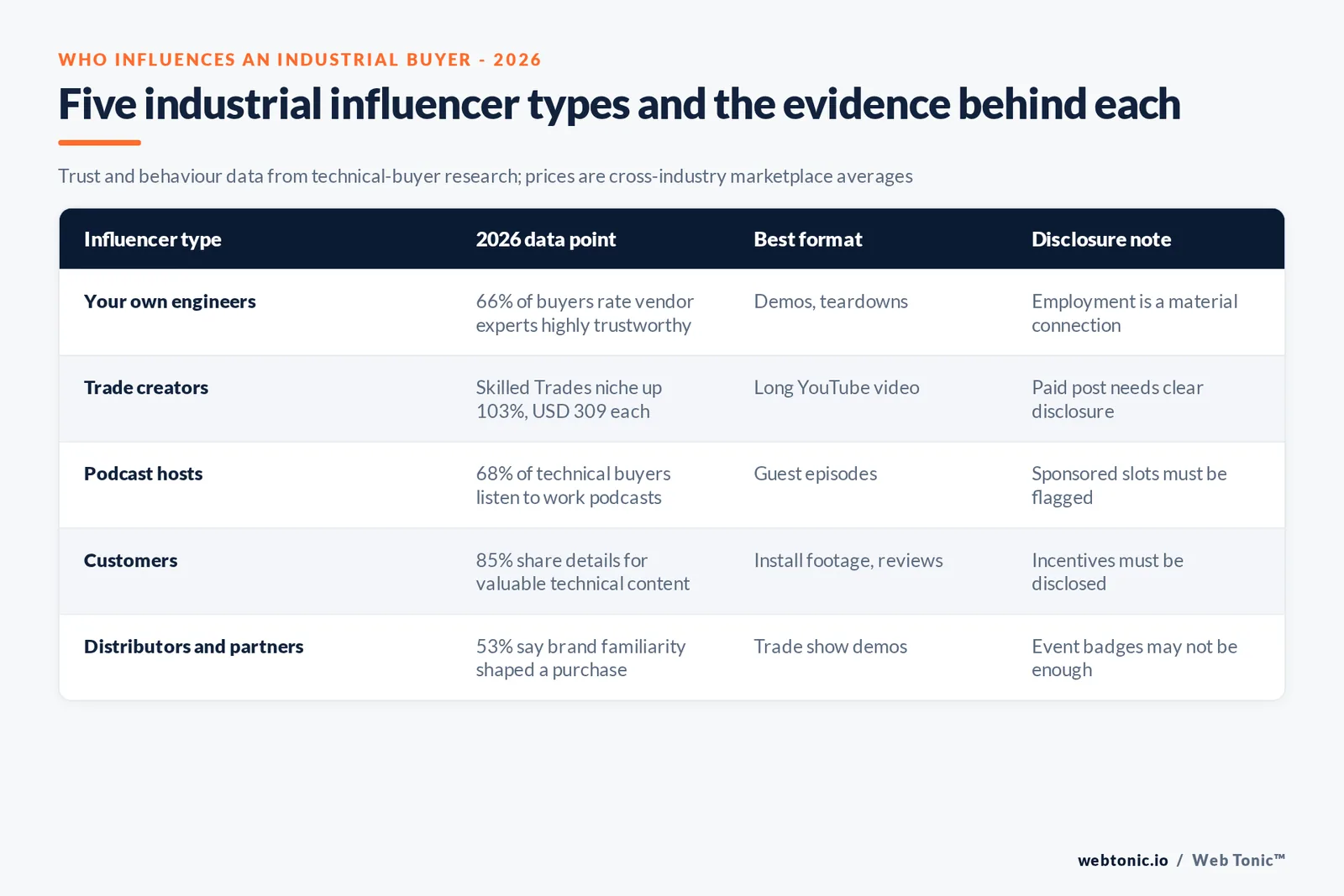
In manufacturing the most trusted influencer is an engineer, not a creator with a ring light: 66% of technical buyers rate vendor engineering experts as very or extremely trustworthy. No industrial influencer benchmark exists, so this page builds the picture from technical-buyer research, cross-industry creator pricing and the FTC rules on employee advocacy.
Key Takeaways
- 66% of technical buyers rate vendor engineering experts very or extremely trustworthy.
- Only 10% say the same about generative AI tools, which rank last.
- 94% of technical buyers watch work-related videos; 68% listen to work podcasts.
- Buyers complete 62% of the buying journey before contacting a vendor.
- 53% say brand familiarity influenced their most recent purchase.
- Skilled Trades creators grew 103% year on year on Collabstr and cost USD 309 per engagement.
- US manufacturing counts 239,265 firms, all but 4,177 of them small.
- Manufacturing employed over 12.6 million workers in August 2026.
Why industrial influence looks different
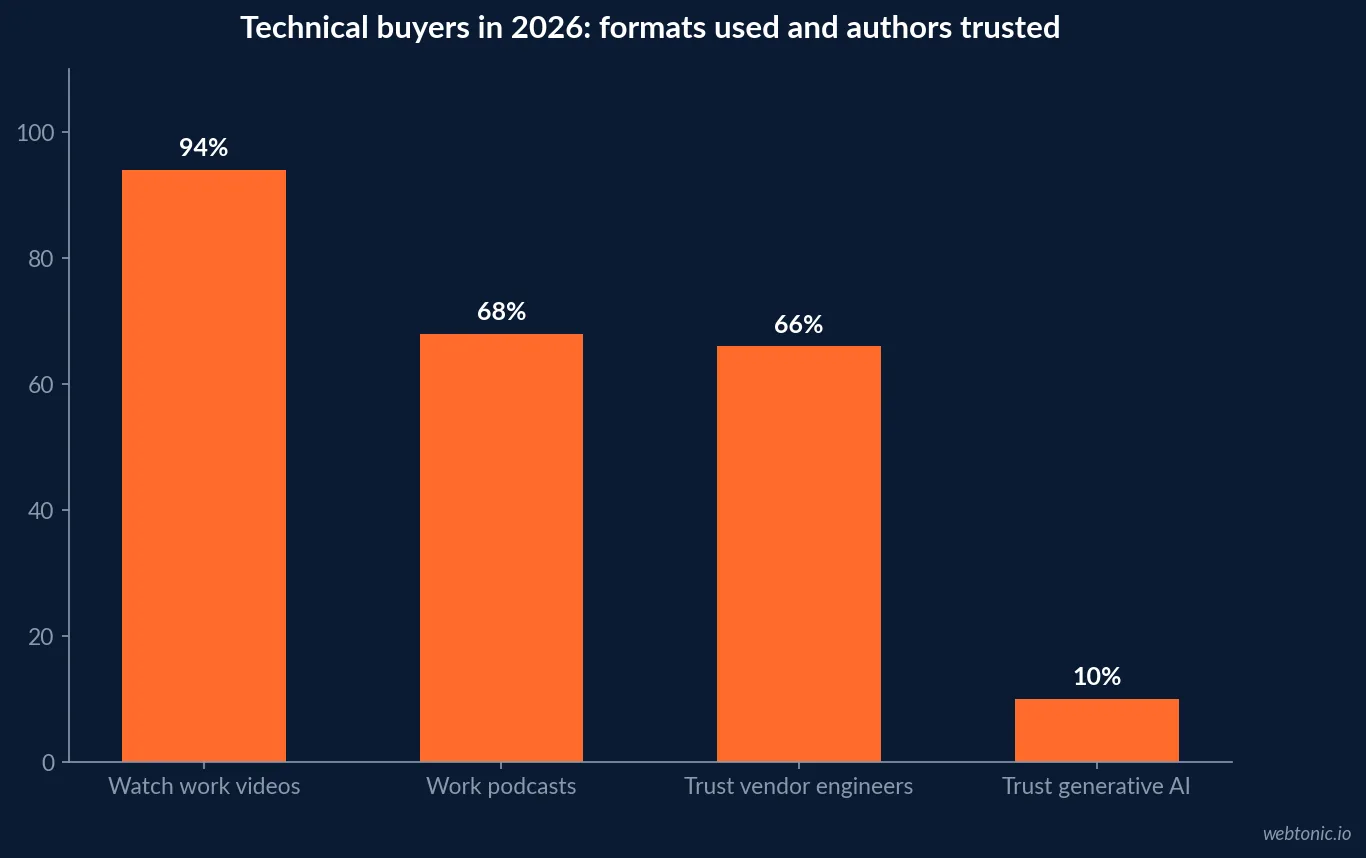
The 2026 State of Marketing to Engineers report from TREW Marketing and GlobalSpec, now in its ninth year, asks technical buyers which authors they trust. Engineering experts at vendor companies came first, with 66% rating them very or extremely trustworthy, while generative AI tools came last at 10%. Technical buyers rate AI answers 4.7 out of 10 for trust, up from 4.4 in 2025 but down from 6.5 in 2024.
That ranking is the industrial version of influencer marketing. The person with influence is the one who can explain a tolerance, a failure mode or an installation step, and the most credible version of that person often already works for the manufacturer.
How technical buyers consume creator-style content
The same study found 94% of technical buyers watch work-related videos, with how-to guides, whiteboard sessions and product demos the most wanted formats. 68% listen to work-related podcasts, 94% subscribe to newsletters and 91% attend at least one webinar a year, with 49% attending more than three.
Technical buyers also name YouTube, LinkedIn and GitHub as the most valuable social platforms for work. None of those is a short-form entertainment feed, which is why industrial creator work tends to be long, specific and searchable.
| Technical-buyer behaviour (TREW/GlobalSpec 2026) | Share | What it means for creator content |
|---|---|---|
| Watch work-related videos | 94% | Demos and teardowns are the core format |
| Subscribe to work newsletters | 94% | Creator explainers travel well by email |
| Attend at least one webinar a year | 91% | Guest engineers suit live formats |
| Share contact details for valuable content | 85% | Creator content can gate a technical asset |
| Use generative AI while purchasing | 69% | Named experts help content get cited |
| Listen to work-related podcasts | 68% | Podcast guesting is industrial influence |
The buying journey is mostly self-directed
Technical buyers complete 62% of the buying journey online before contacting a vendor, according to the 2026 study; buyers aged 35 and under spend 66% of the process online against 63% for those aged 36 to 55. 53% say brand familiarity influenced their most recent purchase, and 69% now use generative AI during purchasing.
Creator and user content earns its place in that unsupervised phase. A third-party engineer's walkthrough or a customer's installation video is what a buyer finds while the sales team is still unaware the project exists.
Named experts matter more as AI answers spread
The trust curve for generative AI among technical buyers has been volatile: 6.5 out of 10 in 2024, 4.4 in 2025 and 4.7 in 2026, according to the TREW and GlobalSpec series. Usage moved the other way, with 69% now using generative AI during a purchase. Buyers are asking AI tools more often while believing them less, and they check what they find against sources they already trust.
That gap is where named industrial voices earn their keep. A video or article carrying a real engineer's name, credentials and test data is the thing a sceptical buyer goes looking for after an AI summary. Younger engineers lean even further into self-directed research, which makes the effect stronger over time rather than weaker.
| Research signal (TREW/GlobalSpec) | Value | Implication for creator content |
|---|---|---|
| Trust in generative AI answers, 2024 | 6.5 / 10 | Early optimism |
| Trust in generative AI answers, 2025 | 4.4 / 10 | Sharp correction |
| Trust in generative AI answers, 2026 | 4.7 / 10 | Cautious use, verified elsewhere |
| Journey online before vendor contact, age 35 and under | 66% | Creator content reaches them first |
| Journey online before vendor contact, age 56 and over | 62% | Still mostly self-directed |
The size of the market being influenced
The National Association of Manufacturers counts 239,265 manufacturing firms in 2022, with all but 4,177 classed as small (under 500 employees); around three-quarters have fewer than 20 employees. Manufacturers contributed USD 3.0 trillion at an annual rate in Q1 2026, 9.4% of US value-added output, and every USD 1.00 spent in manufacturing has a total impact of USD 2.69 on the economy.
Most of those firms have no marketing department to speak of, which makes low-cost expert content and customer footage more realistic than paid creator campaigns.
| US manufacturing indicator (NAM) | Figure | Period |
|---|---|---|
| Manufacturing firms | 239,265 | 2022 |
| Firms with 500+ employees | 4,177 | 2022 |
| Manufacturing workers | Over 12.6 million | August 2026 |
| Value-added output, annual rate | USD 3.0 trillion | Q1 2026 |
| Share of US value-added output | 9.4% | Q1 2026 |
| Total impact per USD 1.00 spent | USD 2.69 | Latest NAM estimate |
What expertise-led creators cost
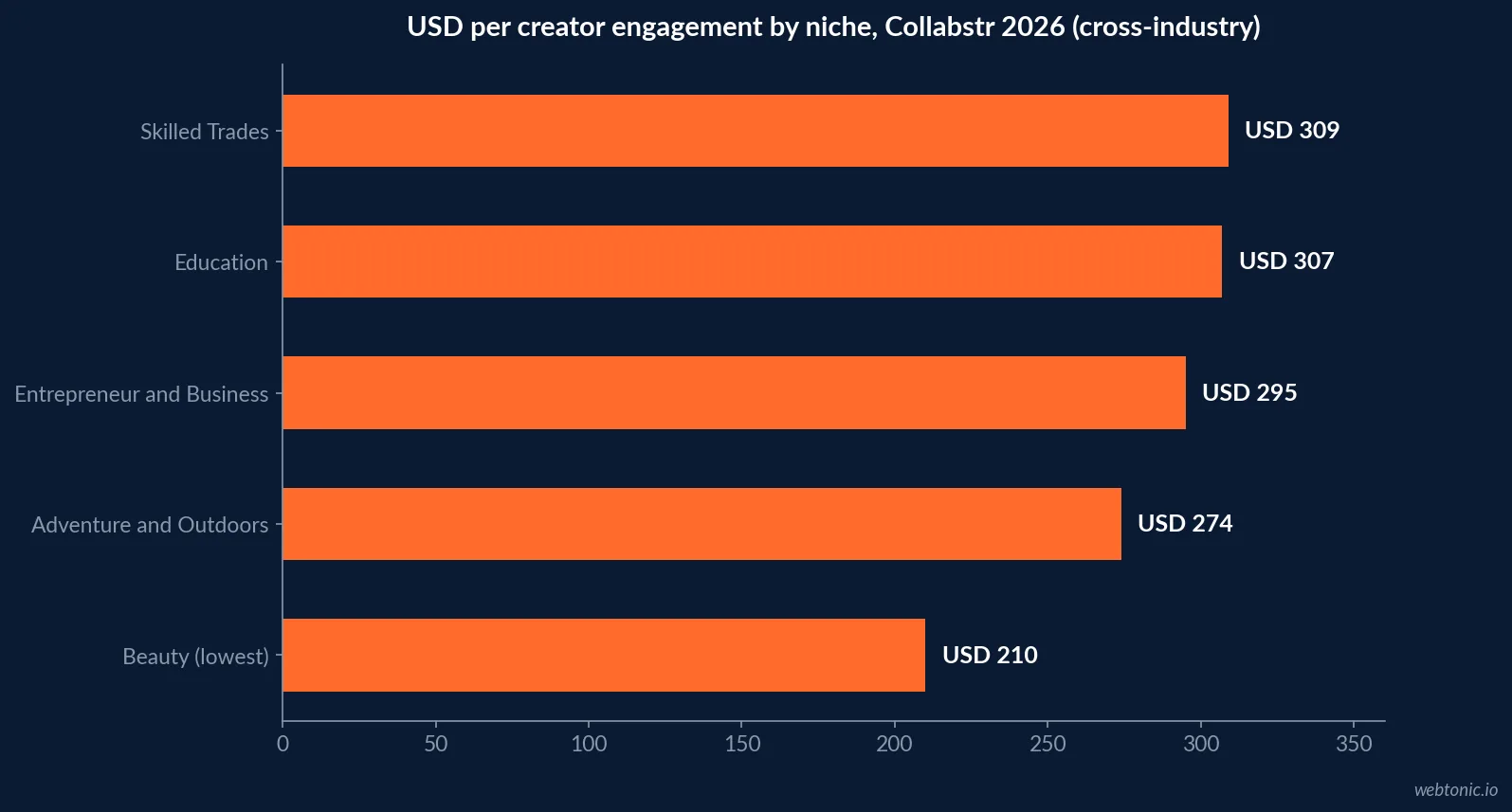
There is no industrial creator rate card. The nearest proxy is Collabstr's 2026 Influencer Marketing Report, built on more than 21,000 collaborations, where the most expensive niches are all expertise-led: Skilled Trades at USD 309, Education at USD 307 and Entrepreneur and Business at USD 295 per engagement. The cheapest are awareness niches such as Beauty at USD 210. These are cross-industry marketplace averages.
Skilled Trades was also the second-fastest-growing niche, up 103% year on year, behind Athlete and Sports at 108%. Collabstr reports that long-form YouTube videos drove the highest engagement at 6%, ahead of Instagram Reels at 5%.
| Niche (Collabstr 2026, cross-industry) | Average price per engagement | Industrial relevance |
|---|---|---|
| Skilled Trades | USD 309 | Fabrication, maintenance, installation |
| Education | USD 307 | Engineering explainers, training |
| Entrepreneur and Business | USD 295 | Plant owners, operations leaders |
| Adventure and Outdoors | USD 274 | Equipment in the field |
| Beauty (lowest) | USD 210 | Reference point for awareness niches |
Employees and customers are the industrial UGC supply
LinkedIn's Thought Leader Ads let a company boost posts from employees, industry experts, customers or content creators, after requesting permission from the author, and the author can see the combined organic and paid metrics on the post. For a manufacturer, that turns an application engineer's post into a targeted ad without writing it in the brand voice.
The cross-industry data supports reuse. Linqia's 2026 survey found 100% of marketers repurpose influencer content beyond the creator's own page, 81% say it outperforms brand-created assets and 49% now work with specialist influencer agencies.
Disclosure when the influencer is on the payroll
The FTC's Endorsement Guides at 16 CFR Part 255 require any connection that might materially affect an endorsement's credibility, and that the audience would not expect, to be disclosed clearly and conspicuously; business relationships are named explicitly (255.5). One worked example is an employee of a home robot manufacturer promoting the product on a discussion board, and the guides say the employer should train employees to limit its own liability. The rule applies equally to employees posting reviews.
Trade shows raise a second issue. The FTC's Endorsement Guides FAQ warns that a badge or event hashtag may not adequately tell consumers about a paid connection, and that a platform's built-in disclosure tool is not automatically enough. Engineers and distributors invited to demo days should get written disclosure guidance.
Where budgets are heading, cross-industry
Influencer Marketing Hub's 2026 benchmark survey of 600+ marketers found 87.49% expecting influencer budgets to rise and 5.55% expecting a cut. It also shows LinkedIn at 15% incidence among brands with no plans to invest in influencer marketing, a reminder that B2B-heavy platforms are still under-used by the wider influencer industry.
The creator mix is shifting toward smaller specialists: 52.83% of respondents plan to expand micro-creator use and 50.00% UGC creators, while macro creators split at 20.59% expansion against 20.58% contraction.
| Budget signal (cross-industry, 2026) | Figure | Source |
|---|---|---|
| Expect influencer budgets to rise | 87.49% | Influencer Marketing Hub |
| Expect a cut | 5.55% | Influencer Marketing Hub |
| Plan to expand micro-creator use | 52.83% | Influencer Marketing Hub |
| Increasing influencer budgets | 62% | Linqia |
| Struggle to measure ROI | 79% | Linqia |
What the data does not tell a manufacturer
No source here measures industrial influencer return on spend, cost per lead or engagement rate for manufacturing specifically. The trust and behaviour data describe technical buyers; the price data describe a cross-industry marketplace. Anyone quoting an industrial influencer ROI figure should be asked for the sample, the period and whether the brands in it sell to engineers at all. Most published influencer returns come from consumer categories with short purchase cycles, which is the opposite of a capital-equipment sale that can run for months.
What can be said with confidence is directional: technical buyers trust engineers, watch long video, research alone for most of the journey and discount generic AI answers. Creator programs built around those facts are working with the evidence rather than against it.
How to run industrial influencer and UGC work
- Start with your own engineers. Vendor experts are trusted by 66% of technical buyers.
- Make it long and searchable. 94% watch work videos; YouTube leads engagement at 6%.
- Guest on podcasts before paying posts. 68% of buyers listen to work podcasts.
- Boost, do not rewrite. Thought Leader Ads keep the engineer's voice.
- Train staff on disclosure. 16 CFR 255.5 covers employees explicitly.
Our performance creative team turns engineer-led footage into paid variants, and our data intelligence practice connects long buying cycles to pipeline. For cross-industry context, read our influencer and UGC marketing statistics and the broader advertising statistics.
Frequently Asked Questions
Does influencer marketing work for manufacturers?
There is no published manufacturing influencer benchmark, so nobody can quote an industrial engagement rate or return honestly. What the 2026 State of Marketing to Engineers research does show is that technical buyers rate engineering experts at vendor companies as their most trusted content authors, at 66% very or extremely trustworthy, and that 94% watch work-related videos. Expertise-led creators fit that behaviour; lifestyle influencers do not.
Who counts as an influencer in industrial marketing?
Mostly engineers, application specialists, trade creators and your own staff. LinkedIn's Thought Leader Ads let a company boost posts from employees, industry experts, customers or content creators, which formalises that wider definition. Collabstr's 2026 data shows Skilled Trades as the fastest-growing paid niche after sports, up 103% year on year.
What does an expertise-led creator cost?
Collabstr's 2026 cross-industry marketplace data shows the most expensive niches are Skilled Trades at USD 309, Education at USD 307 and Entrepreneur and Business at USD 295 per engagement. These are marketplace averages across all industries, not industrial rate cards, and highly specialised engineering creators often negotiate outside marketplaces.
Do employees posting about their employer need to disclose?
Yes, when the audience would not expect the connection. The FTC's Endorsement Guides (16 CFR 255.5) list business relationships among material connections and use the example of a manufacturer's employee promoting a product on a discussion board; the guides say employers should train employees to limit their own liability. The same applies to employees posting reviews.
Which platforms matter most for industrial creators?
Technical buyers in the 2026 State of Marketing to Engineers study continue to name YouTube, LinkedIn and GitHub as the most valuable social platforms for work, and 68% listen to work-related podcasts. That points industrial creator budgets toward long-form video, LinkedIn and podcasts rather than short-form entertainment feeds.
Sources
TREW Marketing and GlobalSpec - 2026 State of Marketing to Engineers
National Association of Manufacturers - Facts About Manufacturing
Collabstr - 2026 Influencer Marketing Report
Influencer Marketing Hub - Influencer Marketing Benchmark Report 2026
Linqia - 2026 State of Influencer Marketing
LinkedIn Marketing Solutions - Thought Leader Ads
eCFR - 16 CFR Part 255, Guides Concerning Endorsements and Testimonials
FTC - Endorsement Guides: What People Are Asking