



Table of contents

No survey reports where manufacturing and industrial native advertising budgets are headed; the named data shows digital budgets growing and display-style channels under scrutiny. The CMO Survey 2026 and Straight North's 2026 manufacturing survey give the direction, and native vendors' own filings show how much of the open-web market is growing at all.
Key Takeaways
- B2B product companies expect digital marketing budgets to grow 9.4% in the next 12 months (CMO Survey 2026).
- Overall marketing spend grew only 1.7% in the prior 12 months; digital grew 8.2%.
- Traditional advertising is projected to decline a further 1.5%.
- 36% of B2B marketers name content syndication or partner networks a top lead source (Sagefrog 2026).
- 46% of manufacturing marketers actively invest in SEO; display and paid social are more often paused (Straight North 2026).
- Taboola's 2025 ex-TAC gross profit rose 7% to USD 713.5 million.
- Teads' 2025 revenue rose 46% to USD 1,300.5 million, primarily due to the Acquisition.
- Industrial and commercial search leads cost USD 75.19 in WordStream's 2026 data, a search comparator.
Budget direction signals at a glance
Each row is a named, dated figure. None is a manufacturing native budget, because no issuer publishes one; together they show which way the money around native is moving.
| Signal | Figure | Issuer and period | Direction |
|---|---|---|---|
| B2B product digital budget, next 12 months | +9.4% | CMO Survey 2026 | Up |
| Overall marketing spend, prior 12 months | +1.7% | CMO Survey 2026 | Flat to slightly up |
| Traditional advertising, next 12 months | -1.5% | CMO Survey 2026 | Down |
| Taboola ex-TAC gross profit | USD 713.5M (+7%) | Taboola, FY2025 | Up |
| Manufacturing native share of budget | Not published | No issuer | Unknown |
What the CMO Survey says about B2B product budgets
The CMO Survey 2026 highlights report, produced at Duke's Fuqua School of Business, puts marketing budgets at 9.6% of company budgets, their lowest level since 2021, and 9.0% of company revenues. Overall marketing spending grew just 1.7% over the prior 12 months, the weakest since 2021, while digital marketing spending grew 8.2%. For the next 12 months, B2B product companies, the sector that includes most manufacturers, expect digital marketing to grow 9.4% and brand building 5.1%, against 10.4% and 5.9% for all respondents. Traditional advertising is projected to fall a further 1.5%.
Native is digital, so it sits in the growing bucket. The survey does not split digital into native, search or social, so how much of the 9.4% goes to native is not knowable from it. The same report rates digital marketing's contribution to company performance lowest for manufacturing, at 4.25 on its scale, against 4.83 for B2B product overall.
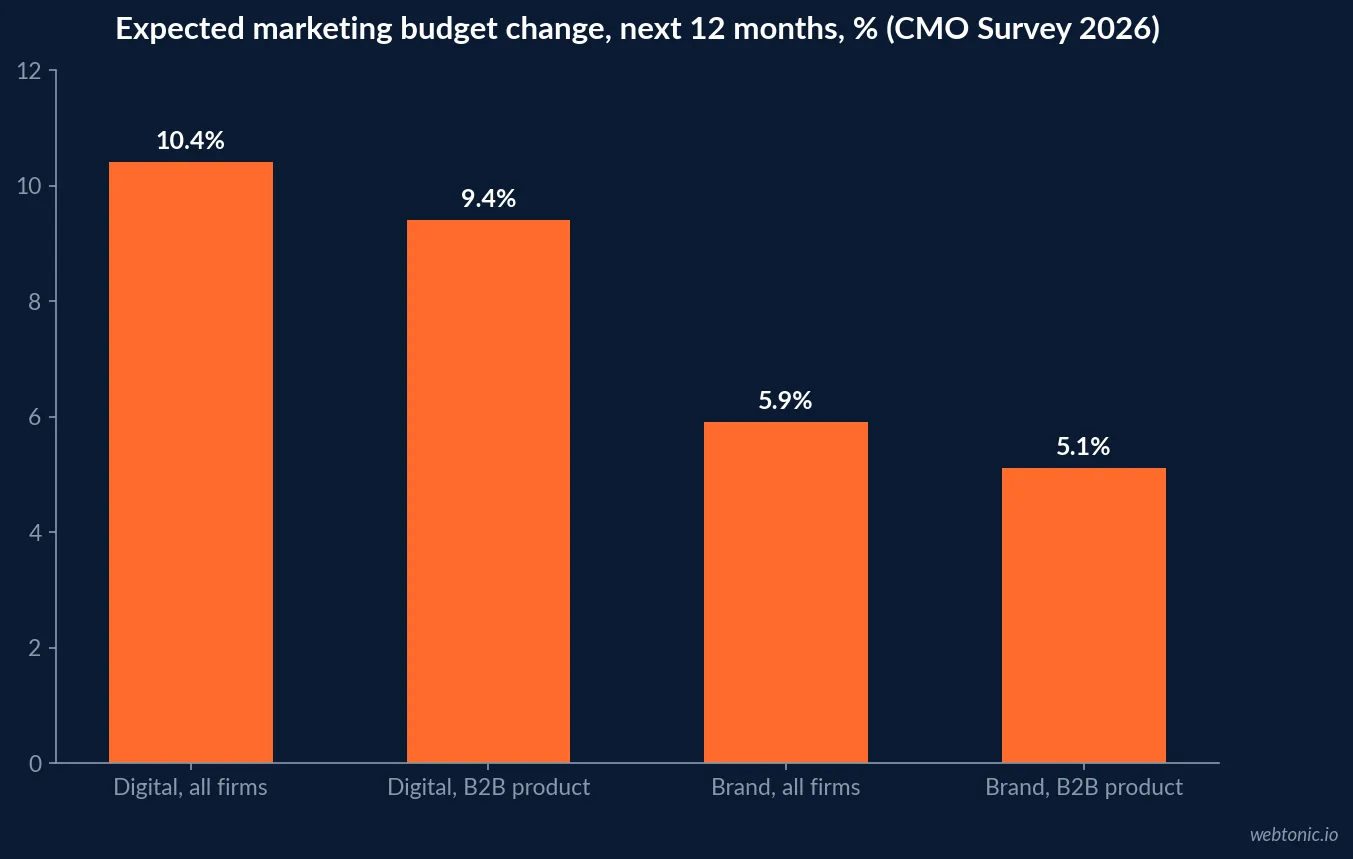
| CMO Survey 2026, next 12 months | All firms | B2B product | B2B services |
|---|---|---|---|
| Digital marketing | +10.4% | +9.4% | +8.8% |
| Brand building | +5.9% | +5.1% | +8.3% |
| New product introductions | +5.9% | +7.0% | +3.0% |
| Customer relationship management | +3.5% | +3.9% | +4.5% |
Where B2B marketers say the money is going
Sagefrog's 2026 B2B Marketing Mix Report, in which industrial, manufacturing and engineering firms made up 19% of respondents, ranks the top areas of marketing spend as content marketing 30%, AI tools and applications 28%, customer experience and journey optimisation 26%, PR and media outreach 20%, search engine marketing 20%, social media management and direct and print advertising 18% each, and SEO and paid social 16% each. Its top lead sources are closer to native: content syndication or partner networks 36%, directories, sponsorships or industry listings 36%, email 33% and paid social 30%.
Content syndication and sponsored placements on trade publications are the forms native most often takes in manufacturing. That they rank as a top lead source suggests budget is not leaving sponsored content, but the report does not show an increase, and it does not separate open-web native networks.
| Sagefrog 2026 | Top spend area | Share | Top lead source | Share |
|---|---|---|---|---|
| 1 | Content marketing | 30% | Content syndication or partner networks | 36% |
| 2 | AI tools and applications | 28% | Directories, sponsorships or listings | 36% |
| 3 | Customer experience | 26% | Email marketing | 33% |
| 4 | PR and media outreach | 20% | Paid social media | 30% |
| 5 | Search engine marketing | 20% | Events, tradeshows and webinars | 28% |
What manufacturing marketers are keeping and cutting
The manufacturing-specific view comes from Straight North's second annual survey of 245 manufacturing marketers (2026; 60% at companies with fewer than 100 employees). SEO is an active investment for 46% and the most effective channel for 13%. The report finds teams deepening existing channels rather than launching new ones, and says display advertising and paid social appear more frequently among abandoned efforts, which it links to channels that are hard to measure or justify in niche B2B markets. In the 2025 edition, 62% invested in SEO and 20% called it most successful.
For native, this is the clearest direction available: open-web native is a display-adjacent format, and manufacturing marketers are cutting display where measurement is weak. Budgets that stay will be the ones tied to measured pipeline.
Native vendors: growth, and what it is made of
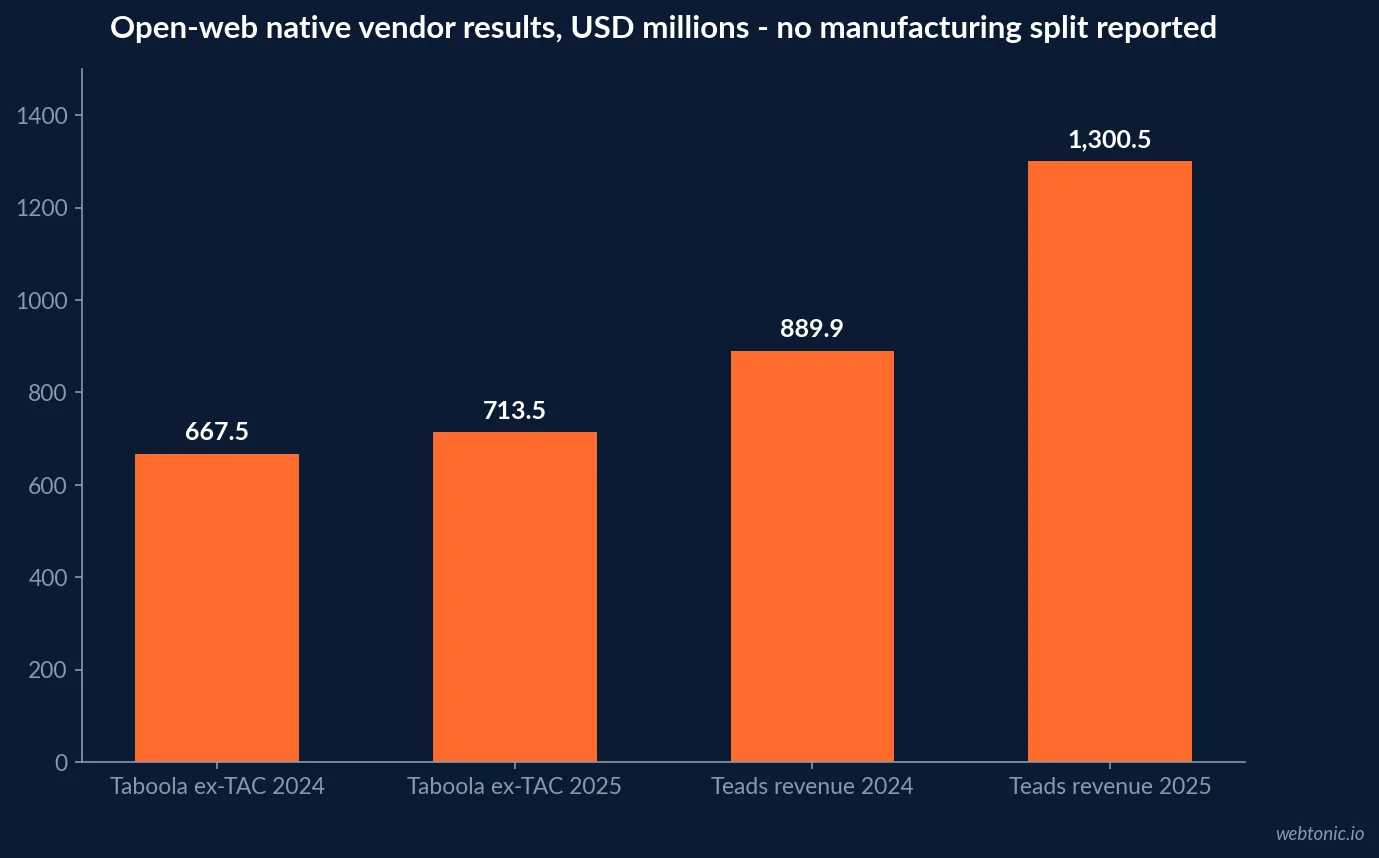
Taboola reported 2025 ex-TAC gross profit of USD 713.5 million against USD 667.5 million, an increase of about 7%. Teads, the business formed when Outbrain acquired Teads in February 2025, reported revenue of USD 1,300.5 million against USD 889.9 million, up 46%, and states the increase was "primarily due to the Acquisition". Both investor pages block automated requests; the figures were confirmed in the companies' published release text. Neither company reports manufacturing or industrial revenue, so vendor growth shows the market is expanding modestly, not that manufacturers are joining it.
| Native vendor, FY2025 | Metric | 2024 | 2025 | Change |
|---|---|---|---|---|
| Taboola | ex-TAC gross profit | USD 667.5M | USD 713.5M | About +7% |
| Teads | Revenue | USD 889.9M | USD 1,300.5M | +46%, merger-driven |
| Either | Manufacturing revenue | Not reported | Not reported | Unknown |
The wider ad market
US digital advertising reached USD 294.6 billion in 2025, a 13.9% year-over-year increase, according to the IAB/PwC Internet Advertising Revenue Report released April 16, 2026. The release highlights video, social and commerce media growth; native is not reported as its own line, so the market-level native trend cannot be read from it either.
Two more CMO Survey 2026 figures shape where a manufacturer's native money would come from. Social media spending rebounded to 14.3% of marketing budgets after falling in 2025, so paid social, the channel manufacturers are also pausing, still takes a large slice. And B2B product companies say external agencies, partners and services currently perform about 28% of their digital marketing activities, a share they expect to reach 31% in two years. Native programmes in manufacturing are therefore often run in-house, which makes a simple, repeatable measurement setup more important than a sophisticated media plan.
How industrial buyers research, and where native can reach them
TREW Marketing's State of Marketing to Engineers research reports technical buyers spend 62% of the buying process online before engaging sales, 69% use generative AI during purchasing, 94% subscribe to newsletters and 85% will provide their information for valuable technical content. Kula Partners' Industrial Buyer Pulse (Q3 2025, 263 North American decision-makers) found 82% shortlist suppliers before speaking with them, 85% use AI to research suppliers and 77% obtain pricing or lead-time information through self-serve tools. Kula also reports only 2% of industrial buyers expect a modest capex budget decrease.
The opening for native is the anonymous research stage. The 85% willing to trade details for technical content suggests gated specs and guides promoted through sponsored placements fit how engineers buy, which is a format argument, not evidence of rising native budgets.
| Industrial buyer behaviour | Figure | Issuer, year |
|---|---|---|
| Share of buying process online before sales | 62% | TREW, 2026 |
| Shortlist suppliers before contacting them | 82% | Kula Partners, Q3 2025 |
| Use AI to research suppliers | 85% | Kula Partners, Q3 2025 |
| Provide details for valuable technical content | 85% | TREW, 2026 |
| Prefer email for first vendor contact | 59% | TREW, 2026 |
The size of the manufacturing audience
The National Association of Manufacturers counts 239,265 manufacturing firms in 2022, all but 4,177 of them small, with 93.1% employing fewer than 100 people; yet 59.1% of sector employees work at firms with 500 or more. US manufacturers exported USD 1,763.8 billion in 2025. A market made mostly of small firms with concentrated employment is a narrow, technical audience, which is why broad open-web native reach is harder to justify than trade-publication sponsorship.
The cost benchmark native has to beat
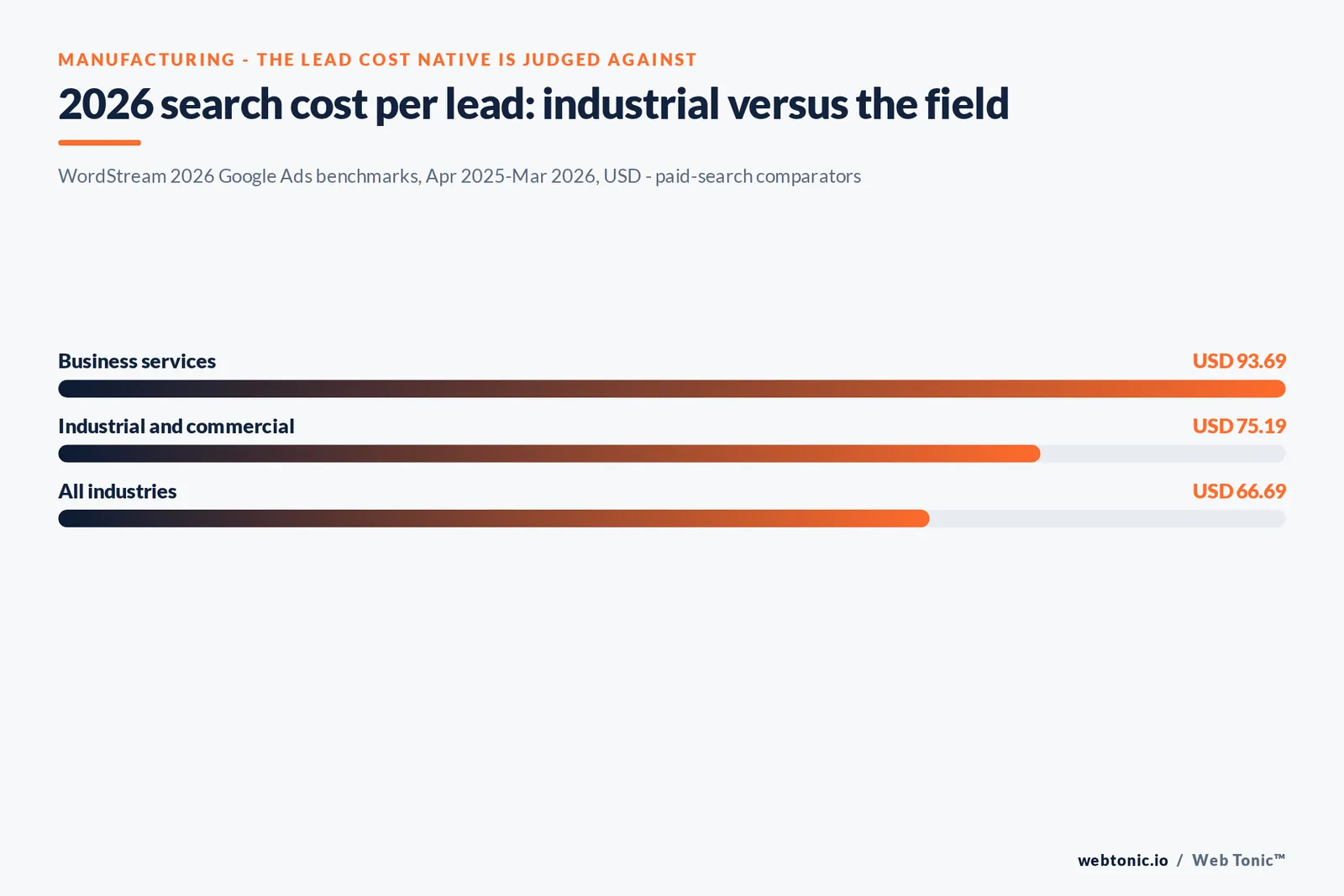
No manufacturing native cost per lead is published, so the reference is search. WordStream's 2026 Google Ads benchmarks (over 13,000 campaigns, April 2025 to March 2026) list industrial and commercial at a 6.57% click-through rate, a USD 5.87 cost per click and a USD 75.19 cost per lead, against USD 66.69 across all industries. WordStream notes the industries with rising lead costs aligned with those affected by tariffs. A native programme that cannot show a qualified-lead cost near that range, measured against a holdout, is the kind of spend the Straight North respondents are pausing.
| Search comparator, 2026 | CTR | CPC | Cost per lead |
|---|---|---|---|
| Industrial and commercial | 6.57% | USD 5.87 | USD 75.19 |
| Business services | 6.10% | USD 5.87 | USD 93.69 |
| All industries | 6.64% | USD 5.42 | USD 66.69 |
Labelling sponsored technical content
Sponsored white papers and case studies on trade sites are still advertising. The FTC native advertising guide says a native ad is deceptive if it is not readily identifiable as advertising and that disclosures must be clear and prominent. An engineering article paid for by a component supplier needs a visible Sponsored label, which also protects the trust technical buyers place in trade media.
Setting a direction for your own native budget
- Treat native as part of digital, the line B2B product firms expect to grow 9.4%.
- Favour syndication and trade sponsorship, a top lead source for 36% of B2B marketers.
- Measure before scaling: unmeasured display is what manufacturers are pausing.
- Gate technical content, since 85% of technical buyers trade details for it.
- Compare qualified-lead cost with USD 75.19, the industrial search comparator.
For cross-industry data see our native advertising statistics. Manufacturing organic data is in our manufacturing enterprise SEO statistics and export-market data in our manufacturing international SEO statistics. Our growth marketing team can design the holdout test.
Frequently Asked Questions
Are manufacturers increasing native advertising budgets?
No published survey says so. The CMO Survey 2026 shows B2B product companies expect digital marketing budgets to grow 9.4% over the next 12 months, and Sagefrog's 2026 report lists content syndication or partner networks as a top lead source for 36% of B2B marketers, but neither isolates native ads or manufacturing native spend.
Which channels are manufacturers cutting?
Straight North's 2026 Manufacturing Marketing Survey of 245 marketers reports that display advertising and paid social appear more often among paused efforts, which it links to channels that are hard to measure. Native display placements face the same measurement test.
How fast are native ad vendors growing?
Taboola reported 2025 ex-TAC gross profit of USD 713.5 million, up 7% from USD 667.5 million. Teads reported 2025 revenue of USD 1,300.5 million, up 46%, which the company says was primarily due to the Acquisition of Teads by Outbrain, so it is not organic growth. Neither breaks out manufacturing.
What does a manufacturing search lead cost for comparison?
WordStream's 2026 benchmarks put industrial and commercial search ads at a USD 75.19 cost per lead, a 6.57% click-through rate and a USD 5.87 cost per click. These are paid-search comparators; no manufacturing native cost per lead is published.
Where do industrial buyers research before talking to sales?
TREW Marketing reports technical buyers spend 62% of the buying process online before engaging sales, and Kula Partners' Q3 2025 pulse of 263 buyers found 82% shortlist suppliers before speaking with them. Native content can only influence that stage if it is labelled, technical and measurable.
Sources
The CMO Survey 2026, Highlights and Insights Report
Sagefrog, 2026 B2B Marketing Mix Report
Straight North, 2026 Manufacturing Marketing Survey
TREW Marketing, State of Marketing to Engineers
Kula Partners, Industrial Buyer Pulse Q3 2025
NAM, Facts About Manufacturing
Taboola, Q4 and full year 2025 results
Teads, Q4 and full year 2025 results
IAB/PwC, Internet Advertising Revenue Report 2025
WordStream, Google Ads Benchmarks 2026
FTC, Native Advertising: A Guide for Businesses


