



Table of contents
The state of international SEO in manufacturing is a gap between export reality and website reality: 68,001 US manufacturers exported goods in 2023, yet the average translated site carries only a small fraction of its English content. This page measures the export side with Census Bureau data, the buyer side with industrial buying surveys, and the market side with Statcounter and W3Techs. No dataset measures how many manufacturers run localized sites, so we do not estimate one.
Key Takeaways
- 68,001 manufacturers were among 278,207 identified US goods exporters in 2023 (Census, preliminary).
- Manufacturers carried 54.8% of known export value, about USD 970.0 billion.
- Small and mid-size firms were 95.9% of manufacturer exporters but 18.2% of their export value.
- Small and mid-size firms make up 98% of the nearly 280,000 US exporting businesses (trade.gov).
- 80% of B2B buyers use search engines to source new suppliers (Thomas, 2019).
- 82% of industrial buyers shortlist suppliers before talking to them (Kula Partners, Q3 2025).
- The average target language gets just 5% of a site's English content (CSA Research).
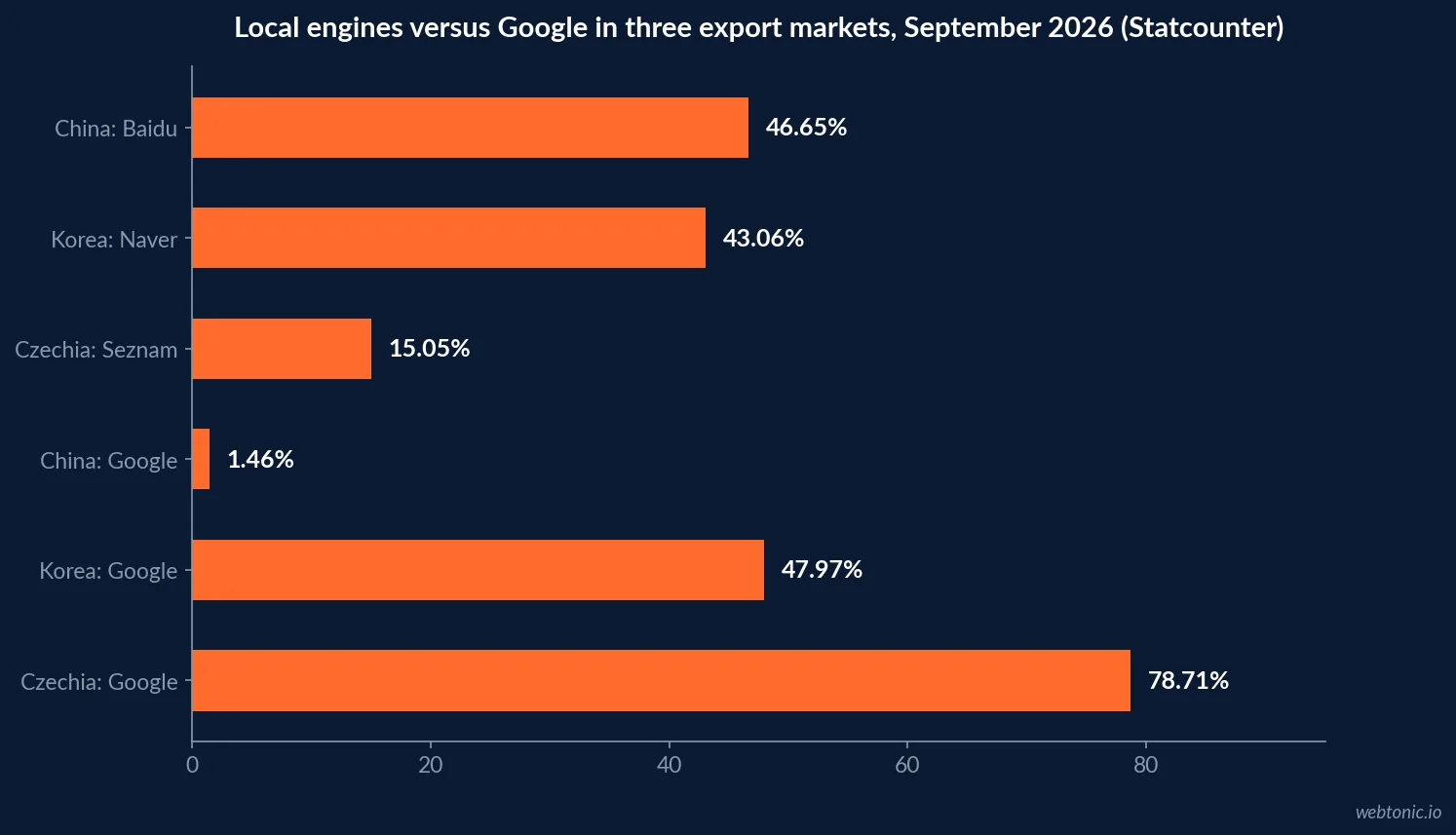
- Seznam holds 15.05% of search in Czechia and Naver 43.06% in South Korea (Statcounter, September 2026).
Manufacturing international SEO at a glance
| Indicator | Figure | Year | Source |
|---|---|---|---|
| Identified US goods exporters | 278,207 | 2023 (preliminary) | Census exporter profile |
| Of which manufacturers | 68,001 | 2023 (preliminary) | Census exporter profile |
| Manufacturers' known export value | USD 970.0 billion | 2023 (preliminary) | Census exporter profile |
| B2B buyers using search to source suppliers | 80% | 2019 | Thomas Industrial Buying Habits |
| Buyers using AI to research suppliers | 85% | Q3 2025 | Kula Partners (n=263) |
| English share of web content | 49.5% | October 2026 | W3Techs |
Who actually exports
The Census Bureau's preliminary 2023 exporter profile identifies 278,207 US companies linked to goods exports, with USD 1,769.3 billion of known export value. Manufacturers were 68,001 of them, 24.4% of exporters, but carried USD 970.0 billion, or 54.8% of known value. The Bureau notes the preliminary method captures about 95% of known value and 99% of identified exporters compared with final data.
| 2023 preliminary (Census) | Exporters | Known value (USD millions) | Share of manufacturer total |
|---|---|---|---|
| All identified exporters | 278,207 | 1,769,336 | - |
| Manufacturers | 68,001 | 969,998 | 100% |
| Small and mid-size manufacturers | 65,191 | 176,111 | 95.9% of firms, 18.2% of value |
| Large manufacturers (500+ employees) | 2,810 | 793,887 | 4.1% of firms, 81.8% of value |
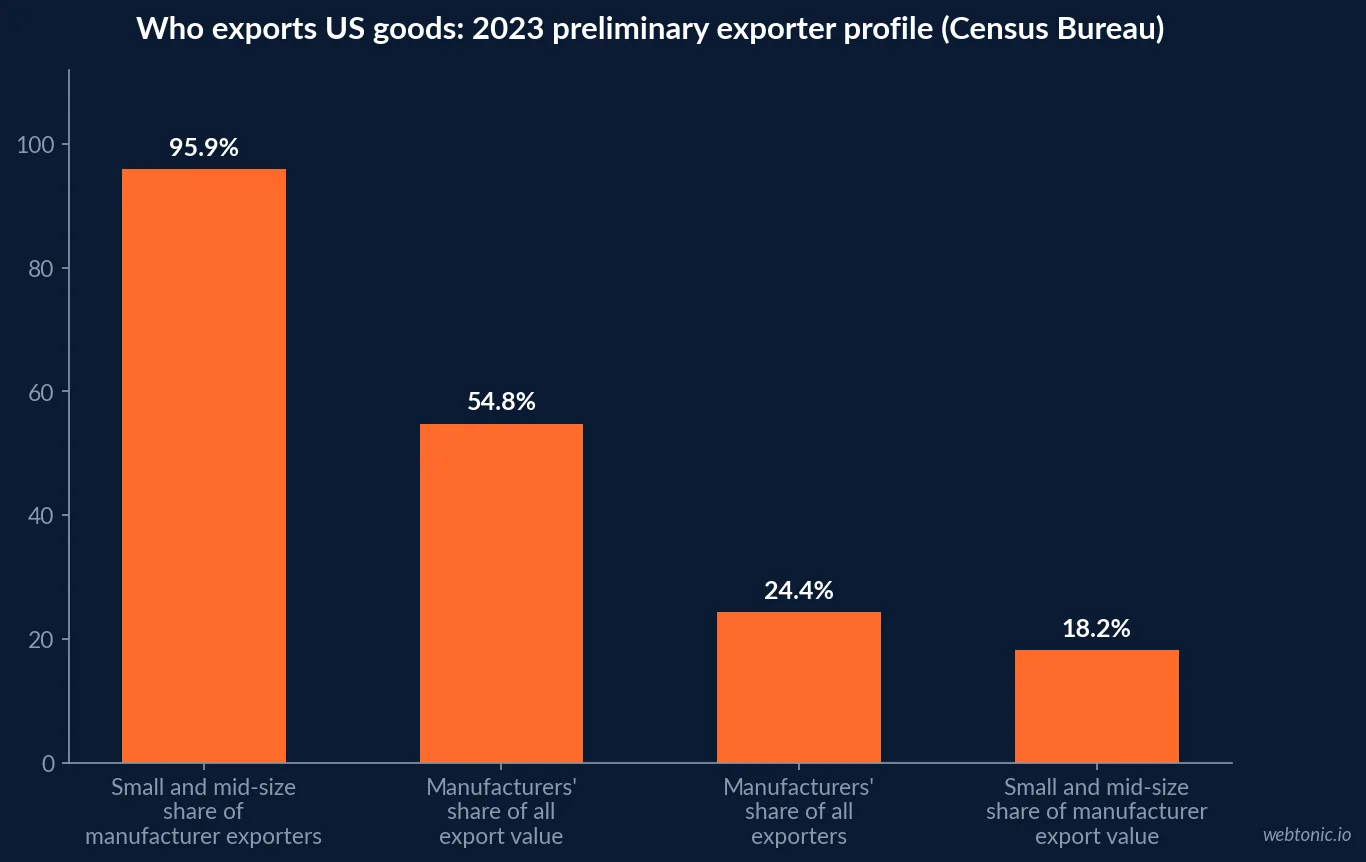
The large-manufacturer row is derived by subtraction from the Census table. The point for SEO is the first column: almost every exporting manufacturer is a small or mid-size firm, usually without an in-house localization team. The International Trade Administration makes the same point for all sectors: firms with fewer than 500 employees "account for 98 percent of the nearly 280,000 exporting businesses", and US goods and services exports were USD 3.1 trillion in 2023.
Exporters against the whole manufacturing base
The National Association of Manufacturers counts 239,265 manufacturing firms in 2022, with all but 4,177 considered small (fewer than 500 employees), around three-quarters with fewer than 20 employees and 93.1% with fewer than 100. Set against the Census figure of 68,001 manufacturing exporters in 2023, that suggests a minority of manufacturers, very roughly three in ten, ship goods abroad. The two counts come from different programs and years, so treat the ratio as an order of magnitude, not a statistic.
The size profile is what shapes the SEO plan. A firm with fewer than 100 employees rarely has a localization manager, a multilingual content team or a developer who owns hreflang. Its international site is usually a translation plugin on top of the English site, which is how the 5% average content coverage CSA describes comes about. The budget question for these firms is not how many languages, but how many pages per language: the product families that actually sell abroad, with their datasheets, certifications and lead times.
What the data cannot tell you yet
Several numbers that would settle the international SEO case for manufacturers are not published anywhere we could verify. There is no public count of manufacturers with localized websites, no industry-level hreflang adoption rate, and no study of how industrial buyers in Germany, Mexico or Korea split their research between search engines, marketplaces and AI tools. The buying surveys above are US-centred; the Census data counts exporters, not their marketing. We have left these gaps open rather than filling them with agency estimates. Manufacturers can close them for their own markets with Search Console country and language reports, RFQ source tracking by locale, and distributor feedback, which together give a better basis for a budget than any industry average would.
How industrial buyers find suppliers
Buyer research is mostly US-based, and the figures should be read that way. Thomas's 2019 Industrial Buying Habits Survey found 80 percent of B2B buyers use search engines when sourcing new suppliers, 71% use Thomasnet.com, 65% word-of-mouth and 41% internal databases. Kula Partners' Q3 2025 Industrial Buyer Pulse, a survey by the industrial marketing agency fielded with InnovateMR, (n=263) found 82% of respondents placed suppliers on shortlists before speaking with them, 85% used AI tools to research suppliers in the past 90 days (91% of smaller firms against 58% of larger ones), and just over 77% obtained pricing or lead-time information through self-serve digital tools.
| Buyer behaviour | Figure | Survey | International SEO reading |
|---|---|---|---|
| Use search engines to source new suppliers | 80% | Thomas 2019 | Search visibility in the buyer's market matters |
| Use Thomasnet.com | 71% | Thomas 2019 | Directories carry part of discovery |
| Shortlist before talking to suppliers | 82% | Kula Q3 2025 | The site has to sell before sales does |
| Used AI to research suppliers (90 days) | 85% | Kula Q3 2025 | AI answers draw on site content |
| Smaller firms using AI vs larger | 91% vs 58% | Kula Q3 2025 | Small buyers move first |
| Got pricing or lead time via self-serve tools | Just over 77% | Kula Q3 2025 | Localized spec and lead-time pages |
Language is where most export sites fall short
CSA Research reports that "only seven languages receive more than 10% of the content available in English" and that the average target language gets just 5% of the original site's content. For a manufacturer, that usually means a translated homepage and contact form with English-only datasheets. CSA's B2B analysis of 1,116 business buyers found 66% would pay up to 30% more for a localized product. It was a survey of technology-product buyers, so it is a proxy for industrial buyers, not a measurement of them.
W3Techs data (October 2026) shows how much of the web sits outside English: English 49.5%, Spanish 6.0%, German 5.9%, Japanese 4.9%, French 4.5%, Portuguese 4.1%, Russian 3.4%, Italian 2.8% and Polish 1.8%.
| Content language (W3Techs, Oct 2026) | Share of websites | Export relevance |
|---|---|---|
| English | 49.5% | Default for most US manufacturer sites |
| Spanish | 6.0% | Mexico and Latin America |
| German | 5.9% | DACH engineering buyers |
| Japanese | 4.9% | Japan, with Bing at 31.41% |
| French | 4.5% | Quebec, France, francophone Africa |
| Portuguese | 4.1% | Brazil |
Search engines in export markets
Google dominates most of the large export markets, but not all of them. Statcounter data for September 2026 puts Google at 88.08% in Mexico and 87.84% in Germany, against 86.1% in the US in August 2026. Czechia splits 78.71% Google and 15.05% Seznam; South Korea 47.97% Google and 43.06% Naver; China 46.65% Baidu and 1.46% Google.
| Export market | Google (Sept 2026) | Local engine | What to budget |
|---|---|---|---|
| Mexico | 88.08% | Bing 9.43% | Spanish pages, Google-first |
| Germany | 87.84% | Bing 6.49% | German datasheets and application pages |
| Czechia | 78.71% | Seznam 15.05% | Seznam indexing and Czech content |
| South Korea | 47.97% | Naver 43.06% | Naver presence plus Korean content |
| China | 1.46% | Baidu 46.65% | Separate site, hosting and engine plan |
What Google expects from a multi-country manufacturer site
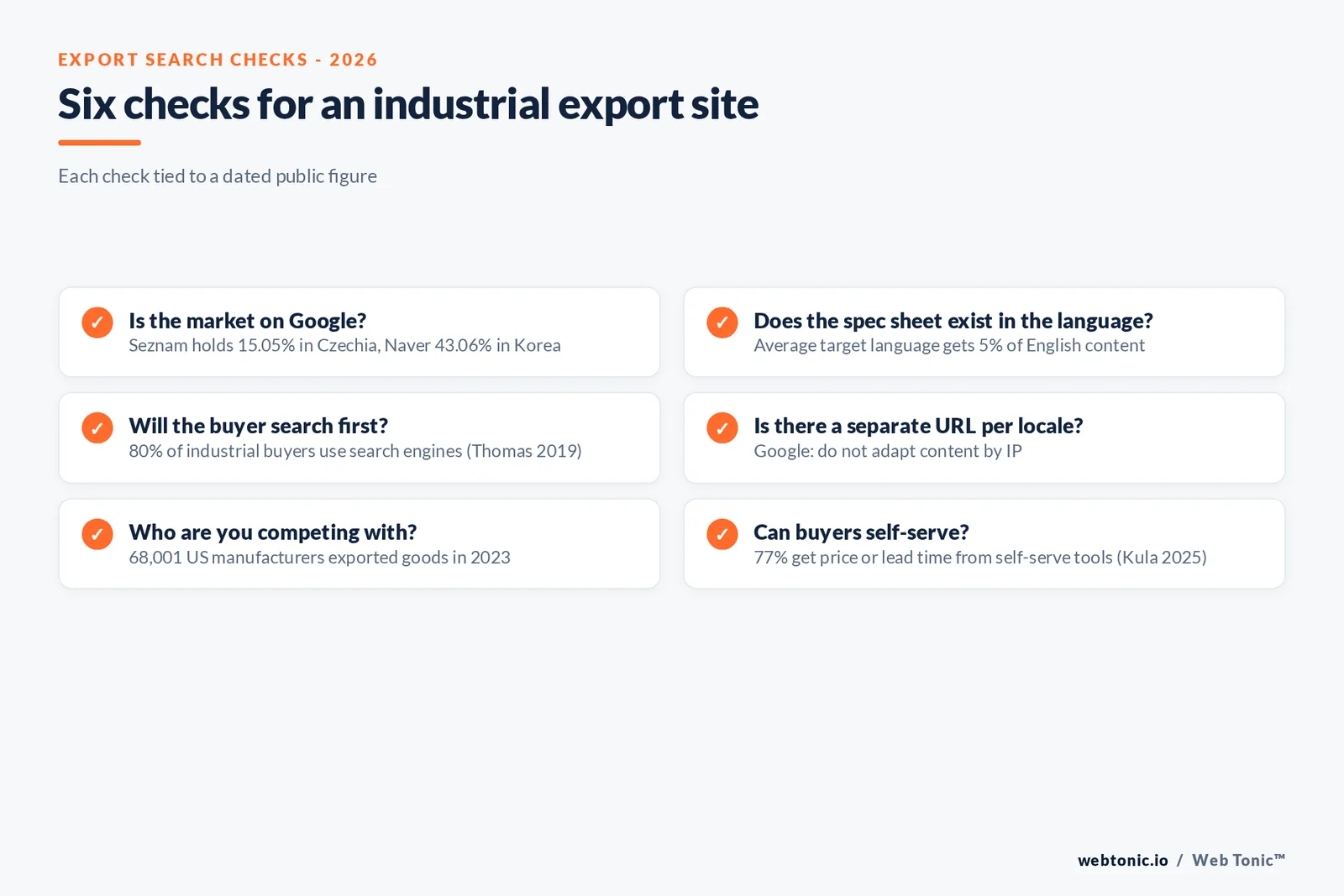
Google's own example of a multi-regional site is a manufacturer: its documentation describes one that "explicitly targets users in different countries. For example, a product manufacturer that ships to both Canada and the United States." It recommends "different URLs for each language version", warns "Don't use IP analysis to adapt your content", and notes Googlebot usually crawls from the USA without an Accept-Language header. The localized versions guide covers hreflang and x-default, and says newly expanded language pages should link bidirectionally to the originating language.
The same document covers Canada's bilingual case: a site may have "different versions for the USA and for Canada, and both French and English versions of the Canadian content." For a US manufacturer selling into Quebec, that is the most common first step beyond English.
The AI-search layer
Kula's 85% AI-research figure matters because AI answers reduce clicks. Ahrefs measured a 34.5% lower top-result click-through rate when an AI Overview appeared (April 2025) and 58% lower in its February 2026 update on December 2025 data. Pew Research Center found clicks on 8% of visits with an AI summary against 15% without one (March 2025). These are US, English-language studies; no published study measures the effect on German, Czech or Korean industrial queries. Detailed, localized technical pages remain the material AI tools cite, so the content gap CSA describes is also an AI-visibility gap. A buyer in Monterrey who asks an AI tool for suppliers of a specific valve or bearing will get answers built from pages that exist in Spanish or that the tool can translate with confidence; a manufacturer whose only Spanish page is a contact form gives it little to cite. Localized specification pages therefore serve classic search, AI answers and the self-serve buyer Kula describes at the same time.
Where manufacturers should start
- List export markets by revenue, then check each one's search engine share.
- Translate datasheets, application and lead-time pages before blog content.
- Use one URL per locale, hreflang with return links, and a visible country selector.
- Add French-Canadian pages first if Canada is a market, following Google's own example.
- Treat Baidu, Naver and Seznam as separate projects, not translations.
The domestic baseline is in our manufacturing enterprise SEO data, and app discovery in the manufacturing app store data. Tracking which locale pages produce RFQs is a data and attribution task.
Frequently Asked Questions
How many US manufacturers export?
The Census Bureau's preliminary 2023 exporter profile identifies 68,001 manufacturing companies among 278,207 identified US goods exporters. Small and medium-sized firms (under 500 employees) were 65,191 of those manufacturers, or 95.9%, but carried only USD 176.1 billion of the USD 970.0 billion in manufacturers' known export value, about 18.2%.
Do industrial buyers abroad find suppliers through search?
Survey data says search is central, though most of it is US-based. Supplier-directory operator Thomas (Thomasnet.com) reported that its 2019 Industrial Buying Habits survey found 80% of B2B buyers use search engines when sourcing new suppliers. Kula Partners, an industrial marketing agency, in its Q3 2025 survey (n=263) found 82% shortlisted suppliers before speaking to them and 85% used AI to research suppliers. No published study measures the same behaviour for buyers in a specific export market.
Is Google enough for industrial export markets?
Not everywhere. Statcounter's September 2026 data shows Seznam at 15.05% in Czechia, Naver at 43.06% in South Korea and Baidu at 46.65% in China, where Google has 1.46%. Mexico (Google 88.08%) and Germany (87.84%) are Google markets.
Should technical documentation be translated?
CSA Research reports the average target language gets just 5% of the original site's content, and that only seven languages receive more than 10% of the content available in English. Its B2B data shows 66% of business buyers would pay up to 30% more for a localized product. Spec sheets, datasheets and application pages are the content buyers shortlist from, so they are the logical place to start.
What does Google say about sites for manufacturers that ship to several countries?
Google's multi-regional documentation uses this exact case: a multi-regional website is one that targets users in different countries, 'for example, a product manufacturer that ships to both Canada and the United States'. It recommends separate locale URLs with hreflang and warns against adapting content by IP.
Sources
US Census Bureau - 2023 preliminary exporter profile
National Association of Manufacturers - Facts about manufacturing
International Trade Administration - Strategic reasons to export
Thomas - 2019 Industrial Buying Habits
Kula Partners - Industrial Buyer Pulse Q3 2025
CSA Research - Interactive tools
CSA Research - B2B buyers and localization
W3Techs - Content languages
Statcounter - Search engine share
Google Search Central - Multi-regional sites
Ahrefs - AI Overviews and clicks


