



Table of contents

The headline holds, with a date on it: in Thomas's 2019 survey 80% of B2B buyers used search engines to source new suppliers, and 2025-2026 studies show buyers still researching mostly online before they call. No current survey gives one up-to-date search percentage, so the figures below are dated and labelled.
Key Takeaways
- 80% of B2B buyers used search engines to source new suppliers (Thomas, 2019).
- Technical buyers complete 62% of the buying process online before contacting sales.
- 82% of industrial buyers shortlist suppliers before speaking to them.
- 85% use AI to research suppliers, but supplier websites stay the first stop.
- 77% obtained pricing or lead times through self-serve digital tools.
- 93.1% of manufacturing firms have fewer than 100 employees.
- Industrial paid search averages USD 75.19 per lead in 2026.
- 96.55% of pages in Ahrefs' index got no Google traffic (2023).
What the search claim rests on
Thomas's 2019 Industrial Buying Habits Survey found 80% of B2B buyers used search engines when sourcing new suppliers, alongside 71% who used Thomasnet.com, 65% who relied on word-of-mouth referrals and 41% who used internal preferred-supplier databases. Thomas runs the Thomasnet supplier directory, so it is an interested party, and the survey is seven years old.
The newer evidence is directional rather than a single percentage. TREW Marketing's 2026 State of Marketing to Engineers reports that technical buyers "still heavily favor traditional search engines over generative AI platforms", with 16% using them equally, and that they complete 62% of the buying process online before engaging sales.
| Sourcing channel (Thomas 2019) | Share of B2B buyers using it | Read for SEO |
|---|---|---|
| Search engines | 80% | The largest single channel |
| Thomasnet.com | 71% | Industrial directory, run by the survey issuer |
| Word-of-mouth referrals | 65% | Leads to branded searches |
| Internal preferred databases | 41% | Incumbent suppliers only |
| Survey date | 2019 | Pre-dates AI Overviews |
How industrial buyers research in 2025
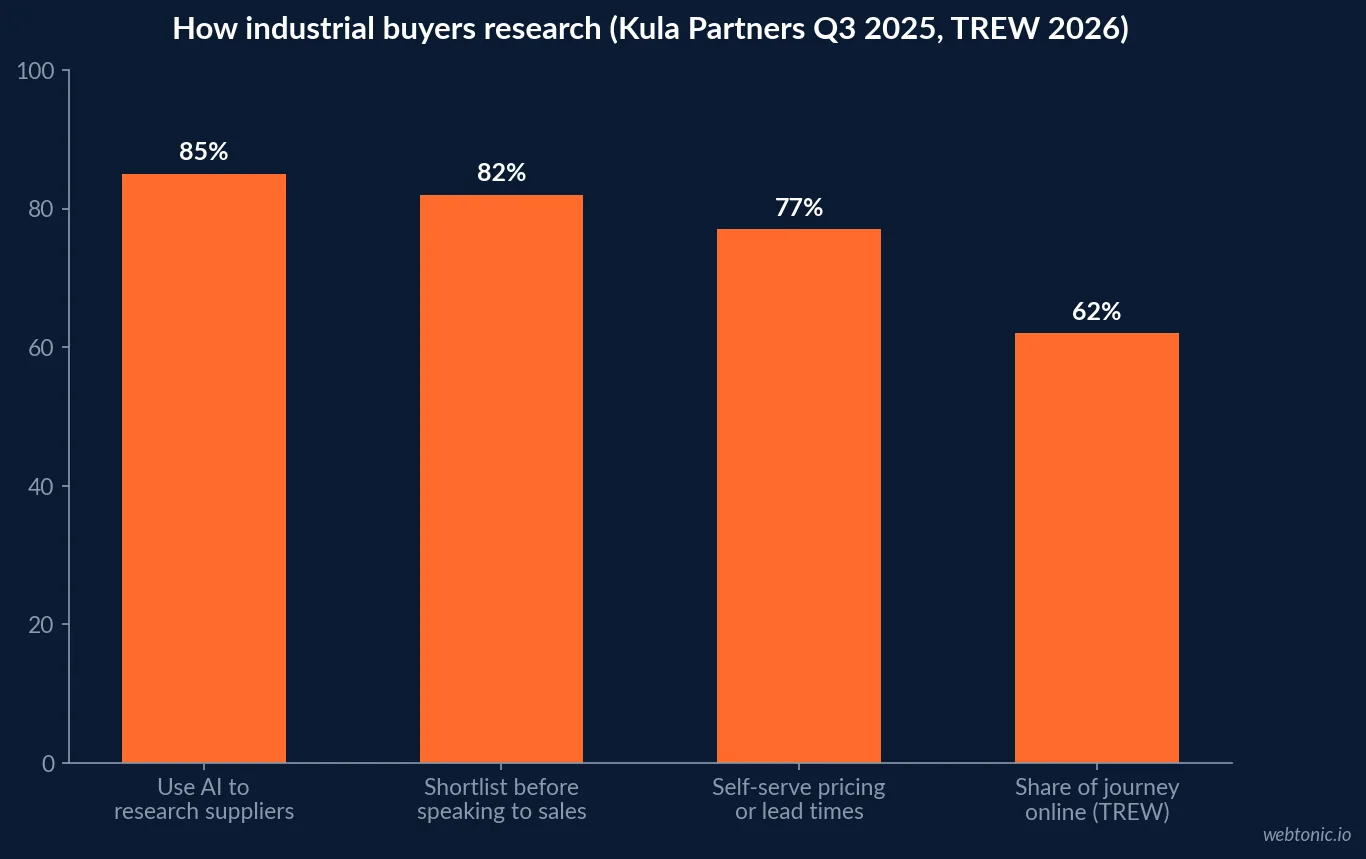
Kula Partners' Q3 2025 Industrial Buyer Pulse, fielded with InnovateMR among 263 North American decision-makers, found 82% shortlisting suppliers for a major purchase before speaking to them and 85% using AI to research suppliers. Even so, supplier websites remained the first place buyers look, with almost twice as many preferring them to in-person trade events. 77% had obtained pricing or lead-time information through self-serve digital tools, and 80% said they would place an order of USD 50,000 or more entirely online.
AI summaries in engineers' searches
In TREW's 2026 webinar follow-up, 75% of respondents had noticed AI-generated summaries at the top of Google or Bing results, 10% had not and 15% were unsure. Of those who noticed them, 69% read the summary and then continue through the results, and just 6% said the summary is usually enough. TREW's main report adds that 69% of technical buyers use generative AI and rate their trust in its answers at 4.7 out of 10.
For manufacturers that is a more reassuring picture than cross-industry click studies suggest: engineers treat AI summaries as a starting point and still click through to specifications and supplier pages.
| Technical buyer behaviour (TREW 2026) | Figure | Implication for supplier sites |
|---|---|---|
| Share of buying process done online first | 62% | Specs and pricing pages do the selling |
| Use generative AI | 69% | Be citable, not just rankable |
| Noticed AI summaries in search | 75% | Summaries are now part of the SERP |
| Read summary, then keep scrolling | 69% of those | Clicks to detailed pages continue |
| Summary usually enough | 6% of those | Few stop at the AI answer |
Market structure: small firms, big catalogs
The National Association of Manufacturers, citing Census Statistics of U.S. Businesses, counts 239,265 manufacturing firms in 2022, all but 4,177 of them small (under 500 employees). About three-quarters have fewer than 20 employees and 93.1% fewer than 100, yet 59.1% of sector employees work at firms with 500 or more. NAM reports more than 12.6 million manufacturing workers in August 2026.
Enterprise SEO in manufacturing therefore means the few thousand large manufacturers and the distributors that sell their parts, plus mid-size makers whose catalogs behave like enterprise sites even when the marketing team is tiny.
That split changes what a benchmark means. A survey of manufacturing marketers mostly hears from small firms, while most search demand for components and industrial supplies is captured by larger manufacturers, distributors and directories. When you read any manufacturing marketing statistic, check which of those two populations it describes before you apply it to a site with tens of thousands of pages.
Who is doing the marketing
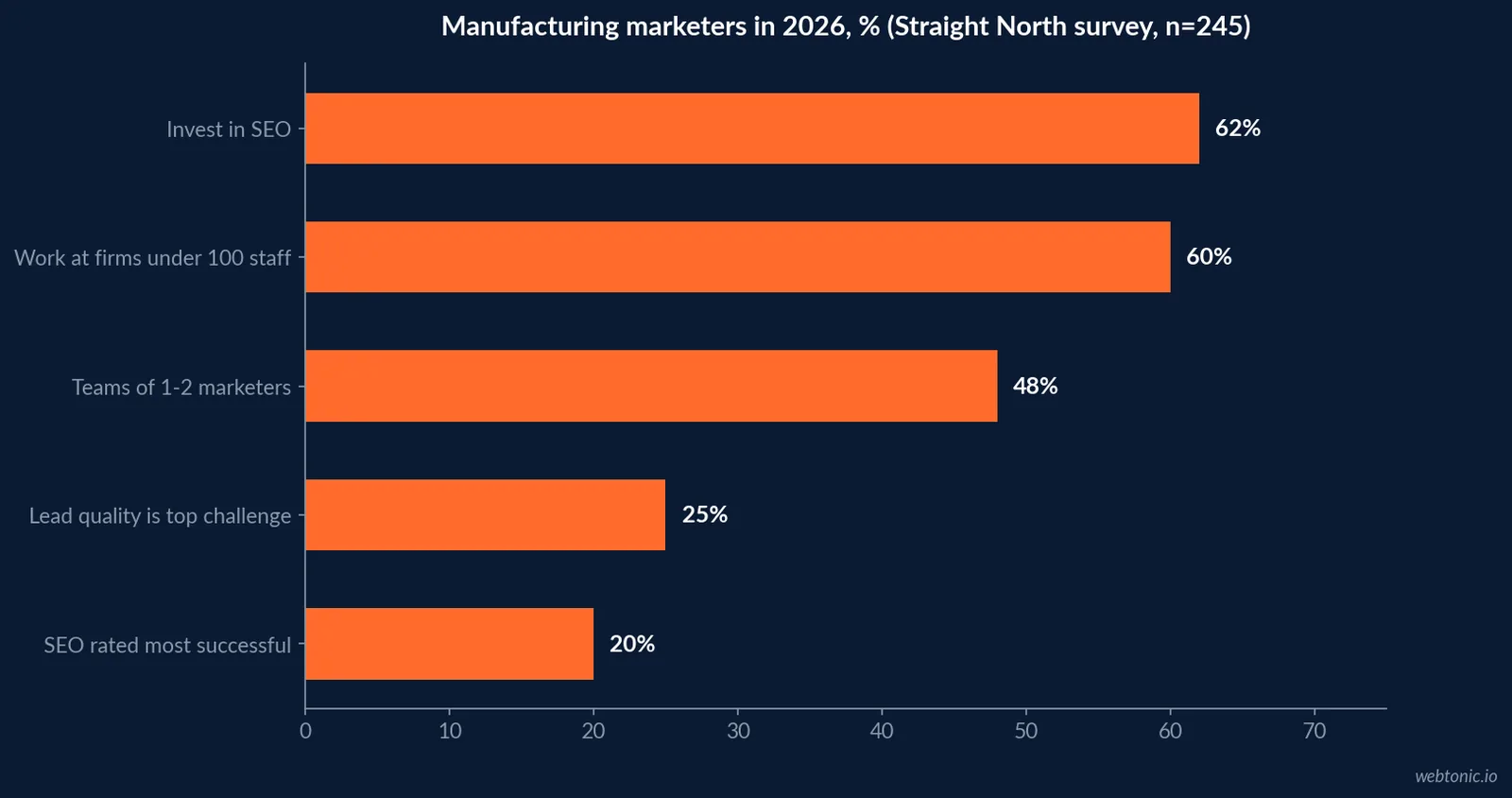
Straight North's 2026 manufacturing marketing survey, an agency survey of 245 marketers, found 60% at companies with fewer than 100 employees, only 14% at firms above 300, and 48% on teams of one or two people. SEO was cited as an active investment by 62% and ranked the most successful channel by 20%. The top challenge was generating high-quality leads, named by 25%.
Catalog scale and crawl
Google's faceted navigation guidance warns that parameter-based filters "can generate infinite URL spaces", leading to overcrawling and slower discovery of new, useful URLs. Its crawl budget guide is aimed at sites with 1 million+ unique pages changing weekly, or 10,000+ changing daily, and calls those rough estimates. Part catalogs with size, material, thread and finish filters reach those counts quickly.
Ahrefs' 2023 study of about 14 billion pages found 96.55% got no traffic from Google, a reminder that publishing every SKU variant is not the same as being found for it.
| Catalog issue | Google guidance | Practical control |
|---|---|---|
| Filter combinations | Faceted URLs can create infinite URL spaces | Block non-indexable facets from crawling |
| Site size | Crawl guide targets 1M+ or 10k+ fast-changing pages | Log-file analysis on large catalogs |
| Near-duplicate SKUs | Crawling spent on useless URLs slows discovery | Canonical parent product pages |
| Pages that never rank | 96.55% of pages get no Google traffic (Ahrefs) | Prune or consolidate thin variants |
| Spec data | Structured data describes products | Consistent attributes across pages |
Enterprise tasks beyond the catalog
Large manufacturers and distributors add a second layer of scale: plants, branches and service centres. Google Business Profile allows bulk verification for 10 or more locations of the same business, which is how a distributor with dozens of branches keeps hours, phone numbers and categories consistent. Duplicate, suspended and disabled profiles do not count toward that minimum.
The cross-industry click data is harsher than TREW's engineer survey. Pew Research Center found users clicked a traditional result in 8% of visits when an AI summary appeared, against 15% without one. Engineers may click through more than average, but a manufacturer's informational content, such as material guides and how-to explainers, is exactly the query type AI summaries answer. Specification pages, CAD downloads and quote tools are harder to summarise away, which is where enterprise SEO effort in this sector pays off.
| Enterprise layer | What scales | Governing rule or figure | Source |
|---|---|---|---|
| Branches and plants | Business Profiles | Bulk verification from 10+ locations | Google Business Profile Help |
| Part catalog | Filter and variant URLs | Faceted URLs can create infinite URL spaces | Google Search Central |
| Informational content | Guides and explainers | 8% vs 15% click rate with AI summaries | Pew Research 2025 |
| Supplier research | Shortlist-stage pages | 82% shortlist before contact | Kula Partners 2025 |
| Search engine mix | Google and Bing indexing | 86.1% and 8.92% US share | Statcounter Aug 2026 |
The paid comparator
WordStream's 2026 Google Ads benchmarks (LocaliQ vendor data) put Industrial and Commercial at USD 75.19 per lead, 6.57% click-through and USD 5.87 per click, against USD 66.69, 6.64% and USD 5.42 across all industries. With 82% of buyers shortlisting before contact, a paid click often reaches someone who has already formed a shortlist from organic research.
| Paid search metric (2026) | Industrial & Commercial | All industries |
|---|---|---|
| Average cost per lead | USD 75.19 | USD 66.69 |
| Average click-through rate | 6.57% | 6.64% |
| Average cost per click | USD 5.87 | USD 5.42 |
| Organic equivalent | Not published | Not published |
Which engine engineers use
Statcounter puts Google at 86.1% of US search share in August 2026 and Bing at 8.92%. Bing matters more in manufacturing than the share suggests, because many plant and office PCs default to it and several AI assistants draw on its index.
What the data does not show
No issuer publishes an organic click-through rate, organic cost per lead or organic conversion rate for manufacturers, and we have not estimated one. The 80% search figure is from 2019 and from a directory operator; the 2025-2026 studies measure online research and AI use, not search share. The honest reading of the title is that search remains central to how industrial buyers find suppliers, with AI tools now layered on top.
Two further limits apply. The Kula Partners and TREW samples are North American and weighted toward engineers and buyers who answer research surveys, which may skew toward digitally active respondents. And none of these studies separate branded from non-branded searches, so a buyer who searches a supplier's name after a trade show counts the same as one who discovers the supplier through a generic part query. A manufacturer's own Search Console data, split by branded and non-branded queries and by product family, is the only way to see how much new business search is really finding.
Priorities for manufacturing enterprise SEO
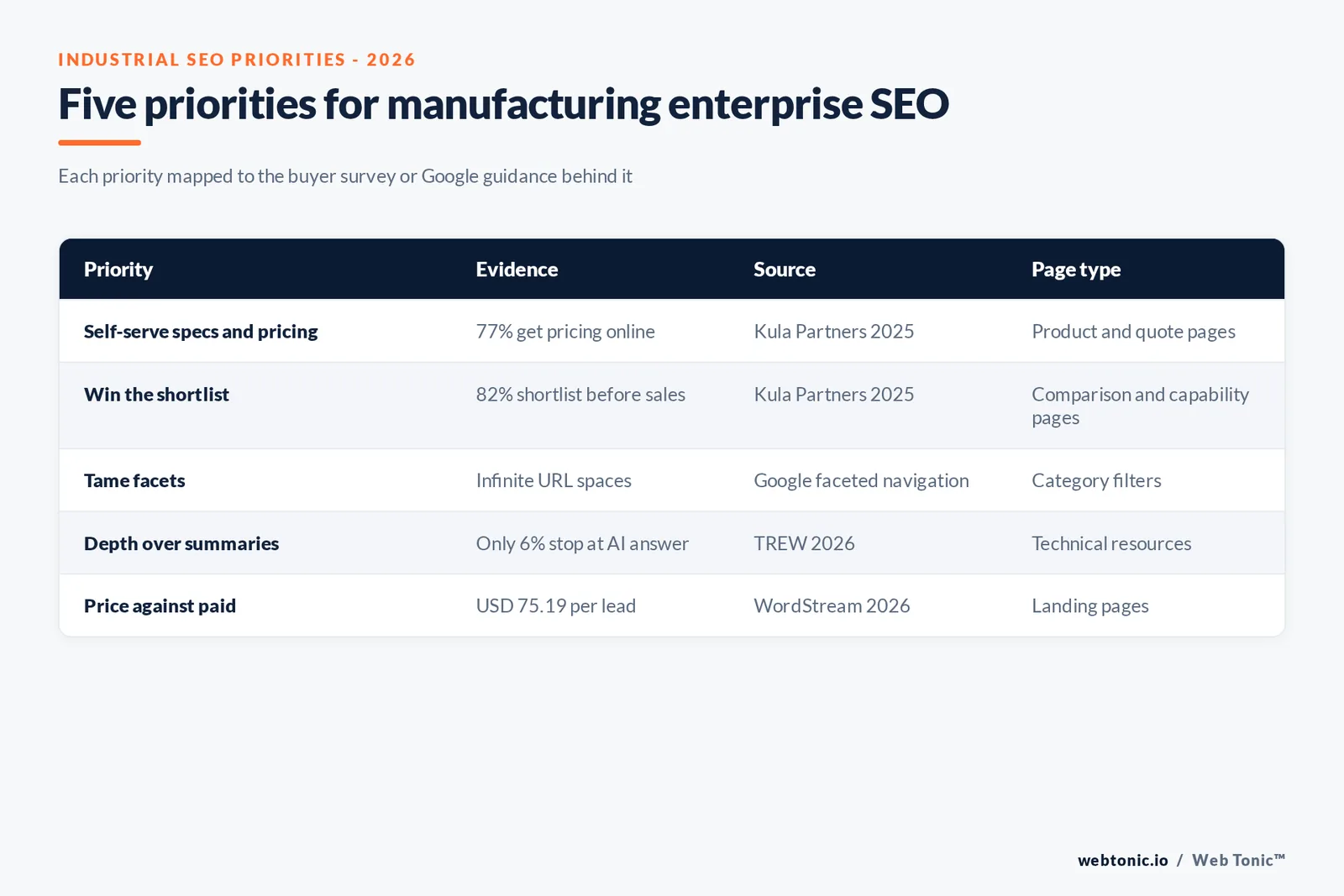
- Make spec, pricing and lead-time information self-serve: 77% already get it that way.
- Win the shortlist stage, where 82% of decisions are shaped before sales contact.
- Control facets and variants before adding more SKU pages.
- Write detailed pages engineers click through to; only 6% stop at the AI summary.
- Benchmark against paid at USD 75.19 per industrial lead.
See our cross-industry enterprise SEO statistics and wider advertising statistics, explore growth marketing, or contact us.
Frequently Asked Questions
Do most industrial buyers really rely on search?
The named data supports it with a date attached. Thomas's 2019 Industrial Buying Habits Survey found 80% of B2B buyers used search engines when sourcing new suppliers, ahead of word-of-mouth referrals at 65%. TREW Marketing's 2026 study says technical buyers still heavily favour traditional search engines over generative AI and complete 62% of the buying process online before contacting sales. No 2026 survey we found gives a single current percentage for search use.
How are AI tools changing industrial supplier research?
Kula Partners' Q3 2025 Industrial Buyer Pulse (263 North American buyers) found 85% using AI to research suppliers, yet supplier websites remained the first place buyers look. In TREW's 2026 research, 75% had noticed AI summaries in search results; of those, 69% read the summary and keep scrolling, and only 6% said the summary is usually enough.
Why is enterprise SEO different for manufacturers?
Scale sits in the catalog, not the company. NAM, citing Census data, counts 239,265 manufacturing firms in 2022 with 93.1% under 100 employees, but a single distributor or component maker can publish tens of thousands of part pages. Google's faceted navigation guidance warns that filter URLs can create infinite URL spaces that cause overcrawling.
What does a paid search lead cost in industrial categories?
WordStream's 2026 benchmarks (LocaliQ vendor data) put Industrial and Commercial at USD 75.19 per lead, a 6.57% click-through rate and USD 5.87 per click, against USD 66.69 per lead across all industries. No organic equivalent is published.
How much are manufacturers investing in SEO?
Straight North's 2026 survey of manufacturing marketers, an agency survey of 245 respondents, found SEO cited as an active investment by 62% and rated the most successful channel by 20%. 60% of respondents worked at companies under 100 employees and 48% on marketing teams of one or two people.
Sources
Thomas - Industrial Buying Habits Survey 2019 (Thomas Insights)
TREW Marketing - 2026 State of Marketing to Engineers
TREW Marketing - 2026 webinar questions answered
Kula Partners - Industrial Buyer Pulse Q3 2025
NAM - Facts about manufacturing
Straight North - 2026 Manufacturing Marketing Survey
WordStream by LocaliQ - 2026 Google Ads benchmarks
Google - Managing crawling of faceted navigation URLs
Google - Crawl budget management
Ahrefs - Search traffic study 2023
Statcounter - US search engine market share
Pew Research Center - AI summaries and clicks, 2025
Google Business Profile Help - Verify profiles in bulk


