Table of contents

US native display ad spending is projected to grow 13.1% in 2026, reaching USD 147.98 billion, and it is consolidating hard around two networks. Taboola alone now carries more captured live creative volume than the next two networks combined. This page tracks where that budget is actually moving, and what disclosure rules apply once it lands.
Key Takeaways
- US native display ad spend is forecast to reach USD 147.98 billion in 2026, up 13.1%.
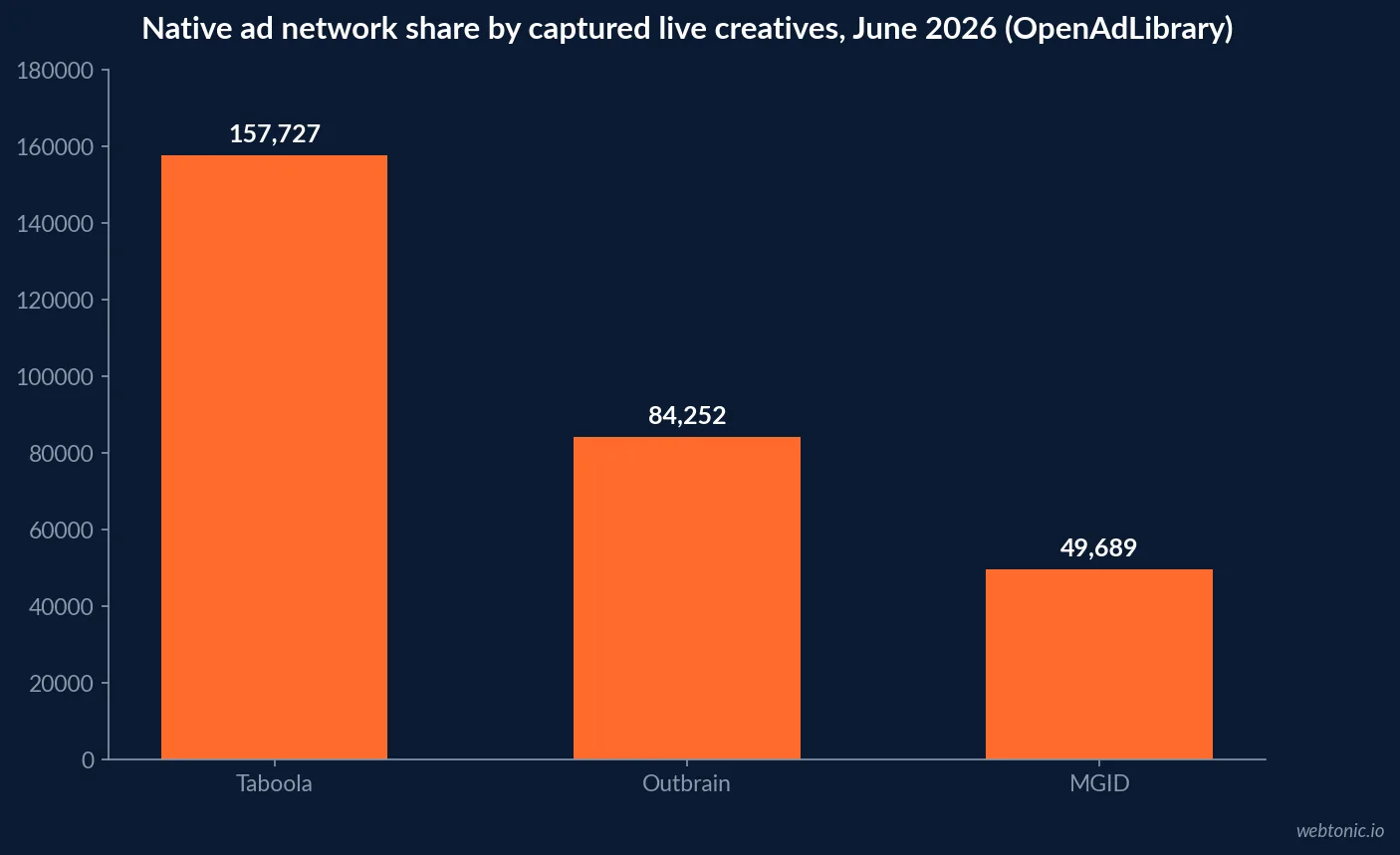
- Consumers view native ads 53% more frequently than banner ads.
- Native ad exposure lifts purchase intent by 18% versus standard display.
- OpenAdLibrary's live index tracks 589,000-plus captured native creatives as of June 2026.
- That index spans 25,933 advertisers across 42 networks.
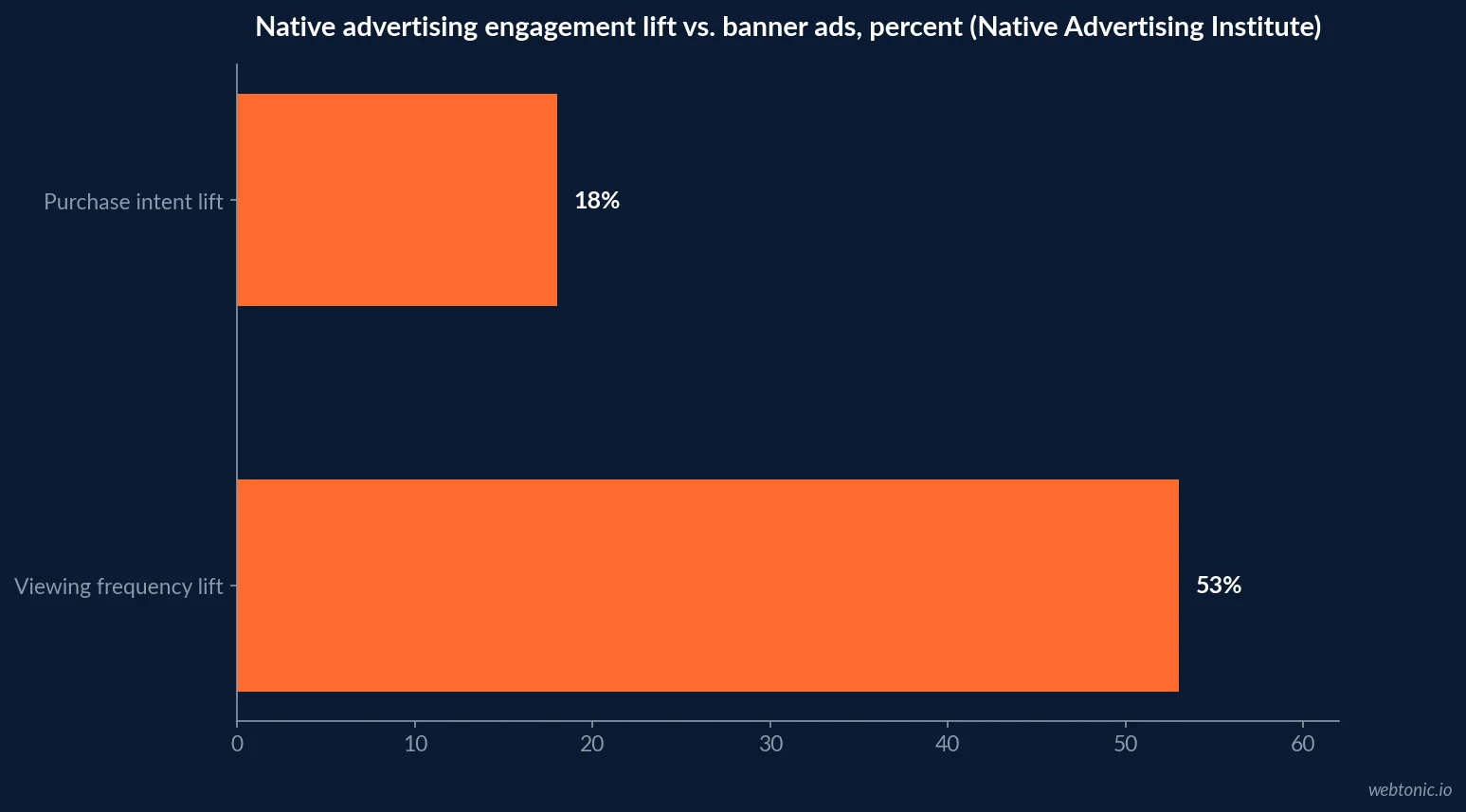
- Taboola alone accounts for 157,727 captured creatives, more than the next two networks combined.
- Outbrain carries 84,252 captured creatives, MGID 49,689.
- Outbrain completed its Teads acquisition in February 2025 and rebranded by mid-2025.
- Taboola repositioned its performance product under the Realize brand for CPA and ROAS buyers.
- The EU's political-ad transparency regulation entered full application in October 2025.
- A common EU political-ad repository was adopted in April 2026, with standardized metadata.
- US digital ad revenue overall reached USD 294.6 billion in 2025, the market native competes inside.
- Commerce media, a format native increasingly blends into, grew 18% to USD 63.4 billion.
| Native advertising benchmark, 2026 | Figure | Source |
|---|---|---|
| US native display ad spend, 2026 forecast | USD 147.98 billion, +13.1% YoY | EMARKETER, December 2025 forecast |
| Native ad viewing frequency vs. banner ads | 53% more frequent | Native Advertising Institute, via EMARKETER |
| Purchase intent lift from native exposure | 18% higher than standard display | Native Advertising Institute, via EMARKETER |
| Live-captured native creatives tracked | 589,036 as of June 2026 | OpenAdLibrary index |
| Advertisers in the same index | 25,933 | OpenAdLibrary index |
| Networks covered by the index | 42 | OpenAdLibrary index |
The spend story: double-digit growth, no sign of slowing
EMARKETER's FAQ on native advertising for 2026 puts US native display ad spending at USD 147.98 billion for the year, a 13.1% increase, driven by higher engagement rates, AI-powered optimization, and the growing importance of contextual targeting for brand safety as third-party cookies keep eroding elsewhere. The same report cites Native Advertising Institute research showing consumers view native ads 53% more frequently than banner ads, and that exposure to native content produces an 18% increase in purchase intent compared to standard display - the engagement case that keeps budget moving into the format even as overall digital ad growth has slowed elsewhere.
| Native vs. standard display, 2026 | Native advertising | Standard display | Source |
|---|---|---|---|
| Viewing frequency | 53% higher | Baseline | Native Advertising Institute, via EMARKETER |
| Purchase intent lift | +18% | Baseline | Native Advertising Institute, via EMARKETER |
| 2026 US spend growth | +13.1% | Slower, per broader IAB category data | EMARKETER; IAB/PwC |
Where the budget actually lands: two networks, not a fragmented market
Forecasts disagree on the exact global market size depending on definition and region, but the most useful read on where budget is concentrating comes from live ad capture rather than a market-size estimate. OpenAdLibrary's State of Native Advertising 2026 report, built from continuous capture across major content-recommendation networks, indexed 589,036 creatives, 25,933 advertisers and 42 networks as of June 2026. Within that index, Taboola alone accounts for 157,727 captured creatives - more than Outbrain's 84,252 and MGID's 49,689 combined.
That concentration is partly the result of a 2025 restructuring: Outbrain completed its acquisition of Teads in February 2025 and rebranded the combined company as Teads by mid-2025, folding classic content recommendation into a full-funnel, video-forward open-web platform. Taboola repositioned its own performance product under the Realize brand, purpose-built for advertisers optimizing to CPA, ROAS and conversion volume. The practical read for a media planner: the old "Taboola vs Outbrain" framing no longer describes the market you are buying into. Taboola's own Realize platform page confirms the positioning: the product is now sold on measurable conversion outcomes, not on reach alone.
| Native ad network, June 2026 | Captured live creatives | Positioning | Source |
|---|---|---|---|
| Taboola / Realize | 157,727 | Performance-first, CPA/ROAS optimized | OpenAdLibrary index |
| Outbrain (now part of Teads) | 84,252 | Full-funnel, video-forward open web | OpenAdLibrary index |
| MGID | 49,689 | Mid-market, absorbs demand majors screen out | OpenAdLibrary index |
| Revcontent, MediaGo, Yahoo, MSN and others | Remainder of 589,036 total | Fragmented long tail | OpenAdLibrary index |
What is actually driving AI into native buying
Both major platforms now route optimization through machine learning by default, according to OpenAdLibrary's report - Taboola's Realize and Teads both lead with AI bidding and creative tooling rather than manual placement selection. That shift matters for budget planning because it changes where a media buyer's time goes: less time on manual placement bids, more on feeding the algorithm enough creative variation and landing-page signal to optimize against.
The wider digital ad market native competes inside grew to USD 294.6 billion in the US in 2025, per the IAB/PwC 2025 Internet Advertising Revenue Report, with commerce media - a format native increasingly blends into via shoppable and sponsored-product placements - growing 18% to USD 63.4 billion.
Disclosure is not optional, and the FTC's bar is specific
Budget moving into native does not exempt it from advertising law. The FTC's Native Advertising Guide for Businesses sets the core test as transparency: an ad should not suggest or imply it is anything other than an ad. The FTC's guidance identifies labels like "Ad" or "Sponsored Content" as likely to be understood by consumers, while vaguer language such as "Promoted by" or "Presented by" may not adequately inform them, a distinction laid out in the Commission's 2015 Enforcement Policy Statement on deceptively formatted advertisements, which remains the FTC's operative guidance for native placements in 2026.
Regulatory pressure on ad transparency more broadly is also rising outside the US. The EU's Digital Services Act now requires very large online platforms to keep public ad repositories, and the EU's Transparency and Targeting of Political Advertising regulation entered full application on October 10, 2025, with a common European political-ad repository adopted in April 2026. OpenAdLibrary's analysis reads the direction as unambiguous: ad data is becoming a public utility rather than a vendor secret, a principle that commercial native disclosure is likely to follow over time even where it is not yet legally mandated.
| Disclosure guidance, native advertising | Guidance | Source |
|---|---|---|
| Core transparency test | Should not imply it is anything other than an ad | FTC Native Advertising Guide for Businesses |
| Labels the FTC considers clear | "Ad", "Sponsored Content" | FTC Native Advertising Guide for Businesses |
| Labels the FTC flags as potentially unclear | "Promoted by", "Presented by" | FTC 2015 Enforcement Policy Statement |
| EU political-ad transparency regulation, full application | October 10, 2025 | OpenAdLibrary, citing EU TTPA |
| EU common political-ad repository adopted | April 2026 | OpenAdLibrary, citing European Commission |
Setting a 2026 native advertising budget
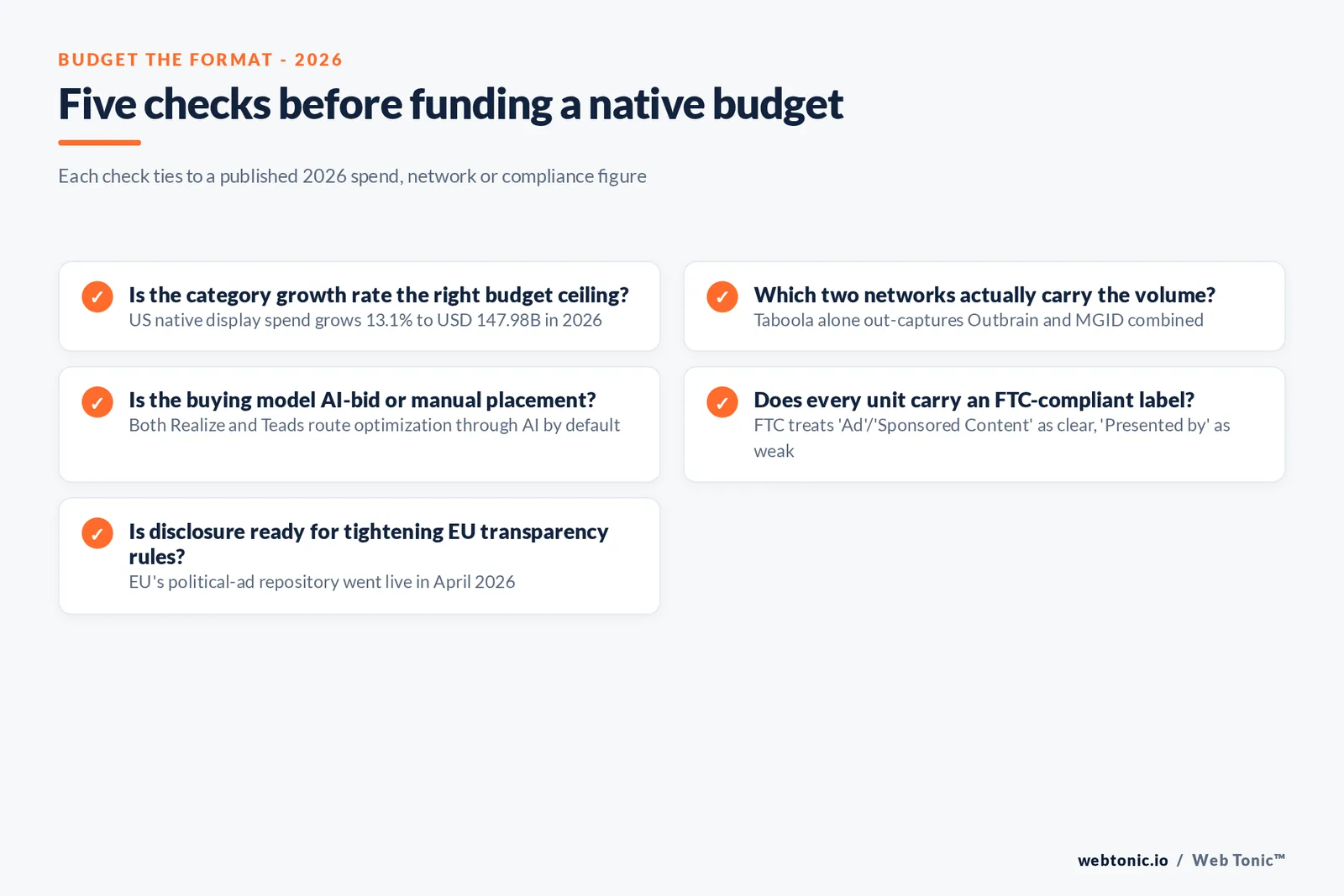
Three decisions follow from this data. First, size the budget against the 13.1% category growth rate, not against a single global market-size estimate that varies widely by definition. Second, plan the network mix around the Taboola/Realize-Teads duopoly rather than a fragmented long tail, and treat MGID and the mid-market networks as a deliberate choice for aggressive direct-response demand the majors screen out, not a fallback. Third, budget the creative review and disclosure-labeling work as a fixed cost of the format, not an afterthought, given the FTC's specific stance on which sponsorship labels actually satisfy the transparency test.
If native is one line in a broader open-web and commerce-media plan, our performance creative team can brief creative to the AI-bidding-first buying model both major networks now run on.
What a live-capture data set can tell you that a spend forecast cannot
Market-size forecasts answer "how much." OpenAdLibrary's live-capture approach answers a different, arguably more useful question for a media planner: which specific creatives are still running, and for how long. Ad longevity is treated in the report as the clearest signal of what is actually working, since a fraudulent or underperforming native ad gets pulled quickly while a genuinely converting creative stays live for weeks. One captured Taboola finance creative using an "IRS forgives" tax-deadline hook ran for 13 days before rotation, a data point the report treats as a proxy for real performance rather than a vendor's self-reported claim.
For a media buyer evaluating a new native placement, that longevity signal is more actionable than a network's own case study: a creative surviving multiple weeks against algorithmic rotation pressure has already cleared a bar that spend alone does not guarantee.
| Native ad evaluation signal | What it tells you | Where it comes from |
|---|---|---|
| Creative longevity (days live) | Proxy for real conversion performance | OpenAdLibrary live-capture index |
| Network creative volume | Where budget and demand concentrate | OpenAdLibrary live-capture index |
| Category ad-spend growth rate | Realistic budget ceiling for the format | EMARKETER 2026 forecast |
| Disclosure label used | Compliance exposure under FTC guidance | FTC Native Advertising Guide for Businesses |
How native fits against the rest of the paid mix
Native's growth case rests on engagement and brand safety rather than raw reach, which is why it pairs well as a mid-funnel line alongside search and social rather than as a replacement for either. For search-side budget comparisons, see our guide to what search advertising costs in 2026, and talk to our team if you are weighing a first native budget against an existing paid-media plan.
The one-year outlook
Expect the network concentration documented here to deepen before it loosens. Both Taboola/Realize and Teads are investing in AI-driven bidding and creative tooling specifically to widen the gap with mid-market networks on conversion efficiency, which makes it harder for MGID, Revcontent and the long tail to compete on anything other than price and volume. Budget planning for next year should assume the duopoly holds, and treat any mid-market native buy as a deliberate choice for aggressive, lower-cost direct response rather than a brand-safety-first placement.
Frequently Asked Questions
How big is the native advertising market in 2026?
US native display ad spending is projected to grow 13.1% in 2026, reaching USD 147.98 billion, according to a December 2025 EMARKETER forecast. That growth is driven by higher engagement rates, AI-powered optimization, and contextual targeting's growing importance for brand safety.
Which native advertising networks actually carry the budget?
OpenAdLibrary's live-capture index, built from more than 589,000 tracked creatives across 42 networks as of June 2026, found Taboola alone accounts for 157,727 captured creatives, more than the next two networks, Outbrain (84,252) and MGID (49,689), combined. The old 'Taboola vs Outbrain' framing is outdated since Outbrain completed its acquisition of Teads and rebranded the combined business in 2025.
Do native ads actually outperform banner ads?
On engagement, yes: consumers view native ads 53% more frequently than banner ads, and exposure to native content produces an 18% increase in purchase intent compared to standard display, per the Native Advertising Institute's research cited in EMARKETER's 2026 native advertising FAQ.
What does the FTC require for native advertising disclosure?
The FTC's Native Advertising Guide for Businesses says the core test is transparency: an ad should not suggest or imply it is anything other than an ad. Labels like 'Ad' or 'Sponsored Content' are considered clear, while vaguer terms such as 'Promoted by' or 'Presented by' may not adequately inform consumers, per FTC guidance and its 2015 Enforcement Policy Statement on deceptively formatted advertisements.
Has ad transparency regulation reached native advertising outside political ads?
Not directly yet, but the direction is set. The EU's Digital Services Act now requires very large online platforms to keep public ad repositories, and the EU's Transparency and Targeting of Political Advertising regulation entered full application in October 2025 with a common political-ad repository adopted in April 2026. OpenAdLibrary's research reads that as the same transparency principle likely extending to commercial native advertising over time.
Sources
EMARKETER - FAQ on native advertising: Formats, AI opportunities, and the best metrics for 2026
OpenAdLibrary - The State of Native Advertising 2026 (live ad-capture index)
Federal Trade Commission - Native Advertising: A Guide for Businesses
IAB - Digital Ad Revenue Climbs to Nearly $300B (2025 IAB/PwC Internet Advertising Revenue Report)
European Commission - Transparency and Targeting of Political Advertising
Taboola - Realize performance advertising platform