



Table of contents
Generative engine optimization has no published cost per lead for manufacturers, but its CTR effect is measured: Ahrefs found AI Overviews correlate with a 58% lower click-through rate for the top result on December 2025 data. This page reports those CTR figures, labels the only available CPL as a paid-search comparator, and adds what engineers and industrial buyers say about AI research.
Key Takeaways
- Top-result CTR was 58% lower with an AI Overview (Ahrefs, December 2025 data).
- The April 2025 Ahrefs study measured 34.5% lower on the same 300,000-keyword method.
- At position 10 the CTR impact was -19.4%; at position 2 it was -50.8%.
- No named study publishes a GEO cost per lead for manufacturing.
- Industrial and Commercial search ads cost USD 75.19 per lead in 2026 (WordStream comparator).
- 85% of industrial buyers used AI to research suppliers in the past 90 days (Kula, n=263).
- 75% of engineers surveyed by TREW had noticed AI summaries; only 6% find them usually enough.
- Organic search was 33.8% of Industrials-sector traffic (Conductor 2026).
Manufacturing GEO Benchmarks at a Glance
The H1 promises CPL and CTR. CTR figures below are measured; the CPL line is a paid-search comparator because no GEO CPL exists in public research.
| Benchmark | Value | Type | Source and date |
|---|---|---|---|
| Top-result CTR change with an AIO | -58% | Measured, cross-industry | Ahrefs, December 2025 data |
| Top-result CTR change with an AIO | -34.5% | Measured, cross-industry | Ahrefs, April 2025 |
| GEO cost per lead, manufacturing | Not published | - | No named study |
| Search ads CPL, Industrial and Commercial | USD 75.19 | Paid comparator | WordStream 2026 |
| Search ads CTR, Industrial and Commercial | 6.57% | Paid comparator | WordStream 2026 |
| Organic share of Industrials traffic | 33.8% | Measured, sector | Conductor 2026 |
CTR Impact by Ranking Position
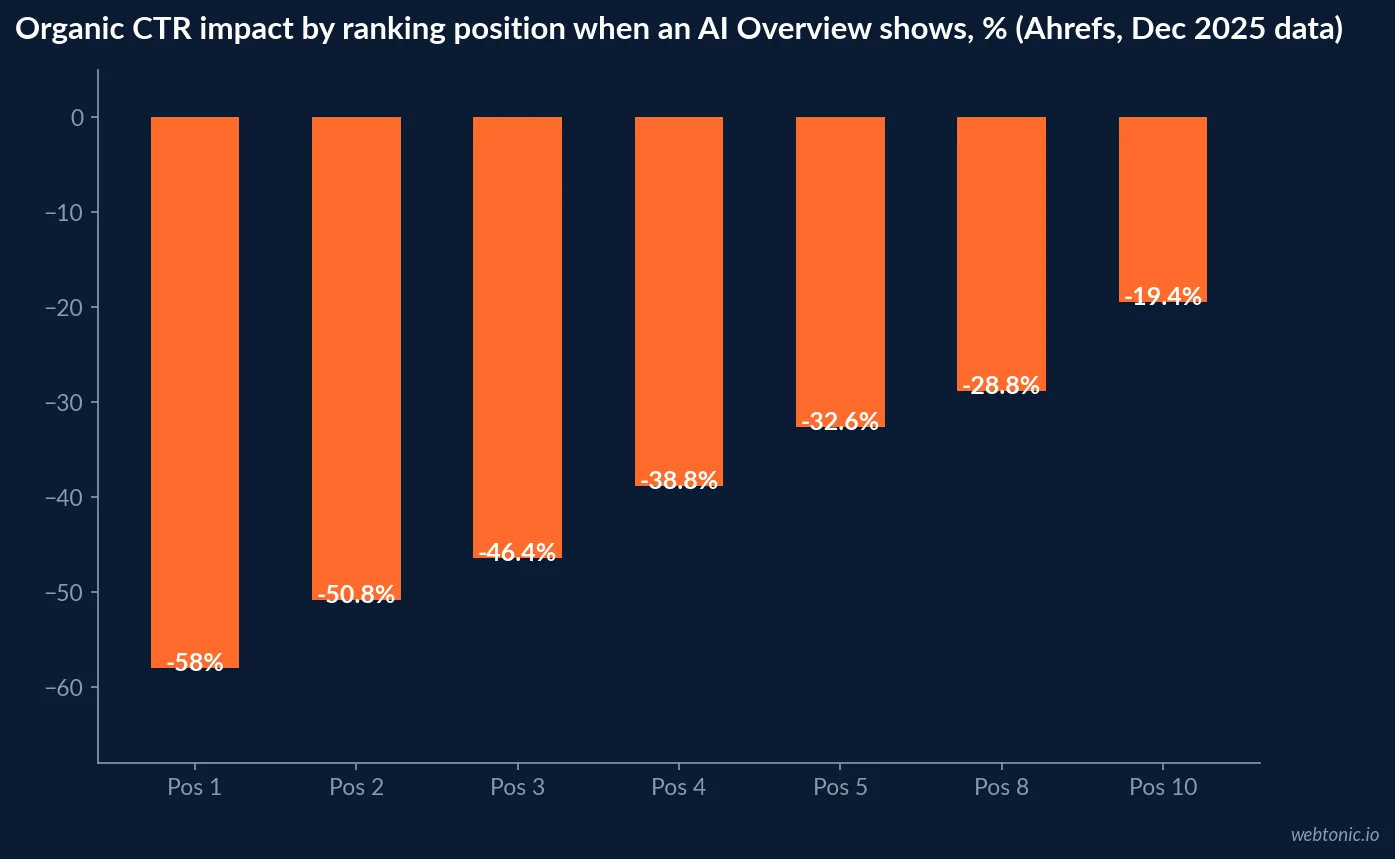
Ahrefs re-ran its study on 300,000 keywords: 150,000 with an AI Overview and 150,000 informational keywords without one. Position-one CTR on AIO keywords fell from 0.073 in December 2023 to 0.016 in December 2025, and the forecast versus actual gap was 0.03734 against 0.015677, or about 58%. The impact weakens down the page but never disappears, which matters for industrial sites that rank in positions 3 to 8 for technical terms.
| Position | CTR impact with an AIO | Position | CTR impact with an AIO |
|---|---|---|---|
| 1 | -58.0% | 6 | -30.5% |
| 2 | -50.8% | 7 | -29.7% |
| 3 | -46.4% | 8 | -28.8% |
| 4 | -38.8% | 9 | -29.7% |
| 5 | -32.6% | 10 | -19.4% |
Two Years of Position-One CTR
The same Ahrefs update shows the decline is not only an AI Overview effect. Average position-one CTR for informational keywords without an AIO fell from 0.076 in December 2023 to 0.039 in December 2025, roughly halving. For keywords that trigger an AI Overview it fell from 0.073 to 0.016, a drop of about four-fifths. Ahrefs also notes that around 9% of AI Overviews appear outside position one. For industrial marketers the practical reading is that informational content about materials, standards and processes is losing clicks on two fronts at once: a general decline in organic CTR and a steeper one where AI answers appear. Commercial and navigational terms, such as part numbers and supplier names, were not part of the AIO sample.
| Keyword group | Position-one CTR, Dec 2023 | Position-one CTR, Dec 2025 | Change |
|---|---|---|---|
| Informational, no AI Overview | 0.076 | 0.039 | about -49% |
| Keywords with an AI Overview | 0.073 | 0.016 | about -78% |
| Forecast vs actual, AIO keywords | 0.03734 forecast | 0.015677 actual | about -58% |
Why No GEO Cost Per Lead Exists
Cost per lead needs a price per click or impression and a tracked conversion. AI answers have neither in a form that can be benchmarked: there is no auction for an organic citation, AI referrers are often unlabelled in analytics, and buyers who read a summary may arrive later by typing the brand name. No vendor or association we found publishes a GEO CPL for manufacturing, and we have not estimated one. What a team can compute is its own cost per AI-referred lead, once AI referral sessions are segmented and content costs are allocated.
A workable method has three steps. First, create an analytics channel for known AI referrers such as chatgpt.com, perplexity.ai, gemini.google.com and copilot.microsoft.com. Second, tag RFQ, sample and quote forms so each lead keeps its first and last source. Third, divide the cost of the content and technical work behind cited pages by the leads that channel produced over a full quarter. The result is a first-party GEO CPL that can sit beside the paid-search comparator below, provided both are labelled for what they are.
The Paid-Search CPL Comparator
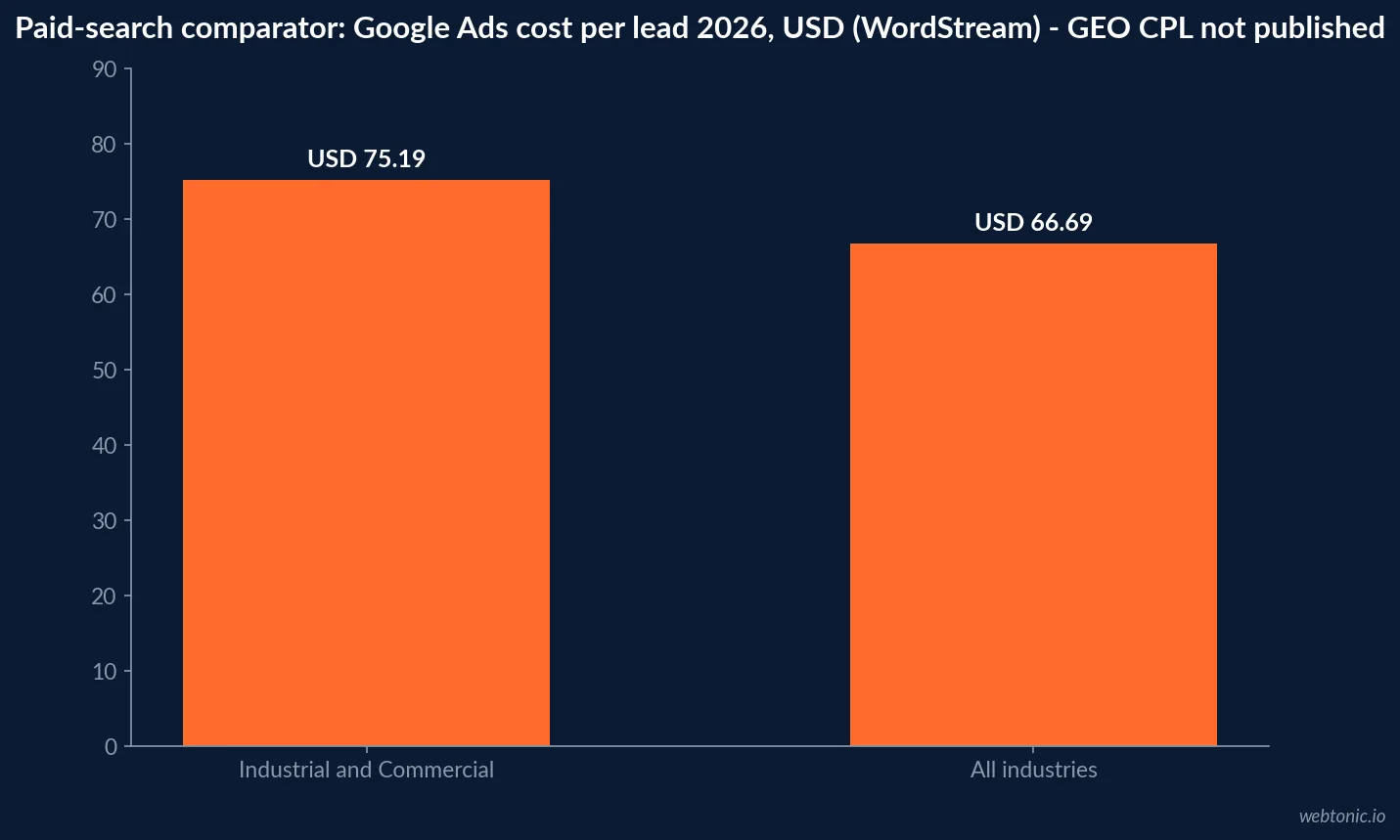
WordStream's 2026 Google Ads benchmarks give the nearest priced channel. Industrial and Commercial averaged USD 75.19 per lead, a 6.57% CTR, USD 5.87 per click and an 8.20% conversion rate, against all-industry averages of USD 66.69, 6.64%, USD 5.42 and 8.18%. These describe paid ads, not AI answers; they help set a ceiling for what an organic lead from any source is worth.
| Google Ads metric, 2026 | Industrial and Commercial | All industries | Gap |
|---|---|---|---|
| Cost per lead | USD 75.19 | USD 66.69 | +USD 8.50 |
| Click-through rate | 6.57% | 6.64% | -0.07 pts |
| Cost per click | USD 5.87 | USD 5.42 | +USD 0.45 |
| Conversion rate | 8.20% | 8.18% | +0.02 pts |
How Engineers Read AI Summaries
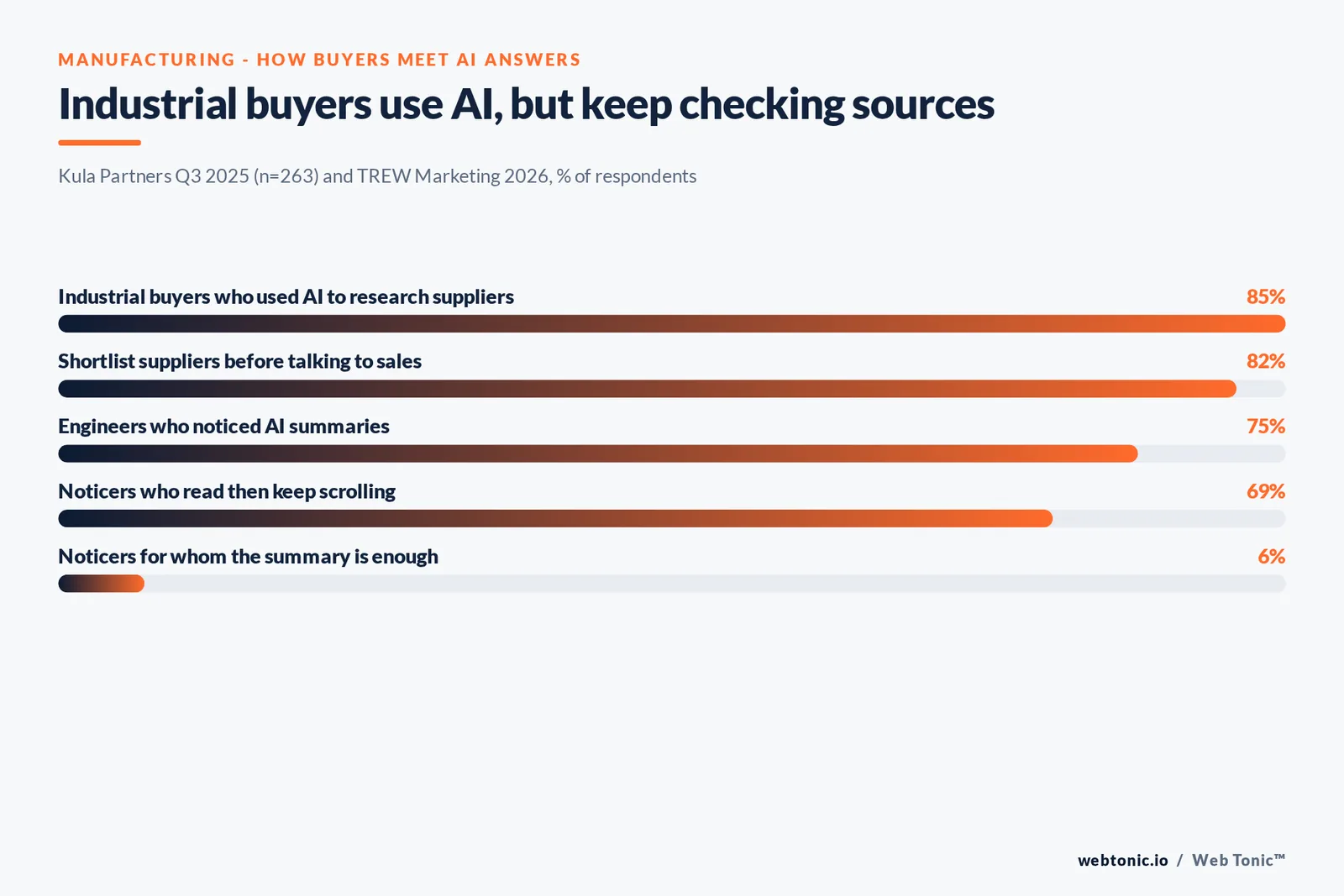
TREW Marketing's 2026 State of Marketing to Engineers asked whether respondents had noticed AI-generated summaries at the top of search results: 75% said yes, 10% no and 15% were not sure. Of those who had noticed, 69% read the summary and then continued through the results, and only 6% said the summary is usually enough. TREW put engineers' trust in AI at 4.7 out of 10. That pattern fits the CTR data: clicks fall, but technical buyers still go looking for a source. The general-population picture from Pew Research Center is similar: in March 2025 users clicked a traditional result in 8% of visits with an AI summary versus 15% without one.
| TREW 2026 finding | Share |
|---|---|
| Noticed AI summaries in search | 75% |
| Read the summary, then keep scrolling results | 69% |
| Summary is usually enough | 6% |
| Did not notice / not sure | 10% / 15% |
How Industrial Buyers Use AI to Find Suppliers
Kula Partners' Industrial Buyer Pulse for Q3 2025 (with InnovateMR, n=263) found 85% of respondents had used AI tools to research industrial suppliers in the past 90 days, with smaller firms more engaged. 82% shortlisted suppliers for a major purchase before speaking with them, and just over 77% obtained pricing or lead-time information through self-serve digital tools. Kula also reports that supplier websites remain the first place buyers look, which keeps the website at the centre of both SEO and GEO.
Self-service extends to large orders: over 80% of respondents were likely to place orders of USD 50,000 or more online. For GEO this means the pages AI engines summarise, such as specifications, lead times and quote paths, are the same pages buyers use to qualify a supplier before any sales contact.
| Kula Q3 2025 finding (n=263) | Share of industrial buyers |
|---|---|
| Used AI tools to research suppliers, past 90 days | 85% |
| Shortlisted suppliers before speaking with them | 82% |
| Got pricing or lead time via self-serve tools | 77% |
| Likely to place USD 50k+ orders online | 80%+ |
Who AI Engines Cite in the Industrials Sector
In Conductor's 2026 benchmarks, the top five Industrials domains by AI citation share were deloitte.com, indeed.com, mckinsey.com, wolterskluwer.com and siemens.com. Siemens is the only manufacturer on the list; the rest publish research and analysis. Across ten industries, AI referrals were 1.08% of website traffic, while organic search remained 33.8% of Industrials traffic. Conductor does not publish an AI Overview rate for Industrials in the summary we opened.
The citation list suggests where manufacturers lose ground. Consultancies and publishers win because they publish structured analysis that answers broad questions about supply chains, regulation and digital transformation. A manufacturer's advantage is first-party technical data that nobody else holds: test results, tolerances, material comparisons and application notes. Those are the assets most likely to be quoted when an engineer asks an assistant a specific question, and they also serve the 69% of engineers who keep scrolling past the summary to verify it.
What Manufacturing Marketers Are Investing In
Straight North's 2026 Manufacturing Marketing Survey found SEO cited as an active investment by 62% of respondents and ranked the most successful channel by 20%. The survey covers GEO as a new area many marketers are still assessing. On the click environment, SparkToro reports 68.01% of Google searches ended without a click in the first four months of 2026, versus 60.45% in 2024 (Similarweb and Datos panels respectively).
The academic origin of GEO, Aggarwal et al. (KDD 2024), reports that GEO methods "can boost visibility by up to 40%" in generative engine responses, and that efficacy varies across domains. It is a benchmark experiment, not an industrial field study. Google, for its part, says in its AI features guidance that there are "no additional requirements to appear in AI Overviews or AI Mode, nor other special optimizations necessary."
Applying the CTR Data to a Manufacturing Site
- Flag informational terms that trigger an AI Overview and expect up to 58% fewer top-result clicks.
- Report clicks and impressions by position; the loss is still -28.8% at position 8.
- Value organic leads against the USD 75.19 paid-search CPL, labelled as a comparator.
- Keep specifications, lead times and pricing on-site; 77% of buyers self-serve that information.
- Publish original technical data, the content type that leads industrial citations.
Related Reading
Cross-industry data is in our generative engine optimization statistics. Large catalogue and crawl questions are covered in our manufacturing enterprise SEO data, and export markets in our manufacturing international SEO statistics. Lead tracking is handled by our data intelligence team.
Related reading
- B2B SaaS & Tech AEO Benchmarks: Visibility, Citation & CTR Rates
- The State of Fitness Generative Engine Optimization
- What Realtors Should Budget for Generative Engine Optimization
- GEO & AEO services at Web Tonic
Frequently Asked Questions
What is the cost per lead of generative engine optimization for manufacturers?
No study publishes one. GEO is not sold per click or per lead, and no named dataset reports a manufacturing GEO CPL. The nearest priced benchmark is WordStream's 2026 Google Ads figure for Industrial and Commercial, USD 75.19 per lead, which is a paid-search comparator only.
How much do AI Overviews reduce click-through rate?
Ahrefs found the presence of an AI Overview correlated with a 58% lower top-result CTR on December 2025 data, up from 34.5% in its April 2025 study. The effect shrinks lower on the page: -50.8% at position 2, -38.8% at position 4 and -19.4% at position 10. The study is cross-industry.
Do engineers trust AI search summaries?
Only partly. In TREW Marketing's 2026 research, 75% of respondents had noticed AI-generated summaries; of those, 69% read the summary and kept looking through results, and 6% said the summary is usually enough. TREW put trust in AI at 4.7 out of 10.
How many industrial buyers use AI to research suppliers?
Kula Partners' Q3 2025 Industrial Buyer Pulse (n=263) found 85% had used AI tools to research industrial suppliers in the past 90 days, and 82% shortlisted suppliers before speaking with them.
Which domains do AI engines cite for industrial topics?
In Conductor's 2026 Industrials cut, the top five domains by AI citation share were deloitte.com, indeed.com, mckinsey.com, wolterskluwer.com and siemens.com, led by professional-services research.
Sources
Ahrefs, Update: AI Overviews Reduce Clicks by 58% (February 2026)
Ahrefs, AI Overviews Reduce Clicks by 34.5% (April 2025)
Pew Research Center, AI summaries and clicks (July 2025)
Conductor, 2026 AEO/GEO Benchmarks Report
TREW Marketing, 2026 State of Marketing to Engineers Q&A
Kula Partners, Industrial Buyer Pulse Q3 2025
WordStream, Google Ads Benchmarks 2026
Straight North, 2026 Manufacturing Marketing Survey
SparkToro, zero-click searches in 2026
Aggarwal et al., GEO: Generative Engine Optimization (KDD 2024)
Google Search Central, AI features and your website


