Table of contents
Roughly half of tracked search queries now surface an AI-generated answer before a single organic result loads, and the sources that answer cites overlap only about 17% with the sites that rank on page one. That gap between ranking and being cited is the entire reason generative engine optimization exists as its own discipline in 2026.
Key Takeaways
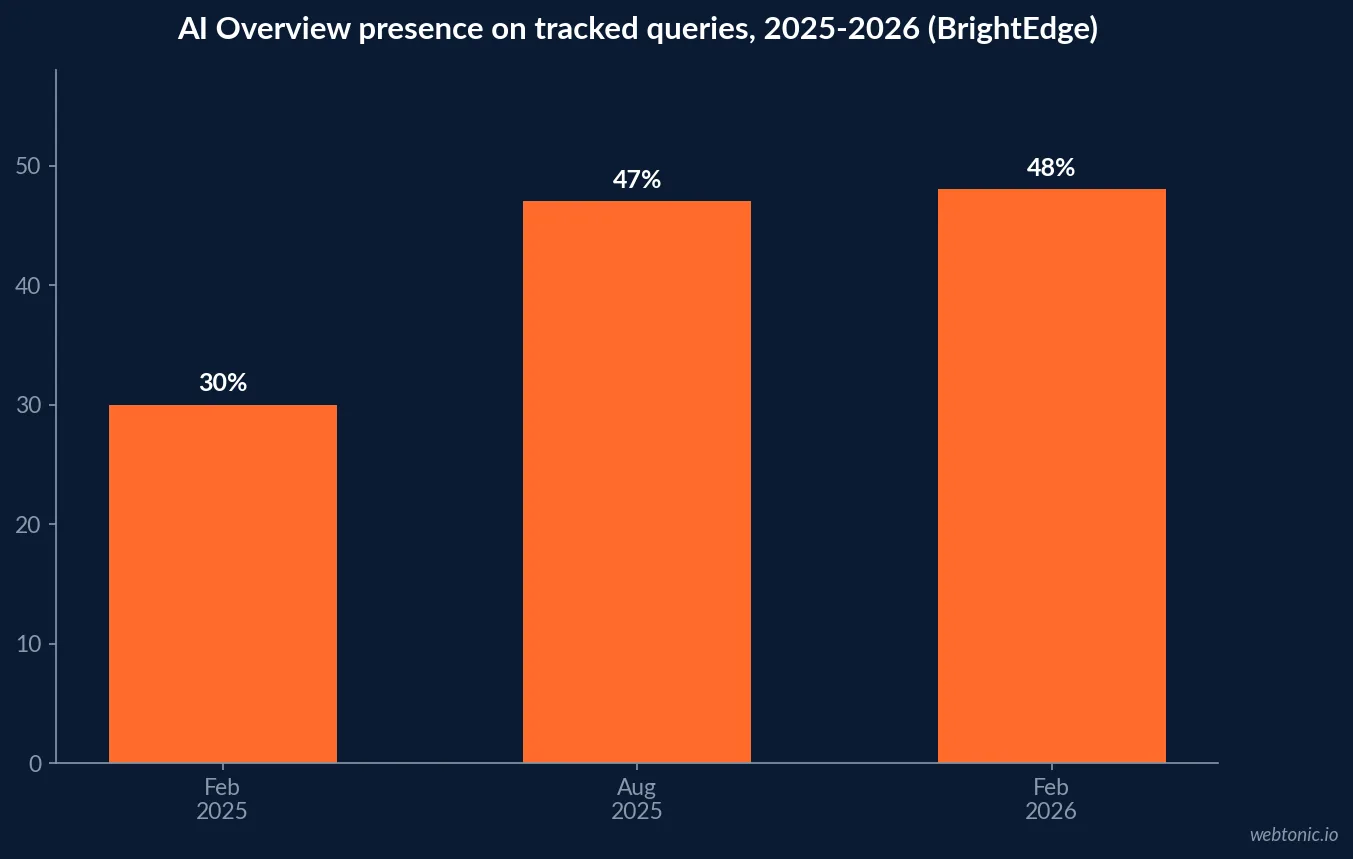
- AI Overviews reached ~48% of tracked queries by February 2026, up from ~30% a year earlier.
- That is a 58% increase in AI Overview presence in twelve months.
- Google AI Overviews passed 2.5 billion monthly active users by May 2026.
- Google AI Mode passed 1 billion monthly active users in roughly a year.
- Only about 17% of AI Overview citations also rank in the organic top ten.
- That overlap ranges from 24% in Healthcare to 11% in Finance.
- Commercial-intent AI Overviews grew 71% in six months to April 2026.
- Finance saw the sharpest jump, up 231% in the same window.
- Google Ads and AI Overviews now co-occur roughly 2x more often than a year ago.
- Conductor measured AI Overviews on 25.11% of a 21.9 million query sample.
- Healthcare queries triggered the most AI Overviews, at 48.75%.
- 68.01% of US Google searches ended with no click at all in early 2026.
- That is up from 60.45% zero-click in 2024, the fastest jump on record.
- ChatGPT's share of AI-assistant web visits fell from 76.4% to 52.7% in a year.
- Gemini's share rose from roughly 9% to 27.3% over the same period.
- ChatGPT converts a conversation into an outbound click only 5.2% of the time.
- 60% of US adults say they read AI summaries atop search results.
- About half of US adults now use AI chatbots, roughly a quarter of them daily.
AI Overviews at a glance, 2026
No single number describes "how often does an AI answer appear" because every tracker builds its own keyword panel. BrightEdge's Generative Parser tracked presence daily across nine industries and found it rising from about 30% to 48% of tracked keywords between February 2025 and February 2026. Conductor ran a separate, larger query set - 21.9 million Google searches - and found 25.11% triggered an AI Overview, with Healthcare queries the most likely to at 48.75%.
The two studies do not contradict each other; they measure different query mixes. What they agree on is direction and scale: this is now a mainstream SERP feature, not an edge case.
| Tracker (2026) | Sample | AI Overview presence | What it measures |
|---|---|---|---|
| BrightEdge | 9-industry keyword panel, daily | ~48% (Feb 2026) | General AI Overview trigger rate |
| Conductor | 21.9M Google searches | 25.11% | Cross-industry AIO trigger rate |
| Semrush | 600,000+ keywords, 10 industries | +71% growth (6 mo.) | Commercial-intent AIO growth |
| Google (self-reported) | Unspecified, Feb 2026 | “roughly 50%” | Company statement |
| Conductor, by industry | 13,770 domains, GICS-mapped | 48.75% Healthcare high | Industry breakdown |
Ranking well no longer means getting cited
The number that should worry a rankings-only strategy is the citation-to-organic overlap. BrightEdge's citation analysis found that only about 17% of the sources an AI Overview cites also rank in the organic top ten for the same query, and that share has been flat for months. Roughly five out of six AI Overview citations pull from pages that never made page one.
The overlap varies sharply by vertical: BrightEdge measured 24% overlap in Healthcare against just 11% in Finance. In practice, the AI system is running its own retrieval and relevance pass on top of - not instead of - the ranking algorithm, and the two do not select the same winners.
| Industry (BrightEdge, 2026) | AIO citation vs. organic top-10 overlap | Reading |
|---|---|---|
| Healthcare | 24% | Highest overlap tracked - authority signals still transfer |
| Cross-industry average | ~17% | Roughly 5 of 6 citations come from outside page one |
| Finance | 11% | Lowest overlap tracked - a different citation logic applies |
| All tracked verticals | Flat for months | Not a temporary artifact of a model update |
Commercial queries are catching up to informational ones
Semrush's six-month analysis of more than 600,000 keywords across 10 industries found AI Overviews on commercial-intent queries grew 71% between November 2025 and April 2026 - faster than the earlier wave that hit purely informational search. Finance queries alone grew 231% in the same window, the sharpest of any industry Semrush tracked.
The same study found Google Ads and AI Overviews now appear together on the same results page roughly twice as often as a year earlier, while AI Overviews on purely transactional queries actually fell 5% - Google appears to be routing the answer box toward research-stage commercial queries rather than ready-to-buy ones.
| Query type (Semrush, Nov 2025-Apr 2026) | AI Overview change | Note |
|---|---|---|
| Commercial intent, all industries | +71% | Fastest-growing AIO segment measured |
| Finance, commercial intent | +231% | Largest single-industry jump |
| Transactional intent | -5% | Google Overviews pulling back near the point of sale |
| SERPs with both Ads + AIO present | ~2x YoY | Paid and generative answers now coexist |
The click is disappearing faster than the query count is
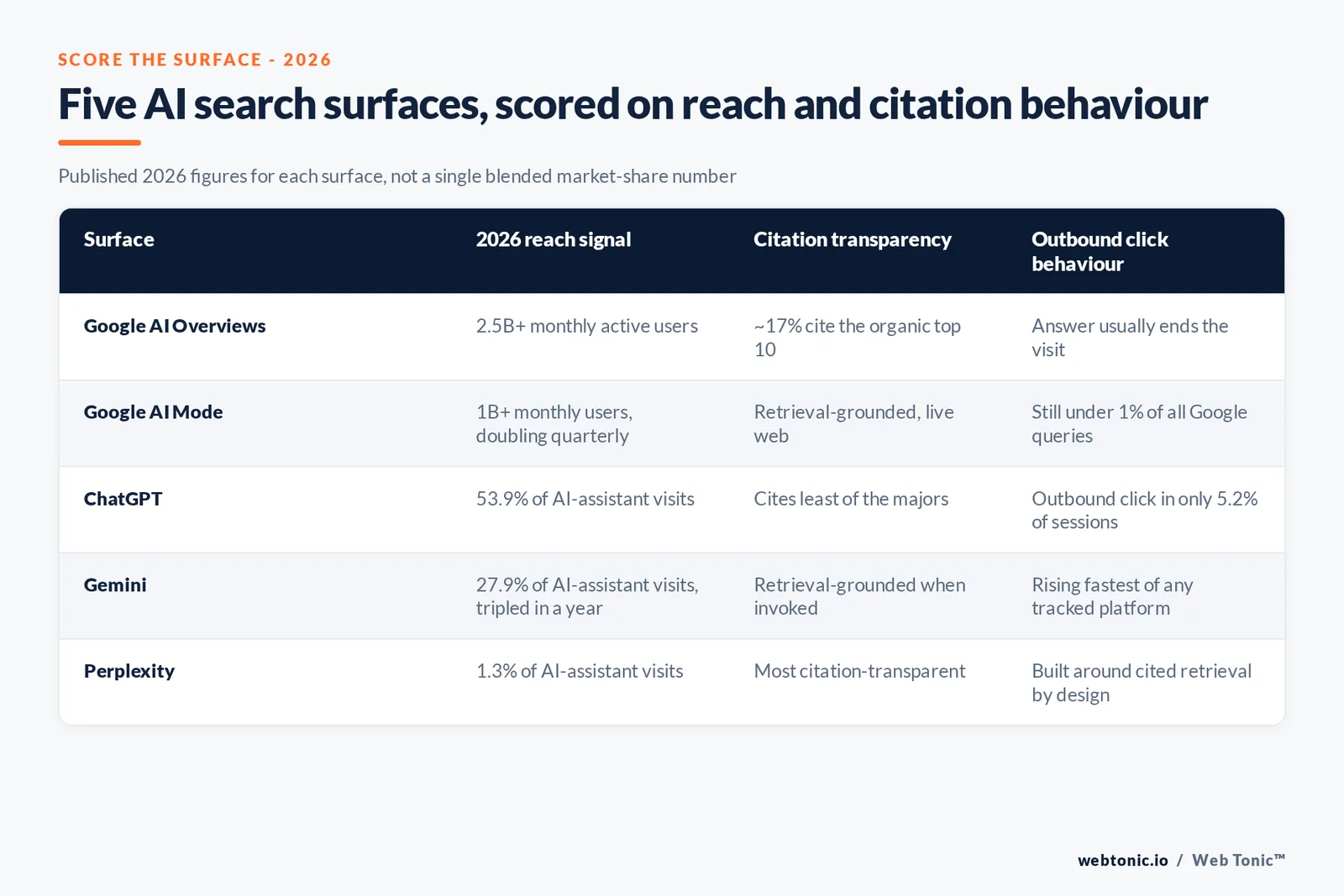
Sundar Pichai told Google's I/O 2026 keynote that AI Overviews had passed 2.5 billion monthly active users and that AI Mode, opened to all US users a year earlier, had already surpassed 1 billion monthly users with queries more than doubling every quarter. More usage of the answer box means fewer reasons to click through.
SparkToro's analysis of Similarweb clickstream data found 68.01% of US Google searches in the first four months of 2026 ended without a click anywhere - not to an ad, not to a Google property, not to the open web - up from 60.45% in 2024. A decade ago the same figure sat near 45%. Only 0.34% of Google searches during that window went on to AI Mode specifically, so the AI Mode surge and the zero-click surge are not yet the same story - they are two separate forces both working against the click.
| Zero-click Google searches, US | Share | Source |
|---|---|---|
| A decade ago | ~45% | SparkToro / Similarweb |
| 2024 | 60.45% | SparkToro / Similarweb |
| Jan-Apr 2026 | 68.01% | SparkToro / Similarweb |
| Two-year change | +7.6 points | Fastest acceleration on record, per SparkToro |
Which chat platform is even worth optimizing for
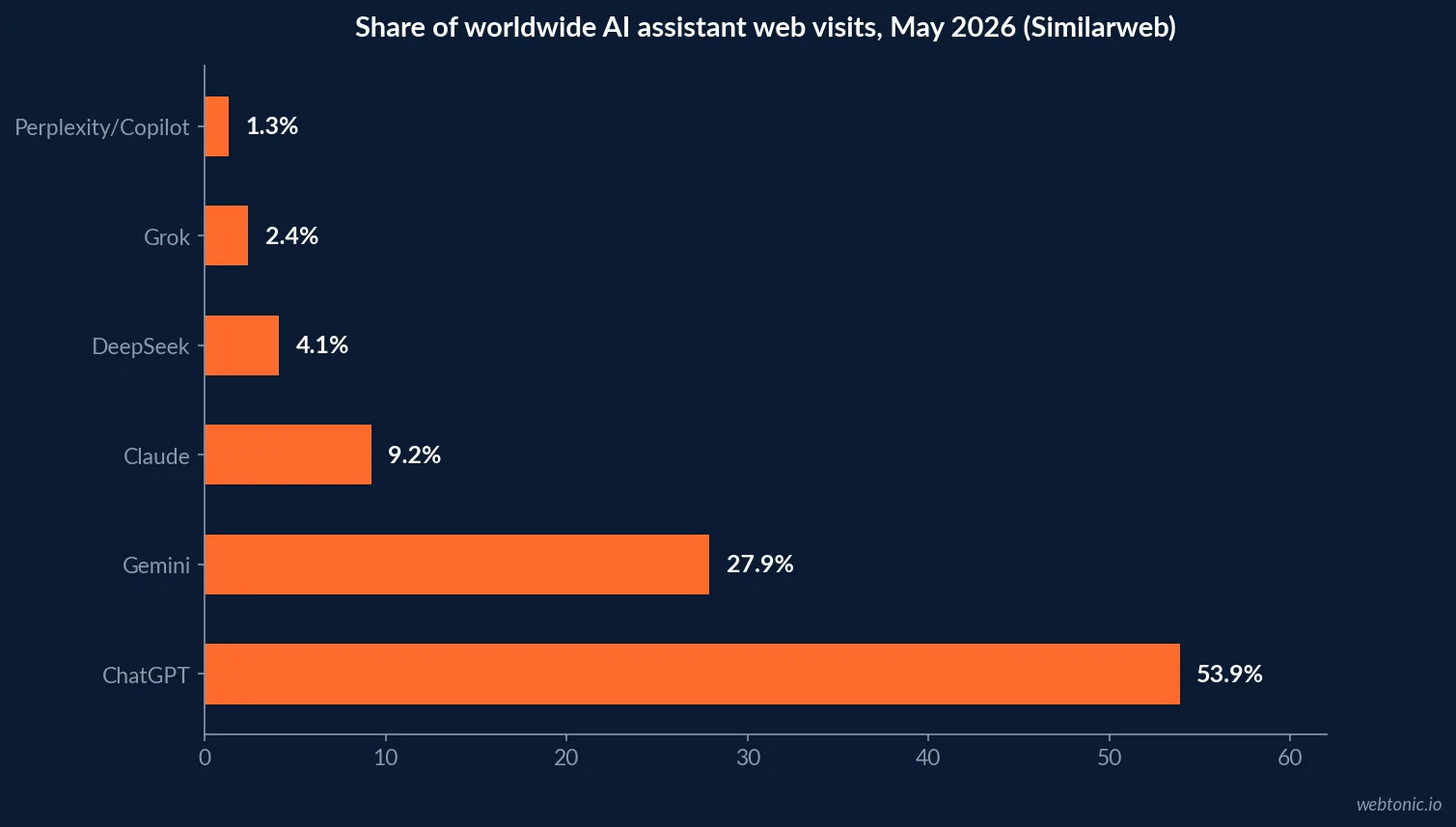
Search Engine Journal's reporting on Similarweb's May 2026 comparison put ChatGPT at 53.9% of worldwide web visits among seven major AI assistants, Gemini at 27.9%, Claude at 9.2%, DeepSeek at 4.1%, Grok at 2.4%, and Perplexity and Copilot tied at 1.3% each. A year earlier, ChatGPT held 76.4% of that same visit share; by May 2026 it had fallen to 52.7%, while Gemini rose from roughly 9% to 27.3% and Claude grew from 1.6% to 8.9%.
Visits are not the same as referrals. A Bocconi University study of Comscore US desktop clickstream data found ChatGPT produces an outbound click in only 5.2% of conversation sessions, far below Google's referral ratio, and that the clicks it does send skew toward specialized destinations rather than ad-supported sites. Being visited by users is not the same as being a source of traffic for anyone else.
| Platform | Worldwide visit share, May 2026 | 12-month change | Source |
|---|---|---|---|
| ChatGPT | 53.9% | 76.4% → 52.7% | Similarweb via Search Engine Journal |
| Gemini | 27.9% | ~9% → 27.3% | Similarweb via Search Engine Journal |
| Claude | 9.2% | 1.6% → 8.9% | Similarweb via Search Engine Journal |
| DeepSeek | 4.1% | n/a | Similarweb via Search Engine Journal |
| Grok | 2.4% | n/a | Similarweb via Search Engine Journal |
| Perplexity / Copilot | 1.3% each | n/a | Similarweb via Search Engine Journal |
The audience reading these answers is not a fringe group
Pew Research Center's February 2026 survey of 5,119 US adults found that about half now report using AI chatbots, roughly one in four on a daily basis, and that six in ten US adults say they read AI summaries at the top of search results, against three in ten who say they do not. Adoption is mainstream even though Pew also finds most adults remain skeptical that AI's overall impact will be positive.
That combination - high exposure to AI answers, low trust in AI generally - is exactly the environment where a cited, attributable, well-sourced page has the most to gain. Our growth marketing team treats AI Overview citations as a distinct funnel stage now, not an SEO side effect.
What actually changes in a GEO playbook
Three things follow directly from the data above. First, page-one rankings and AI citations are different games with only ~17% overlap, so a page can rank and never get cited, or get cited from well outside page one. Second, the fastest AI Overview growth is now in commercial-intent and Finance queries, not just how-to content, so category and comparison pages need the same citation-readiness as blog posts. Third, the AI platform worth measuring is a moving target - Gemini's share nearly tripled in a year - so a single-platform strategy is already out of date by the time it ships.
If a page's content is the raw material an AI system quotes from, the same structural habits that make a page easy to rank also make it easy to extract a clean, attributable quote from - clear claims, one number per sentence, a named source. Read our take on building a search strategy that survives platform shifts, or talk to our team about auditing where your pages currently sit in the citation-to-ranking gap.
Frequently Asked Questions
What is generative engine optimization?
It is the practice of structuring content so AI systems - Google AI Overviews and AI Mode, ChatGPT, Gemini, Perplexity - select and cite it when they compose an answer, rather than optimizing purely for a ranked list of blue links. The discipline exists because BrightEdge measures AI Overviews on roughly 48% of tracked queries as of February 2026, and Conductor separately measured 25.11% of a 21.9 million query sample. Ranking well no longer guarantees getting cited: BrightEdge finds only about 17% overlap between what AI Overviews cite and what ranks in the organic top ten.
How much has AI Overview coverage actually grown?
BrightEdge's Generative Parser tracked AI Overview presence rising from roughly 30% of its keyword set in February 2025 to about 48% by February 2026, a 58% increase in a year. Semrush's separate six-month study of over 600,000 keywords found AI Overviews on commercial-intent queries specifically grew 71%, with Finance queries up 231% in the same window. The two studies use different keyword sets, which is why the headline percentages differ even as the growth trend agrees.
Does an AI Overview actually cost the page a click?
Google's own AI Overviews had passed 2.5 billion monthly active users by May 2026, according to Sundar Pichai's I/O 2026 keynote, and SparkToro's analysis of Similarweb clickstream data found 68.01% of US Google searches in the first four months of 2026 ended without any click at all, up from 60.45% in 2024. That is a seven and a half percentage point jump in two years, the fastest acceleration SparkToro has recorded. A cited source inside the answer is often the only exposure a page gets on that query.
Which AI platform actually sends the most traffic?
Similarweb's May 2026 data, reported by Search Engine Journal, put ChatGPT at 53.9% of worldwide web visits among seven major AI assistants, with Gemini at 27.9% and Claude at 9.2%. But ChatGPT's own share has fallen fast - from 76.4% a year earlier to 52.7% by May 2026 - while Gemini grew from roughly 9% to 27.3% over the same period. A Bocconi University study of Comscore clickstream data found ChatGPT produces an outbound click in only 5.2% of conversation sessions, far below a typical Google referral rate, so even the largest AI platform by visits is not a reliable click-through channel.
Is this measurable enough to build a strategy on?
Yes, but only if the underlying methodology is stated. BrightEdge, Conductor and Semrush each track different keyword panels and arrive at different percentages for the same phenomenon - 48%, 25.11%, and a 71% growth rate are all correct within their own sample. Pew Research Center's February 2026 survey of 5,119 US adults adds the demand-side confirmation: six in ten adults say they read AI summaries at the top of search results, so the audience is real even where the percentage estimate varies by source.
Sources
BrightEdge - AI Overviews at the one-year mark: presence, size and citations
Conductor - The 2026 AEO/GEO Benchmarks Report
Semrush - AI Overviews are expanding across commercial intent search
SparkToro - In 2026, less than one third of Google searches still send a click
Google - Sundar Pichai's opening keynote, I/O 2026
Search Engine Journal - ChatGPT, Gemini and Claude lead AI visibility, 2026
Shi, Zhu and Gu, Bocconi University - Answering without referring: how AI search rewrites the web's economic bargain
Pew Research Center - Americans and AI 2026