



Table of contents
Fitness generative engine optimization has no industry-specific benchmark yet: no study we opened publishes an AI citation share, GEO cost per lead or AEO click rate for gyms. What does exist is cross-industry local data from SOCi, consumer data from Pew Research Center and membership counts from the Health and Fitness Association, and together they show how hard it is for a club to be named in an AI answer.
Key Takeaways
- ChatGPT recommended 1.2% of brand locations in SOCi's 2026 index, against 35.9% Google 3-pack presence.
- Gemini recommended 11.0% of locations and Perplexity 7.4%.
- Locations ChatGPT recommended averaged 4.3 stars.
- 49% of US adults use AI chatbots in 2026, up from 33% in 2024 (Pew).
- 68.01% of Google searches ended without a click in January-April 2026 (SparkToro).
- AI Overviews have over 2.5 billion monthly active users (Google, May 2026).
- 81 million Americans held a fitness facility membership in 2025 (HFA).
- ChatGPT held 75.17% of US AI chatbot visits in September 2026 (Statcounter).
Fitness GEO signals at a glance
Every row below is cross-industry or consumer-wide unless it says fitness. That is the honest state of the data in October 2026.
| Signal | Figure | Period | Issuer | Fitness-specific? |
|---|---|---|---|---|
| ChatGPT location recommendation rate | 1.2% | 2026 index | SOCi (vendor) | No, cross-industry |
| Google local 3-pack presence | 35.9% | 2026 index | SOCi (vendor) | No, cross-industry |
| US adults using AI chatbots | 49% | Feb 2026 | Pew Research Center | No |
| Zero-click Google searches | 68.01% | Jan-Apr 2026 | SparkToro | No |
| Fitness facility members | 81 million | 2025 | HFA | Yes |
| Fitness AI citation share | Not published | Any | No issuer | - |
Why a gym search now ends before the website
SparkToro reports that "in the first four months of 2026, a whopping 68.01% of Google searches ended without a click", against 60.45% in 2024 (2024 on the Datos panel, 2026 on Similarweb's), a rise of 7.5 percentage points. Clicks that do happen are worth less when an AI summary sits on top: Ahrefs found the presence of an AI Overview correlated with a 58% lower click-through rate for the top-ranking page in December 2025 data, up from 34.5% in its April 2025 study. Neither dataset isolates "gym near me" queries, but local fitness searches run through the same results page.
The scale of the surface is not in doubt. At Google I/O 2026, Sundar Pichai said "AI Overviews now has over 2.5 billion monthly active users" and that AI Mode had surpassed 1 billion monthly active users within a year.
Pew's browsing data shows what happens next. On Google pages with an AI summary, users ended their browsing session entirely on 26% of visits, against 16% on pages without one, and 18% of all searches in its March 2025 sample produced a summary. For a studio, a session that ends on the results page means the class schedule, price and address shown there, often pulled from the Business Profile, are the whole first impression.
| Search behaviour metric | Earlier value | Later value | Source |
|---|---|---|---|
| Google searches ending without a click (US) | 60.45% (2024) | 68.01% (Jan-Apr 2026) | SparkToro |
| Top-result CTR change with an AI Overview | -34.5% (Apr 2025 study) | -58% (Dec 2025 data) | Ahrefs |
| Clicks on a result, with vs without AI summary | 15% without | 8% with | Pew, Mar 2025 data |
| Sessions ending on the results page | 16% without summary | 26% with summary | Pew, Mar 2025 data |
| AI Overviews monthly active users | - | Over 2.5 billion (May 2026) |
How often AI names a club location
SOCi's 2026 Local Visibility Index is the closest public measure of whether an AI assistant will name a specific location. It covers 2,751 multi-location brands and roughly 350,000 locations, and asked each platform the standardized prompt "Can you recommend businesses of X type in Y market?" for every audited location, counting a recommendation only when the brand appeared in the first five results. Across industries, ChatGPT recommended 1.2% of locations, Perplexity 7.4% and Gemini 11.0%, while the same brands appeared in Google's local 3-pack 35.9% of the time. SOCi calls AI recommendation "three to thirty times harder to earn" than a strong traditional ranking.
SOCi does not publish a gym or studio row on the pages we opened. A franchise club operator can read these figures as the baseline its locations compete against, not as a fitness result.
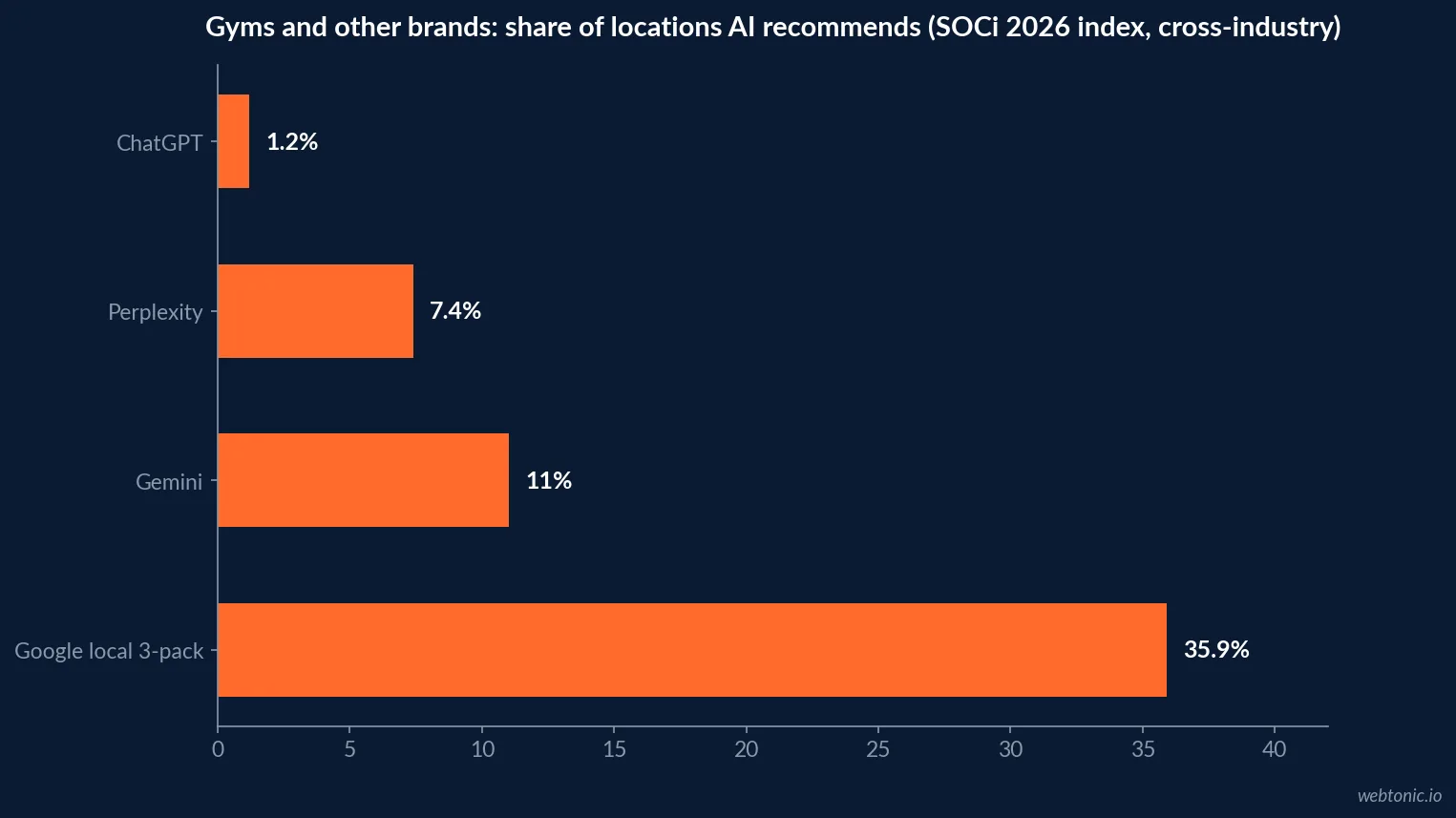
| Platform | Locations recommended | Multiple of ChatGPT rate | What a club should check |
|---|---|---|---|
| ChatGPT | 1.2% | 1x | Listings accuracy and review volume |
| Perplexity | 7.4% | About 6x | Directory and map listings |
| Gemini | 11.0% | About 9x | Google Business Profile data |
| Google local 3-pack (context) | 35.9% | About 30x | Classic local SEO |
Ratings work as a filter, not a ranking factor
SOCi reports that locations recommended by ChatGPT averaged 4.3 stars, compared with 3.9 on Gemini and 4.2 on Perplexity, and writes that "fall below roughly 4 stars and many AI systems simply won't consider you". The same index found the average business responds to just 46.9% of its Google reviews and only 3.1% of its Yelp reviews. For gyms, where reviews often cover cleanliness, crowding and cancellation, that response gap is the cheapest place to start.
| Review metric (SOCi 2026, cross-industry) | Value | Club action |
|---|---|---|
| Avg rating of ChatGPT-recommended locations | 4.3 stars | Track every location against 4.0 |
| Avg rating, Perplexity recommendations | 4.2 stars | Fix the lowest-rated clubs first |
| Avg rating, Gemini recommendations | 3.9 stars | Keep Business Profile data current |
| Share of Google reviews answered | 46.9% | Answer cancellation complaints |
| Share of Yelp reviews answered | 3.1% | Do not ignore secondary sites |
Who is asking AI about workouts and clubs
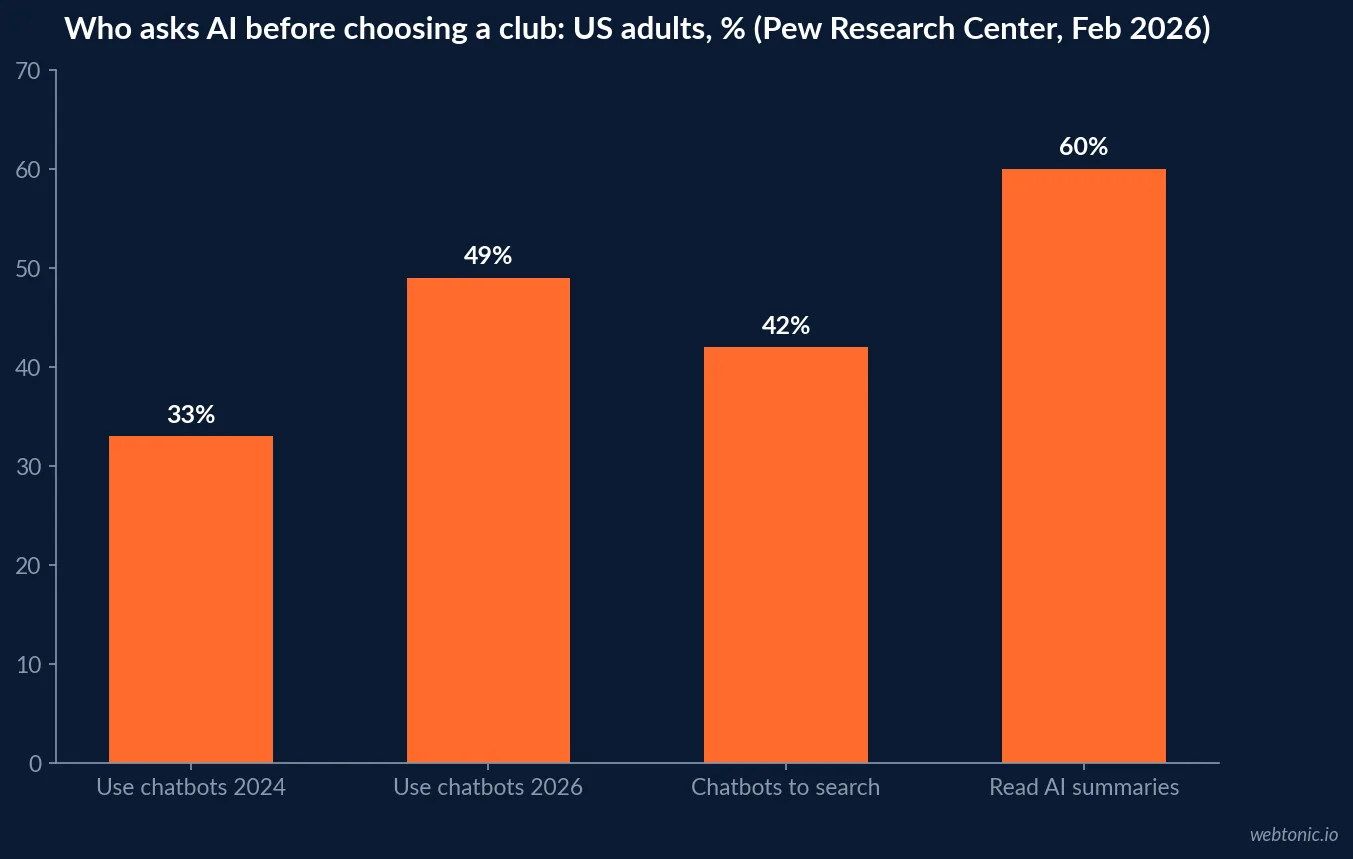
Pew Research Center's survey of US adults, conducted February 17-23, 2026, found 49% now use AI chatbots, up from 33% in 2024 (the 2024 question wording differed slightly). Searching for information was the most common use: 42% of adults say they use chatbots for it, and 60% of adults say they read AI summaries at the top of search results. Pew's July 2025 browsing study of 900 adults adds behaviour: on searches with an AI summary, users clicked a traditional result on 8% of visits versus 15% without one, and clicked a link inside the summary on 1%.
Which assistants a club needs to show up in
Statcounter's US AI chatbot market share for September 2026 puts ChatGPT at 75.17%, Google Gemini at 13.26%, Microsoft Copilot at 6.64%, Perplexity at 3.02% and Claude at 1.81%. Read alongside SOCi, the platform with the most users is also the one that names the fewest locations, which is why a club cannot treat Google rank as a proxy for AI visibility.
| AI chatbot (US, Sep 2026) | Share of chatbot visits | SOCi location recommendation rate |
|---|---|---|
| ChatGPT | 75.17% | 1.2% |
| Google Gemini | 13.26% | 11.0% |
| Microsoft Copilot | 6.64% | Not measured |
| Perplexity | 3.02% | 7.4% |
| Claude | 1.81% | Not measured |
The membership base behind fitness queries
The audience is large and still growing. The HFA 2026 consumer report counts 81 million US fitness facility members in 2025, an all-time high and a 5.2% increase on 2024, equal to 26.1% of the population aged six and older; more than 100 million people used a facility when day passes and guest visits are included. Members aged 65 and older grew 8.6%, the fastest cohort. At the brand level, Planet Fitness ended 2025 with approximately 20.8 million members and 2,896 clubs after opening 181, of which 158 were franchisee-owned.
Each of those clubs is a location an assistant may or may not name. Multi-location brands are exactly the population SOCi measured.
| Fitness market figure | Value | Period | Issuer |
|---|---|---|---|
| US fitness facility members | 81 million (+5.2%) | 2025 | HFA |
| Share of population 6+ with a membership | 26.1% | 2025 | HFA |
| Members aged 65+, growth | +8.6% | 2025 | HFA |
| Planet Fitness members | About 20.8 million | Dec 31, 2025 | Planet Fitness |
| Planet Fitness clubs | 2,896 (181 opened) | Dec 31, 2025 | Planet Fitness |
What Google says about optimizing for AI answers
Google's AI features documentation is explicit: "There are no additional requirements to appear in AI Overviews or AI Mode, nor other special optimizations necessary." It adds that sites do not need new machine-readable files, AI text files or markup, that there is "no special schema.org structured data that you need to add", and it points businesses to keeping Merchant Center and Business Profile information up to date. For a gym, that means accurate hours, class schedules and membership details on the Business Profile and the club page carry more weight than any GEO-specific file.
What the research says about content changes
The academic origin of the term is the GEO paper by Aggarwal and colleagues (arXiv 2311.09735, KDD 2024), which reports that "GEO can boost visibility by up to 40%" in generative engine responses and that efficacy "varies across domains". That is a lab benchmark across query sets, not a measured lift for fitness pages, and it was not tested on local recommendation prompts like the ones SOCi used. Cite it as evidence that wording and sourcing can change inclusion, not as an expected result for a club.
A fitness GEO checklist built from the data
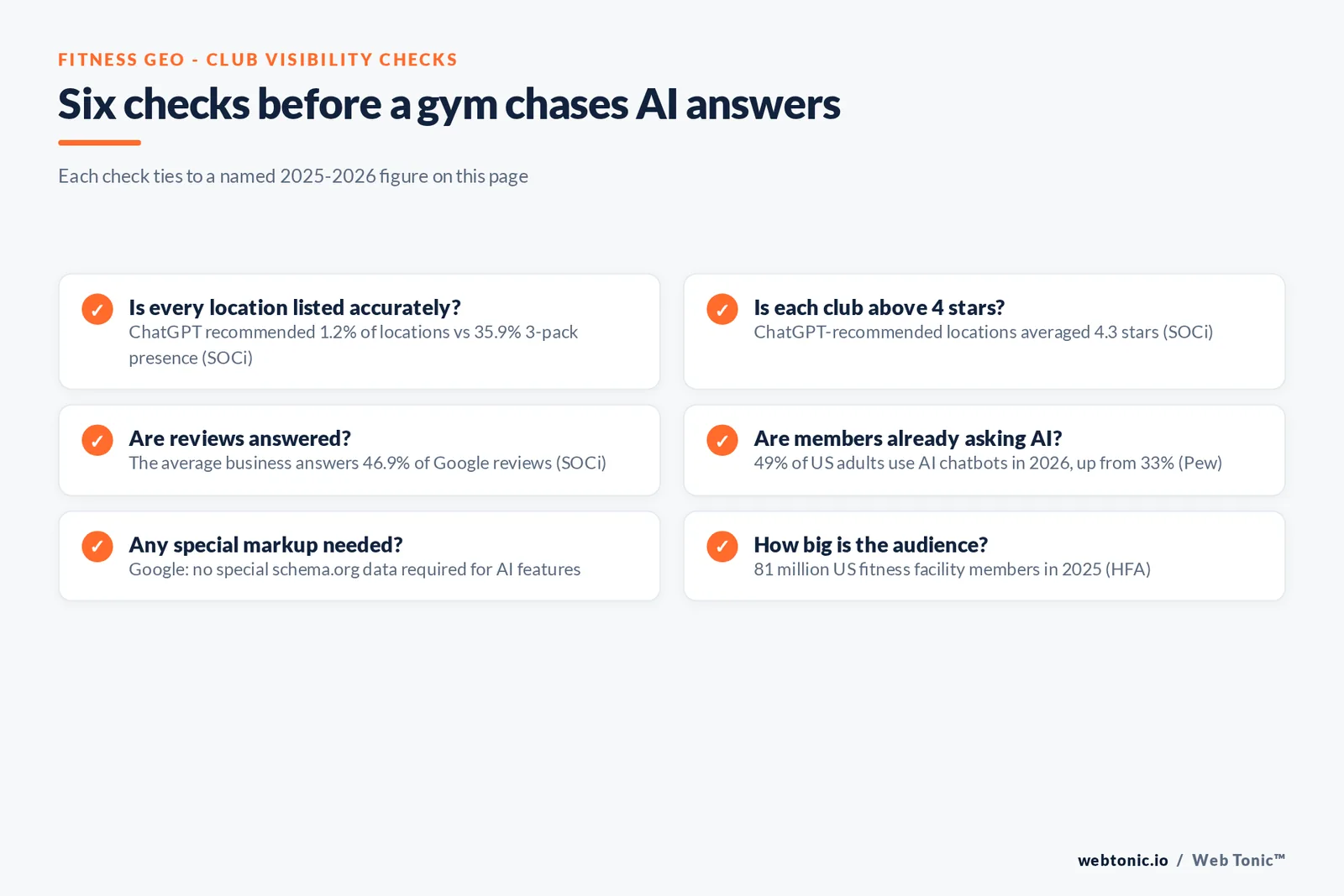
- Audit every location's listing: the gap between 35.9% 3-pack presence and 1.2% ChatGPT recommendation is a listings and reviews problem first.
- Hold each club above 4.0 stars; ChatGPT-recommended locations averaged 4.3.
- Answer more than 46.9% of Google reviews, the cross-industry average.
- Write class, price and schedule facts in plain text: Google says no special markup is required.
- Test prompts monthly per market, since SOCi measures recommendation frequency, not rank.
- Report AI visibility separately from organic traffic; 68.01% of searches no longer click.
What nobody publishes for fitness yet
No source we opened publishes a fitness AI citation share, a GEO cost per member, an AEO click-through rate for gym queries or the share of memberships that start in an AI assistant. Conductor's 2026 sector benchmarks use GICS sectors and none maps cleanly to fitness clubs, so we do not borrow a sector figure here. Any vendor quoting a "fitness AI share" should be asked for its sample and prompt set.
For the paid side of the same funnel, see our fitness native advertising statistics; for organic scale, our fitness enterprise SEO statistics. The cross-industry baseline is in our generative engine optimization statistics, and our growth marketing team can set up per-location prompt tracking.
Frequently Asked Questions
How often do AI assistants recommend a gym location?
No study publishes a fitness-only rate. SOCi's 2026 Local Visibility Index, which covers about 350,000 locations of 2,751 multi-location brands across industries, found ChatGPT recommended 1.2% of locations, Gemini 11.0% and Perplexity 7.4%, while the same brands appeared in Google's local 3-pack 35.9% of the time.
Do star ratings matter for AI recommendations of fitness clubs?
SOCi reports that locations recommended by ChatGPT averaged 4.3 stars, against 3.9 on Gemini and 4.2 on Perplexity, and describes reviews as working like a filter below roughly 4 stars. The study is cross-industry, so treat it as a direction for clubs rather than a fitness benchmark.
Does Google require special markup for AI Overviews?
No. Google Search Central says there are no additional requirements to appear in AI Overviews or AI Mode, nor other special optimizations necessary, and that no special schema.org structured data is needed. Normal SEO best practice and an accurate Business Profile are the stated basis.
How many Americans use AI chatbots in 2026?
Pew Research Center's February 2026 survey found 49% of US adults use AI chatbots, up from 33% in 2024, and 60% say they read AI summaries at the top of search results. Pew does not split these figures by fitness intent.
Is there a published AI citation share for the fitness industry?
No. Conductor's 2026 sector benchmarks do not include a fitness or leisure cut that maps cleanly, and no other study we opened publishes a fitness AI citation share, GEO cost per lead or AEO click-through rate.
Sources
SOCi, Local Visibility Benchmarks (2026 Local Visibility Index)
Pew Research Center, Americans and AI 2026 (Jun 2026)
Pew Research Center, Google users and AI summaries (Jul 2025)
SparkToro, zero-click searches in 2026 (Jun 2026)
Ahrefs, AI Overviews reduce clicks by 58% (Feb 2026)
Google, Sundar Pichai I/O 2026 remarks
Statcounter, US AI chatbot market share (Sep 2026)
Health and Fitness Association, 2026 consumer report release
Planet Fitness, Q4 and full year 2025 results
Google Search Central, AI features and your website
Aggarwal et al., GEO: Generative Engine Optimization (KDD 2024)


