Table of contents
A mailing list is not a fixed asset - it is a shrinking one, decaying at least 23% a year even before anyone unsubscribes. The number that should set next year's budget is not the list's headline size but what fraction of it will still be reachable and valid twelve months from now.
Key Takeaways
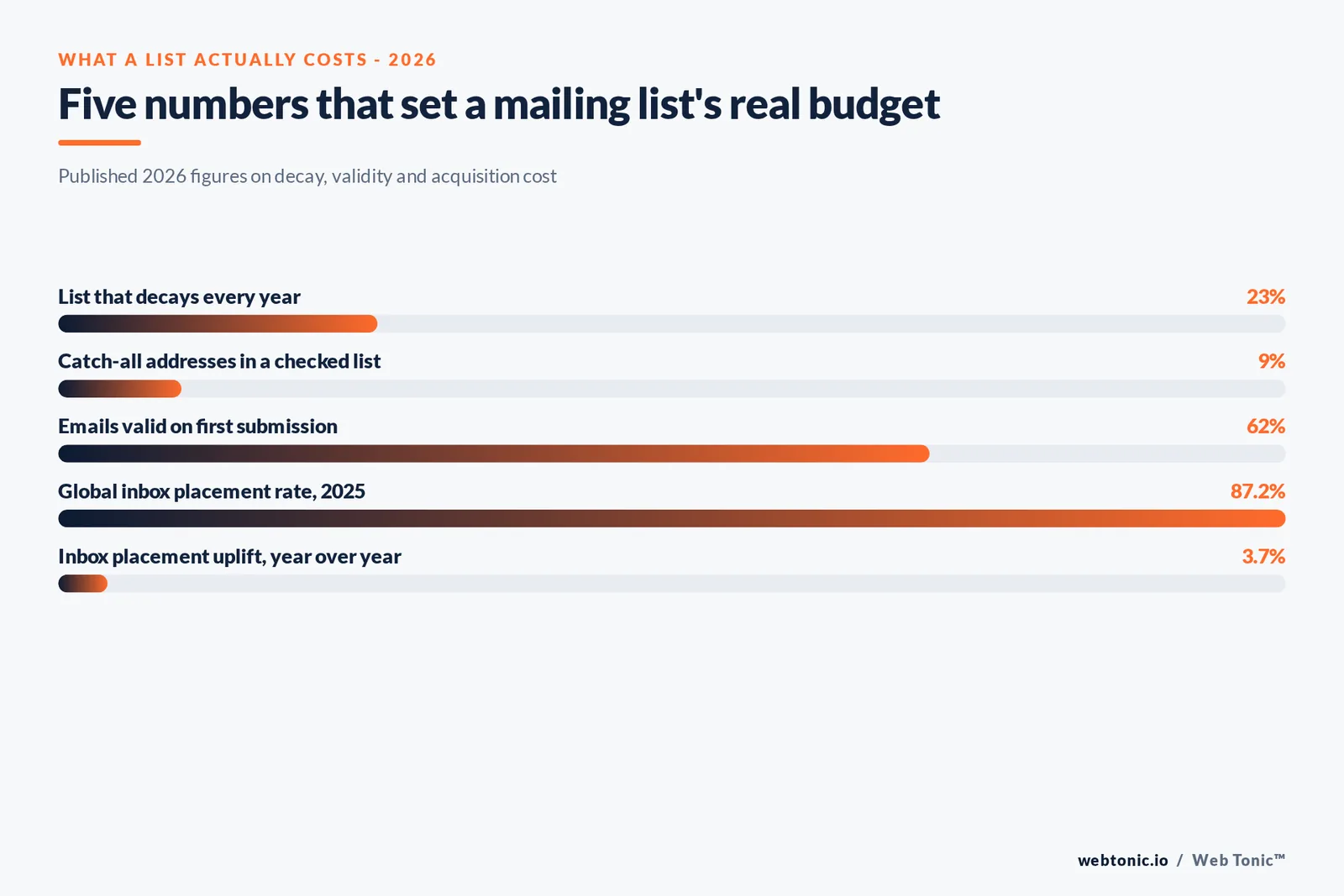
- At least 23% of an email list decays every year.
- That is an improvement from 28% decay in 2024.
- ZeroBounce verified more than 11 billion email addresses in 2025.
- Only 62% of all emails checked in 2025 were confirmed valid.
- More than 9% of checked emails were catch-all addresses.
- ZeroBounce caught 10-plus million typo-driven bounces in a year.
- 5-plus million disposable emails were identified in the same period.
- Global inbox placement rate averaged 87.2% in 2025.
- That is a 3.7-point improvement year over year.
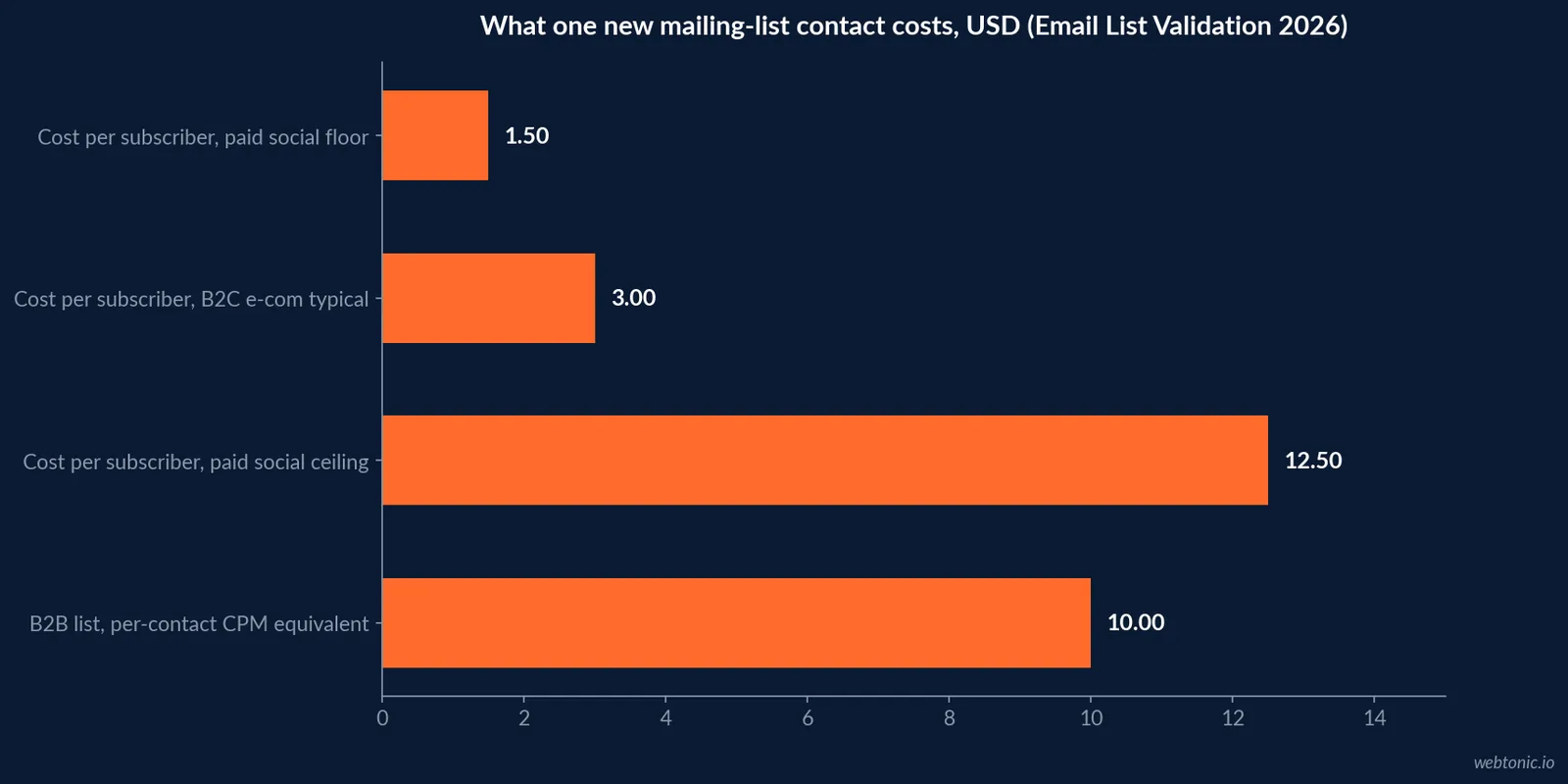
- Cost per subscriber from paid social ranges USD 1.50 to 12.50.
- B2C e-commerce brands typically pay USD 3.00 to 6.50 per subscriber.
- Professional B2B list pricing runs USD 0.10 to 2.00-plus per contact.
- B2B list CPMs can reach USD 300 to 1,000-plus per thousand contacts.
- A bounce rate above 0.5% is a common blacklisting threshold.
The number that should set the maintenance budget
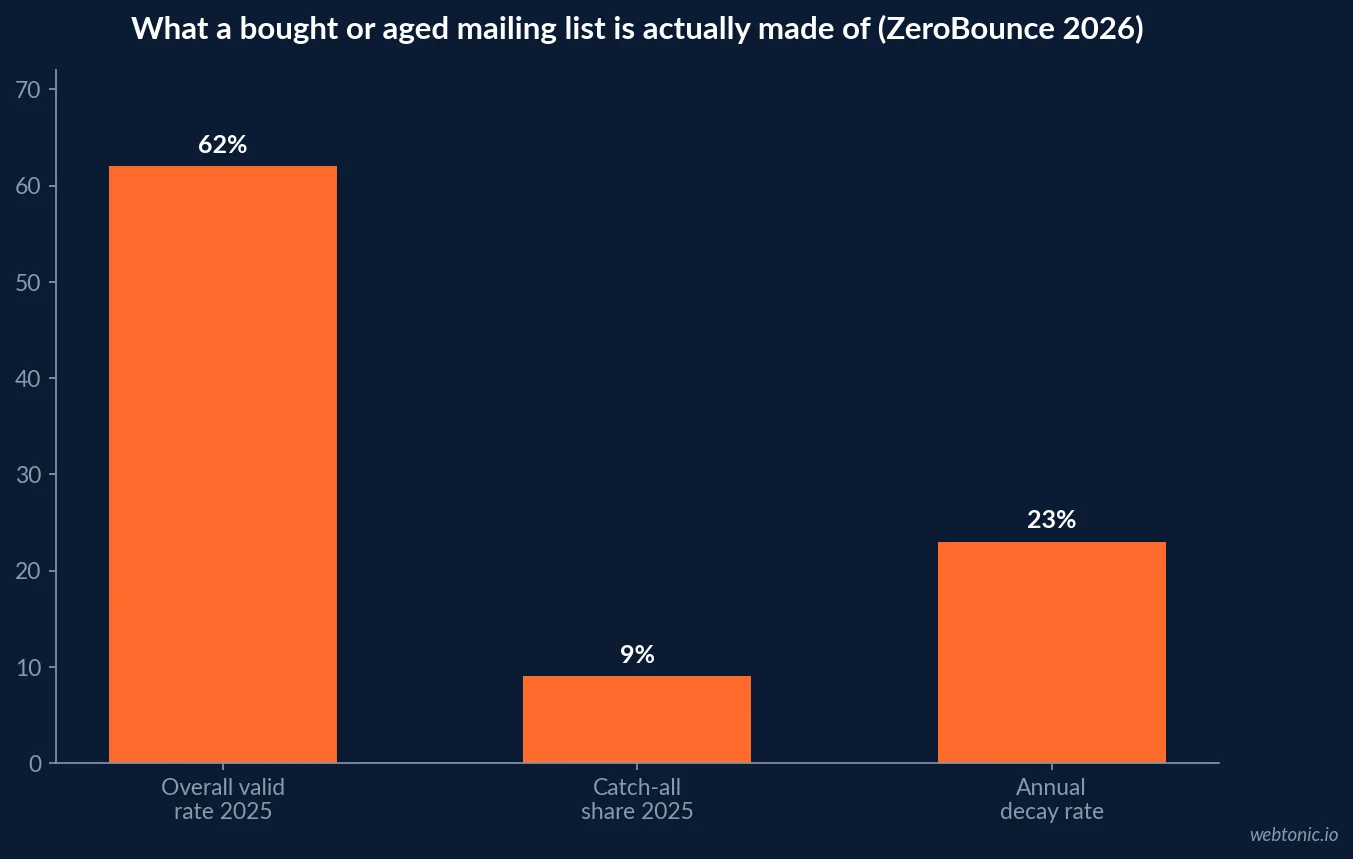
ZeroBounce's Email List Decay Report for 2026, built from more than 11 billion email addresses verified in 2025, finds at least 23% of an email list degrades within a single year - down from 28% in 2024, but still close to a quarter of any list going stale annually. Of everything ZeroBounce checked in 2025, only 62% was confirmed valid outright, and more than 9% came back as catch-all addresses that accept mail without a real person behind them.
The report also flags smaller but costly categories: ZeroBounce's typo-detection caught more than 10 million bounces it would otherwise have triggered in a single year, and identified more than 5 million disposable emails - addresses people create specifically to avoid giving out a real one.
| List-health metric (2026) | Figure | Source |
|---|---|---|
| Annual decay rate | At least 23% | ZeroBounce Email List Decay Report 2026 |
| Decay rate, 2024 comparison | 28% | ZeroBounce |
| Emails confirmed valid, 2025 | 62% | ZeroBounce |
| Catch-all share of checked emails | 9%+ | ZeroBounce |
| Typo-driven bounces prevented | 10M+ | ZeroBounce |
| Disposable emails identified | 5M+ | ZeroBounce |
What a new subscriber actually costs
Email List Validation's 2026 benchmark research puts the cost per subscriber from Facebook and Instagram ads at USD 1.50 to 12.50, with B2C e-commerce brands typically landing at USD 3.00 to 6.50 - but only if list hygiene is maintained, since invalid and role-based addresses inflate the effective cost per real subscriber without improving deliverability. A bounce rate above 0.5% is a common threshold that inbox providers use as a filtering signal, which is where an undermaintained acquisition funnel starts costing more than its sticker price suggests.
For B2B lists bought rather than grown, Email Data Group's 2026 guide puts professional list pricing at USD 0.10 to 2.00-plus per contact, or USD 300 to 1,000-plus per thousand contacts (CPM) depending on niche and data quality - and explicitly warns that unit cost is the wrong metric next to cost per usable, engaged contact.
| Acquisition cost benchmark (2026) | Range | Source | Applies to |
|---|---|---|---|
| Cost per subscriber, paid social | USD 1.50-12.50 | Email List Validation | Facebook/Instagram lead ads |
| Cost per subscriber, B2C e-commerce | USD 3.00-6.50 | Email List Validation | Consumer brands with clean lists |
| Professional list, per-contact price | USD 0.10-2.00+ | Email Data Group | Bought B2B contact lists |
| B2B list, per-thousand CPM | USD 300-1,000+ | Email Data Group | Niche, high-intent B2B segments |
| Consumer list, per-thousand CPM | USD 100-400 | Email Data Group | General consumer segments |
Where the sent email actually lands
Validity's 2026 Email Deliverability Benchmark Report, built on trillions of inbox data points, puts the average global inbox placement rate for 2025 at 87.2% - a 3.7-point improvement year over year. That blended figure hides real variance: Validity's own data shows placement differs meaningfully by mailbox provider and by industry, so a sender celebrating an 87% average industry rate could still be losing a fifth of its sends at a single major provider.
The budget implication is direct: a list-cleaning and authentication line (SPF, DKIM, DMARC) is not optional maintenance, it is the difference between paying for a subscriber and paying for a subscriber who never sees the email.
| Deliverability fact (2026) | Figure | Source |
|---|---|---|
| Global average inbox placement rate, 2025 | 87.2% | Validity 2026 Benchmark Report |
| Year-over-year improvement | 3.7 points | Validity |
| Variance | Significant by mailbox provider and industry | Validity |
Why "list size" is the wrong headline metric
A 100,000-name list at 62% validity and 23% annual decay behaves, within a year, like a 46,000-name list that is still shrinking. Budgeting against the headline count rather than the decayed-and-valid count is the single most common way a mailing-list line under-delivers against its plan - the invoice for acquisition was paid on the full count, but the return only ever came from the usable fraction.
What a clean list actually returns
The maintenance spend is easier to justify against the return it protects. Omnisend's 2026 benchmark data puts average email marketing ROI at USD 36 to 42 for every dollar spent - a 3,600% to 4,200% return - which keeps email among the highest-ROI channels a marketer controls, but only for the portion of a list that is valid and engaged. A list running at 62% validity and 23% annual decay is not returning USD 36 per dollar on its full headcount; it is returning that on a shrinking usable core while the rest inflates the sending volume without adding revenue.
That gap is exactly why cleaning spend pays for itself: every dollar spent removing decayed contacts protects sender reputation for the contacts still capable of producing that USD 36-to-42 return, rather than letting bad addresses drag deliverability down for the whole list.
| Email ROI fact (2026) | Figure | Source |
|---|---|---|
| Average email marketing ROI | USD 36-42 per USD 1 | Omnisend 2026 |
| Equivalent ROI percentage | 3,600-4,200% | Omnisend |
| List validity ceiling this return assumes | Valid, engaged contacts only | Omnisend / ZeroBounce |
The compliance line that rides along with the list
Consent and privacy compliance is a real, separate cost inside the same budget conversation. Adaptive Security's 2026 compliance research notes that GDPR email marketing violations can trigger fines of up to EUR 20 million or 4% of global annual turnover, whichever is higher, when personal data is processed without a valid lawful basis. Monthly platform pricing scales with list size too: Lumilinx's 2026 US pricing guide puts typical monthly platform cost at USD 50 to 1,000 for lists between 1,000 and 10,000 contacts, rising to USD 5,000 to 15,000-plus for enterprise lists above 50,000.
None of that is optional once a list is being actively grown and mailed, which is why "the mailing list budget" has to include consent management and platform tiering, not just the acquisition cost per name.
| Platform / compliance cost (2026) | Figure | Source |
|---|---|---|
| GDPR violation exposure | Up to EUR 20M or 4% of turnover | Adaptive Security 2026 |
| Platform cost, 1,000-10,000 contacts | USD 50-1,000/month | Lumilinx 2026 |
| Platform cost, 50,000+ contacts | USD 5,000-15,000+/month | Lumilinx 2026 |
Building the budget line, in order
Size the acquisition line first, using the B2C or B2B benchmark that matches your audience, then add a maintenance line sized against the 23% annual decay figure - a list that isn't re-verified and re-engaged on a schedule is quietly losing close to a quarter of its value every year regardless of how it was built. Authentication and inbox-placement monitoring belong in the same budget, not a separate "IT" line, since a valid address that never reaches the inbox produces the same zero return as an invalid one.
Put a number on each of the four lines before the fiscal year starts: acquisition cost per net-new valid subscriber, a cleaning cadence tied to the 23% decay rate rather than an annual one-off, platform cost at your actual list-size tier rather than the tier you plan to reach, and a compliance line sized against the GDPR and CAN-SPAM exposure your list's geography actually carries. A budget built from those four numbers survives a board review; a single "email marketing" line item does not.
If email is meant to carry real revenue rather than just list-size vanity metrics, our growth marketing team builds acquisition and retention email programs together, and our data practice can audit what percentage of a current list is already decayed before the next campaign goes out. You can also talk to us about the build, or compare notes against our guide to what paid social list-growth campaigns cost before setting next year's acquisition target.
Frequently Asked Questions
Why does the same list feel smaller every year even without unsubscribes?
Because unsubscribes are the visible fraction of decay, not the whole of it. ZeroBounce's 2026 analysis attributes most of the 23% annual loss to addresses going invalid silently - people changing jobs, abandoning inboxes, or switching providers - rather than to anyone actively opting out. A list owner watching only the unsubscribe count will consistently underestimate how much of the file has already gone cold.
What should a marketer budget for a mailing list in 2026?
Two line items, not one: acquisition and maintenance. Cost per new subscriber from paid social runs USD 1.50 to 12.50 depending on audience and offer, with B2C e-commerce brands typically landing at USD 3.00 to 6.50, per Email List Validation's 2026 benchmarks. On top of that, budget for ongoing list cleaning: ZeroBounce's 2026 Email List Decay Report finds at least 23% of any list degrades within a year, so a static list bought once is a shrinking asset without a maintenance line.
How fast does a mailing list actually decay?
At least 23% a year, based on ZeroBounce's analysis of more than 11 billion email addresses verified in 2025 - an improvement from 28% in 2024, but still nearly a quarter of any list going bad annually. Job changes, abandoned addresses and role-based accounts are the main drivers; the decay is baked into how people actually use email, not a sign of a badly built list.
What's hiding inside a list that looks clean?
Catch-all addresses. ZeroBounce found more than 9% of all emails it checked in 2025 were catch-all - domains that accept mail even for addresses that don't exist. They pass a basic validity check but never open, click or convert, which quietly inflates a list's apparent size while doing nothing for revenue. Only 62% of all emails ZeroBounce processed in 2025 were confirmed valid outright.
Is email deliverability actually improving in 2026?
Yes, modestly. Validity's 2026 Email Deliverability Benchmark Report, built on trillions of inbox data points, puts the average global inbox placement rate for 2025 at 87.2%, a 3.7-point improvement year over year. That gain is not evenly distributed - Validity's data shows placement varies significantly by mailbox provider and by industry, so a single blended rate can mask a specific sender's real problem.
Should a marketer buy a list or build one?
The cost math favors building one whenever the audience allows it. Professional B2B email list pricing runs USD 0.10 to 2.00-plus per contact according to Email Data Group's 2026 guide, but the guide's own warning is the more important point: unit cost is the wrong metric, and cost per usable, engaged contact - after decay and catch-all loss - is what a budget should actually be built around.
Sources
ZeroBounce - The Email List Decay Report for 2026
PR Newswire - ZeroBounce 2026 list decay findings
Validity - 2026 Email Deliverability Benchmark Report
Email List Validation - Paid social email list growth cost-per-subscriber benchmarks 2026
Email Data Group - How much does a professional email list cost, 2026 guide
Omnisend - Email Marketing ROI: 2026 Benchmarks
Adaptive Security - Email Compliance Penalties 2026
Lumilinx - How Much Does Email Marketing Cost in the US, 2026 Full Pricing Guide