Table of contents

Global luxury spending stabilized near EUR 1.44 trillion in 2026 after two rough years, and the marketing-data budget behind it now moves with brand maturity, not with the headline growth rate. A luxury director sizing next year's data and analytics line needs both numbers at once.
Key Takeaways
- Worldwide luxury spending reached EUR 1,443 billion in 2025.
- 2026 spending is forecast at EUR 1,440 to 1,470 billion, 0-2% growth.
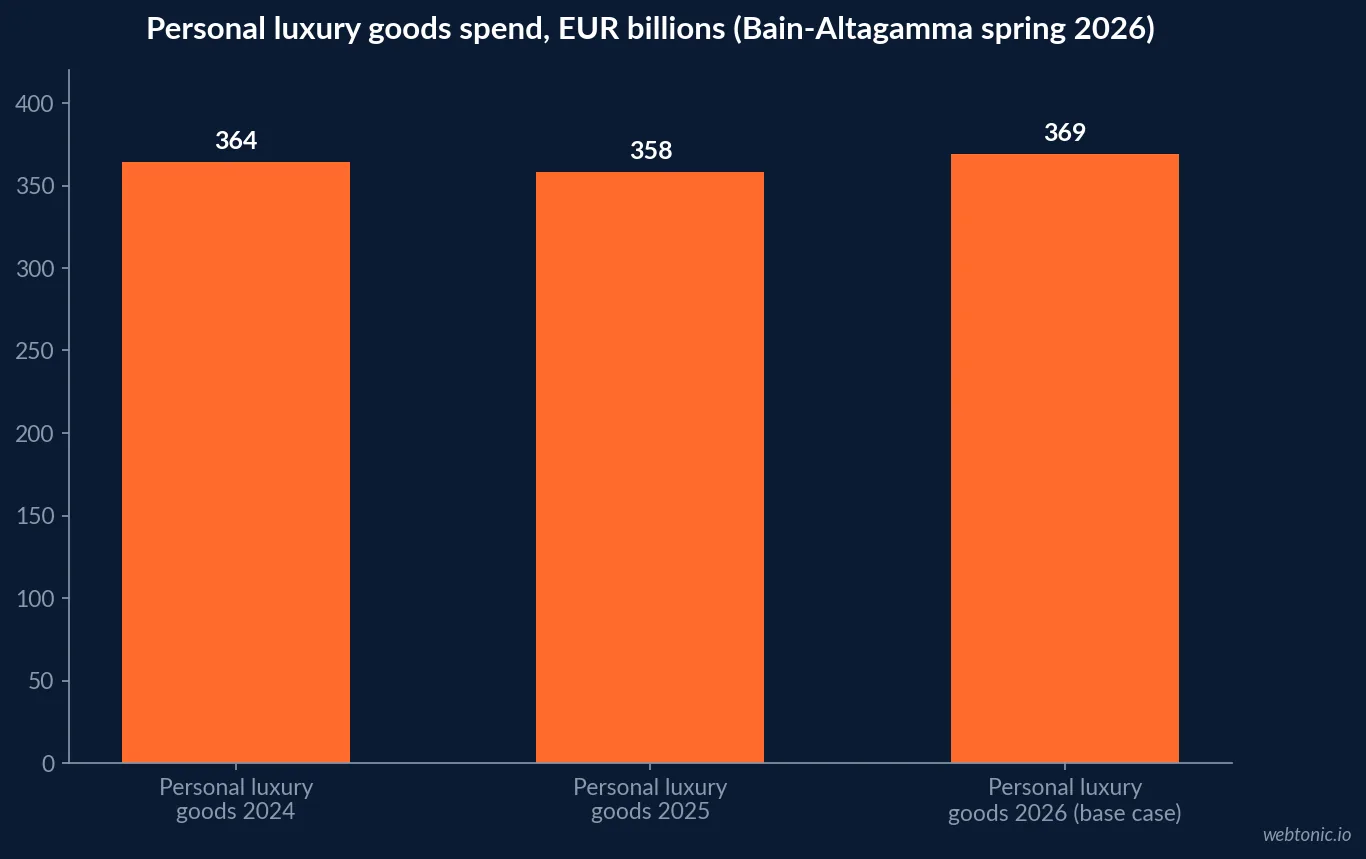
- Personal luxury goods dipped to EUR 358 billion in 2025, from EUR 364 billion.
- 2026 personal luxury goods are forecast to rebound to EUR 365-373 billion.
- Bain assigns that rebound a 70% probability.
- Online channels are forecast to reach 28-30% of personal luxury sales.
- Monobrand stores follow at 26-28%, outlets at 13-15%.
- Emerging luxury brands should budget 12-18% of revenue for digital.
- USD 10M-50M brands typically spend 8-12% of revenue.
- Mature USD 50M+ houses spend 5-8% of revenue.
- A USD 25M beauty brand's digital budget runs USD 2M-3M a year.
- Of that, email and CRM take USD 75K-125K.
- Analytics, tools and agency labour take USD 425K-675K.
- Luxury experiences are outgrowing tangible goods by 1.5x in 2026.
- Luxury share prices fell roughly 8% in January 2026.
- European tourism fell 20% year on year in February 2026.
The market a luxury data budget has to serve
The Bain-Altagamma Luxury Goods Worldwide Market Study's spring 2026 update reports worldwide luxury spending at EUR 1,443 billion in 2025, with 2026 expected to land between EUR 1,440 and 1,470 billion - growth of zero to 2% at constant rates, in Bain's base scenario. The narrower personal luxury goods category dipped to EUR 358 billion in 2025 from EUR 364 billion in 2024, but Bain forecasts a rebound to EUR 365 to 373 billion in 2026, assigning that recovery case a 70% probability on continued Middle East stabilization and gradual Chinese demand recovery.
The BCG-Altagamma 2026 outlook puts medium-term growth at 2% to 5% for FY26, accelerating to 4% to 7% by 2029 - useful context for any three-year data-infrastructure business case, since the budget line being sized here has to survive more than one fiscal year.
| Market fact (2026) | Figure | Source |
|---|---|---|
| Worldwide luxury spending, 2025 | EUR 1,443 billion | Bain-Altagamma spring 2026 update |
| Worldwide luxury spending, 2026 forecast | EUR 1,440-1,470 billion | Bain-Altagamma |
| Personal luxury goods, 2025 | EUR 358 billion | Bain-Altagamma |
| Personal luxury goods, 2026 forecast | EUR 365-373 billion | Bain-Altagamma |
| Probability of the base-case rebound | 70% | Bain & Company |
| Medium-term luxury growth, FY26 | 2-5% | BCG-Altagamma 2026 |
Where luxury sales are actually happening now
Bain & Company's luxury market study, cited in Deus Marketing's 2026 benchmark research, forecasts online channels capturing 28% to 30% of personal luxury goods sales in 2025 - overtaking monobrand stores at 26% to 28%, outlet stores at 13% to 15%, and department stores at 10% to 12%. That single shift is the reason a marketing-data line - attribution, CRM data, first-party identity - now competes for budget alongside media spend rather than sitting under a small IT line item.
| Channel | Share of personal luxury sales | Trend director should plan for |
|---|---|---|
| Online / digital | 28-30% | Largest single channel; needs the most attribution rigor |
| Monobrand stores | 26-28% | Still requires unified customer data across store and digital |
| Outlet stores | 13-15% | Lower-margin channel; data should flag cannibalization risk |
| Department stores | 10-12% | Wholesale data usually the weakest to instrument |
Budgeting the digital and data line by revenue tier
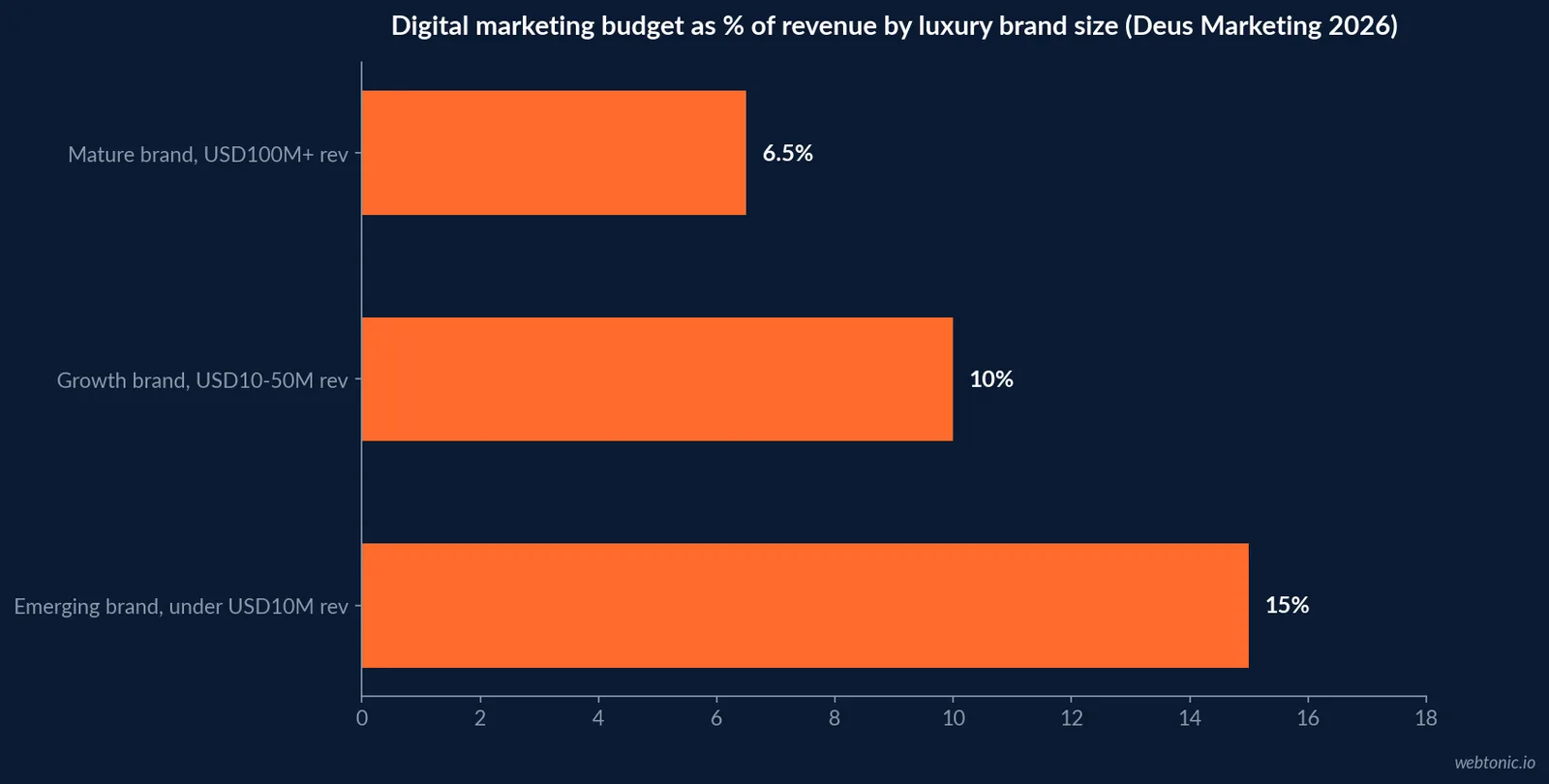
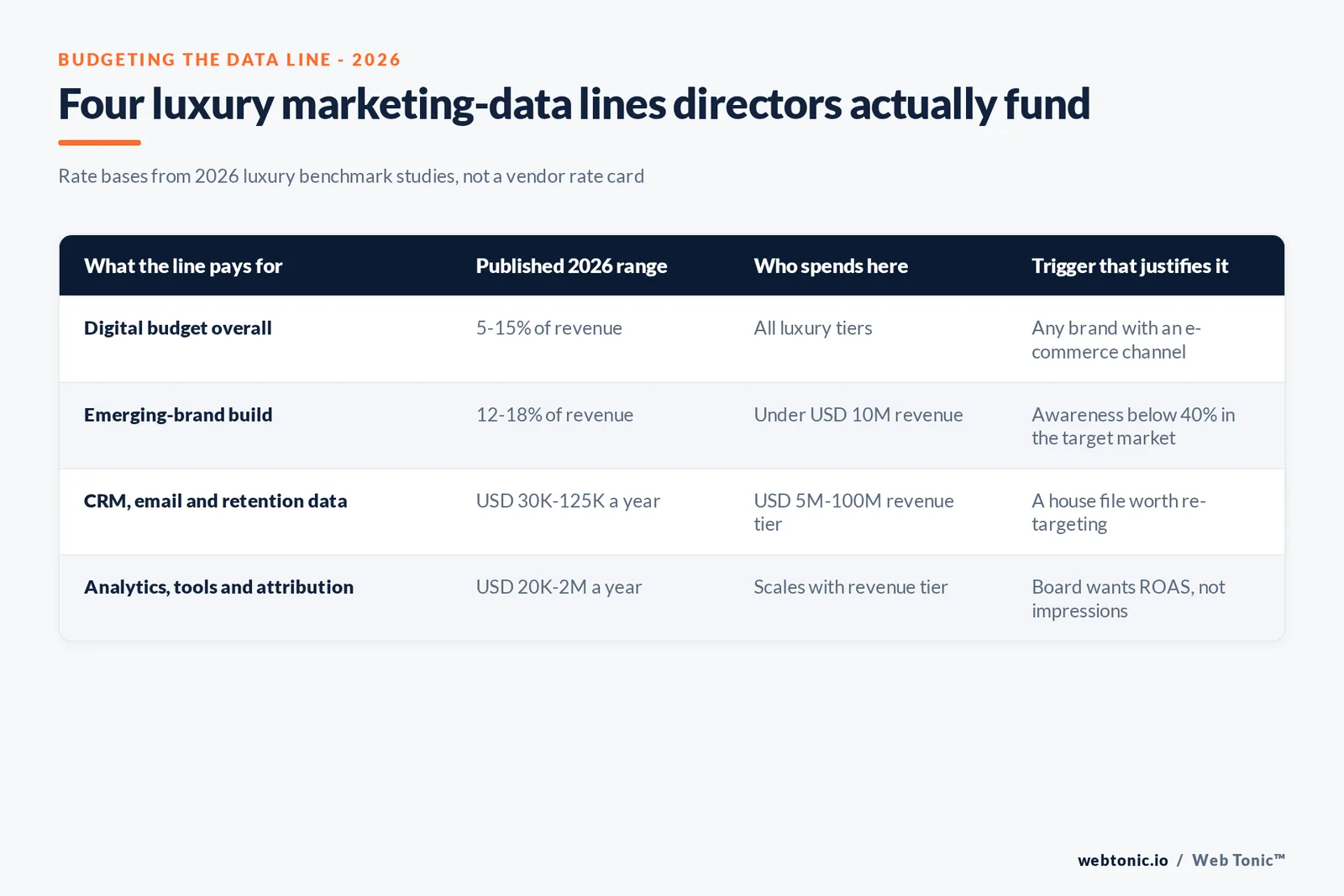
Deus Marketing's 2026 benchmark research puts a luxury brand's digital marketing budget - the umbrella covering paid media, SEO, email/CRM and analytics - at 12% to 18% of revenue for brands under USD 10 million, 8% to 12% for the USD 10-50 million tier, and 5% to 8% for houses above USD 50 million with established brand equity. A worked example: a USD 25 million beauty brand budgets roughly USD 2 million to 3 million annually for digital, of which USD 75,000 to 125,000 goes to email and CRM and USD 425,000 to 675,000 to analytics, tools and agency labour combined.
| Revenue tier | Digital budget, % of revenue | Worked example spend | Email/CRM share of it |
|---|---|---|---|
| Under USD 10M | 12-18% | USD 600K-900K on USD 5M revenue | USD 30K-50K |
| USD 10M-50M | 8-12% | USD 2M-3M on USD 25M revenue | USD 75K-125K |
| Over USD 50M | 5-8% | USD 5M-8M on USD 100M revenue | USD 300K-500K |
What the analytics and data slice specifically buys
Deus Marketing's channel-split data shows the data-and-analytics component growing as a share of the digital budget as brands mature: from a modest line inside the USD 20,000 to 50,000 range at the smallest tier, up to USD 1.2 million to 2 million for analytics, tools and technology at the largest tier once a brand has "sophisticated attribution models and can measure incremental ROI precisely," in Deus's framing - a materially different capability than counting sessions.
Our data and analytics practice builds exactly this kind of attribution layer for growth-stage brands moving from gut-feel channel splits to lifetime-value-based budgeting.
The macro backdrop shaping every budget conversation
The 2026 planning cycle is happening against real turbulence: luxury share prices fell roughly 8% in January 2026, and international tourism in Europe fell 20% year on year in February before partially recovering, per Bain-Altagamma's spring update. Consumer sentiment is also shifting inside the category itself - experiences are outgrowing tangible goods by 1.5x so far in 2026, which changes what a marketing-data stack needs to track: hospitality and event bookings behave differently from a product purchase funnel, and a data budget built only for e-commerce attribution will miss where growth is actually concentrating.
| Macro signal (2026) | Figure | Source | Effect on the data budget |
|---|---|---|---|
| Luxury share price move, January 2026 | -8% | Bain-Altagamma spring update | Boards scrutinize marketing ROI harder |
| European tourism, YoY, February 2026 | -20% | Bain-Altagamma | Travel-retail data needs its own model |
| Experiences vs. tangible goods sentiment | 1.5x | Bain-Altagamma | Booking and event data now matters as much as SKU data |
| Personal luxury rebound probability | 70% | Bain & Company | Base case for the budget, not the ceiling |
Resale is now a line item too, not a threat to ignore
The marketing-data budget increasingly has to cover a channel that didn't exist on a director's radar a decade ago. Research and Markets' 2026 luxury resale report sizes the global luxury resale market at USD 41.61 billion in 2026, forecasting USD 60.11 billion by 2030 at a 9.6% compound annual growth rate. IMARC's competing 2026 estimate puts the broader secondhand luxury goods market at USD 40.4 billion in 2025, growing at roughly 8.2% annually through 2034 - two different methodologies landing on a similar order of magnitude.
For a data budget, resale means tracking a customer relationship that a brand does not fully own: authentication data, resale-price signals and repurchase behavior after a resale transaction all need to feed back into the same CRM that runs first-hand marketing, or the brand is flying blind on a channel worth tens of billions globally.
| Resale market fact (2026) | Figure | Source |
|---|---|---|
| Global luxury resale market size, 2026 | USD 41.61 billion | Research and Markets |
| Forecast, 2030 | USD 60.11 billion | Research and Markets |
| Compound annual growth rate | 9.6% | Research and Markets |
| Secondhand luxury goods market, 2025 | USD 40.4 billion | IMARC Group |
| IMARC forecast CAGR, 2026-2034 | 8.2% | IMARC Group |
The digital benchmarks the data budget has to explain
Luxury digital economics look nothing like mainstream ecommerce, which is exactly why a generic analytics setup undersells luxury performance. Foundry CRO's 2026 DTC luxury benchmarks put luxury site conversion rate at 0.9% to 1.2% - among the lowest in ecommerce - with desktop converting at 3.5% to 4.0% against mobile's 1.8% to 2.5%, the widest device gap in ecommerce outside fashion. Oneiro Digital's 2026 sector data shows average order values ranging from GBP 120-250 for beauty and fragrance up to GBP 800-2,500 for jewellery and watches.
A data stack that reports a 1% conversion rate without also reporting the desktop/mobile split and AOV-by-category context will read as underperformance to a board that hasn't seen luxury-specific benchmarks - which is itself an argument for budgeting analysts who know the category, not just tools that log events.
| Digital benchmark (2026) | Figure | Source |
|---|---|---|
| Luxury site conversion rate | 0.9-1.2% | Foundry CRO / Smart Insights & Eightx |
| Desktop conversion rate | 3.5-4.0% | Foundry CRO |
| Mobile conversion rate | 1.8-2.5% | Foundry CRO |
| AOV, beauty & fragrance | GBP 120-250 | Oneiro Digital |
| AOV, jewellery & watches | GBP 800-2,500 | Oneiro Digital |
How to size the line without overbuilding it
Start from the revenue tier, not the headline luxury growth number - a house above USD 50 million should not be budgeting like an emerging brand, and an emerging brand cannot afford to budget like a mature house and expect awareness to appear on its own. Then split the line so email/CRM and attribution tooling both scale, since the underinvested one is usually CRM at the smallest tier and attribution sophistication at the largest.
If you need the marketing-data layer built rather than modelled, our growth marketing team can scope the channel mix against your actual revenue tier, and you can talk to us about what a luxury-grade attribution build costs before the next planning cycle locks the number in.
Frequently Asked Questions
How much should a luxury brand director budget for marketing data?
It scales inversely with brand maturity, not revenue alone. Deus Marketing's 2026 benchmark set puts digital marketing budgets - the umbrella that includes analytics, CRM data and attribution tooling - at 12% to 18% of revenue for brands under USD 10 million, 8% to 12% for the USD 10 million to USD 50 million tier, and 5% to 8% for houses above USD 50 million with established brand equity. The data and analytics slice specifically tends to run USD 20,000 to several million a year depending on that tier.
Is the luxury market still growing in 2026?
It is stabilizing rather than shrinking. The Bain-Altagamma Luxury Goods Worldwide Market Study's spring 2026 update puts total luxury spending at EUR 1,443 billion in 2025, with 2026 expected to land between EUR 1,440 and 1,470 billion - flat to 2% growth at constant rates. Personal luxury goods specifically dipped to EUR 358 billion in 2025 before an expected rebound to EUR 365-373 billion in 2026, a 2% to 4% gain that Bain assigns a 70% probability.
Where does the marketing-data budget actually go?
Deus Marketing's 2026 channel-split data shows a USD 25 million beauty brand budgeting roughly USD 75,000 to 125,000 a year for email and CRM alone, plus USD 425,000 to 675,000 for analytics, tools and agency labour combined - out of a USD 2 million to 3 million total digital budget. The larger the brand, the more of that money shifts from acquisition tracking toward lifetime-value modelling.
Which channel is now the largest for luxury sales?
Online. Bain & Company's luxury market study forecasts online channels capturing 28% to 30% of personal luxury goods sales, ahead of monobrand stores at 26% to 28%, outlet stores at 13% to 15%, and department stores at 10% to 12%. That shift is exactly why the marketing-data line - attribution, CRM, and analytics - has grown from an afterthought to a board-level budget item.
What is the biggest budgeting mistake luxury brands make?
Capping digital and data spend at the 5% to 10% benchmark meant for mature houses while the brand is still building awareness. Deus Marketing's analysis argues that emerging brands underinvesting early face higher eventual acquisition costs, and recommends 12% to 18% of revenue for the first two to three years, trimmed to 8% to 10% only once target-audience awareness passes 40%.
Sources
Bain & Company / Altagamma - Luxury Goods Worldwide Market Study, spring 2026 update
BCG-Altagamma - Luxury market outlook 2026
Deus Marketing - Luxury brand digital marketing budget benchmarks 2026
Deus Marketing - Luxury marketing benchmarks 2026
Research and Markets - Luxury Resale Market Report 2026
IMARC Group - Global Secondhand Luxury Goods Market
Foundry CRO - DTC Luxury Marketing Benchmarks 2026
Oneiro Digital - Luxury Ecommerce Benchmarks 2026 by Sector