



Table of contents
Key Takeaways
- WordPress powers 43.6% of small business websites overall, but contractors specifically use it at 57.8% — the fourth-highest adoption rate across 14 industries (Elevate Web Design, 4,407-site audit).
- Average WordPress TTFB for service businesses is 612ms — more than 3× the recommended 200ms target — while average LCP sits at 3.8 seconds versus Google's 2.5-second threshold (Grover Web Design, 32-site benchmark).
- Average WordPress site runs 34 plugins, and sites exceeding 35 plugins load 23% slower on average (Grover Web Design).
- Service business WordPress conversion rate averages 2.1%, rising to 3.4% after structured optimization — a 62% improvement without changing the CMS (Grover Web Design).
- Mobile traffic accounts for 65% of visits but converts at just 1.82% versus desktop's 3.14% — the gap has widened to 42% despite mobile-first design being a decade old (LogosWebDesigns).
- Pages with tap-to-call buttons and visible reviews convert 37% higher on locksmith websites specifically (ContentWorks, 50+ site audit).
WordPress remains the dominant CMS for locksmith businesses in 2026, powering the majority of contractor websites despite growing competition from template builders and modern platforms. However, the data reveals a significant performance gap: most locksmith WordPress sites run too many plugins, load too slowly, and fail Core Web Vitals thresholds that directly impact search rankings and conversion rates. This report compiles verified benchmarks from CMS audits, WordPress performance studies, and locksmith-specific conversion data to quantify both the opportunity and the technical debt most shops carry.
WordPress Market Share and Locksmith CMS Adoption
Table 1. CMS market share among small businesses by industry (2026)
| Industry | WordPress Share | Wix Share | Other/Custom |
|---|---|---|---|
| Dental | 63.2% | ~8% | ~28.8% |
| Legal | 59.5% | ~7% | ~33.5% |
| HVAC | 58.9% | ~9% | ~32.1% |
| Contractors (incl. Locksmith) | 57.8% | ~10% | ~32.2% |
| Electricians | 48.3% | ~12% | ~39.7% |
| Plumbers | 42.2% | ~11% | ~46.8% |
| All Small Businesses (avg) | 43.6% | 9.5% | ~46.9% |
According to Elevate Web Design's 2026 audit of 4,407 small business websites across 14 industries, WordPress powers 43.6% of all small business sites, with contractors (including locksmith businesses) using it at 57.8% — significantly above the overall average. This makes contractors the fourth-highest WordPress-adopting industry, behind dental (63.2%), legal (59.5%), and HVAC (58.9%). W3Techs reports WordPress holds 43.5% global market share across all websites — a figure that has held steady since 2024. The "custom/other/undetected" category at 37.7% includes hand-coded sites, headless builds, and lesser-known platforms, highlighting that WordPress's actual competition is often not a named platform but custom development.
WordPress Performance Benchmarks for Service Businesses
Table 2. WordPress performance metrics for service business websites (2026)
| Metric | Recommended Target | Observed Average | Gap | Source |
|---|---|---|---|---|
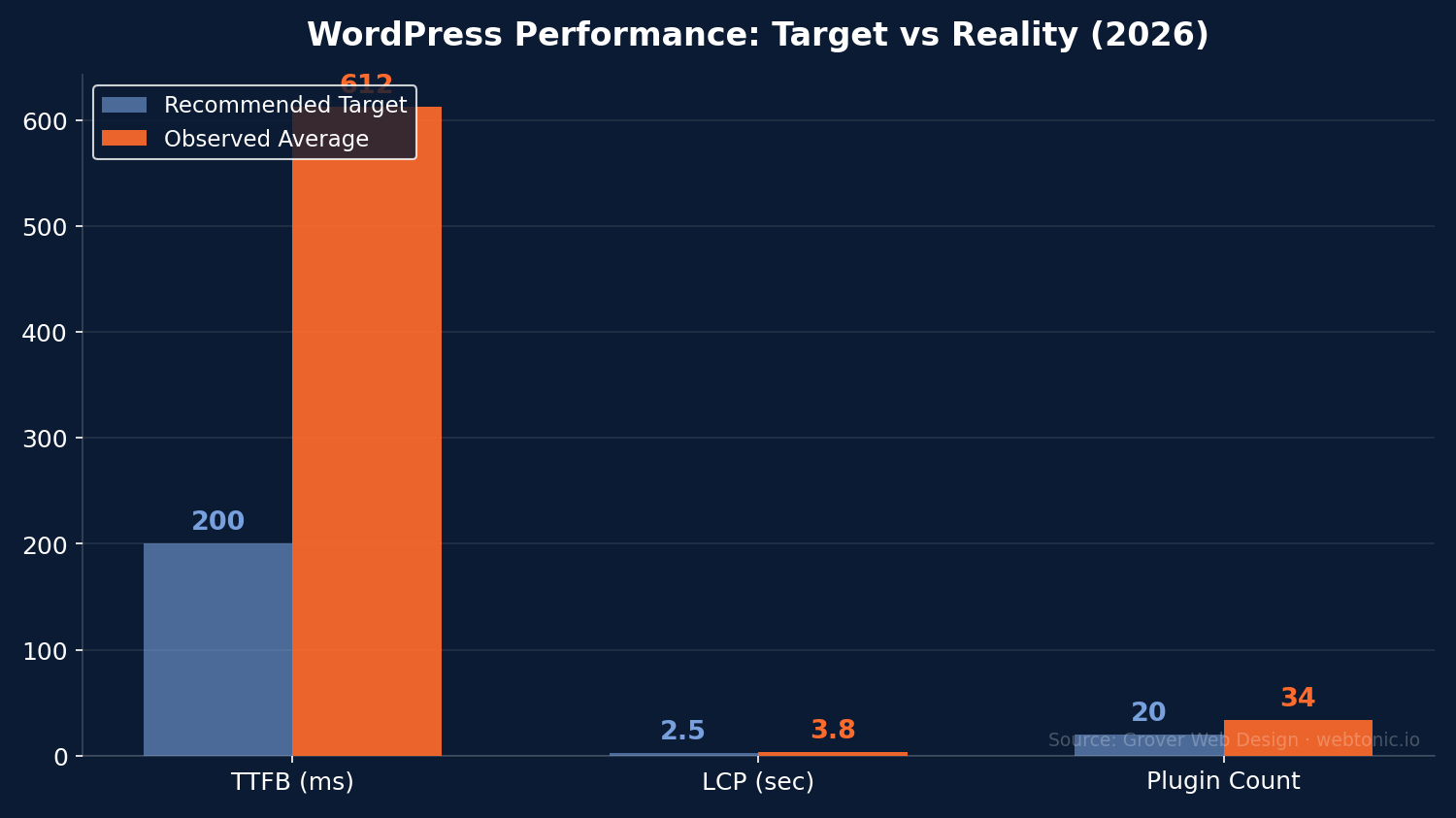
| Time to First Byte (TTFB) | <200ms | 612ms | +206% | Grover Web Design |
| Largest Contentful Paint (LCP) | <2.5s | 3.8s | +52% | Grover Web Design |
| Plugin Count (average) | <20 | 34 | +70% | Grover Web Design |
| PHP 8.2+ Compliance | 100% | 63% | -37% | Grover Web Design |
| Object Caching Enabled | 100% | 28% | -72% | Grover Web Design |
| Staging Environment Present | 100% | 46% | -54% | Grover Web Design |
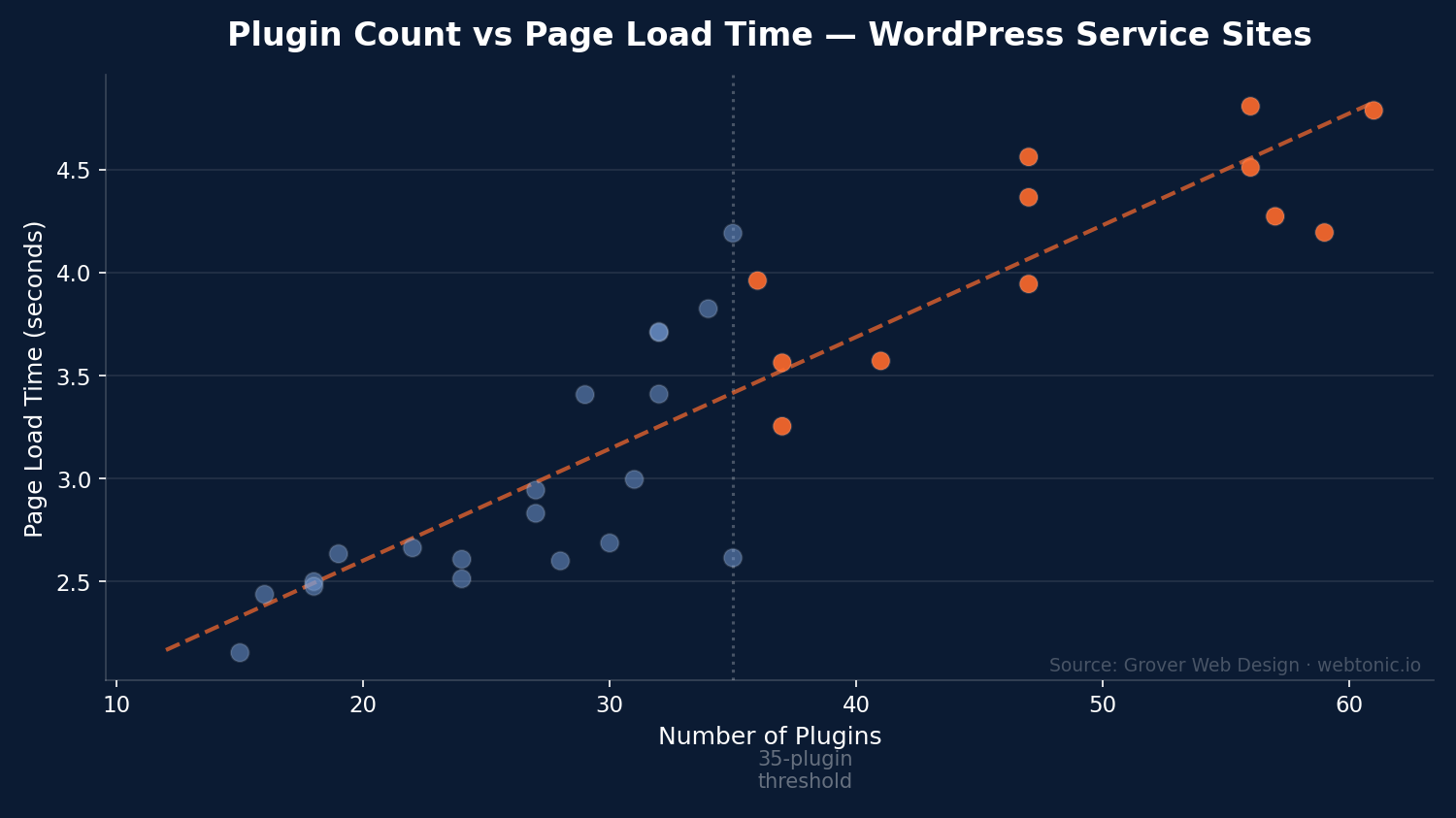
Grover Web Design's 2026 WordPress Performance Benchmark Report analyzed 32 WordPress sites operated by US-based service businesses (5–50 employees, 3,000–52,000 monthly sessions). The findings reveal widespread underperformance: average TTFB sits at 612ms — more than three times the recommended 200ms target — while LCP averages 3.8 seconds, well above Google's 2.5-second "good" threshold. Only 63% of sites run PHP 8.2+, only 28% have object caching enabled, and the average site runs 34 plugins with a range from 12 to 61. Sites exceeding 35 plugins loaded 23% slower on average, establishing a clear correlation between plugin bloat and performance degradation.
WordPress Conversion Rate Data for Locksmith Websites
Conversion rate is where WordPress performance directly translates to revenue. Grover Web Design found that service business WordPress sites average a 2.1% conversion rate on inquiry forms, rising to 3.4% after structured optimization — a 62% improvement achieved through speed optimization, form simplification, and trust signal placement rather than rebuilding on a different CMS. This aligns with LogosWebDesigns' 2026 conversion benchmarks, which set the median website conversion rate at 2.35% across all industries, with service businesses targeting 3–5% on contact form submissions and top-10% sites converting at 11.45%.
Table 3. Website conversion rate benchmarks relevant to locksmith businesses (2026)
| Benchmark | Conversion Rate | Source |
|---|---|---|
| All-industry median | 2.35% | LogosWebDesigns |
| Top 10% of sites | 11.45% | LogosWebDesigns |
| WordPress service businesses (unoptimized) | 2.1% | Grover Web Design |
| WordPress service businesses (optimized) | 3.4% | Grover Web Design |
| Desktop conversion rate | 3.14% | LogosWebDesigns |
| Mobile conversion rate | 1.82% | LogosWebDesigns |
| Locksmith sites with tap-to-call + reviews | +37% vs without | ContentWorks |
| Landing pages (focused single-purpose) | 5–10% | LogosWebDesigns |
For locksmith businesses specifically, ContentWorks' audit of 50+ locksmith sites found that pages with a tap-to-call button in the header and visible reviews convert 37% higher than those without these elements. This matters because locksmith searches are overwhelmingly emergency-driven — 70% of locksmith calls come from people locked out right now (Lead4Pro) — and mobile traffic accounts for 65% of visits at just 1.82% conversion rate versus desktop's 3.14%. The mobile-desktop gap has widened to 42% (up from 38% in 2024), making mobile optimization a critical WordPress configuration priority. A well-structured paid search strategy sends high-intent traffic to these pages, so every percentage point of conversion rate improvement has direct revenue impact.
WordPress Plugin and Security Considerations
Plugin management is one of the most impactful WordPress optimization levers for locksmith websites. Grover Web Design's benchmark data shows the average service business WordPress site runs 34 plugins, with a range from 12 to 61. After audit, the average reduction was 41% of installed plugins — meaning more than a third of plugins on a typical site are unnecessary, conflicting, or replaceable. The essential plugin stack for a locksmith WordPress site typically includes: SEO (Rank Math or Yoast), caching (WP Rocket or LiteSpeed Cache), forms (Gravity Forms or WPForms), schema markup, image optimization, and security. Everything beyond this core set should be justified against the 23% speed penalty that excess plugins impose.
Security is a parallel concern: WordPress sites are the most targeted CMS due to market share, and outdated plugins are the primary attack vector. For locksmith businesses that handle customer addresses, access codes, and payment information, maintaining data security standards is both a business and legal requirement. The Grover benchmark found only 63% of service business sites run current PHP versions, leaving 37% on outdated versions with known vulnerabilities.
WordPress vs Alternative Platforms for Locksmith Businesses
Table 4. CMS platform comparison for locksmith websites (2026)
| Platform | Market Share (SMB) | SEO Flexibility | Avg Monthly Cost | Speed (Typical) | Best For |
|---|---|---|---|---|---|
| WordPress | 43.6% | Full control | $30–$150 (hosting + plugins) | Variable (config-dependent) | SEO-driven lead generation |
| Wix | 9.5% | Limited | $17–$35 | Moderate | Simple brochure sites |
| Squarespace | 4.1% | Moderate | $16–$49 | Moderate-Good | Design-focused portfolios |
| Shopify | 4.0% | Limited for services | $39–$105 | Good | Product-based businesses |
| Webflow | 1.1% | Strong | $18–$49 | Fast | Custom design with CDN |
WordPress maintains its dominance among contractor websites because of unmatched SEO flexibility. According to the Elevate Web Design audit, no template builder exceeds 10% market share among small businesses, and the "custom/undetected" category at 37.7% includes hand-coded sites and headless builds that require developer resources most locksmith shops lack. For a locksmith business focused on Google Ads and organic search as primary lead channels, WordPress provides full control over schema markup, page speed optimization, URL structure, and content publishing cadence — all critical for local SEO performance. The tradeoff is maintenance overhead: WordPress requires active plugin management, security updates, and performance monitoring that template builders handle automatically. Distill Works' analysis of Nashville locksmith websites confirms that well-optimized WordPress sites dominate local search results, but the operative word is "well-optimized" — the performance gaps documented above show that most are not.
WordPress Optimization Checklist for Locksmith Sites
- Audit and reduce plugins to under 25 — remove duplicates, replace multi-plugin solutions with unified alternatives, and deactivate anything not actively used (target: 41% reduction per Grover benchmark)
- Upgrade to PHP 8.2+ and enable object caching — only 28% of service sites use object caching, which significantly reduces TTFB
- Target TTFB under 200ms and LCP under 2.5 seconds — the current service business average (612ms TTFB, 3.8s LCP) fails Core Web Vitals thresholds
- Add tap-to-call button in the header on mobile — locksmith sites with this element plus visible reviews convert 37% higher (ContentWorks)
- Optimize for mobile conversion specifically — 65% of traffic is mobile but converts at 1.82% versus 3.14% on desktop; fixing this gap is the single highest-ROI change
- Implement local schema markup — NAP consistency, service area, and structured data for locksmith service types
- Set up a staging environment — only 46% of service sites have one, leading to live-site testing that risks downtime during emergency-driven traffic peaks
- Install security hardening — automatic updates, two-factor authentication, and regular backups (Wordfence or Sucuri)
Related reading
- Webflow for Locksmith Websites: 2026 Statistics, Costs & Speed Data
- The Complete Allergy & Immunology WordPress Statistics Report (2026)
- 39+ Automotive WordPress Statistics Every Marketer Should Know
- Custom Web Development services at Web Tonic
FAQ
Is WordPress still the best platform for locksmith websites?
WordPress remains the most widely used CMS for contractor businesses at 57.8% market share, offering the deepest plugin ecosystem, strongest SEO flexibility, and largest developer community. However, the data shows most locksmith WordPress sites underperform on speed (612ms TTFB vs 200ms target) and need structured optimization to reach their potential. The CMS itself is not the bottleneck — configuration and maintenance are.
How fast should a locksmith WordPress site load?
Google recommends TTFB under 200ms and LCP under 2.5 seconds for "good" Core Web Vitals scores. The average service business WordPress site misses both targets significantly (612ms TTFB, 3.8s LCP). For locksmith businesses specifically, where 70% of calls are emergency-driven from mobile devices, meeting these thresholds directly impacts whether a prospect calls you or hits the back button.
How many plugins should a locksmith WordPress site have?
The Grover Web Design benchmark found that sites with more than 35 plugins load 23% slower. After professional audits, the average plugin reduction was 41%. A well-configured locksmith site should run 15–25 plugins maximum, covering SEO, caching, forms, schema, image optimization, and security without redundancy.
What conversion rate should a locksmith website target?
Service businesses should target 3–5% on contact form submissions, with the all-industry median sitting at 2.35%. WordPress service sites average 2.1% unoptimized, rising to 3.4% after structured optimization. For locksmith-specific sites, adding tap-to-call buttons and visible reviews improves conversion by 37% over sites without those elements. Landing pages focused on a single service can reach 5–10%.
Should locksmiths migrate away from WordPress?
For most locksmith businesses, migration is unnecessary and potentially disruptive. The performance gaps identified in benchmark data are all configuration issues — plugin bloat, outdated PHP, missing caching — not platform limitations. A properly optimized WordPress site outperforms the vast majority of template-builder alternatives on speed, SEO flexibility, and conversion rate. Migration only makes sense if the existing site is so technically indebted that optimization costs exceed rebuilding.
Sources
Elevate Web Design — Small Business CMS Statistics 2026 (4,407-Site Audit)
W3Techs — WordPress Usage Statistics (July 2026)
Grover Web Design — 2026 WordPress Performance Benchmark Report
LogosWebDesigns — Website Conversion Rate Benchmarks for Small Business (2026)
ContentWorks — Locksmith Website Trust and Conversion
Lead4Pro — Home Services Marketing
TheKeyBot — AI Receptionist for Locksmiths
Distill Works — How Locksmith Websites Convert Emergency Searches
Home Service Base — Locksmith Industry Data


