



Table of contents

Key Takeaways
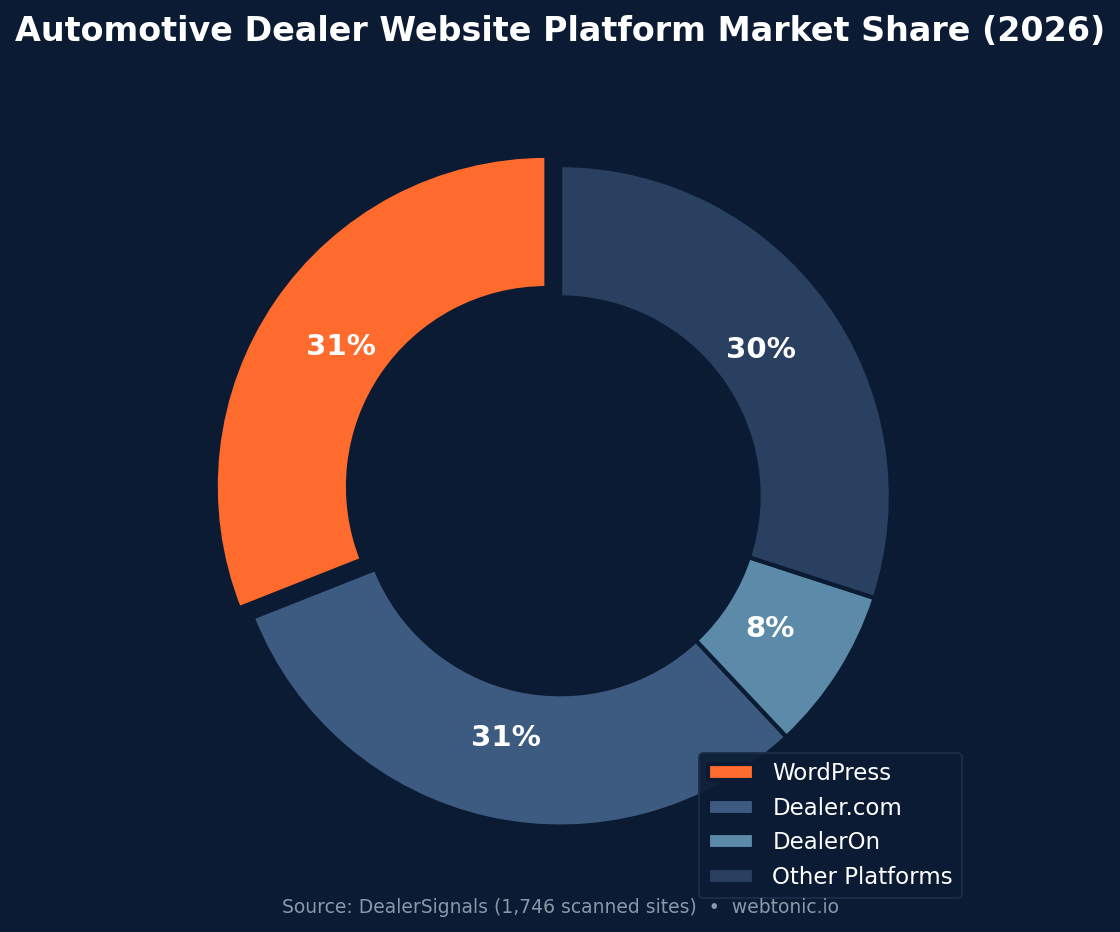
- WordPress and Dealer.com are tied at 31% market share each across 1,746 scanned dealer websites, with WordPress dominating the independent dealer segment and Dealer.com leading franchises (DealerSignals).
- Only 0.4% of the top 50 auto groups' retail websites pass Google Core Web Vitals on both mobile and desktop, with 99.6% failing on at least one platform and 95.5% failing on both (Overfuel).
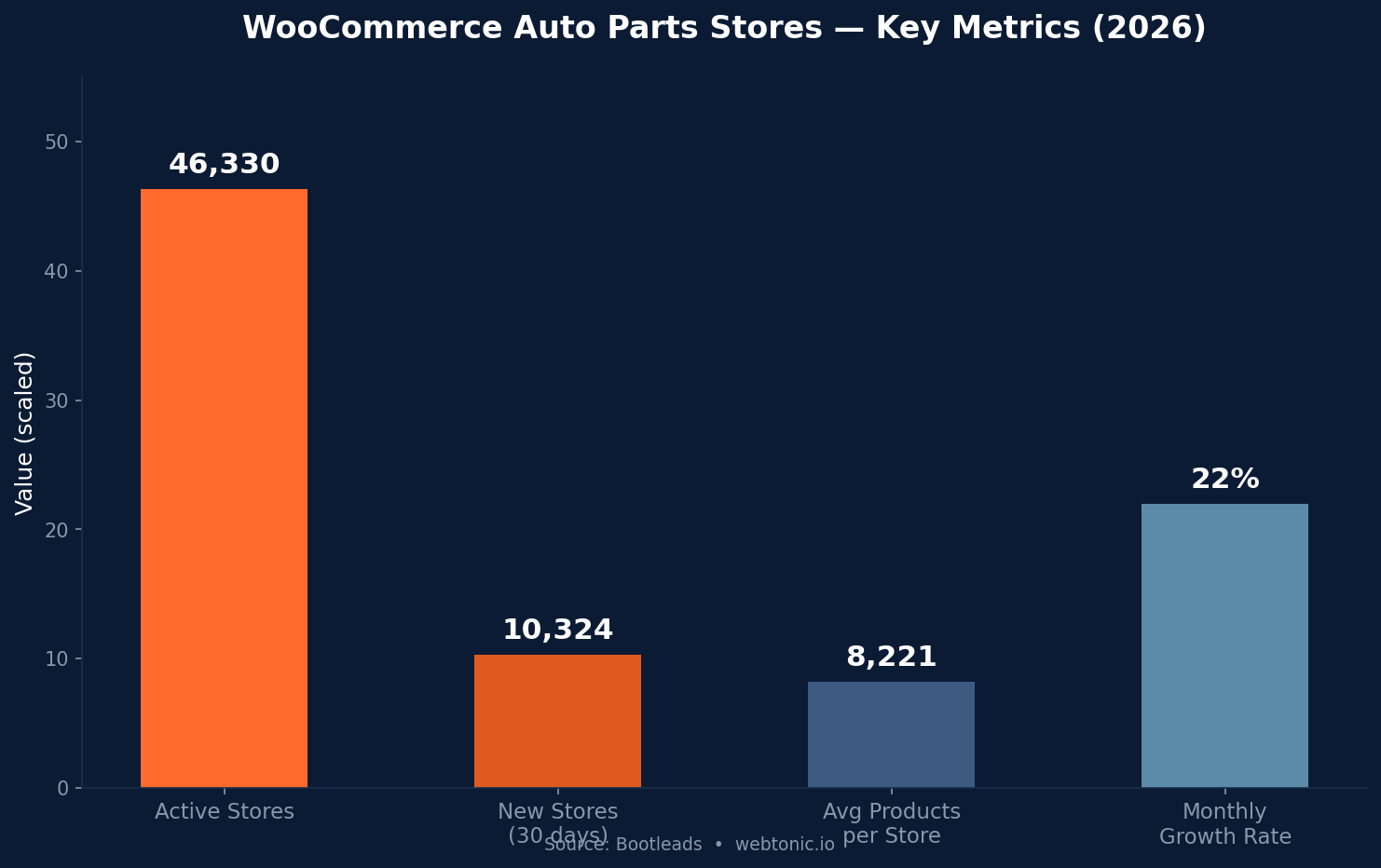
- 46,330 active WooCommerce auto parts stores are now tracked globally, with 10,324 new stores added in the last 30 days—a 22% monthly growth rate making it one of the fastest-growing ecommerce segments (Bootleads).
- The automotive industry records 31% WordPress adoption for product showcases and dealer websites, while WooCommerce leads with 48% plugin adoption among automotive and motorsports WordPress sites (XtendedView; WatsonWP).
- Dealership website conversion rates range from 2–10%, with the industry average at just 1.5–2.0%, meaning 95%+ of traffic goes unmonetized and every contact form fill represents significant revenue potential (Demand Local).
| Metric | Value | Source |
|---|---|---|
| WordPress Dealer Market Share | 31% (tied with Dealer.com) | DealerSignals, 1,746 sites |
| Core Web Vitals Pass Rate | 0.4% (7 of 1,910 sites) | Overfuel, Top 50 auto groups |
| WooCommerce Auto Parts Stores | 46,330 active | Bootleads |
| Avg. Conversion Rate | 1.5–2.0% | Demand Local |
| Automotive WordPress Adoption | 31% of industry | XtendedView |
| Monthly New WooCommerce Stores | 10,324 (+22%) | Bootleads |
WordPress Market Share Among Car Dealer Websites
WordPress has built a significant presence in the automotive web market. DealerSignals scanned 1,746 dealer websites and found that WordPress and Dealer.com are tied at 31% market share each. The platform distribution depends heavily on whether you are looking at franchise or independent dealers.
Dealer.com—a Cox Automotive product—is the dominant website framework in the franchise segment, built specifically for new-car dealerships selling brands like Toyota, Ford, Honda, Nissan, Hyundai, and Volkswagen. WordPress, by contrast, leads among independent dealers who value flexibility, lower long-term costs, and the ability to customize without vendor lock-in. Independent dealers selling used cars, trucks, and heavy duty vehicles often choose WordPress because it supports third party plugin ecosystems for inventory management, contact form integration, and SEO.
XtendedView's 2026 WordPress statistics report confirms broader adoption trends: the automotive industry records 31% WordPress usage for product showcases and dealer websites, comparable to the technology sector at 32%. This market share reflects WordPress's flexibility as a content management framework that can power everything from simple brochure sites to complex vehicle inventory platforms with custom search, filtering, and comparison tools.
Core Web Vitals: 99.6% of Auto Dealer Websites Fail
Website performance remains a critical weakness across the auto sector. Overfuel's 2025 analysis of 1,910 retail websites tied to North America's top 50 auto groups found that only 0.4% (7 sites) pass Google Core Web Vitals on both mobile and desktop. The failure rate of 99.6% has persisted for two consecutive years.
Google Core Web Vitals measure three things every car shopper experiences immediately: load speed (LCP), interactivity (INP), and visual stability (CLS). Websites that fail these standards frustrate mobile users—who represent 68.5% of all automotive web traffic—and risk losing visibility across Google's organic ecosystem, including Search, Maps, Business Profiles, and AI-generated results.
The financial impact is substantial. Shift Digital's 2025 data revealed that failing Core Web Vitals wastes roughly $30 of every $100 in ad spend. WP-powered dealer sites face particular challenges with core web vitals when overloaded with unoptimized plugins, large hero images, and heavy duty JavaScript frameworks. However, the platform also offers the most robust optimization ecosystem: performance tools like WP Rocket, LiteSpeed Cache, and Perfmatters are widely adopted by automotive sites to improve load times for image-heavy vehicle listings.
WooCommerce Auto Parts: 46,330 Stores and Growing
The auto parts ecommerce segment on WordPress is experiencing explosive growth. Bootleads tracks 46,330 active WooCommerce auto parts stores globally, with 10,324 new stores added in just the last 30 days—a 22% monthly growth rate that makes it one of the fastest-growing categories on the WooCommerce framework.
The data reveals a mature market with significant catalog depth: the average WooCommerce auto parts store carries 8,221 products (compared to the WooCommerce average of 1,603), and average product pricing sits at $2,214 (versus the platform average of $422). This reflects the high-value nature of automotive parts, from OEM components for Honda and Toyota vehicles to aftermarket performance parts for trucks, SUVs, and cars.
Marketing adoption among WooCommerce auto parts stores remains moderate: 33% maintain social media profiles and only 1% run Meta ads, which is 6 percentage points below the WooCommerce average of 39%. This gap represents a significant growth opportunity for auto parts retailers willing to invest in digital marketing to fill their sales pipeline with high intent car and truck part buyers.
The strongest WooCommerce auto parts market concentrations are in Germany, the United Kingdom, and Vietnam, reflecting both established automotive aftermarket industries and emerging vehicle service economies. For retailers evaluating WordPress as their ecommerce framework, the data confirms that WooCommerce is the dominant solution for automotive parts, with long term scalability built into its plugin architecture.
Automotive WordPress Plugin Ecosystem
WatsonWP's 2026 automotive plugin data analyzes 225 WordPress sites covering car culture, repairs, motorsports, and enthusiast communities. Key findings from the plugin adoption data include:
- WooCommerce leads at 48.0% adoption among automotive WordPress sites, confirming the platform's role as the default ecommerce framework for the vehicle parts and accessories market.
- Performance plugins are heavily adopted: WP Rocket, LiteSpeed Cache, and Perfmatters are widely used to optimize load times for image-heavy automotive content featuring car and truck photos, vehicle comparison galleries, and parts catalogs.
- Security plugins fill critical gaps: Wordfence, Akismet, and Redirection round out the stack, protecting dealer and parts sites from spam, brute force attacks, and broken link issues that damage SEO.
- Visual builders dominate layout: Elementor is the primary page builder, enabling car dealerships and auto parts retailers to create visually rich product showcases without custom development. WPBakery ranks as the #11 plugin in the automotive niche.
Dedicated automotive WordPress plugins are also emerging. Dealer.ms offers a comprehensive dealership management system built specifically for WordPress, supporting inventory management for cars, trucks, boats, and heavy duty equipment with structured data for Google visibility and mobile-optimized templates.
Dealer Website Conversion Benchmarks
Regardless of framework, automotive website conversion rates tell a story of untapped potential. Demand Local's 39-statistic benchmark study reveals that most dealerships convert only 3–5% of website visitors, with the industry average sitting at just 1.5–2.0%. This means 95%+ of web traffic leaves without a contact form fill, phone call, or chat engagement.
The conversion rate varies significantly by traffic source and vehicle type:
| Traffic Source | Conversion Rate | Context |
|---|---|---|
| Paid Search (PPC) | 5.72% | High intent buyers from Google Ads |
| Organic Search | 1.57% | Earlier in the car buyer journey |
| Industry Standard | 1.5% | Baseline for all dealer websites |
| Top Performers | 6–10% | 2–3× average via CRO optimization |
| Desktop Visitors | 3.8% | Higher than mobile despite lower traffic |
| Mobile Visitors | 1.9% | 68.5% of traffic but half the rate |
The mobile conversion gap is the single largest growth opportunity in the market. With 68.5% of automotive web traffic coming from mobile devices but only 1.9% converting (compared to 3.8% on desktop), every percentage point improvement in mobile conversion represents millions in incremental vehicle sales across the industry. WordPress-built sites that prioritize mobile-first design and data intelligence, fast load times, and streamlined contact form experiences will capture a disproportionate share of this opportunity.
WordPress vs. Other Dealer Website Platforms
| Platform | Market Share | Best For | Key Limitation |
|---|---|---|---|
| WordPress | 31% | Independent dealers, car comparison sites, auto parts stores | Core Web Vitals require optimization work |
| Dealer.com | 31% | Franchise dealers (Ford, Toyota, Honda OEM programs) | Vendor lock-in, limited customization |
| DealerOn | ~8% | Mid-size dealer groups | Smaller third party integration ecosystem |
| Custom/Other | ~30% | Large groups with development resources | Maintenance costs, slower iteration |
Best Practices for Automotive WordPress Websites
- Prioritize Core Web Vitals. With 99.6% of dealer sites failing, passing Google's performance standards is a competitive advantage that can lift organic traffic by up to 20% and reduce wasted ad spend by 30%. Use WP Rocket or LiteSpeed Cache as your base performance framework.
- Optimize every contact form for mobile. The mobile conversion rate of 1.9% versus 3.8% on desktop signals that most contact forms and lead capture tools are not built for thumb-friendly interaction. Simplify form fields and add click-to-call CTAs.
- Invest in structured data for vehicle listings. Google rewards sites with proper schema markup for cars, trucks, and vehicle parts with enhanced search results. WordPress plugins like Dealer.ms offer built-in structured data for automotive inventory.
- Build car comparison functionality. High intent buyers searching for vehicle comparisons spend more time on site and fill contact forms at higher rates. dedicated car comparison plugins can turn a basic dealer site into a research destination.
- Monitor Core Web Vitals monthly. Performance degrades as plugins update and inventory content grows. Set up Google Search Console alerts and track LCP, INP, and CLS scores to catch regressions before they impact organic rankings.
- Leverage WooCommerce for parts and accessories. With 46,330 active auto parts stores and a 22% monthly growth rate, the data confirms WooCommerce as the leading framework for automotive ecommerce on WordPress.
Related reading
- Locksmith WordPress Stats & Data
- 25+ Manufacturing WordPress Statistics Every Marketer Should Know
- Mortgage WordPress Statistics
- Custom Web Development services at Web Tonic
Frequently Asked Questions
How many car dealerships use WordPress?
WordPress holds a 31% market share among scanned dealer websites, tied with Dealer.com. WordPress is particularly dominant among independent dealers selling used cars and trucks, while Dealer.com leads in the franchise segment for brands like Ford, Toyota, Honda, Nissan, Hyundai, and Volkswagen. The auto sector as a whole records 31% WordPress adoption for web presence.
Do automotive websites pass Google Core Web Vitals?
Almost none. Only 0.4% of the top 50 auto groups' websites pass Core Web Vitals on both mobile and desktop, with a 99.6% failure rate. This means that nearly every major dealer group website delivers a suboptimal experience by Google's standards, impacting both organic search visibility and paid advertising efficiency.
How many WooCommerce auto parts stores exist?
46,330 active WooCommerce stores sell auto parts globally, with 10,324 new stores added in the past 30 days. The segment is growing at a 22% monthly rate, making it one of the fastest-growing ecommerce categories. The average store carries 8,221 products with an average price of $2,214.
What is a good conversion rate for a car dealer website?
The industry average is 1.5–2.0%, while top-performing dealer websites achieve 6–10%. Paid search traffic converts at 5.72% versus 1.57% for organic. The biggest growth opportunity is mobile: 68.5% of traffic comes from mobile devices but converts at only 1.9%, half the desktop rate of 3.8%.
Is WordPress good for automotive websites?
WordPress is well-suited for independent dealerships, car comparison sites, auto parts ecommerce, and automotive content platforms. Its plugin ecosystem—led by WooCommerce at 48% adoption in the automotive niche—provides flexibility that proprietary platforms lack. The main challenge is performance: WordPress sites require active optimization with tools like WP Rocket and LiteSpeed Cache to pass Core Web Vitals and compete for high intent organic traffic. Resources on growth marketing and Google Ads strategy can help dealers maximize their WordPress investment.
Sources
dealersignals.com – Car Dealer Website Platform Market Share
overfuel.com – Auto Groups Core Web Vitals Analysis 2025
bootleads.com – WooCommerce Auto Parts Store Data 2026
xtendedview.com – WordPress Statistics 2026
watsonwp.com – Automotive WordPress Plugin Statistics
demandlocal.com – Dealership Website Conversion Rate Benchmarks
authorityspecialist.com – Automotive SEO Benchmarks 2026
cloudways.com – WooCommerce Statistics 2026


