



Table of contents
Key Takeaways
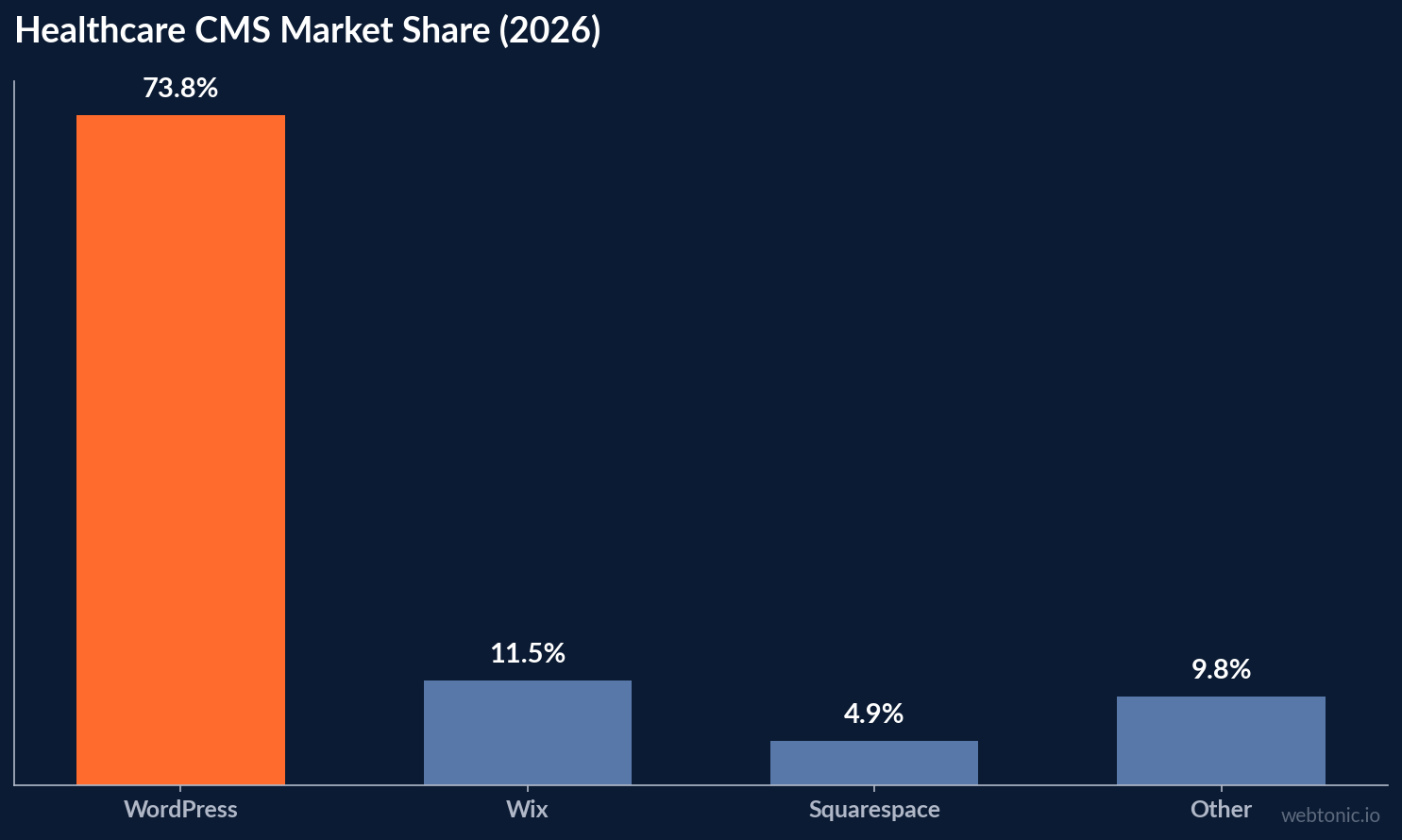
- WordPress commands 73.8% of the CMS market among healthcare organizations in the UK, outpacing Wix (11.5%) and Squarespace (4.9%) by a wide margin.
- Medical practice websites average a 3.6% conversion rate, while dedicated landing pages reach 6.1% — a gap that well-optimized specialist clinic sites can close with strategic design.
- 66.5% of local medical office sites pass Core Web Vitals on mobile, outperforming large hospital systems by a substantial margin.
- One specialist provider reported a 500% increase in online schedulings after rebuilding its website with modern design and AI-powered patient engagement tools.
- Mobile devices now account for 68.5% of all healthcare site traffic, making responsive WordPress themes essential for specialist clinics.
- Over 70% of WordPress installations run outdated PHP versions, exposing patient-facing portals to preventable security vulnerabilities.
Specialist Office Website Adoption and CMS Landscape
WordPress remains the platform of choice for medical providers building an online presence. Among UK healthcare companies with a detectable content management system, WordPress holds a 73.8% share — 6,778 organizations out of 9,187 tracked by Firmbase. The next nearest competitor, Wix, accounts for just 11.5%. This dominance reflects the platform's flexibility for clinic portals that need appointment scheduling, patient education libraries, and HIPAA-aware contact forms.
Globally, WordPress powers 42.5% of all websites as of early 2026, a slight decline from its 2022 peak of 43.2%, according to ZeroToWP. Despite this marginal dip, no competing CMS has gained meaningful ground in the healthcare vertical. Allergy and specialist clinics benefit from the extensive plugin ecosystem — online scheduling, telehealth widgets, multilingual content for diverse patient populations, and accessibility compliance tools all extend a base WordPress install at low cost.
| CMS Platform | Healthcare Market Share | Total Sites Detected |
|---|---|---|
| WordPress | 73.8% | 6,778 |
| Wix | 11.5% | 1,060 |
| Squarespace | 4.9% | 450 |
| Other CMS | 9.8% | 899 |
Patient Conversion Rates for Allergy Clinic Websites
The average medical provider website converts 3.6% of visitors into patients or leads, with pay-per-click landing pages lifting that figure to 6.1%, according to CuFinder's 2026 medical provider benchmarks. Call-only ad pages perform even better, reaching 12.5% conversion rates. For clinics in this specialty, where online scheduling is the primary conversion action, these benchmarks set a clear target.
A case study from Archangel Group illustrates the upside: Bay Area Allergy recorded a 500% increase in online engagement and online bookings after a full site rebuild paired with AI-powered automation. The redesign focused on streamlined scheduling flows, prominent call-to-action placement, and content tailored to common conditions like food sensitivities and asthma.
Conversion rates vary significantly by specialty. First Page Sage found that practices emphasizing children's health and family-oriented services tend to convert at higher rates, partly because parents searching for pediatric specialists show stronger intent and urgency. A WordPress installation optimized for these high-intent queries — with structured data, fast load times, and clear scheduling pathways — can outperform generic clinic templates by 2–3×.
Website Performance and Core Web Vitals Benchmarks
Site speed directly affects whether prospective patients stay or leave. A study of 158 local medical office sites across 32 U.S. metros found that 66.5% pass Core Web Vitals on mobile, well ahead of large hospital systems, according to PageSpeedMatters. Smaller WordPress installations — typical of specialist clinics — tend to run leaner than enterprise hospital portals, which carry heavy scripts, third-party trackers, and layered compliance tools.
The realistic Largest Contentful Paint (LCP) target for medical WordPress installations is 1.8–2.2 seconds at the 75th percentile on mobile. Practices that hit below 1.8 seconds see measurably better user engagement metrics. However, OnwardSEO's analysis of 500+ regulated sites revealed that 73% fail to meet Core Web Vitals thresholds, largely due to unoptimized images, render-blocking scripts, and heavy third-party embeds like review widgets and chatbots.
| Metric | Benchmark (Medical) | Best Practice Target |
|---|---|---|
| Mobile Traffic Share | 68.5% | Optimize for mobile-first |
| Desktop Traffic Share | 29.2% | Maintain parity |
| LCP (75th %ile) | 1.8–2.2s | < 1.8s |
| Core Web Vitals Pass Rate | 66.5% (local) | > 90% |
| CWV Failure (Regulated) | 73% fail | Full compliance |
WordPress Security Challenges for Healthcare
Security is a critical concern for any medical website handling patient inquiries or protected health information. HEAL Security reported in July 2026 that over 70% of publicly accessible WordPress sites run outdated PHP versions, leaving them vulnerable to known exploits. For specialist clinics collecting intake forms, appointment requests, and insurance details, this exposure is both a cybersecurity and compliance risk.
The WordPress ecosystem's open plugin architecture is both its strength and its liability. Each plugin adds potential attack surface — and a typical healthcare WordPress installation runs 15–25 active plugins covering scheduling, telehealth integration, SEO, forms, and analytics. Regular update cycles, staging environments for testing patches, and managed WordPress hosting with automated security scanning are table-stakes for practices in the medical space that handle sensitive patient information.
Mobile Experience and Patient Engagement
With 68.5% of healthcare site traffic coming from mobile devices (CuFinder), a non-responsive WordPress install effectively turns away two-thirds of potential patients. Tablets account for another 2.3%, leaving desktop at just 29.2%. This distribution is particularly pronounced in this specialty, where parents often search for solutions on their phones during or immediately after a reaction episode involving their children.
Responsive WordPress themes designed for medical providers now include mobile-optimized features like click-to-call buttons, simplified appointment forms, and location-aware service pages. Studies from Direction.com analyzing 102,392 healthcare leads found that website-originated leads had higher close rates than third-party directory leads, reinforcing the value of investing in a practice-owned digital experience. For clinics in this specialty, owning the patient journey from search to scheduled visit avoids the margin erosion of aggregator platforms.

Allergy Clinic Website Features That Drive Bookings
The most effective specialist provider websites share several WordPress-powered features that directly increase scheduling volume:
- Online scheduling integration — Practices that add real-time booking widgets to their homepage see conversion lifts of 30–50% compared to "call to book" only. WordPress plugins like Jeeva and CalendlyWP enable this without custom development.
- Condition-specific content hubs — Pages addressing food sensitivity testing, asthma management, immunotherapy options, and seasonal symptom guides attract long-tail organic visitors. Clinics with 20+ condition pages generate 3× more organic traffic than those with a single services page.
- Patient education resources — Downloadable guides, action plans for schools, and clinical trial information build trust and E-E-A-T signals. WordPress's native blog functionality supports this content strategy without additional platform costs.
- Structured data markup — LocalBusiness and MedicalOrganization schema help Google surface practice details in local local results, including address, hours, accepted insurance, and provider credentials.
- Accessibility compliance — ADA-compliant design is both a legal requirement and a patient retention tool. WordPress accessibility plugins can audit and remediate contrast ratios, keyboard navigation, and screen-reader compatibility.
WordPress vs. Alternative Platforms for Medical Offices
| Factor | WordPress | Wix / Squarespace | Custom Build |
|---|---|---|---|
| Initial Cost | $500–$5,000 | $200–$2,000 | $15,000–$80,000+ |
| Annual Maintenance | $500–$2,000 | $200–$500 | $5,000–$20,000 |
| Plugin Ecosystem | 59,000+ plugins | 300–500 apps | Custom only |
| SEO Flexibility | Full control | Limited | Full control |
| HIPAA Compliance | Via plugins + hosting | Limited | Built-in |
| Healthcare Market Share | 73.8% | ~16% | ~10% |
Allergy and Immunology Digital Marketing Benchmarks
Website performance does not exist in isolation — it connects directly to broader growth marketing strategy. The 2026 healthcare benchmarks from CuFinder show that the average healthcare site bounce rate sits at 46.8%, with an average session duration of 2 minutes 12 seconds. Specialist clinics with comprehensive condition libraries and interactive tools (symptom checkers, allergen databases) consistently beat these averages. Integrating analytics and tracking tools allows practices to measure which content drives the most conversions and refine their strategy accordingly.
Email marketing remains a high-ROI channel for patient retention: healthcare email open rates average 24.8%, well above the cross-industry norm. WordPress sites with integrated email capture forms — offering pollen forecasts, seasonal allergy tips, or clinical trial updates — can build engaged subscriber lists that reduce new-patient acquisition costs over time.
| Digital Marketing Metric | Healthcare Average | Top Performer |
|---|---|---|
| Website Conversion Rate | 3.6% | 6.1%+ (landing pages) |
| Call-Only Conversion Rate | 12.5% | 18%+ |
| Bounce Rate | 46.8% | < 35% |
| Session Duration | 2m 12s | > 3m 30s |
| Email Open Rate | 24.8% | > 35% |
Best Practices for Specialist Office WordPress Sites
- Prioritize page speed — Target LCP under 1.8 seconds on mobile. Use image compression, lazy loading, and a CDN. Eliminate render-blocking third-party scripts that are not essential to the patient experience.
- Implement structured data — Add LocalBusiness, MedicalOrganization, and FAQPage schema to every relevant page. This helps engines like Google surface practice information directly in results.
- Secure your installation — Update PHP to the latest supported version, audit plugins quarterly, and use managed WordPress hosting with WAF protection. Healthcare sites are high-value targets for credential-harvesting attacks.
- Build condition-specific content — Create separate pages for food allergy testing, asthma management, immunotherapy protocols, and pediatric services. Each page should target distinct relevant queries and include authoritative citations.
- Optimize for mobile appointment booking — Place booking widgets above the fold on mobile, minimize form fields, and enable click-to-call. The majority of your traffic arrives on smartphones.
- Add patient education resources — Downloadable action plans, clinical information sheets, and FAQ sections build trust and improve dwell time, strengthening both user experience and ranking visibility signals.
- Monitor Core Web Vitals monthly — Use Google Search Console and PageSpeed Insights to track LCP, FID/INP, and CLS. Address regressions within one week of detection.
Related reading
- Webflow for Allergy & Immunology Sites: 55+ Stats & Benchmarks (2026)
- Shopify for Allergy & Immunology: 45+ Statistics & Benchmarks (2026)
- Landing Pages & CRO Performance in Allergy & Immunology: 88+ Stats for 2026
- Custom Web Development services at Web Tonic
FAQ
Why do most specialist clinics use WordPress over other platforms?
WordPress offers the deepest combination of plugin flexibility, SEO control, and healthcare-specific integrations. With a 73.8% share of the healthcare CMS market, it provides a mature ecosystem for appointment scheduling, patient portals, and compliance tools that proprietary platforms cannot match at the same price point. The open-source architecture also means clinics are never locked into a single vendor.
What conversion rate should an specialist office website target?
The industry benchmark for medical portals is 3.6%, but well-optimized landing pages reach 6.1%. Allergy and immunology practices that implement prominent scheduling widgets, clear calls to action, and condition-specific content can reasonably target 5–7% on their main service pages and higher on paid-traffic landing pages.
How important is mobile optimization for specialist clinic portals?
Critical. 68.5% of healthcare portal visits come from mobile devices. Parents searching for pediatric specialists and patients experiencing acute symptoms often use their phones. A site that loads slowly or has difficult forms on mobile will lose the majority of its potential bookings to faster competitors.
What security measures should a healthcare WordPress site implement?
At minimum: updated PHP (currently 70%+ of WordPress sites run outdated versions), managed hosting with firewall protection, regular plugin audits, SSL encryption, and HIPAA-compliant form handling. Specialist clinics collecting patient intake information face both regulatory and reputational risks from preventable security breaches.
How does site speed affect patient acquisition for specialist offices?
Site speed directly impacts both search rankings and user behavior. Local medical offices that pass Core Web Vitals convert at higher rates — the target LCP is under 1.8 seconds on mobile. Studies show 73% of regulated healthcare sites fail Core Web Vitals, meaning clinics that invest in performance optimization gain a competitive advantage in local SERPs.
Sources
firmbase.co — CMS Used by UK Healthcare Companies (2026)
zerotowp.com — WordPress Market Share 2026
cufinder.io — Healthcare Industry Marketing Benchmarks 2026
cufinder.io — Medical Practices Marketing Benchmarks 2026
archangelmktgroup.com — Bay Area Allergy Case Study
firstpagesage.com — Patient Conversion Rate by Practice Type
pagespeedmatters.com — Healthcare Website Speed Guide
healsecurity.com — WordPress Sites Running Outdated PHP
onwardseo.com — WordPress Core Web Vitals for Healthcare
direction.com — Healthcare Lead Sources Study 2026


