Table of contents
Webflow origins pass all three mobile Core Web Vitals 68.9% of the time against 49.3% for WordPress — a 19.6-point gap on a platform where every extra second of mobile load costs about 7% of conversions. Here is the 2026 platform, speed and cost data for a locksmith site.
Key Takeaways
- Webflow passes mobile CWV 68.9% of the time vs WordPress 49.3% (CrUX, May 2026).
- 55.5% of Webflow origins hit good mobile TTFB vs 24.8% of WordPress origins.
- Webflow carries the lightest combined JS + image payload of the four major builders (918 KB JS / 855 KB images).
- Wix leads CWV pass rate at 80.7%, Squarespace 70.2% — Webflow is third, not first.
- Webflow powers roughly 822,550 active sites at 0.8% of all websites, with 67% YoY user growth.
- US adoption leads with 160,696 sites; the platform hit $213M revenue in 2024, up 66%.
- Simple 1–5 page build: $2,000–$5,000 in 1–2 weeks; 5–15 page site: $5,000–$10,000.
- Hosting: $18 Basic, $29 CMS, $49 Business per month.
- WordPress migration adds $1,000–$5,000; SEO setup $500–$3,000; CMS architecture $2,000–$6,000.
- Three-year totals: Webflow $2,648–$58,460 vs custom WordPress $6,600–$75,000.
- Median contractor site converts 2–4%; the top 6% convert 8–12% on the same traffic.
- 71% of home-service traffic is mobile and 53% of mobile visitors abandon after 3 seconds.
- A sticky tap-to-call bar alone lifts call volume 25–40%.
- Only 28% of web projects ship on time and on budget; 95% of marketing leaders say governance hurts site management.
- Locksmith context: AI assistants tell buyers to hire a professional 82.2% of the time vs a 44.2% 14-industry average.
Platform Speed: The Only Metric That Pays a Locksmith
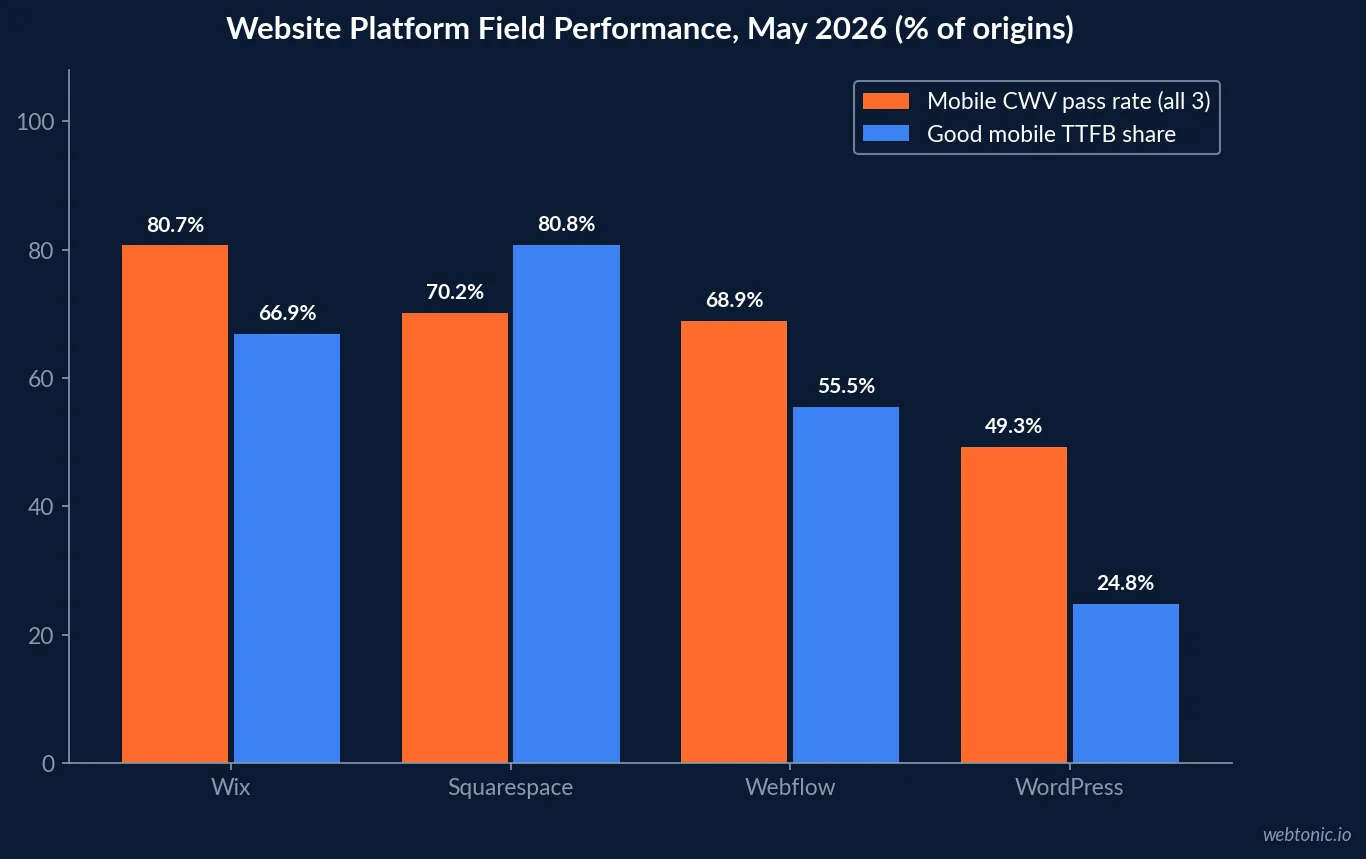
Field data from HTTP Archive’s CrUX dataset (May 2026) compares the four major builders on real user experience rather than lab scores. Webflow passes all three mobile Core Web Vitals on 68.9% of origins; WordPress manages 49.3%. The gap is mostly infrastructure: Webflow serves one managed stack, WordPress runs on everything from $3 shared hosting to enterprise clusters, which is why only 24.8% of WordPress origins hit good mobile TTFB against Webflow’s 55.5%.
| Platform | Mobile CWV pass (all 3) | Good mobile TTFB | Median mobile JS | Median mobile images |
|---|---|---|---|---|
| Wix | 80.7% | 66.9% | 1,707 KB | 185 KB |
| Squarespace | 70.2% | 80.8% | 1,571 KB | 1,111 KB |
| Webflow | 68.9% | 55.5% | 918 KB | 855 KB |
| WordPress (defaults) | 49.3% | 24.8% | 692 KB | 1,029 KB |
Webflow is third on pass rate, not first — and the honest reading is that platform choice sets a floor, not a ceiling. A lean WordPress build on good hosting will beat a Webflow site stuffed with custom scripts. What Webflow buys is payload discipline by default: the lightest combined JavaScript and image weight of the four.
Why Speed Converts Differently in an Emergency Trade
PipelineOn’s 2026 contractor benchmark puts the median contractor site at 2–4% visitor-to-lead conversion while the top 6% convert 8–12% on identical traffic and identical ad spend. Emergency-intent trades cluster at the top of the range — plumbing 12–16%, pest control 12–15%, HVAC emergency pages 10–15% — while research-intent trades like remodeling sit at 3–7%. Locksmith work shares the emergency profile, which means the ceiling is high and the cost of a slow site is unusually literal.
The arithmetic: 71% of home-service traffic is mobile, 53% of mobile visitors abandon a site that takes over 3 seconds, and each additional second drops conversion roughly 7% — so a 5-second site loses about 35% of leads versus a 1-second site. Platform-level pass rates are the cheapest way to move that number before a single design decision is made. The deeper crawl, schema and speed-budget detail sits in our locksmith technical SEO breakdown.
| Conversion factor | 2026 data | Implication |
|---|---|---|
| Median contractor conversion | 2–4% | Where most locksmith sites sit |
| Top 6% of contractor sites | 8–12% | 2–4× the jobs on the same spend |
| Plumbing / pest (emergency) | 12–16% / 12–15% | Urgency ceiling for the trades |
| Sticky tap-to-call bar | +25–40% call volume | Single highest-ROI element |
| Mobile LCP target | Under 2.5s | 1.8s converts ~2× a 4.5s site |
| Form length | 3–4 fields max | Multi-step beats single-page by 30–60% on mobile |
| Reply speed | 60s lifts conversion 391% | Site speed is wasted without call answering |
Webflow’s 2026 Footprint
Aggregated BuiltWith and W3Techs data puts Webflow at roughly 822,550 active websites, about 0.8% of all sites and 1.2% of the tracked CMS market — against WordPress at 61.3% CMS share. Growth is the story rather than scale: 67% year-over-year user growth, up from 544,053 sites two years earlier, and revenue of $213 million in 2024, a 66% increase on 2023. The US leads with 160,696 sites, followed by the UK (14,891) and Germany (14,510).
Customer profile matters for a locksmith evaluating the ecosystem: firmographic data shows 74.3% of Webflow customers have 1–10 employees and 92.1% have fewer than 50. This is a small-business platform with an agency layer on top, which is why finding a competent builder is easier than it was in 2022 — the developer pool is compounding at 23% a year.
What a Locksmith Site Actually Costs to Build
2026 Webflow pricing data breaks builds down by scope. A locksmith almost always falls in the first two rows.
| Project type | Build cost | Timeline | Pages |
|---|---|---|---|
| Simple landing page / 1–5 pages | $2,000–$5,000 | 1–2 weeks | 1–5 |
| Small business site | $5,000–$10,000 | 2–4 weeks | 5–15 |
| Standard corporate site | $10,000–$15,000 | 4–8 weeks | 15–30 |
| E-commerce store | $10,000–$30,000 | 6–12 weeks | 10–50+ |
| Enterprise marketing site | $15,000–$50,000+ | 8–16 weeks | 30–100+ |
Line items that get forgotten: CMS setup and content migration $500–$5,000 (a WordPress migration alone adds $1,000–$5,000), technical SEO setup $500–$3,000, custom code and integrations $500–$10,000, and copywriting at $100–$300 per page. Premium templates cost $49–$149 and cut design and development time 30–50%, saving $2,000–$10,000 — the single largest lever on a small build. Revision creep adds 15–30%.
Three-Year Ownership Math vs WordPress
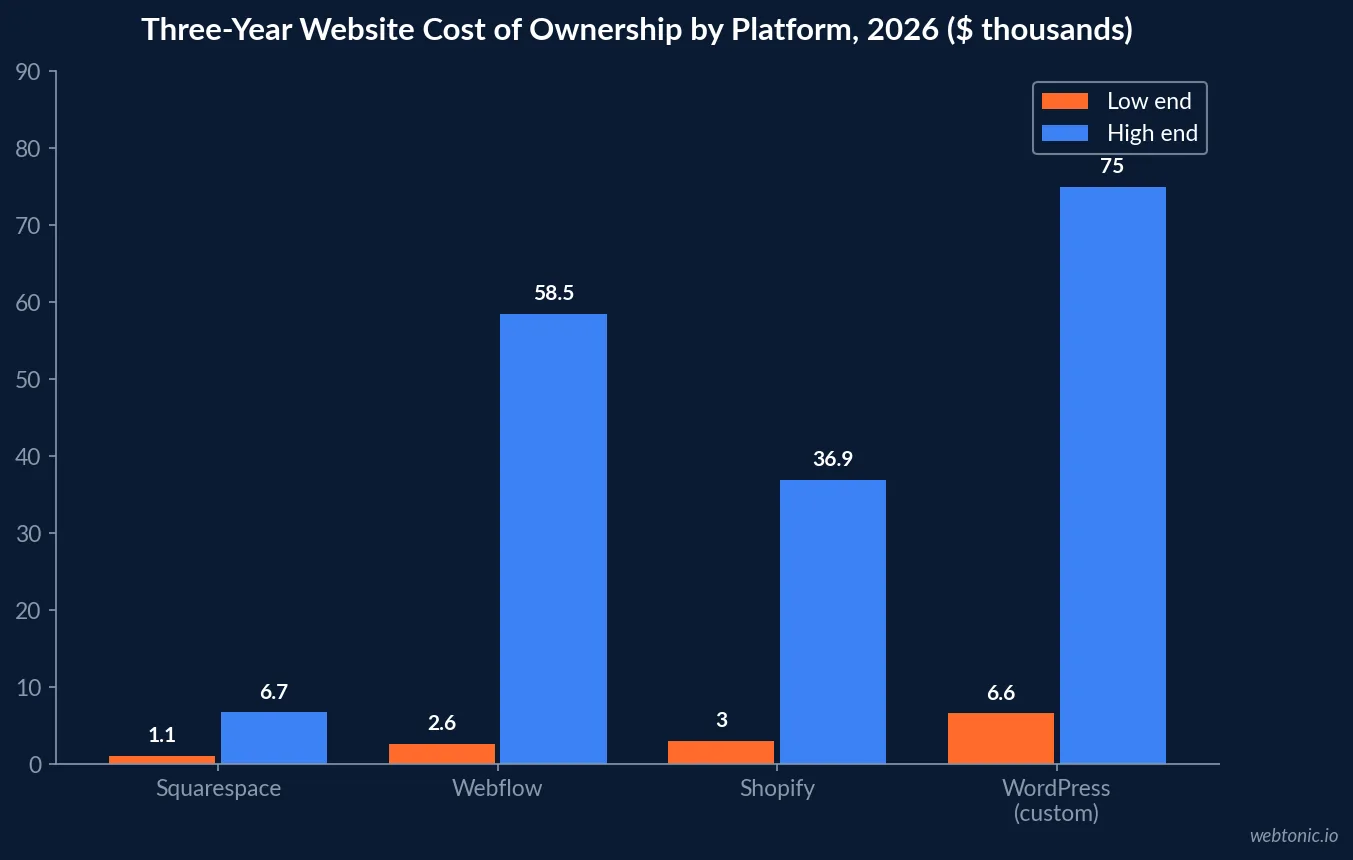
Hosting is $18/month Basic, $29/month CMS, $49/month Business. Across three years the totals land at $2,648–$58,460 for Webflow against $6,600–$75,000 for custom WordPress and $1,076–$6,728 for Squarespace. For a five-page locksmith site with no CMS needs, Squarespace is cheaper and passes CWV at a higher rate; the case for Webflow starts when you need structured content — service pages, service-area pages, review collections — that a template builder cannot model.
Also worth pricing honestly: only 28% of organisations deliver web projects on time and on budget, and 95% of marketing leaders say their governance practices hurt site management. On a locksmith build the governance problem is smaller, but the deadline problem is identical — a rush timeline carries a 30–50% premium.
Service-Area Pages: Where the CMS Earns or Destroys Value
The $29 CMS plan makes it trivial to spin up thirty templated town pages, which is exactly why so many locksmith sites carry thirty near-duplicate pages that rank for nothing. A collection-driven architecture is worth $2,000–$6,000 of setup only when each entry holds genuinely distinct content: response time from your actual base, local pricing, real job photos, and named neighbourhoods. Multi-language localisation adds $2,000–$8,000 — relevant in bilingual metros, wasted elsewhere.
Get the structure right and the same collection feeds schema, internal linking and local search visibility at once. Get it wrong and you have paid for a duplicate-content liability. The 2026 locksmith visibility audit adds a reason to care about page substance: AI assistants tell buyers to hire a professional locksmith 82.2% of the time against a 44.2% average across 14 industries, but almost never name a specific provider — so the pages that get cited are the ones with concrete, extractable detail.
When Not to Migrate
Three cases where staying put is the right call. First, a WordPress site already passing CWV on managed hosting — the platform gap disappears and migration buys nothing but $1,000–$5,000 of content movement. Second, a shop whose real bottleneck is call answering: a 60-second reply lifts conversion 391% and waiting five minutes kills 80% of the qualifying odds, which no platform fixes. Third, a site with no tracked baseline — if forms and calls are not measured separately, you cannot tell whether a rebuild worked.
Migrate when the site is slow at the origin level, when service-area content needs structure, or when nobody in the business can change a phone number without hiring a developer. Otherwise spend the money on measurement first.
The Build Spec Worth Paying For
The 2026 data converges on a short spec: mobile LCP under 2.5 seconds, a sticky tap-to-call bar on every page (+25–40% calls), a 3–4 field multi-step form, service pages separated by intent rather than lumped into one page, and structured data on every service-area entry. On Webflow that is a $5,000–$10,000 build on a $29/month plan, and the honest benchmark of success is moving from the median 2–4% conversion band toward the 8–12% band — which doubles booked jobs on unchanged ad spend. If you want that spec built and measured, talk to us.
Frequently Asked Questions
Is Webflow good for a locksmith website?
For most single-location and small multi-van shops, yes. In field data from May 2026, Webflow origins pass all three mobile Core Web Vitals 68.9% of the time versus 49.3% for WordPress, and 55.5% hit good mobile TTFB versus 24.8% on WordPress. That gap matters because every additional second of mobile load time costs roughly 7% of conversions, and 71% of home-service traffic is mobile. The trade-off is cost of change: Webflow build pricing starts around $2,000 for a simple site and hosting runs $18 to $49 a month.
How much does a Webflow locksmith site cost in 2026?
A simple 1–5 page site runs $2,000 to $5,000 and takes one to two weeks; a 5–15 page small-business site with service pages runs $5,000 to $10,000 over two to four weeks. Hosting is $18 a month on Basic, $29 on CMS and $49 on Business. Content migration from WordPress adds $1,000 to $5,000, technical SEO setup $500 to $3,000, and complex CMS architecture $2,000 to $6,000. Three-year totals land around $2,650 at the low end and $58,000+ for enterprise builds.
Does Webflow load faster than WordPress?
On defaults, in the field, yes — but the platform is not the whole story. HTTP Archive CrUX data from May 2026 shows Webflow at a 68.9% mobile Core Web Vitals pass rate against WordPress at 49.3%, and Webflow carries the lightest combined JavaScript plus image payload of the four major builders. Wix leads the group at 80.7% and Squarespace at 70.2%. A lean WordPress site on good hosting still beats a bloated Webflow site full of custom code.
Should a locksmith build city pages in Webflow's CMS?
Only if the service area genuinely spans distinct towns and each page carries unique content: real addresses or service radii, local response times, pricing, and job photos. Webflow's CMS plan at $29 a month makes templated service-area pages cheap to produce, which is exactly why they are often produced badly. Thin duplicated city pages are a ranking liability, not an asset. Budget $2,000 to $6,000 for a properly structured collection architecture.
What conversion rate should a locksmith website hit?
The median contractor site converts 2–4% of visitors into a tracked call or form, while the top 6% reach 8–12% on identical traffic. Emergency-intent trades sit at the top of the range: plumbing converts at 12–16% and HVAC emergency pages at 10–15%, and locksmith work shares that urgency profile. The mechanics that separate the groups are a sticky tap-to-call button, mobile LCP under 2.5 seconds, and 3–4 field forms.
Sources
PageSpeed Matters — WordPress vs Webflow vs Squarespace CWV 2026
Popupsmart — Webflow Statistics 2026
Enricher — Webflow Market Share Statistics
Webflow Jobs — How Much Does a Webflow Website Cost in 2026
PipelineOn — Contractor Website Conversion Rate 2026
The Alien Design — Webflow Usage Statistics
W3Techs — Webflow Usage Statistics
Authority Specialist — Locksmith SEO Statistics 2026
TheKeyBot — State of the Locksmith Industry 2026