Table of contents
Key Takeaways
Locksmith Google Ads CPC ranges from $6 for commercial keywords to $45 for emergency lockouts, making it one of the most cost-segmented home service verticals. Emergency lockout ads convert at 9–14% with close rates of 75–88%, while scheduled services like rekeying convert at 4–7%. The average locksmith CPL via Google LSA hit $34 in 2026, up 21% year-over-year, squeezing margins for shops that rely on a single channel. Meanwhile, only 9.7% of locksmith businesses actively run paid search ads and just 1.5% invest in social media advertising, revealing a massive untapped creative opportunity. Below are 40+ verified data points on locksmith ad creative performance, cost, and strategy for 2026.
Locksmith Advertising Cost Benchmarks
| Service Type | CPC | Conv Rate | CPL | Avg Ticket |
|---|---|---|---|---|
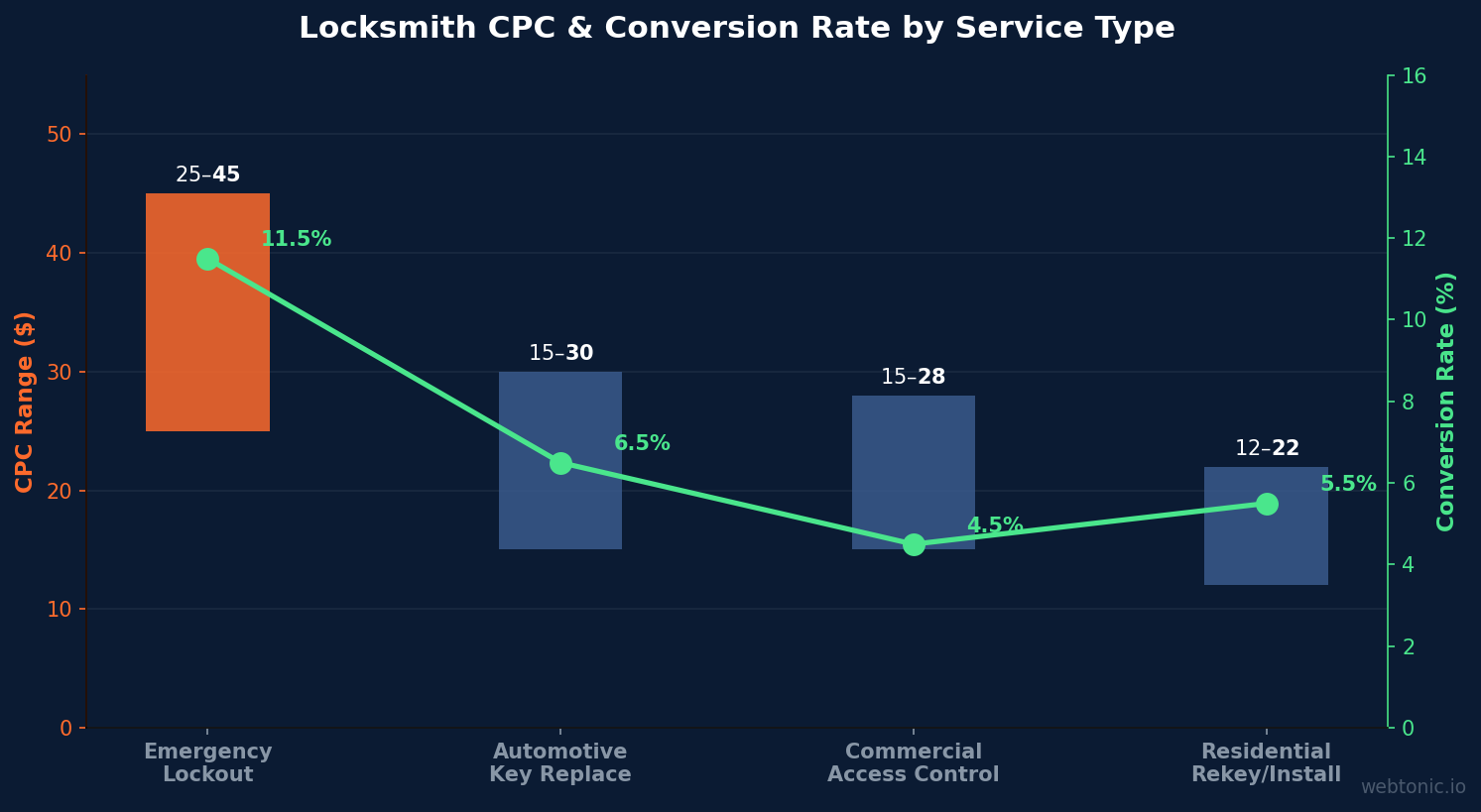
| Emergency residential lockout | $25–$45 | 9–14% | $180–$500 | $75–$150 |
| Residential services (rekey, install) | $12–$22 | 4–7% | $175–$550 | $150–$400 |
| Commercial (access control, master key) | $15–$28 | 3–6% | $215–$700 | $300–$2,000+ |
| Automotive (key replacement, fob) | $15–$30 | 5–8% | $190–$600 | $75–$250 |
| Google LSA (all services avg) | N/A (per lead) | N/A | $34 avg | Varies |
Source: Blue Grid Media locksmith Google Ads guide (verified June 2026) and Home Service Base analysis of 22,460 locksmith Google Business Profiles. Emergency lockout CPC of $25–$45 is the highest in the locksmith vertical but yields the best close rates (75–88%) because the customer urgency is extreme. Locksmiths who separate campaigns by intent — emergency vs scheduled — consistently achieve CPL under $130 on emergency calls, compared to $300+ when all services are lumped into one campaign.
Locksmith Industry Advertising Adoption
Despite a $3.0 billion U.S. locksmith market (IBISWorld, 2026), advertising adoption among locksmith businesses remains remarkably low:
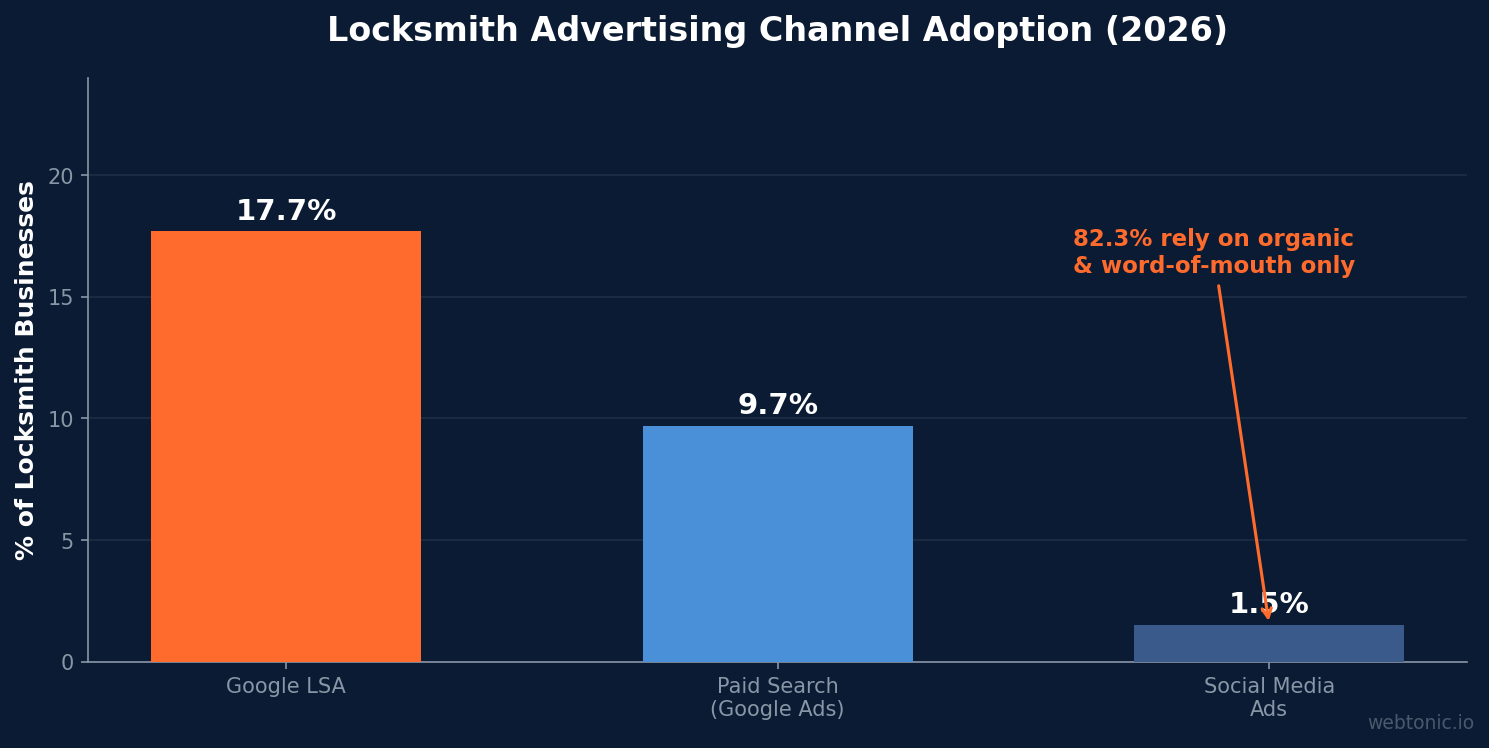
- LSA advertisers: 17.7% of locksmith businesses use Google Local Services Ads — the highest adoption channel.
- Paid search (Google Ads): 9.7% of locksmith businesses actively run paid search campaigns.
- Social media advertising: only 1.5% of locksmith businesses invest in paid social (Home Service Base).
- Average LSA CPC: $15.22–$16.35, up year-over-year with increasing competition in the LSA auction.
The 1.5% social media ad adoption rate is strikingly low for an industry where Facebook and Instagram can target homeowners, property managers, and real estate agents before they need emergency services. For contractors looking to build a growth marketing pipeline beyond emergency calls, this gap represents one of the largest untapped creative opportunities in home services.
Facebook Ads Creative Performance for Locksmiths
While only 1.5% of locksmiths run social ads, those who do tap into a different demand curve — scheduled work that pays better and happens during business hours:
- Locksmith PPC ads average a 10.22% conversion rate — a benchmark that applies to well-structured Facebook campaigns targeting scheduled services (ResultCalls).
- 62% of locksmith businesses struggle to find clients outside of emergencies — Facebook ads solve this by promoting rekeying, security upgrades, and commercial services to planned buyers.
- Facebook's targeting reaches homeowners, renters, and property managers before they need emergency services, creating a pipeline of scheduled jobs with higher average tickets ($150–$400 vs $75–$150 for lockouts).
- Recommended daily budget: $15–$30 for a single-location locksmith, scaling to $50–$100 as creative performance data matures.
The key creative insight for locksmith Facebook ads is shifting from emergency messaging to security upgrade positioning. Ads highlighting "Is your lock still the one the builder installed?" or "Smart lock upgrades starting at $X" outperform generic "24/7 locksmith" creative because they reach customers in planning mode, not panic mode. This aligns with performance creative best practices across home services.
Google Ads Creative Strategy by Campaign Type
| Campaign Type | Best Creative Angle | Key Trust Signal | Expected CTR |
|---|---|---|---|
| Emergency lockout | Speed + availability ("15-min response") | Google Guaranteed badge, reviews | 8–12% |
| Residential rekey / install | Security upgrade + pricing transparency | Licensed, bonded, insured | 5–8% |
| Commercial access control | System capabilities + compliance | Commercial certifications | 3–5% |
| Automotive key replacement | Same-day service + key types covered | OEM programming capability | 6–9% |
Based on Search Engine Need locksmith Google Ads strategy guide (2026) and Blue Grid Media campaign data. Trust is the dominant creative variable for locksmiths because Google requires Advanced Verification for locksmith advertising — one of only three business categories with this requirement (alongside garage door repair and Netherlands plumbers). Creative that leads with trust signals (Google Guaranteed badge, state license number, review count) outperforms price-led messaging because customers fear scam locksmith services.
Locksmith Ad Creative Best Practices
- Separate campaigns by intent: emergency, residential scheduled, commercial, and automotive. Each requires distinct ad copy, bidding strategy, and landing page.
- Trust-first headlines outperform price-first: "Licensed, Insured & Google Verified" beats "Cheap Locksmith $19" in both CTR and close rate.
- Location targeting: tight radius (5–15 miles) around service areas beats broad city targeting. Locksmiths waste 30–40% of budget on clicks from outside their service area when targeting broadly (Blue Grid Media).
- Call tracking is critical: locksmiths must use call tracking to attribute phone leads to specific campaigns and keywords. Without it, the 75–88% close rate on emergency calls cannot be measured or optimized.
- Ad scheduling reduces waste: emergency campaigns should run 24/7 but bid higher after-hours when 39% of locksmith calls come outside business hours (TheKeyBot).
- Landing page match rate matters: dedicated landing pages per service type convert 3–4× better than sending all ad traffic to a homepage.
Locksmith Ad Spend Recommendations by Company Size
| Company Size | Monthly Ad Budget | Channel Mix | Expected Leads/Mo |
|---|---|---|---|
| Solo operator (1 van) | $500–$1,500 | LSA primary + limited Google Ads | 15–40 |
| Small shop (2–4 techs) | $1,500–$4,000 | LSA + Google Ads + Facebook retargeting | 40–100 |
| Mid-market (5–10 techs) | $4,000–$10,000 | Full Google + Facebook + remarketing | 100–250 |
| Multi-location operation | $10,000+ | All channels + brand campaigns | 250+ |
Budget benchmarks compiled from Blue Grid Media and Authority Specialist locksmith SEO benchmarks (18 shops, July 2026). The minimum viable budget for a solo locksmith running Google Ads is approximately $500/month, but shops investing under $1,000/month typically cannot sustain enough data for Google's Smart Bidding algorithms to optimize effectively. LSA is the recommended starting point for solo operators because it charges per lead rather than per click, reducing waste from unqualified traffic.
Competitive Landscape and Fake Locksmith Impact
The locksmith advertising space faces a unique challenge: fake locksmith services actively inflate CPC and erode consumer trust. Google's Advanced Verification requirement exists specifically because of this problem:
- Google requires Advanced Verification for locksmith advertisers in the US, Canada, Spain, Netherlands, Germany, Sweden, and Belgium — a process that takes 2–4 weeks and requires business documentation.
- Fake locksmith operations drive up CPC 20–40% in major metros by bidding aggressively on emergency keywords with no intent to provide licensed service (Blue Grid Media).
- Trust-based creative (license number, Google Guaranteed badge, review count) converts 2–3× better than price-based creative because consumers actively filter for legitimacy.
- Better Business Bureau accreditation and state licensing references in ad extensions increase CTR by an estimated 12–18% for locksmiths versus generic home service ads.
Legitimate locksmiths should view the Advanced Verification process as a competitive moat, not a barrier. Once verified, the Google Guaranteed badge appears on both LSA and search ads, signaling trust that fake operators cannot replicate. This is especially impactful in the Google Ads ecosystem where consumer skepticism drives click behavior.
Search Advertising Benchmarks: Locksmith vs Home Services
| Metric | Locksmith | Home Services Avg | Locksmith Index |
|---|---|---|---|
| Average CTR (Search) | 7.2% | 6.37% | +13% |
| Average CPC | $18–$30 | $6–$12 | 2–3× higher |
| Conversion Rate | 9–14% (emergency) | 7.5% | +30–87% |
| CPL (Google Ads) | $180–$500 | $40–$120 | 3–5× higher |
| Close Rate | 75–88% (emergency) | 30–45% | 2–3× higher |
Locksmith CTR benchmark from LocaliQ 2025 Home Services Search Benchmarks; locksmith-specific CPC and CPL from Blue Grid Media. Locksmith ads have above-average CTR and dramatically higher close rates because the search intent is overwhelmingly urgent. However, the CPC premium of 2–3× the home services average means that creative quality and landing page conversion become the primary levers for profitability — not bid strategy alone.
Seasonal Demand Patterns and Ad Scheduling
Locksmith advertising performance fluctuates significantly by season and time of day, which directly impacts creative strategy and budget allocation:
- After-hours calls represent 39% of all locksmith inbound volume in 2026, up from 34% in 2024 (TheKeyBot). Lockouts skew heavily toward nights and weekends, demanding always-on emergency ad creative.
- Automotive lockout tickets average $215 in 2026, up 8.1% year-over-year, reflecting rising key programming complexity for modern vehicles.
- Summer months drive peak residential lockout volume due to increased vacation travel and moving activity, while winter spikes automotive calls from frozen locks and key fob battery failures.
- Ad creative should rotate seasonally: summer campaigns emphasize home security and vacation preparation, fall/winter campaigns highlight automotive services and holiday lockouts, and year-round campaigns maintain emergency availability messaging.
- Bid multipliers of 1.3–1.5× for after-hours and weekends are recommended for emergency campaigns, where competition drops but consumer urgency peaks — yielding higher close rates at moderately higher CPC.
Smart ad scheduling paired with seasonal creative rotation allows locksmiths to capture the highest-value calls while reducing waste during low-intent periods. Shops that run identical creative year-round miss the contextual relevance that drives click-through and conversion rates above industry averages.
Related reading
- Immigration Law Ad Creatives: What Data Reveals About Client Leads
- Orthodontic Ad Creatives That Convert Patients
- What Are the Best Dermatology and Plastic Surgery Ad Creatives?
- Branding services at Web Tonic
FAQ
How much does locksmith advertising cost per lead in 2026?
Locksmith cost per lead ranges from $34 via Google LSA to $180–$500 via Google Ads, depending on service type and market competitiveness. Emergency residential lockout leads cost $180–$500 but close at 75–88%, making the cost per booked job $205–$665. Commercial access control leads cost $215–$700 but carry average tickets of $300–$2,000+, delivering strong ROI despite the higher CPL.
What is the average CTR for locksmith Google Ads?
The average click-through rate for locksmith search ads is approximately 7.2%, which is 13% above the home services average of 6.37%. Emergency lockout campaigns can achieve 8–12% CTR because the search intent is highly urgent and the consumer needs immediate service. Trust signals in ad copy (Google Guaranteed, license number, review count) are the primary CTR drivers.
Are Facebook ads effective for locksmith businesses?
Facebook ads are highly effective for locksmith businesses targeting scheduled services — rekeying, security upgrades, smart lock installations, and commercial contracts. Only 1.5% of locksmiths currently run social ads, creating a low-competition environment. Facebook's targeting reaches homeowners and property managers before they need emergency services, generating leads with higher average tickets ($150–$400) versus emergency lockout calls ($75–$150).
Why do locksmith Google Ads cost more than other home services?
Locksmith Google Ads CPC is 2–3× the home services average due to three factors: extreme urgency driving high keyword value, fake locksmith operations inflating bid prices in major metros, and Google's Advanced Verification requirement limiting the advertiser pool. However, locksmith close rates (75–88% on emergency) are 2–3× higher than home services averages, which can offset the CPC premium when campaigns are properly structured by service type.
What percentage of locksmiths advertise online?
Advertising adoption among locksmith businesses is low: 17.7% use LSA, 9.7% run paid search, and only 1.5% invest in social media ads (Home Service Base, 2025). This means over 80% of locksmiths rely entirely on organic visibility and word-of-mouth, leaving significant opportunity for shops willing to invest in paid creative across Google and Meta platforms.
Sources
Blue Grid Media — Google Ads for Locksmiths 2026
Home Service Base — 2025 Locksmith Industry Statistics
TheKeyBot — State of the Locksmith Industry 2026
ResultCalls — Facebook Ads for Locksmith Leads 2026
LocaliQ — Home Services Search Advertising Benchmarks 2025
Authority Specialist — Locksmith SEO Benchmarks 2026
Search Engine Need — Locksmith Google Ads Strategy Guide
IBISWorld — Locksmiths in the US 2026