Table of contents
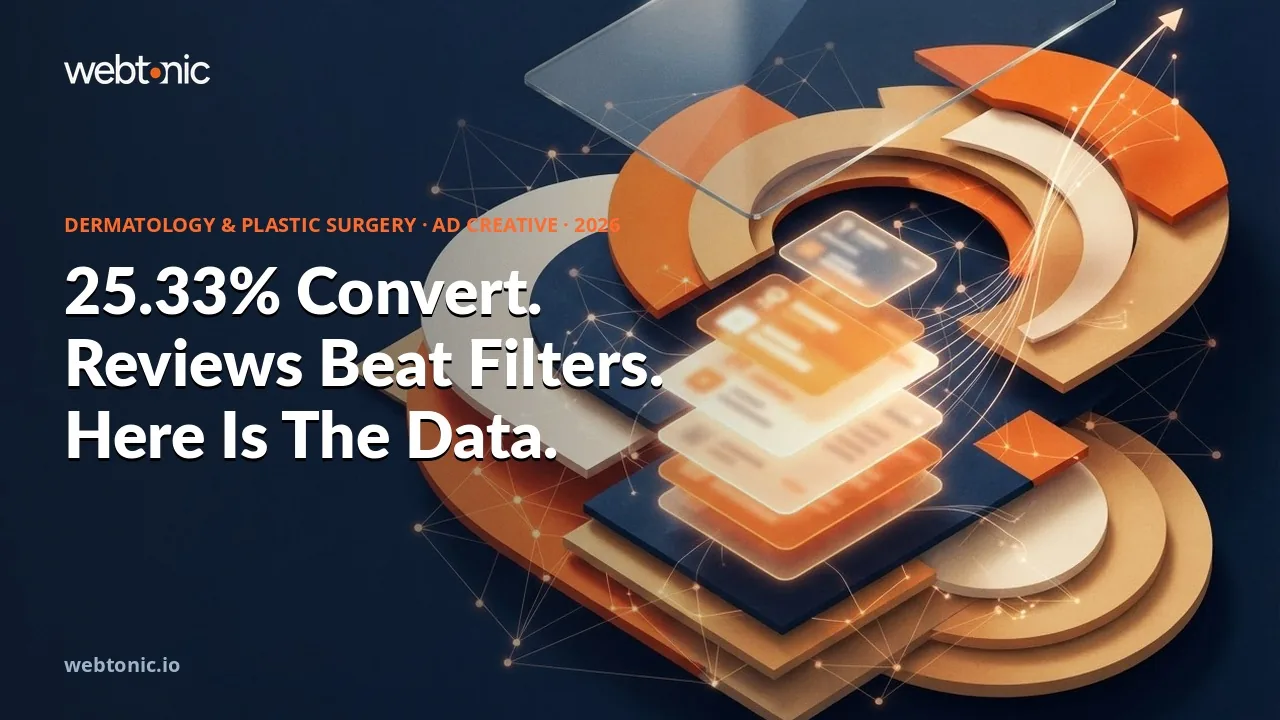
No agency or association study grades dermatology and plastic surgery ad creative head to head, so this page builds the answer from what patients say drives their booking decision and from LocaliQ's 2026 conversion data. Where the data only exists at the general-healthcare level, that is labeled explicitly below rather than presented as derm-specific.
Key Takeaways
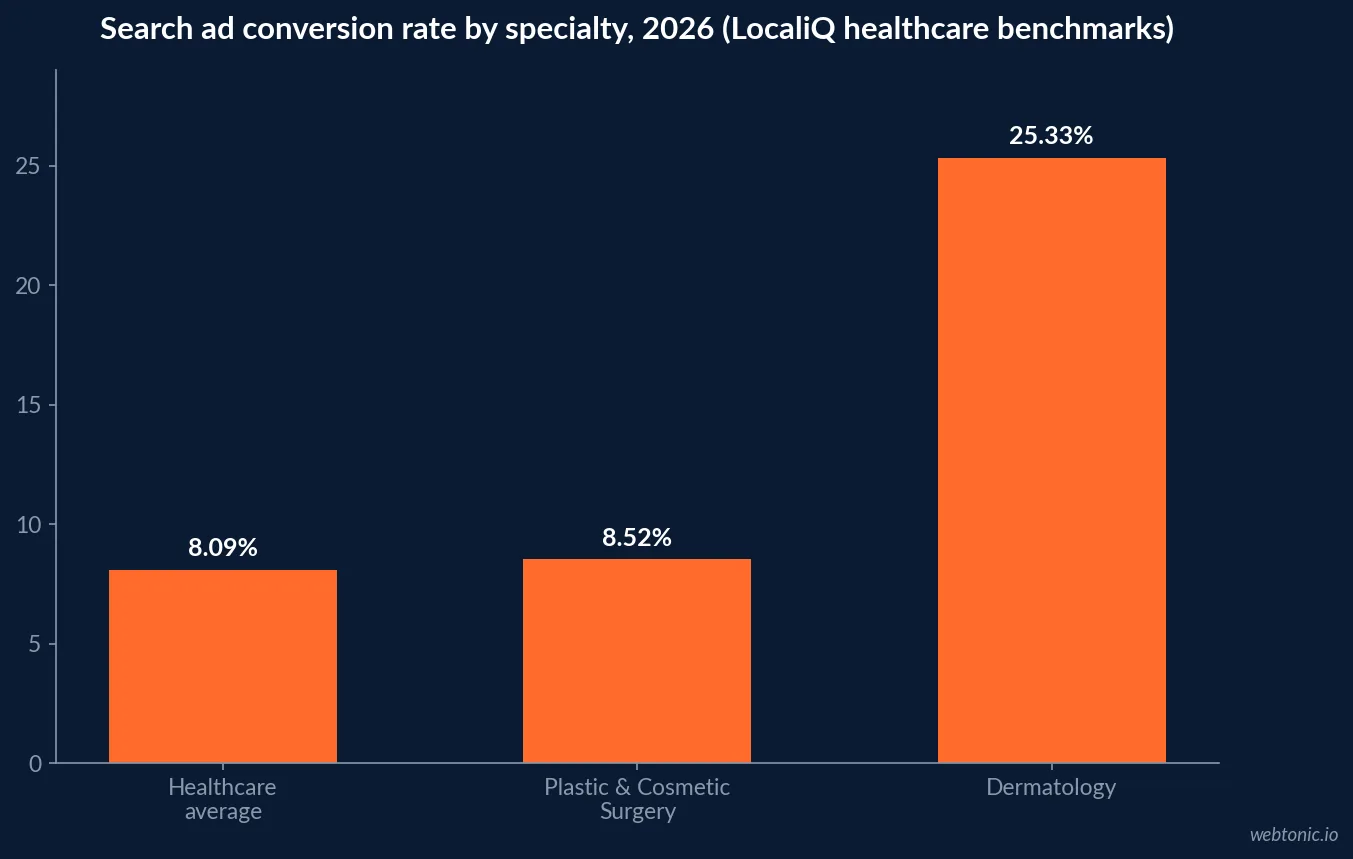
- Dermatology converts at 25.33% on search ads, the top healthcare vertical measured.
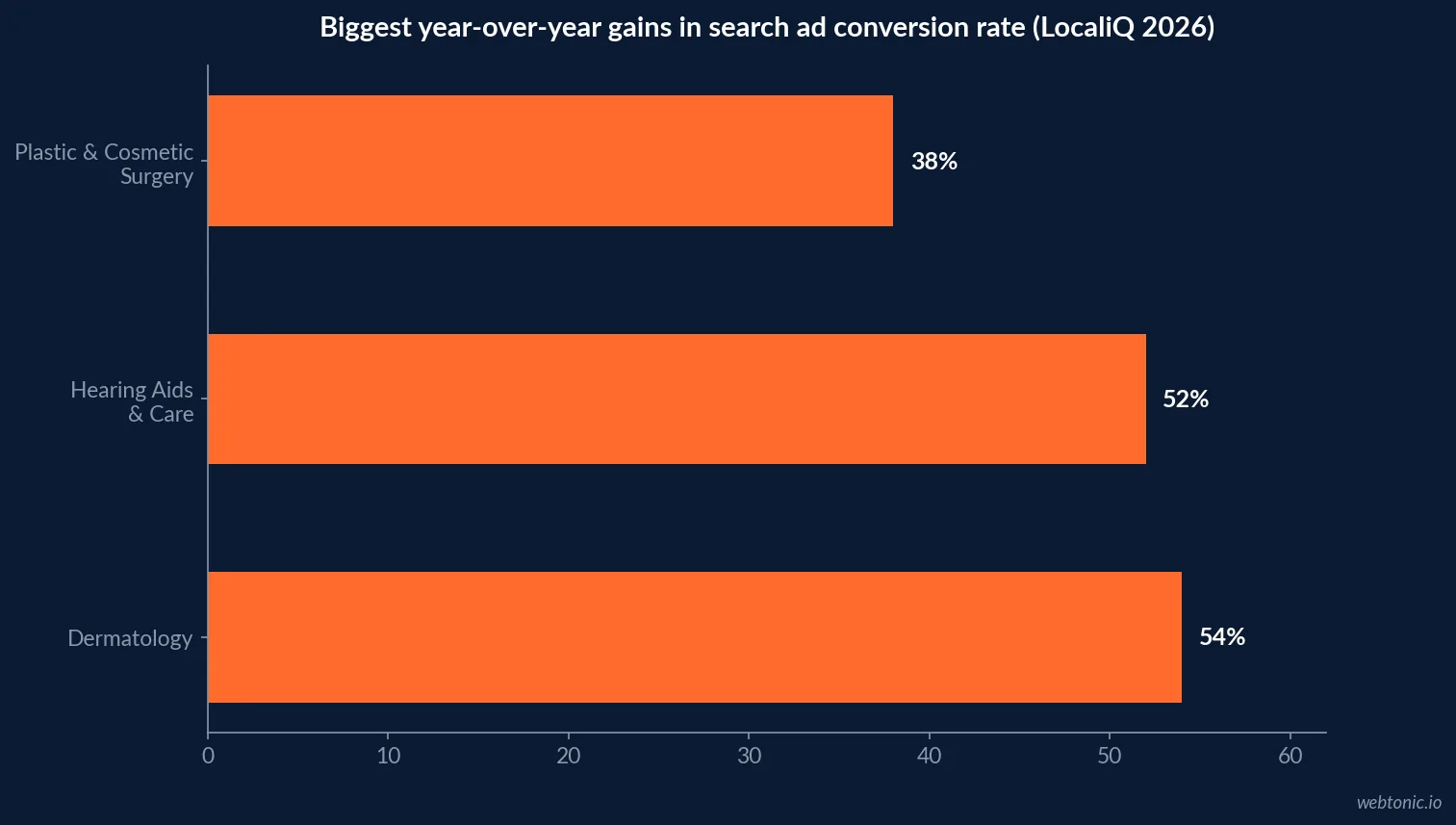
- That conversion rate rose 54% year over year.
- Plastic and Cosmetic Surgery converts at 8.52%, up 38% year over year.
- 94% of patients use rating and review sites to choose a provider.
- Nearly half say a provider's social media presence affects booking.
- 70% of consumers are considering a cosmetic procedure.
- Dermatologists have ranked the top influencer on procedure decisions since 2018.
- 57% of facial plastic surgeons see rising under-30 demand for subtle results.
- 80% of facial plastic surgery volume is now non-invasive.
- A projected 19% rise in facial procedures is expected for 2026.
- Physicians and Surgeons hit a 3.02% Facebook click-through rate in 2025.
- Facebook cost per click for that category runs about USD 0.82.
- Dermatology's cost per lead is USD 18.54, the lowest of 16 specialties.
- Plastic and Cosmetic Surgery's cost per lead is USD 102.51, among the highest.
- Plastic surgery procedure volume overall rose 7% in 2025.
- Eyelid surgery volume rose 19% in one year.
- FTC endorsement rules require substantiation behind testimonial claims.
- AHPRA bans edited or filtered before-and-after images in cosmetic ads.
What actually correlates with conversion here
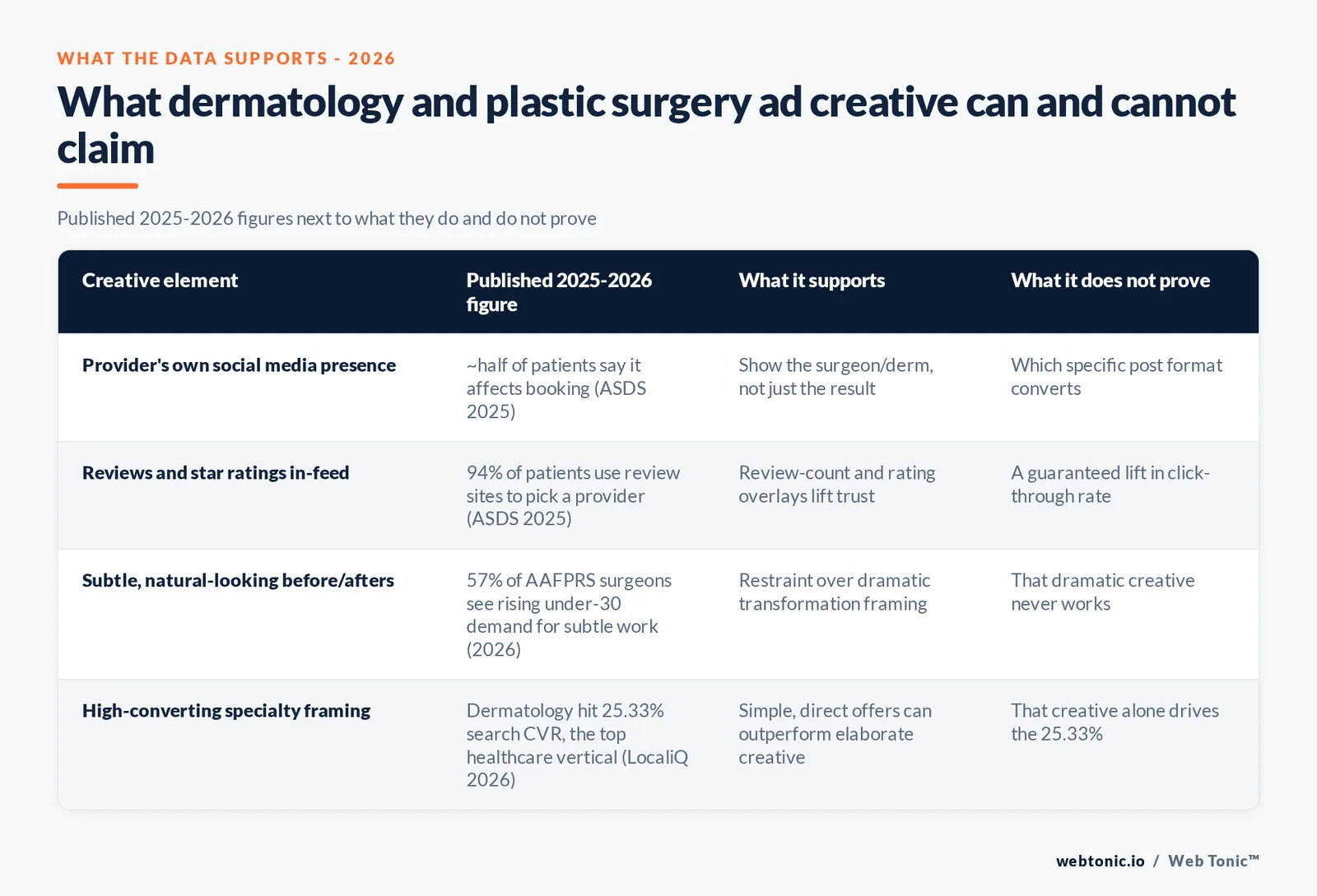
Start with what patients themselves report, not with a swipe file. ASDS's 2025 Consumer Survey found 94% of respondents use rating and review sites to choose a provider, and nearly half say a provider's own social media presence affects whether they book an appointment. Dermatologists have ranked as the top influencer over cosmetic-procedure decisions in every ASDS survey since 2018. None of that is an ad-creative A/B test, but it is a direct, sourced signal about which creative elements a prospective patient is already primed to trust: the named provider and real proof, not a filtered transformation photo.
| Patient-behavior signal (2025) | Figure | Source | Creative implication |
|---|---|---|---|
| Use review/rating sites to choose a provider | 94% | ASDS 2025 Consumer Survey | Feature real review counts/ratings in-creative |
| Provider's social presence affects booking | ~half | ASDS 2025 Consumer Survey | Show the named provider, not a stock model |
| Considering a cosmetic procedure | 70% | ASDS 2025 Consumer Survey | Demand is broad; creative can be direct, not aspirational-only |
| Dermatologist ranked top influencer since | 2018 | ASDS 2025 Consumer Survey | Provider credibility outranks any visual trick |
The subtlety shift: what the surgeons themselves report
AAFPRS's 2026 annual survey describes today's patient as "far less forgiving of results that announce themselves," with 57% of member surgeons reporting rising demand from patients under 30 for subtle, preventative work. Non-invasive treatments now account for 80% of all procedure volume the association tracks, and the group projects a 19% increase in facial procedures nationwide for 2026.
That is a stated preference from practicing surgeons, not a controlled creative test - so read it as a reason to test subtler, more credibility-driven creative against the dramatic-transformation format, not as proof that dramatic creative has stopped working everywhere.
| Trend (AAFPRS 2025-2026 survey) | Figure | What it suggests for creative |
|---|---|---|
| Surgeons reporting rising under-30 demand for subtlety | 57% | Test restrained framing against dramatic transformation |
| Non-invasive share of total procedure volume | 80% | Injectable/filler creative has the larger addressable audience |
| Projected facial-procedure growth, 2026 | 19% | Category demand is rising regardless of creative choice |
| Members reporting rising virtual-consult use | More than half | A low-friction 'book a virtual consult' CTA has surgeon-reported momentum |
Where before-and-after creative runs into the law
This is the gap most creative guidance skips. Australia's medical board guidance requires that before-and-after images used in cosmetic surgery advertising not be edited, filtered, retouched or grey-scaled, on the grounds that any of those techniques can misstate the result. In the US, the FTC's Health Products Compliance Guidance requires that any endorsement in an ad reflect the endorser's honest experience and that the underlying implied claim have adequate scientific substantiation - which applies directly to patient testimonials used as ad creative, including before-and-after pairs presented as typical results. State medical boards layer their own advertising rules for "graphic representations" on top of that federal baseline.
None of this bans before-and-after creative outright. It does mean unedited, clearly labeled, individually consented images with a substantiated typical-result claim are the only version that survives both the FTC standard and most state board rules.
| Regulatory source | What it restricts | Applies to |
|---|---|---|
| FTC Health Products Compliance Guidance | Endorsements must reflect honest experience with adequate substantiation | Testimonials, patient stories in ad creative |
| AHPRA cosmetic surgery advertising guidelines | Before/after images cannot be edited, filtered or retouched | Before/after creative (AU jurisdiction, directionally instructive) |
| US state medical board advertising rules | Regulate 'graphic representations' in ads on a state-by-state basis | Before/after and testimonial creative in the US |
| FTC Endorsement Guides (2023 update) | Requires disclosure of material connections in endorsements | Influencer/UGC creative featuring patients or staff |
What the paid-media data shows, labeled by platform
This is general-healthcare data, not derm-specific, and should be read that way. WordStream's 2025 Facebook Ads benchmarks put Physicians and Surgeons at a 3.02% click-through rate on lead campaigns - among the highest categories WordStream tracks - at an average USD 0.82 cost per click. On the search side, LocaliQ's 2026 healthcare benchmarks put dermatology's cost per lead at USD 18.54, the lowest of sixteen specialties measured, against USD 102.51 for Plastic and Cosmetic Surgery, among the highest.
The spread between those two cost-per-lead figures is itself useful creative guidance: a category converting easily at low cost (dermatology) can support simpler, direct-offer creative, while a higher-cost, longer-consideration category (plastic and cosmetic surgery) needs creative built to earn trust before the click, not just after it. Our performance creative practice treats that distinction as the starting brief, not an afterthought.
| Platform metric (2025-2026) | Figure | Source | Scope |
|---|---|---|---|
| Facebook CTR, Physicians & Surgeons | 3.02% | WordStream 2025 Facebook benchmarks | General healthcare, not derm-specific |
| Facebook CPC, Physicians & Surgeons | USD 0.82 | WordStream 2025 Facebook benchmarks | General healthcare, not derm-specific |
| Search CPL, Dermatology | USD 18.54 | LocaliQ 2026 healthcare benchmarks | Derm-specific |
| Search CPL, Plastic & Cosmetic Surgery | USD 102.51 | LocaliQ 2026 healthcare benchmarks | Plastic/cosmetic-specific |
| Search CVR, healthcare average (16 specialties) | 8.09% | LocaliQ 2026 healthcare benchmarks | Cross-specialty baseline |
What the 2023 endorsement rules changed
The endorsement rules behind that FTC guidance were themselves updated. The 2023 Federal Register notice confirms the FTC's revised Guides Concerning the Use of Endorsements and Testimonials in Advertising, which extended disclosure obligations to social media posts and reviews generated with any material connection to the advertiser - including a patient given a discount or free treatment in exchange for a testimonial used in ad creative. For a specialty where nearly half of patients say a provider's social presence affects booking, any UGC-style creative built from patient content needs that material-connection disclosure built in from the first draft, not added after legal review.
A test plan built from what the data actually supports
Given the evidence above, the defensible test order is: named-provider creative against stock/anonymous creative first, since that is the most directly patient-reported preference; subtle before-and-after (properly consented, unedited, disclosed) against dramatic transformation second, since that tracks the fastest-growing patient segment; and review-count or rating overlays against offer-only creative third. Platform choice should follow the cost data: Meta for reach at a low CPC in general healthcare, Google search where dermatology's own 25.33% conversion rate is already doing much of the work.
See how paid social pricing compares more broadly in our breakdown of whether Facebook ads are worth it, or talk to us about building a compliant creative test plan for your practice.
Frequently Asked Questions
What is the best dermatology and plastic surgery ad creative?
No published study grades creative formats head to head for this vertical, so the honest answer is built from adjacent data. ASDS's 2025 Consumer Survey found 94% of patients use rating and review sites to choose a provider and nearly half say a provider's own social media presence affects whether they book - both point toward creative that foregrounds the named provider and real reviews over generic transformation imagery. LocaliQ's 2026 benchmarks then show dermatology converting at 25.33%, the highest of sixteen healthcare specialties, which suggests the offer and the provider's credibility are doing more work than any specific visual trick.
Do dramatic before-and-after photos still work?
The patient-preference data argues against leaning on them as the primary hook. AAFPRS's 2026 annual survey reports 57% of facial plastic surgeons seeing rising demand from patients under 30 specifically seeking subtle, natural-looking results, and describes today's patients as 'far less forgiving of results that announce themselves.' That is a stated preference shift, not a controlled ad test, so treat it as directional: creative promising a dramatic, obvious transformation may now work against the exact audience segment growing fastest.
Are before-and-after photos even allowed in ad creative?
It depends on the jurisdiction, and this is the biggest gap between marketing advice and law. Regulators including Australia's AHPRA explicitly require that before-and-after images used in cosmetic surgery advertising not be edited, filtered or retouched, because doing so misrepresents the result. US state medical boards impose their own rules on graphic representations in advertising, and the FTC's Health Products Compliance Guidance requires that any endorsement reflect the honest, typical experience with adequate substantiation behind the implied claim - a rule that applies directly to patient testimonials in ad creative.
Does Facebook or Google convert better for this creative?
The general-healthcare data, not a derm-specific study, is what exists here and should be labeled as such. WordStream's 2025 Facebook benchmarks put Physicians and Surgeons at a 3.02% click-through rate, among the highest lead-campaign categories measured, at roughly USD 0.82 per click. LocaliQ's 2026 Google search data shows dermatology and plastic surgery converting well above the healthcare average once a click happens. Read that as Meta creative doing more of the initial-interest work and Google search doing more of the conversion work, not as one platform being objectively better.
What creative element has the most evidence behind it?
Provider identity and review proof. Dermatologists have ranked as the top influencer over patients' cosmetic-procedure decisions every year since 2018 per ASDS, and 94% of 2025 respondents used review sites before choosing a provider. Any creative test plan for this vertical should treat 'does the ad show a named, credentialed provider and a real review' as the first variable, ahead of color, copy length or offer framing.
Sources
American Society for Dermatologic Surgery - 2025 Consumer Survey on Cosmetic Dermatologic Procedures
AAFPRS - 2025 Annual Survey trends in facial plastic surgery
American Society of Plastic Surgeons - 2025 plastic surgery by the numbers
LocaliQ - Healthcare search ads benchmarks for 16 specialties, 2026
WordStream - Facebook Ads Benchmarks 2025
Federal Trade Commission - Health Products Compliance Guidance
Federal Register - FTC Guides Concerning the Use of Endorsements and Testimonials, 2023
AHPRA - Guidelines for advertising cosmetic surgery