Table of contents
No published study scores orthodontic ad creative for conversion directly, and the paid-search data that exists cuts against the easy claim that these ads "convert patients" by default. Orthodontics has the lowest healthcare click-through rate LocaliQ tracks. What the data does show is where the creative and compliance decisions that move the needle actually sit - and what happens if a before-and-after photo skips the disclosure a state medical board requires.
Key Takeaways
- Orthodontics has the lowest click-through rate of 16 healthcare specialties LocaliQ tracks, at 4.35%.
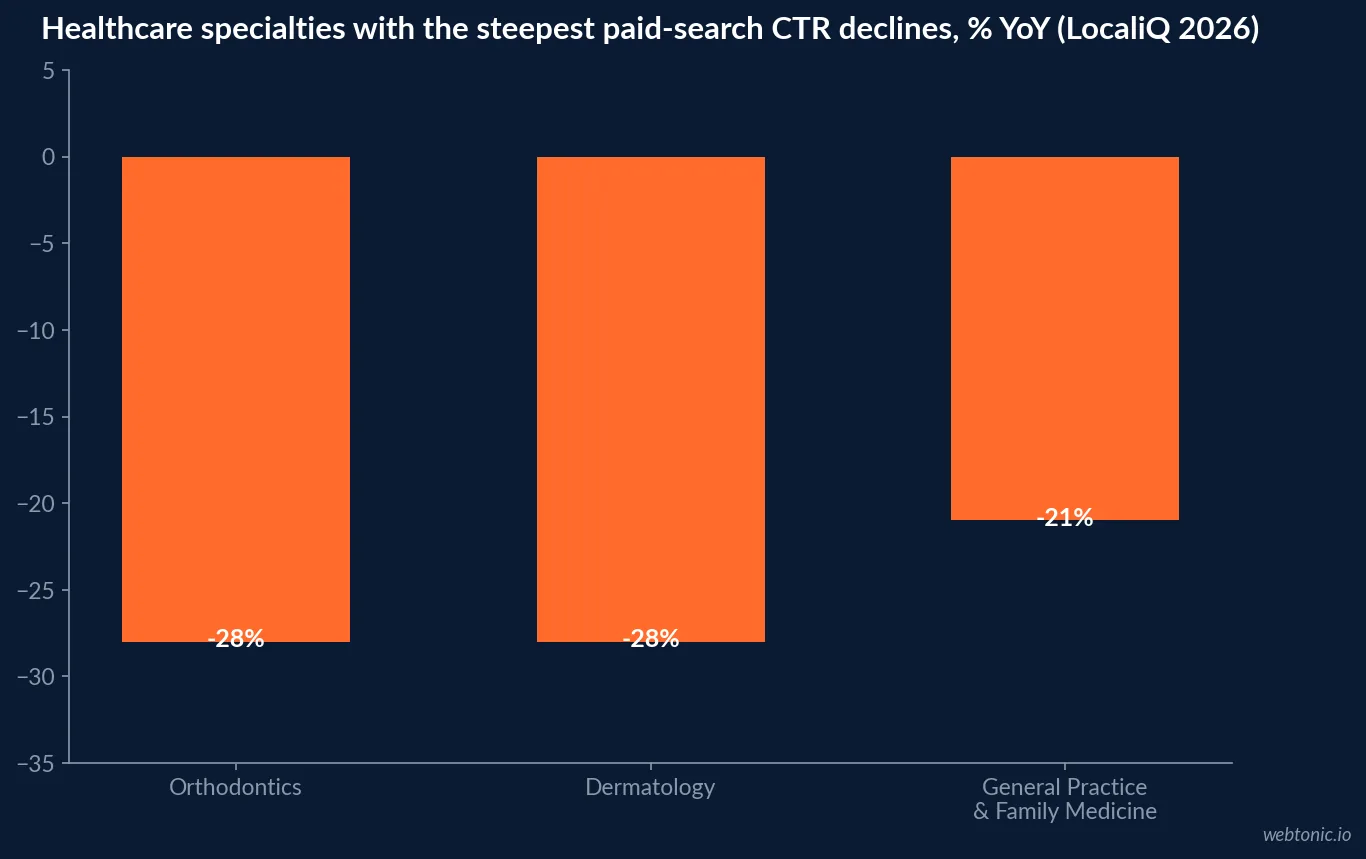
- That CTR fell 28% year over year, tied with dermatology for the steepest drop in the report.
- Orthodontics also has the highest average cost per click of those specialties, at USD 8.76.
- Despite the weak click rate, orthodontics converts at 14.21%, well above the healthcare average of 8.09%.
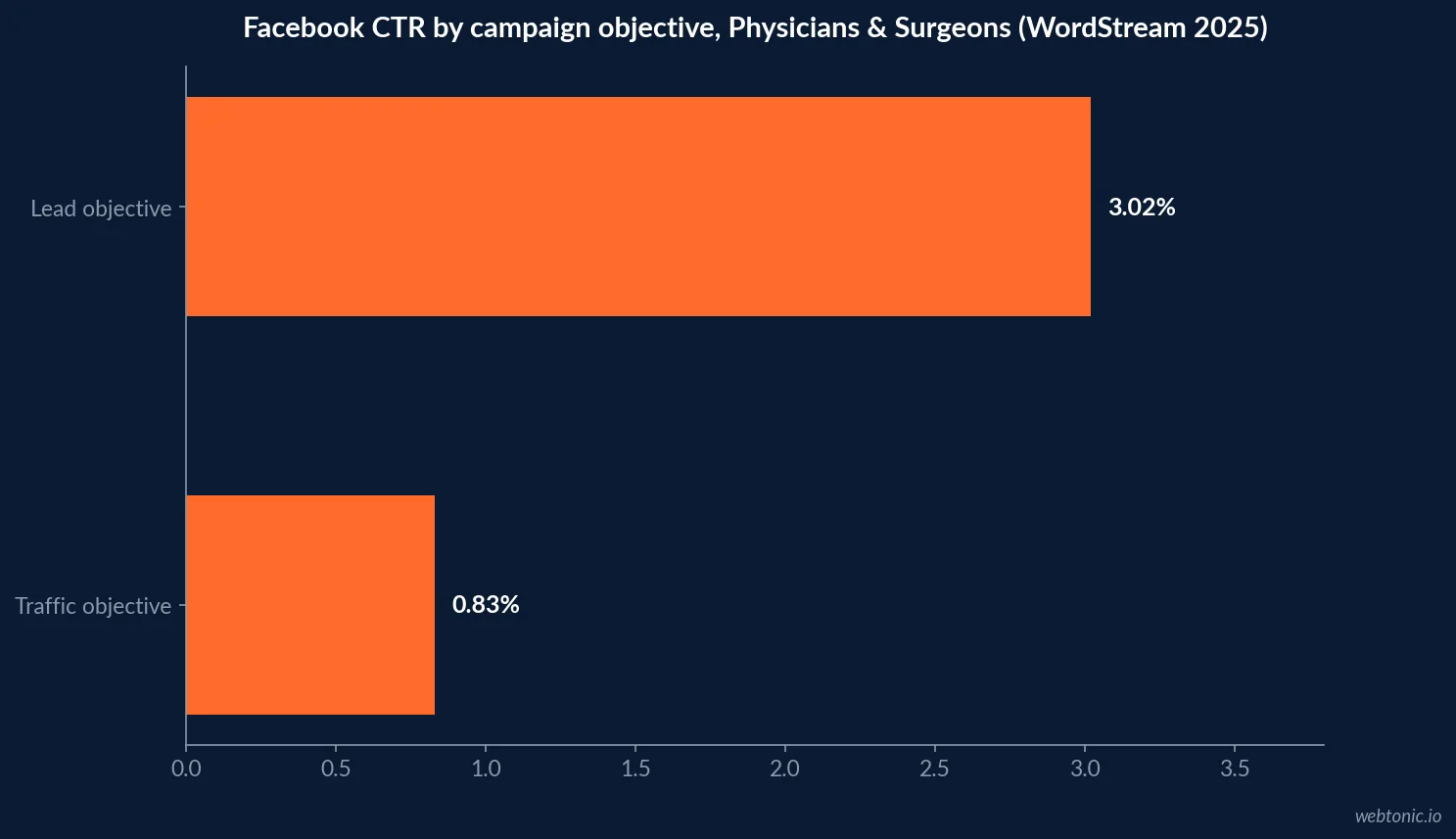
- A cross-industry Physicians & Surgeons Facebook lead-objective benchmark shows 3.02% CTR, well above the same category's 0.83% CTR on traffic-objective campaigns.
- Dentist referral, historically orthodontics' top acquisition channel, fell from 43% of AAO respondents in 2021 to 28% in 2024.
- Orthodontists now treat 70% of all patients in active orthodontic treatment, up from 65% in 2022, per the AAO's Landscape Consumer Study.
- Orthodontists hold a 78% share of the teen treatment market and a 64% share of the adult market.
- 86% of consumers believe orthodontists have more specialized training than dentists; 83% trust orthodontist-provided treatment more than mail-order aligners.
- 90% of US teens use YouTube, 63% use TikTok and 61% use Instagram, per Pew Research's 2025 teens survey.
- California's Business and Professions Code Section 651 requires before-and-after photos to be comparable and carry a results-vary disclosure.
- The FTC's Endorsement Guides (16 CFR Part 255) treat an undisclosed atypical before/after result as a deceptive testimonial.
- Align Technology reported 691,785 Clear Aligner cases shipped in Q2 2026, up 7.4% year over year across adult, teen and growing patient segments.
What the paid-search data does and does not prove
Start with what a "convert patients" headline should be checked against. LocaliQ's 2026 healthcare search benchmarks, drawn from 3,542 US campaigns running October 2024 through September 2025, put orthodontics at the lowest click-through rate of the 16 healthcare subcategories tracked (4.35%), the highest cost per click (USD 8.76), and a CTR that fell 28% year over year - tied with dermatology for the steepest decline in the report. On the click side, that is a weak creative and demand environment, not a strong one.
But the same report shows orthodontics converting at 14.21%, nearly double the healthcare-wide average of 8.09%, and at a cost per lead of USD 71.52 against a healthcare average of USD 66.02. Read together: orthodontic creative has to work harder than most healthcare categories to earn a click, but once it does, the visitor is unusually likely to convert. That is a real, sourced nuance - and a different claim than "these ads convert."
| Metric (orthodontics, paid search) | 2025-26 figure | Healthcare average | YoY change |
|---|---|---|---|
| Click-through rate | 4.35% | 6.07% | -28% |
| Cost per click | USD 8.76 | USD 5.64 | Highest of 16 specialties |
| Conversion rate | 14.21% | 8.09% | n/a published |
| Cost per lead | USD 71.52 | USD 66.02 | n/a published |
Objective, not platform, is where creative performance moved
The clearest creative-adjacent signal in the paid-social data is not industry, it is campaign objective. WordStream's 2025 Facebook Ads benchmarks report the cross-specialty Physicians & Surgeons category (554 traffic campaigns, 726 lead campaigns, April 2024-June 2025) at a 0.83% CTR on traffic-objective campaigns versus 3.02% on lead-objective campaigns - a nearly fourfold difference driven by how Meta's delivery algorithm targets the audience, not by a change in the ad's visual. Cost per click moves the other way, from USD 0.82 on traffic to USD 2.23 on leads, and conversion rate lands at 4.51% for leads. This is a broader physician/surgeon category, not orthodontics-specific, so treat it as a proxy for what objective choice can do rather than an orthodontics number.
| Facebook campaign objective (Physicians & Surgeons) | CTR | CPC | CVR | CPL |
|---|---|---|---|---|
| Traffic objective | 0.83% | USD 0.82 | n/a reported | n/a reported |
| Lead objective | 3.02% | USD 2.23 | 4.51% | USD 47.47 |
Who the creative has to persuade, and away from what
The AAO's 2024 Orthodontic Landscape Consumer Study gives the clearest published read on what is actually competing for a patient's attention. Orthodontists now treat 70% of all patients in treatment, up from 65% in 2022, and hold a 78% share of the teen segment and a 64% share of the adult segment, against general dentists and mail-order aligner brands. Trust runs in orthodontists' favor - 86% of consumers believe orthodontists carry more specialized training than dentists, and 83% trust orthodontist-delivered treatment over a mail-order brand - but the channel bringing patients in the door has shifted. Dentist recommendation, the number-one driver of orthodontist selection, fell from 43% of respondents in 2021 to 28% in 2024. That decline is the actual case for why paid and organic creative now carries more of the acquisition load than it used to.
| Patient-choice signal (AAO Landscape Study, 2024) | 2024 | 2022 or 2021 |
|---|---|---|
| Orthodontist share of all patients in treatment | 70% | 65% (2022) |
| Orthodontist share of teen patients | 78% | n/a published |
| Orthodontist share of adult patients | 64% | n/a published |
| Dentist recommendation as top selection driver | 28% | 43% (2021) |
| Consumers trusting orthodontist specialization over dentist | 86% | n/a published |
Creative for the platforms teens actually use
With orthodontists holding a 78% teen-segment share, teen-facing platform choice is not a minor detail. Pew Research's 2025 survey of US teens ages 13-17 (n=1,458) reports 90% use YouTube, 63% use TikTok and 61% use Instagram, with 61% visiting TikTok and 55% visiting Instagram at least daily. No published study isolates orthodontic ad performance on TikTok specifically, so the honest creative brief is: build for the platforms this age group actually opens daily, and validate performance in-account rather than assuming a benchmark that does not exist yet.
| Teen platform usage (ages 13-17, Pew Research 2025) | Ever use | Visit daily |
|---|---|---|
| YouTube | 90% | n/a published |
| TikTok | 63% | 61% |
| 61% | 55% | |
| Snapchat | 55% | n/a published |
The compliance layer every before-and-after asset runs through
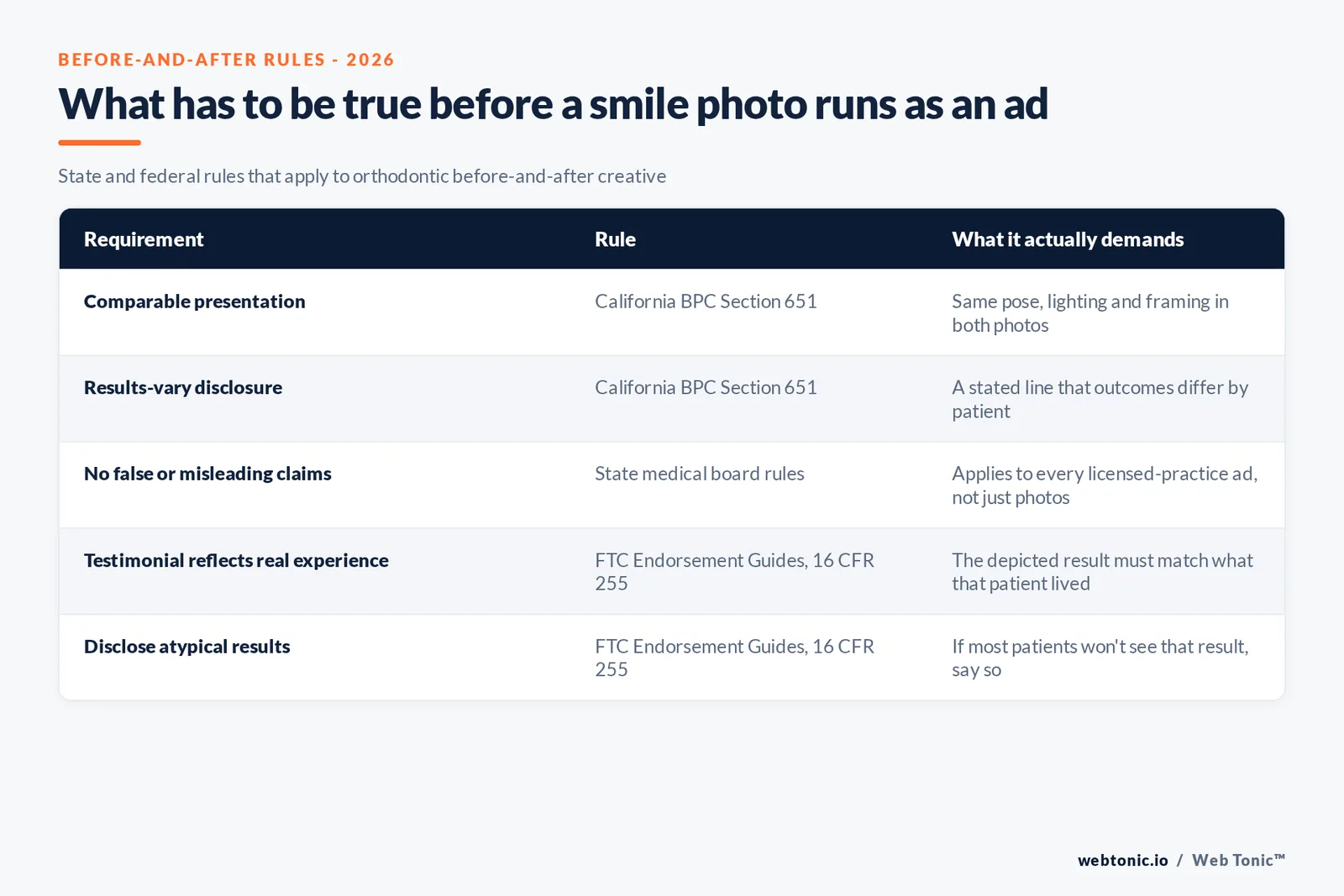
Before-and-after photography is the single most common ortho ad-creative format, and it is the one with the most explicit legal rules attached. California's Business and Professions Code Section 651 requires that before-and-after images be comparable in presentation - not distorted by favorable poses, lighting or other presentation choices - and carry a statement that results and treatment times vary by patient. The FTC's Endorsement Guides (16 CFR Part 255) add a second layer: a testimonial's depicted result has to reflect what that endorser actually experienced, and if it is not what most patients should expect, the ad needs a clear and conspicuous disclosure of the generally expected result. The Guides use a before/after weight-loss photo as their own worked example of what an undisclosed atypical result looks like when it is deceptive - the same logic applies directly to a smile-transformation photo.
| Before-and-after requirement | Rule | Applies to |
|---|---|---|
| Comparable pose, lighting, framing | California BPC Section 651 | Any before/after image used in advertising |
| Disclosure that results vary by patient | California BPC Section 651 | Any before/after image used in advertising |
| No false or misleading advertising | State medical board rules (e.g. Florida, Missouri) | All licensed-practice advertising |
| Testimonial result must reflect real experience | FTC Endorsement Guides, 16 CFR Part 255 | Patient testimonials and reviews used in ads |
| Disclose if shown result is not typical | FTC Endorsement Guides, 16 CFR Part 255 | Testimonials showing an atypical outcome |
What the platforms themselves restrict before creative even runs
Two separate ad-policy layers filter orthodontic creative before it reaches a feed or a SERP. Google's Healthcare and Medicines policy reserves its certification requirement for prescription drugs, pharmaceutical manufacturers and a short list of other named categories - general orthodontic advertising is not on that list, so the more common rejection reason for ortho creative is Google's standard misleading-claims or destination-quality review, not a missing certification. The FTC's Health Products Compliance Guidance sets the bar those claims are held to: any statement about treatment speed, comfort or outcome needs the same kind of substantiation a supplement or device claim would, whether it appears in ad copy or in the before-and-after caption next to it.
| Ad policy layer | What it actually restricts | Applies to general ortho creative? |
|---|---|---|
| Google Healthcare & Medicines certification | Prescription drugs, pharma manufacturers, named categories | No - not a listed category |
| Google misleading-claims / destination-quality review | Any unsubstantiated or deceptive claim | Yes, on every ad regardless of certification |
| FTC Health Products Compliance Guidance | Substantiation standard for health outcome claims | Yes, for any speed/comfort/outcome claim in copy or captions |
What this means for a creative brief
The data supports a narrower, more defensible version of "creatives that convert patients": lead- objective structure over traffic-objective structure, platform selection that matches where the teen half of the market actually spends time, and before-and-after assets built with the disclosure language a state board or the FTC would expect to see, not added after a complaint. Our performance creative team builds that brief against a practice's own funnel data rather than a generic template; see our related look at whether Facebook ads are worth it for the broader ROI case, or the agencies we benchmark against. Get in touch to have your own before-and-after assets checked against the rules above before they run.
Frequently Asked Questions
Do orthodontic ads actually convert well?
No published dataset measures creative quality directly, so the honest answer comes from two proxies that pull in different directions. LocaliQ's 2026 healthcare benchmarks put orthodontics paid search at the lowest click-through rate of 16 specialties, 4.35%, down 28% year over year - the weakest click signal in the set. But the same report shows orthodontics converting clicks at 14.21%, well above the 8.09% healthcare average. Read plainly: orthodontic ad creative struggles to earn the click, but whoever does click is unusually likely to become a lead. That points at the ad copy and visual as the leverage point, not the landing page.
What creative actually reaches the teen half of the ortho market?
Platform choice, more than any single creative trick. Pew Research's 2025 teens survey (ages 13-17, n=1,458) reports 90% of teens use YouTube, 63% use TikTok and 61% use Instagram, with 61% visiting TikTok and 55% visiting Instagram daily. Align Technology's own Q2 2026 earnings call transcript (cited in Sources) describes growth 'across orthodontists and GP dentist channels and across adult, teen, and growing patient segments,' without breaking out a teen-specific ad channel - so the platform data has to stand in for a teen-specific creative benchmark that does not exist yet.
Can I use patient before-and-after photos in orthodontic ads?
Only under real disclosure rules, not a caption. California's Business and Professions Code Section 651, one of the most detailed state standards, requires that before-and-after images be comparable in presentation - not distorted by favorable poses, lighting or camera angle - and carry a statement that results vary and are not guaranteed for every patient. Other state medical boards, including Florida's and Missouri's, carry similar false-or-misleading-advertising language. Treat any before-and-after photo as a compliance decision before it is a creative one.
Is a patient testimonial in an ad enough on its own?
No. The FTC's Endorsement Guides (16 CFR Part 255) treat a testimonial the way they treat any endorsement: results shown have to reflect what the endorser actually experienced, and if that result is not what most patients should expect, the ad needs a clear disclosure of the generally expected outcome. The Guides give a directly relevant example - a weight-loss before/after image paired with a testimonial - and treat an unqualified 'I lost 50 pounds' claim as deceptive if it implies a typical result. Orthodontic before-and-after testimonials sit in the same category.
Why did orthodontic ad click-through drop 28% in a single year?
LocaliQ's own explanation, from the same 2026 healthcare report: orthodontics and dermatology posted the two largest CTR declines of the 16 subcategories tracked, both down 28%, and the report attributes that specifically to elective procedures being more exposed to economic uncertainty than emergency or insurance-covered care. That is a demand-side explanation, not a creative-quality one - which is also why a creative refresh alone should not be expected to reverse it.
Sources
LocaliQ - Healthcare Search Ads Benchmarks
WordStream - Facebook Ads Benchmarks 2025
American Association of Orthodontists - 2024 Orthodontic Landscape Consumer Study
Pew Research Center - 10 Facts About Teens and Social Media (2025)
California Legislative Information - Business and Professions Code Section 651
Electronic Code of Federal Regulations - FTC Endorsement Guides, 16 CFR Part 255
Google Ads Advertising Policies Help - Healthcare and Medicines
Federal Trade Commission - Health Products Compliance Guidance
Align Technology - Q2 2026 Earnings Call Transcript (The Motley Fool)