Table of contents
Attorneys and Legal Services carries the highest cost per click ($9.87) and the highest cost per lead ($131.63) of any of the 23 industries WordStream tracks in its 2026 search benchmark. No published study isolates immigration law ad creative on its own, so this page builds its case from that verified category-level data and states plainly where the evidence stops and where a firm still has to test.
Key Takeaways
- Attorneys & Legal Services has the highest Google Ads CPC of any tracked industry: $9.87.
- It also has the highest cost per lead: $131.63, per WordStream's 2026 benchmark.
- The category converts at 5.55% on Google/Microsoft Search, in line with the cross-industry average.
- On Meta lead campaigns, Attorneys & Legal Services converts at 10.53%, WordStream's 2025 data shows.
- That is up from under 1% CTR two years earlier in the same benchmark series.
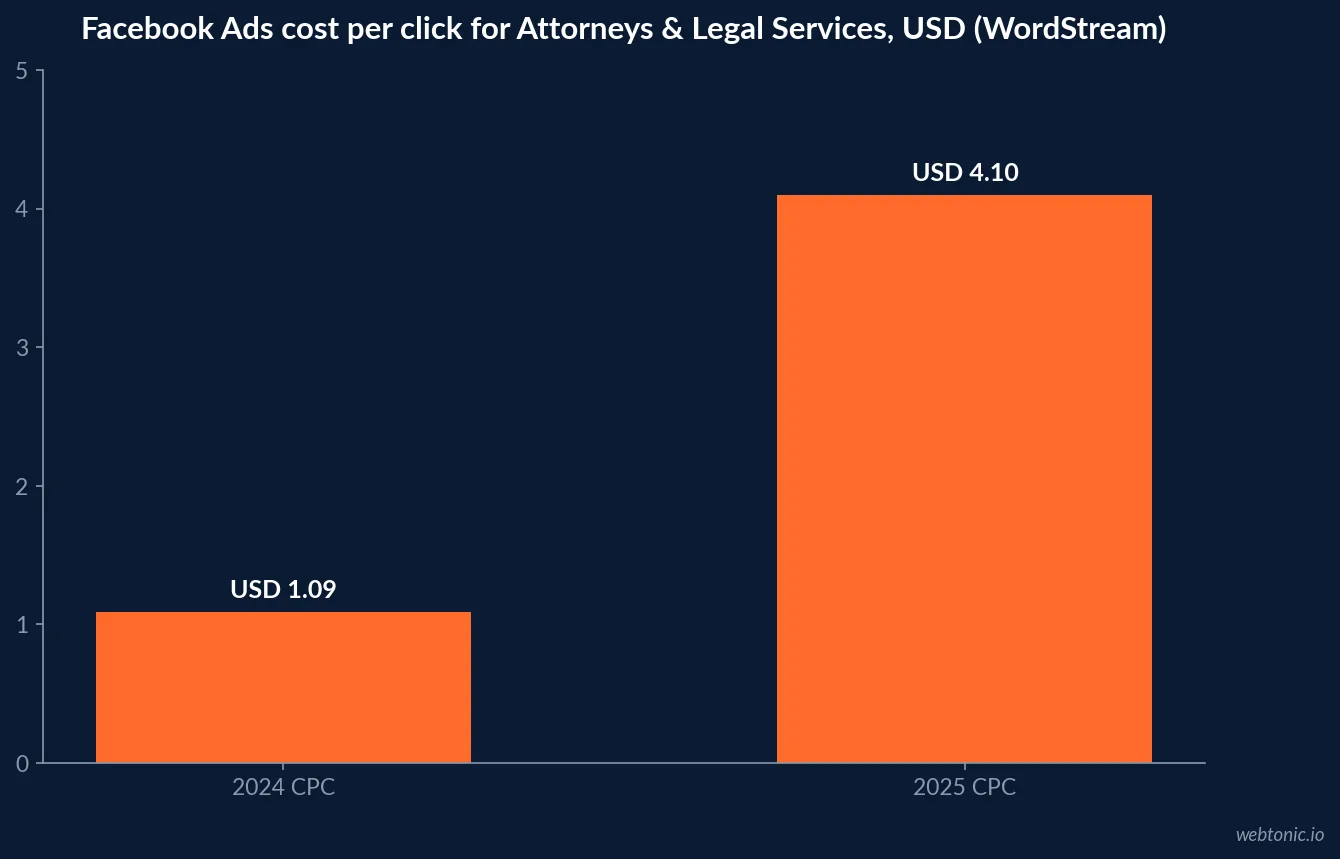
- Facebook CPC for the category rose from $1.09 in 2024 to $4.10 in 2025, roughly quadrupling.
- CTR nearly doubled over the same span, from 0.99% to 1.76%.
- 13,474 US search campaigns fed WordStream's 2026 benchmark, across 23 industries.
- Roughly 1,800 Facebook campaigns fed the 2026 Meta benchmark update.
- The FTC's endorsement guides were last revised in 2023 and require material-connection disclosure.
- ABA Model Rule 7.2 restricts paying for recommendations of a lawyer's services.
- Google began requiring identity checks for lawyers on Local Services Ads in 2024.
- Meta's Special Ad Category rules impose a minimum 15-mile targeting radius on covered campaigns.
- Clio's 2026 Legal Trends survey covered 1,702 legal professionals, providing the firm-side spend context.
- Firms above the utilization benchmark spend 41% more on marketing, per Clio's separate research.
What immigration law ad creative is actually bidding against
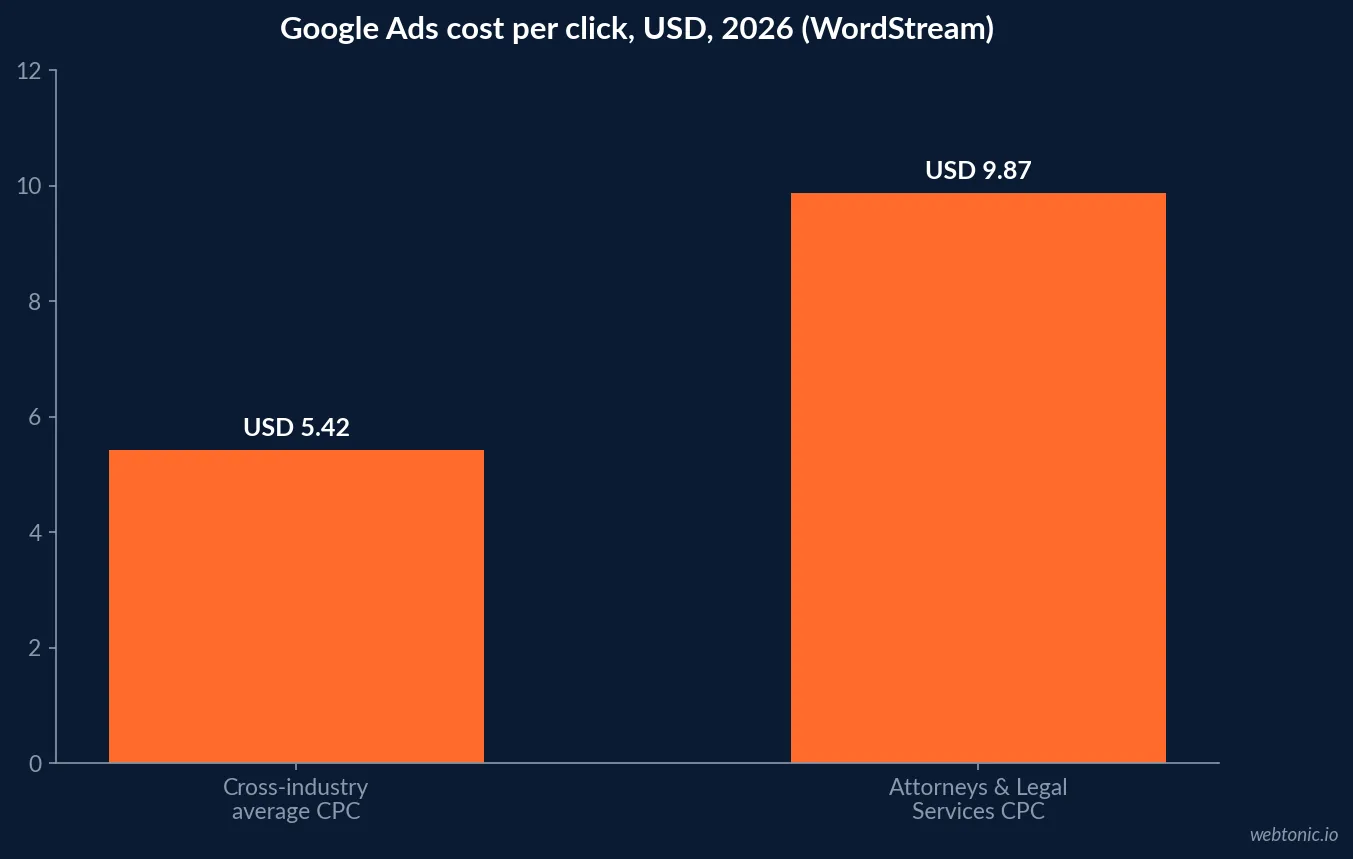
Before any creative decision, the cost data sets the ceiling. WordStream's 2026 search advertising benchmark - built from 13,474 US-based campaigns across 23 industries running April 2025 through March 2026 - puts Attorneys and Legal Services at a $9.87 average cost per click, the highest of every tracked category, ahead of Furniture at $106.70 CPL and Real Estate at $102.51 CPL on the cost-per-lead side. Legal services itself leads cost per lead too, at $131.63. Immigration law is not broken out separately, but it sits inside this category, and the report attributes the premium to high customer lifetime value: a single retained case funds a great deal of auction spend.
| Metric (Google/Microsoft Search, 2026) | Attorneys & Legal Services | Cross-industry average | Rank |
|---|---|---|---|
| Average CPC | $9.87 | $5.42 | Highest of 23 industries |
| Average CPL | $131.63 | Not disclosed as a single average | Highest of 23 industries |
| Conversion rate | 5.55% | 5.4% | Roughly average |
| Sample size | Part of 13,474 campaigns | 13,474 campaigns, 23 industries | WordStream/LocaliQ 2026 |
What changed on the Meta side in one year
The more interesting movement for creative planning is on Meta. WordStream's Facebook Ads Benchmarks report showed Attorneys and Legal Services at a $1.09 average CPC and 0.99% CTR in the 2024 edition. By the 2025 edition, the same category's CPC had risen to $4.10 and CTR had climbed to 1.76% - and conversion rate on lead campaigns reached 10.53%, the second-highest of any tracked industry behind Restaurants and Food. Costs rose alongside performance, which reads less like a fluke and more like more law firms bidding for the same inventory once the channel started converting.
| Meta metric, Attorneys & Legal Services | 2024 benchmark | 2025 benchmark | Direction |
|---|---|---|---|
| Average CPC | $1.09 | $4.10 | Up ~276% |
| Average CTR | 0.99% | 1.76% | Up ~78% |
| Lead campaign CVR | Not in top-ranked tier | 10.53% | 2nd highest of tracked industries |
| Sample base | WordStream 2024 benchmark set | ~1,800 US campaigns, 2025/2026 update | Expanded sample |
The claim the data does not support
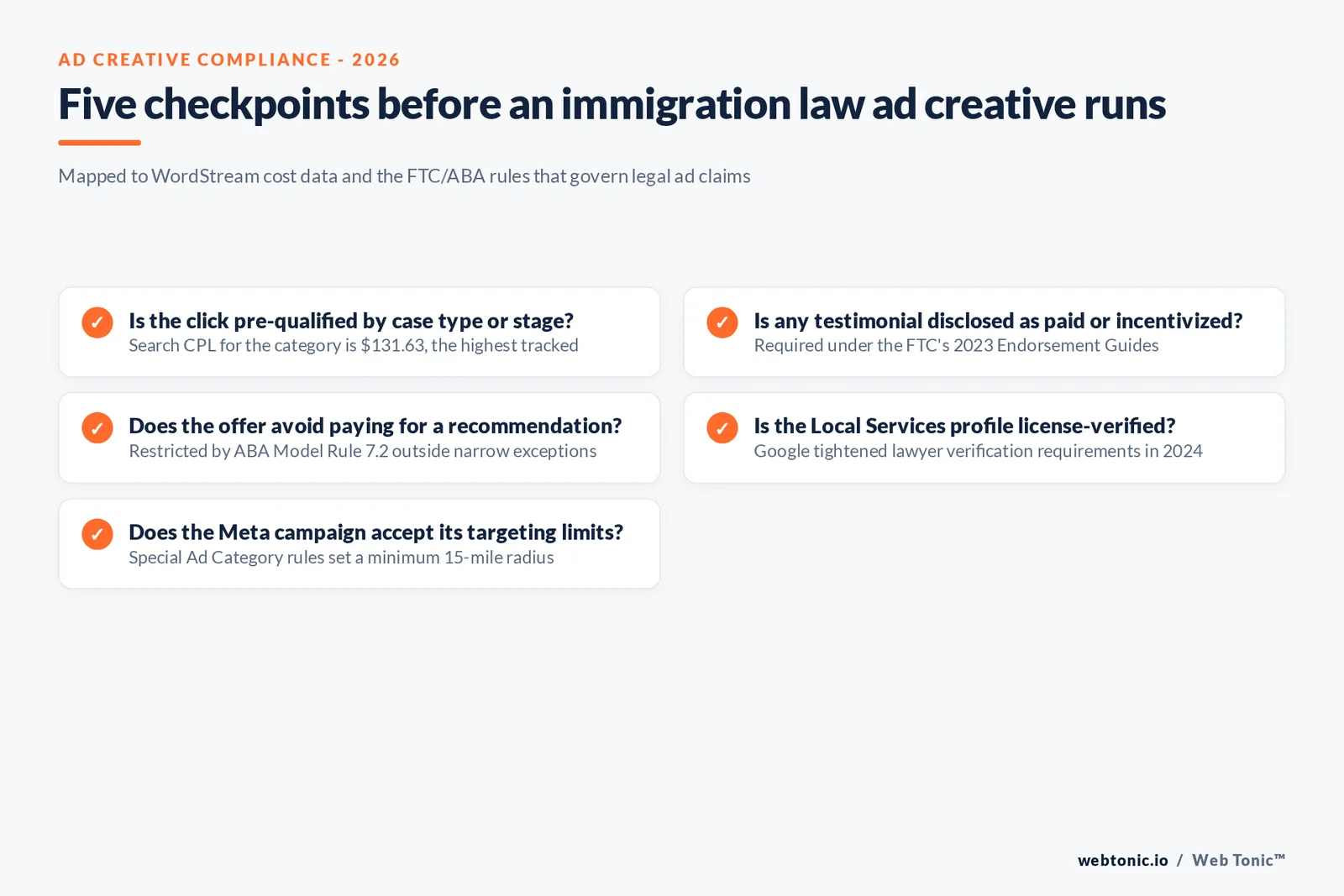
No public study breaks "immigration law" out from the broader Attorneys & Legal Services category, and none scores specific creative formats - video versus static, testimonial versus fact-sheet - against conversion for this vertical. What the category data does support is a cost-discipline argument: at $131.63 per lead in search, creative that pre-qualifies (naming the visa type, the case stage, the circumstance) protects budget better than broad "immigration help" messaging built to maximize clicks rather than qualified inquiries. That is a defensible inference from the cost data, not a tested creative-format finding, and the difference matters when a headline claims to know what "converts."
Where testimonial and endorsement rules cap the creative
Two separate rule sets constrain what an immigration law ad can say and who can say it. The FTC's Guides Concerning the Use of Endorsements and Testimonials in Advertising, revised in 2023, require disclosure of any material connection between an endorser and the advertiser - a paid client testimonial has to say it was paid for or incentivized. Separately, the American Bar Association's Model Rule 7.2 commentary restricts lawyers from paying others to recommend their services outside a narrow set of permitted arrangements (like directory listings or qualified referral services), regardless of FTC disclosure. A testimonial-driven ad creative has to clear both frameworks, and state bar rules on top of them can be stricter still.
| Rule or policy | Issuer | What it restricts | Creative implication |
|---|---|---|---|
| Endorsement Guides, 16 CFR 255 | Federal Trade Commission | Undisclosed material connections in testimonials | Label paid or incentivized client stories clearly |
| Model Rule 7.2 commentary | American Bar Association | Paying for client recommendations | Testimonials must be organic, not compensated referrals |
| Local Services Ads verification | Unverified lawyer identity/license on Local Services | Firm must complete license checks before featured-profile ads run | |
| Special Ad Category targeting rules | Meta | Broad demographic/geo targeting on sensitive categories | Minimum 15-mile radius, no age/gender narrowing when flagged |
What Google and Meta actually check before the creative runs
Beyond content rules, both platforms gate who can advertise at all. Google's own Local Services platform policies require license and business verification before a provider - including attorneys - can serve featured ads, and Google tightened that further in 2024 with identity checks for business owners and named professionals. Meta's own Special Ad Category documentation describes the targeting limits - no fine-grained age, gender or small-radius geo targeting - that apply once a campaign is flagged into a sensitive category, which several legal-services ad accounts encounter regardless of practice area. Neither platform treats immigration law as automatically banned; both treat it as a vertical that has to prove who is behind the ad before the creative gets full reach.
| Verification checkpoint | Platform | What is required | When it applies |
|---|---|---|---|
| Local Services provider verification | License number, business registration, background check | Before any Local Services Ads profile goes live | |
| Local Services identity verification (2024 update) | ID checks for owners and featured professionals | Law firms and practices using Local Services Ads | |
| Special Ad Category declaration | Meta | Category flag plus targeting restriction acceptance | Campaigns Meta classifies as sensitive |
| Ad account business verification | Meta | Business Manager identity confirmation | Ongoing, prior to scaling spend |
None of these checkpoints ban immigration law creative outright; they add friction and lead time before a new account or a new professional can serve ads at scale, which is worth building into a campaign launch timeline rather than discovering mid-flight.
What Clio's firm-side data adds to the creative budget question
The demand side of this equation comes from how firms themselves report spending. Clio's 2026 Legal Trends Report for Solo and Small Law Firms surveyed 1,702 US legal professionals and its companion research on firm spending found that firms running attorney utilization above the industry's 33% benchmark spend 41% more on marketing than average firms, and are 21% more profitable as a result. Firms willing to spend more on creative and testing are also, on this data, the firms already running a tighter operation - which argues against treating a stalled ad account as purely a creative problem when the underlying utilization and intake process may be the real constraint.
| Clio firm-spending metric | Above-benchmark firms | Average firms | Relevance to ad creative budget |
|---|---|---|---|
| Attorney utilization rate | Above 33% | At or below 33% | Correlates with marketing spend capacity |
| Marketing spend | +41% | Baseline | More budget available to test creative variants |
| Software spend | +12% | Baseline | Better tracking of which creative actually converts |
| Firm profitability | +21% | Baseline | More room to absorb a $131.63 CPL while testing |
Building a creative plan the data can actually defend
The honest brief is narrower than most agency pitches suggest: the category-level numbers argue for creative that qualifies hard before the click (specific to visa type, case stage or urgency) given the $131.63 cost per lead, and for treating any testimonial as a compliance decision first and a creative decision second. Firms with the budget to test format-by-format performance - video explainer versus static fact-sheet versus case-outcome data visualizations - are the ones who will eventually produce the immigration-specific creative benchmark that does not exist yet. Our performance creative team builds and tests that kind of qualification-first ad set, and our breakdown of whether Facebook ads are worth it by vertical covers the ROI side of the same question. For a structured comparison of agencies running this kind of paid legal creative, see our list of Facebook ad agencies, or talk to us directly about a test plan.
Frequently Asked Questions
Does the data actually show which immigration law ad creatives convert best?
No study isolates immigration law specifically - the cross-industry Attorneys & Legal Services category is the closest verified benchmark, and it does not break out ad creative formats by outcome. What the data does show is where the category sits on cost and conversion relative to every other tracked vertical: the highest CPC in Google's search benchmark set and a conversion rate that moved from under 1% to double digits on Meta lead campaigns between 2024 and 2025. Any creative claim more specific than that is a hypothesis to test, not a published finding.
Why is legal advertising so much more expensive than other industries?
WordStream's 2026 Google Ads benchmark data puts Attorneys and Legal Services at a $9.87 average cost per click and $131.63 cost per lead - both the highest of the 23 tracked industries - which the same report attributes to high customer lifetime value per case. A single retained immigration matter can be worth many multiples of the acquisition cost, which is exactly what keeps auction prices high.
Can an immigration law firm use client testimonials in its ad creative?
Only with disclosure. The FTC's Guides Concerning the Use of Endorsements and Testimonials in Advertising require any material connection between the endorser and the advertiser to be disclosed, and the American Bar Association's Model Rule 7.2 commentary separately restricts paying for recommendations of a lawyer's services outside a narrow set of permitted arrangements. A testimonial in a paid ad has to clear both bars, not just one.
Do Google and Meta treat immigration law ads like other legal ads?
Both platforms apply extra verification layers to lawyers rather than blanket bans. Google requires license and identity verification for attorneys using Local Services Ads, and Meta's Special Ad Category framework restricts targeting - age, gender and a minimum 15-mile zip radius - for campaign categories it classifies as sensitive. Immigration practices should expect verification steps most other service businesses skip.
What creative angle does the cost data actually support?
One that treats the click as expensive and the case as high-stakes. At $131.63 per lead in the search channel, per WordStream, creative that filters for genuinely qualified inquiries - specific case type, specific circumstance - protects margin better than broad, generic 'immigration help' messaging that pulls in clicks the firm can't convert. It also means budgeting for a cost per lead in the low hundreds of dollars as the category norm rather than an anomaly to optimize away entirely.
Sources
WordStream - Search Advertising Benchmarks by Industry, 2026
WordStream - 2026 Google Ads Benchmarks
WordStream - Facebook Ads Benchmarks 2025
WordStream - Facebook Ads Benchmarks 2025 (blog breakdown)
WordStream - Facebook Ads Benchmarks for 2024
Federal Trade Commission - Endorsement Guides, 16 CFR Part 255
American Bar Association - Model Rule 7.2 commentary
Google - Local Services platform policies
Meta for Developers - Special Ad Category documentation
Clio - 2026 Legal Trends Report for Solo and Small Law Firms