Table of contents
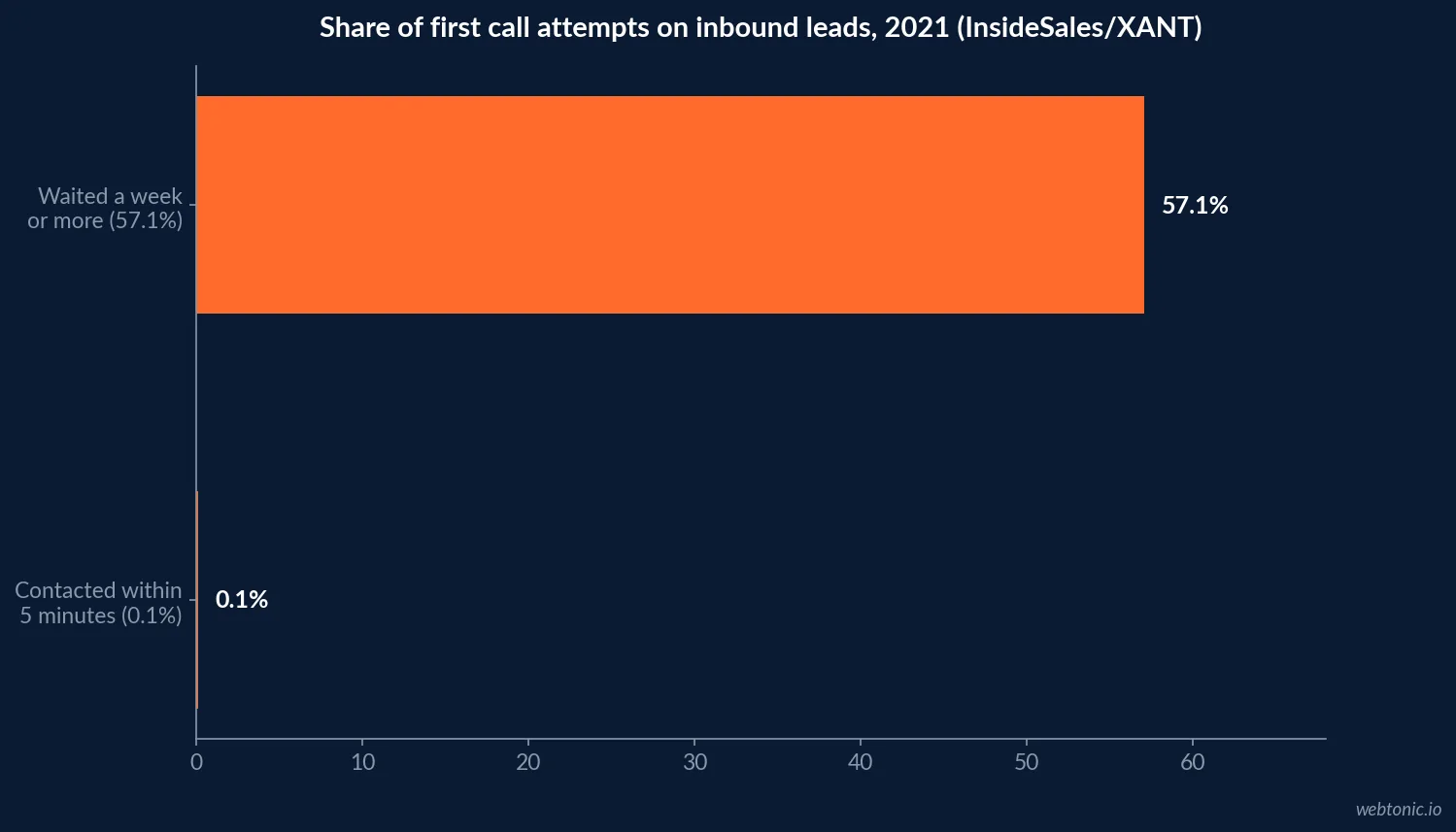
The single largest lever in a 2026 lead-management budget is speed, and most budgets still fund it last. InsideSales' 2021 Lead Response Research, covering 55 million sales activities across 400-plus companies, found that 57.1% of first call attempts on inbound leads happen a week or more after the lead arrives, while only 0.1% are contacted inside five minutes - the window that its data ties to an 8x conversion lift. This page prices out where a campaign manager's budget should actually go, using published 2026 research rather than a vendor feature list.
Key Takeaways
- 57.1% of first call attempts happen a week or later (InsideSales, 2021 study, 400+ companies).
- Only 0.1% of leads are contacted within 5 minutes.
- Conversion runs roughly 8x higher inside that 5-minute window.
- Automated routing cut one team's response time from ~24 hours to under 5 minutes (LeanData).
- That same team saw MQL-to-SQL conversion improve by about 20%.
- Advanced speed-to-lead adopters are 3x more likely to outgrow competitors (LeanData 2026).
- 80% of sales require five or more follow-up touches (Invesp).
- 48% of salespeople never make a second follow-up attempt.
- 44% give up after just one follow-up.
- 60% of customers say no four times before saying yes (Invesp).
- The first follow-up email lifts reply rates by 49% (Belkins).
- Follow-ups drive 58.6% of all replies in Belkins' dataset.
- Two follow-up emails is the reply-rate optimum in B2B outreach (Belkins).
- Only a third of sales teams run one all-in-one platform (Salesforce 2026).
- The rest juggle an average of eight standalone tools.
- Nearly half of reps say they are overwhelmed by tool volume.
- Martech's share of the marketing budget fell to 19.4% in 2026, from 26.6% in 2021 (Gartner via Chief Marketer).
- 81% of revenue leaders say deals are more complex than ever (Gong).
- One Salesforce Agentforce deployment worked 130,000 previously untouched leads in four months.
Why speed is the first budget line, not the last
The evidence base is unusually large for a B2B claim: InsideSales' 2021 Lead Response Research reviewed over 55 million sales activities on 5.7 million inbound leads across 400-plus companies and found 57.1% of first call attempts occur after more than a week. Conversion rates drop 8x once that first contact slips past the first five minutes - and only 0.1% of inbound leads were ever engaged inside that window.
That is not a training problem. It is a budget-allocation problem, and it is the cheapest one on this page to fix.
What routing spend actually returns
LeanData's Speed to Lead in 2026 research documents a customer, TetraScience, cutting response time from roughly 24 hours to under 5 minutes through routing and automation, with MQL-to-SQL conversion improving by about 20%. The same research reports that companies with advanced go-to-market and speed-to-lead practices are three times more likely to outgrow competitors, and that today's buyers interact across more than ten digital channels before a rep ever gets involved.
Budget for routing before budgeting for a bigger sales floor. A team that answers in five minutes converts more of the same lead volume than a bigger team that answers in a week.
| Budget line | What published 2026 data says it returns | Source | Priority |
|---|---|---|---|
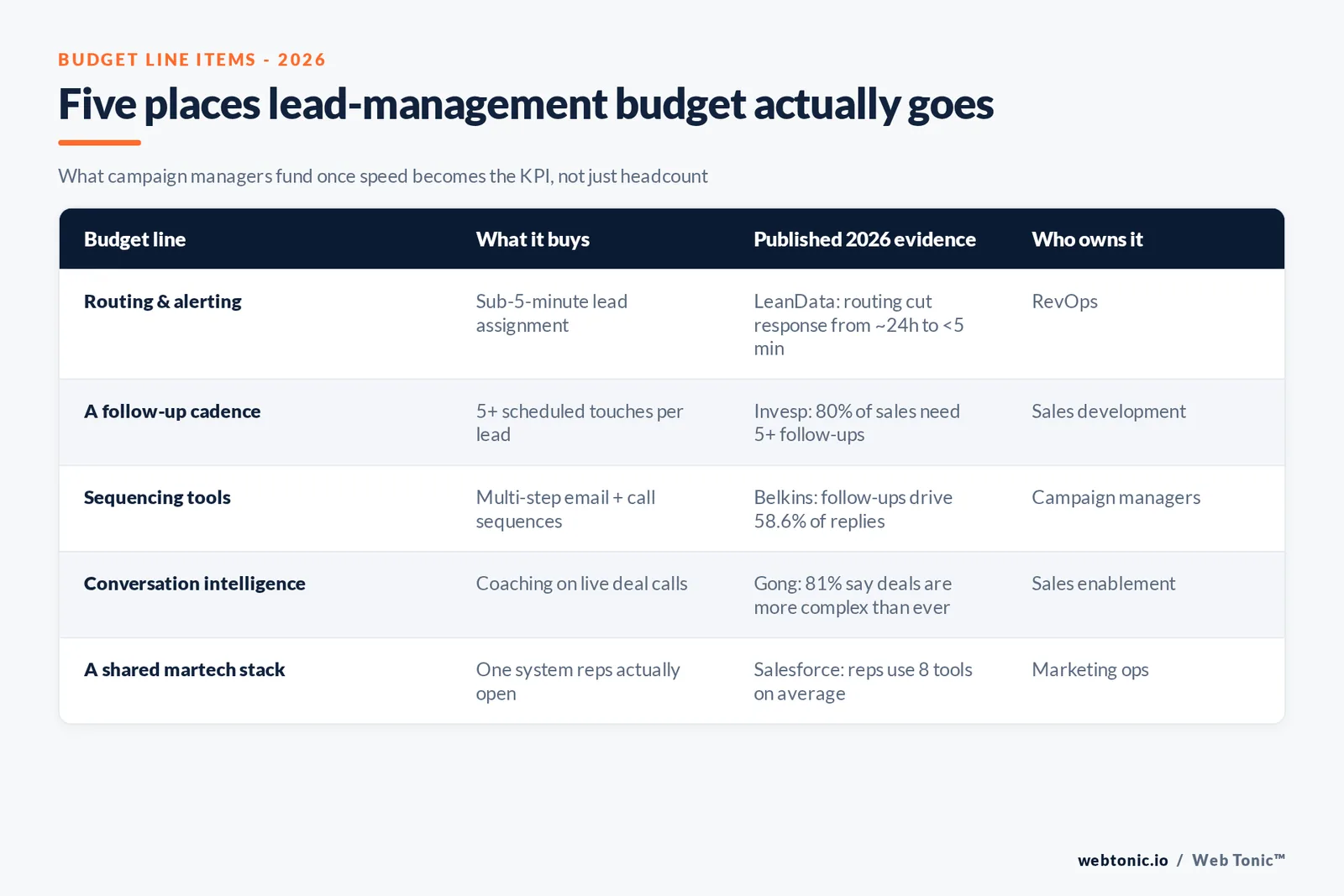
| Lead routing & alerting | Response time cut from ~24h to under 5 min; +20% MQL-to-SQL | LeanData | 1 - fund first |
| Follow-up cadence tooling | 80% of sales need 5+ touches; first follow-up lifts replies 49% | Invesp / Belkins | 2 |
| Conversation intelligence | 81% of revenue leaders call deals more complex than ever | Gong | 3 |
| Consolidated CRM/martech | Reps run 8 tools on average; nearly half feel overwhelmed | Salesforce | 4 |
| AI agents on cold leads | 130,000 leads worked, 3,200 opportunities in 4 months, one deployment | Salesforce | 5 - once routing works |
The follow-up line: what the cadence has to survive
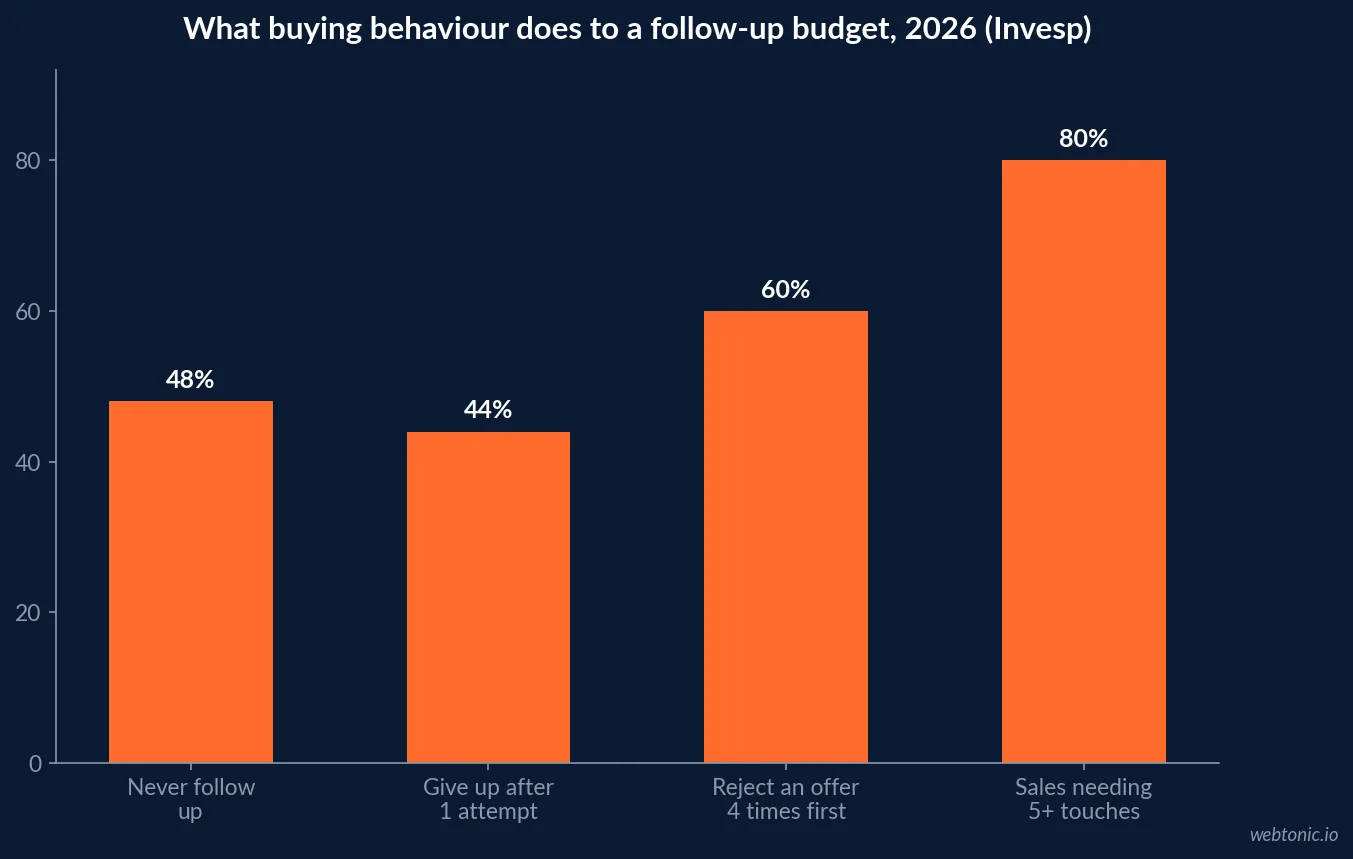
Invesp's sale follow-up research puts the number of contacts behind a typical sale at five or more, and finds 60% of customers say no four times before they say yes. Against that, 48% of salespeople never attempt a second follow-up and 44% stop after just one. The gap between what a sale requires and what a rep actually does is exactly what a cadence budget line is meant to close.
Belkins' follow-up data quantifies the payoff: the first follow-up email lifts reply rates by 49%, and follow-up steps collectively account for 58.6% of every reply the campaign gets. Its outreach benchmarks put the reply-rate optimum at two follow-up emails per sequence.
| Follow-up behaviour (2026) | Figure | Source | Budget implication |
|---|---|---|---|
| Sales requiring 5+ touches | 80% | Invesp | Cadence tool, not a single-touch script |
| Reps who never follow up again | 48% | Invesp | Automation to remove the human drop-off |
| Reps who quit after 1 attempt | 44% | Invesp | Same fix - sequencing over memory |
| Customers rejecting 4 times first | 60% | Invesp | Budget expects a multi-month cadence |
| Reply lift from first follow-up | 49% | Belkins | Justifies the sequencing spend on its own |
| Replies from follow-ups overall | 58.6% | Belkins | Most of the pipeline is in message 2+ |
The tool-consolidation question
The Salesforce State of Sales Report 2026 finds that only a third of sales teams run a single all-in-one platform; the rest use an average of eight standalone tools, and nearly half of reps say they are overwhelmed by that volume. A new point solution added to an already-fragmented stack rarely improves lead management - it adds another login competing for the same five minutes that InsideSales' research says matters most.
Before approving a new tool line, ask whether it replaces two existing logins or adds a ninth. Our data and analytics practice builds the audit that answers that question before the invoice is signed.
Where the martech share of the budget actually sits
Gartner's 2026 CMO Spend Survey, reported by Chief Marketer, puts martech's share of the marketing budget at a five-year low of 19.4% in 2026, down from 26.6% in 2021, even though most CMOs surveyed plan to invest more in marketing technology going forward. That contraction is the backdrop every lead-management budget request has to argue against: the pool is smaller, so the routing and cadence lines above have to outcompete other technology asks on evidence, not on appeal.
| Martech budget fact (2026) | Figure | Source | What it means for lead-management asks |
|---|---|---|---|
| Martech share of marketing budget | 19.4% | Gartner / Chief Marketer | A shrinking pool to compete inside |
| Martech share in 2021 | 26.6% | Gartner / Chief Marketer | The five-year direction is down |
| Sales tools used per team, average | 8 | Salesforce 2026 | Consolidation beats addition |
| Reps overwhelmed by tool volume | Nearly half | Salesforce 2026 | Adoption risk on any new tool |
| Revenue leaders calling deals more complex | 81% | Gong | Coaching tools compete for the same budget |
What AI changes about the budget, and what it doesn't
Salesforce reports one Agentforce deployment where agents contacted 130,000 previously untouched leads and created 3,200 opportunities inside four months, framing it as leads that "used to fall to the floor like sawdust." That is a genuine expansion of capacity, but it is downstream of the same routing and data quality problems this page opens with - an agent working a badly routed lead list still works a badly routed lead list, just faster.
Fund the routing and cadence lines first. The agent layer is the multiplier on top of them, not a replacement for them.
Why the resourcing gap keeps widening
The budget pressure behind all of this is structural, not a one-year dip. The CMO Survey 2026 reports marketing budgets at 9.0% of revenue with spend growth of just 1.7%, while marketing headcount growth is down 50% year on year. The Content Marketing Institute's B2B research finds resourcing the single most common content and demand-generation challenge, cited by 39% of B2B marketers, ahead of measurement at 33% and lead quality at 28%.
Fewer people covering the same lead volume is exactly the condition under which routing and cadence automation stop being nice-to-haves and start being the only way the numbers work.
| Resourcing pressure (2026) | Figure | Source | Effect on lead management |
|---|---|---|---|
| Marketing spend growth | 1.7% | The CMO Survey 2026 | No new budget is arriving |
| Marketing headcount growth | Down 50% YoY | The CMO Survey 2026 | Fewer people work the same leads |
| B2B marketers citing resourcing as top challenge | 39% | CMI B2B Research | Automation has to cover the gap |
| B2B marketers citing measurement as a challenge | 33% | CMI B2B Research | Budget requests need harder proof |
| B2B marketers citing lead quality as a challenge | 28% | CMI B2B Research | Routing has to also filter, not just speed up |
What high-growth teams fund differently
Hinge Marketing's 2026 High Growth Study finds high-growth professional services firms spend 12.0% of revenue on marketing against 5.0% for no-growth firms, and pull 39.5% of new leads from referrals - a channel that lives or dies on how quickly and consistently a firm follows up with the people making the introduction. The same study puts overall firm growth at a median of just 9.9%, the lowest since 2018, which raises the stakes on every lead a budget is spent trying to convert.
The pattern across every source on this page is consistent: budget follows speed and follow-up discipline, not headcount or tool count, and the firms already growing fastest are the ones spending more on marketing as a share of revenue, not less.
A simple sequencing for the budget conversation
Put routing and response-time SLAs first because InsideSales' data shows the largest single conversion swing sits there. Put a follow-up cadence tool second because Invesp and Belkins both show most of the pipeline is lost between attempt one and attempt five. Consolidate the stack before adding to it, because Salesforce's overwhelmed-rep data says adoption failure is the real cost of a ninth tool. Only then add AI agents or conversation intelligence, once the leads reaching them are routed and followed up on correctly.
If you want the campaign-side half of this fixed - the channels and creative feeding the funnel that lead management has to keep up with - talk to us, or see how our growth marketing practice approaches funnel handoffs end to end.
| Sequencing step | Budget priority | Metric that proves it worked |
|---|---|---|
| 1. Routing and response-time SLA | Highest | % of leads contacted within 5 minutes |
| 2. Follow-up cadence tooling | High | Touches per lead before close or disqualification |
| 3. Stack consolidation | Medium | Number of tools an average rep logs into daily |
| 4. Conversation intelligence | Medium | Win rate on coached vs. uncoached calls |
| 5. AI agents on cold/aged leads | Lowest until routing works | Opportunities created from previously untouched leads |
Frequently Asked Questions
What should a lead-management budget prioritize first?
Routing and alerting, not headcount. LeanData's 2026 Speed to Lead research documents one enterprise case where automated routing cut response time from roughly 24 hours to under 5 minutes and lifted MQL-to-SQL conversion by about 20%. InsideSales' 2021 Lead Response Research, built on 55 million sales activities across 400-plus companies, found 57.1% of first call attempts still land a week or more after the lead arrives. A budget that fixes that gap before it buys anything else is spending on the highest-leverage line item available.
How many follow-up touches does the budget need to fund?
At least five. Invesp's follow-up research puts the number of contacts behind a typical sale at five or more, yet reports that 48% of salespeople never attempt a second follow-up and 44% stop after one. Belkins' outreach data adds the mechanism: the first follow-up email alone lifts reply rates by 49%, and follow-ups collectively generate 58.6% of all replies in its dataset. A cadence tool that enforces five touches is cheap next to the pipeline lost to a single-attempt process.
Is more sales software the right place to spend?
Not by default. Salesforce's 2026 State of Sales Report finds only a third of sales teams run one all-in-one platform; the rest juggle an average of eight standalone tools, and nearly half of reps say they are overwhelmed by the volume. The budget question is consolidation before addition - a shared system reps actually open beats a ninth login nobody adopts.
Does AI change what the lead-management line should cover?
It is already moving money there, but slowly relative to the hype. Gartner's 2026 CMO Spend Survey, reported by Chief Marketer, shows martech's share of the marketing budget at a five-year low of 19.4%, down from 26.6% in 2021, even as most CMOs plan to raise martech investment. Salesforce separately reports agents working previously untouched leads - 130,000 contacted, 3,200 opportunities created, in four months at one deployment. Budget for the routing and data layer AI agents need before budgeting for the agents themselves.
What is the cheapest fix with the biggest measurable return?
A response-time SLA enforced by routing rules. InsideSales measured an 8x jump in conversion when a lead is contacted within 5 minutes versus later, and found only 0.1% of leads were actually reached that fast. Closing even part of that gap costs a routing rule change, not a new headcount line, and the return shows up in the very next reporting cycle.
Sources
InsideSales (XANT) - 2021 Lead Response Research
LeanData - Speed to Lead in 2026
Invesp - The Importance of Sales Follow-Ups
Belkins - Sales follow-up statistics
Salesforce - State of Sales Report 2026
Chief Marketer - Gartner 2026 CMO Spend Survey coverage
Gong - The State of Revenue AI 2026
HubSpot - Sales statistics, drawn from the Sales Trends Report
The CMO Survey - Highlights and Insights Report 2026
Content Marketing Institute - B2B Content Marketing Trends Research
Hinge Marketing - 2026 High Growth Study