Table of contents
93.8% of marketers say the leads they generate now are better quality than a year ago, yet 34% still call limited visibility into funnel performance their single biggest obstacle. This page reads HubSpot's marketer survey, CMI's B2B content research, Ascend2's 2026 challenges data and WordStream's cost-per-lead figures together to show what is actually moving pipeline in 2026, and what is still stuck.
Key Takeaways
- 93.8% of marketers say their lead quality improved over the past year.
- 55.7% say lead generation is easier than a decade ago.
- 24.5% saw lead volume significantly increase in the past 12 months.
- 30% still call lead generation a top challenge, per HubSpot.
- 34% of B2B marketers cite limited funnel visibility as their top obstacle.
- 33% say having too few channels limits full-funnel success.
- 31% still struggle specifically with top-of-funnel lead generation.
- Website, blog and SEO rank first for reported ROI, at 30.2%.
- Email marketing follows at 23.6% reported ROI, paid social at 23.3%.
- Average email ROI is USD 36 for every dollar spent, per Litmus.
- 87% say content marketing built brand awareness in the past 12 months.
- 74% say content marketing helped generate demand or leads.
- 49% say content marketing directly helped generate sales or revenue.
- The average cost per lead across Google Ads is USD 70.11.
- Attorneys & Legal Services pay up to USD 131.63 per lead.
- Measuring marketing ROI is marketers' top roadblock, at 33%.
The state of lead generation, in the marketers' own numbers
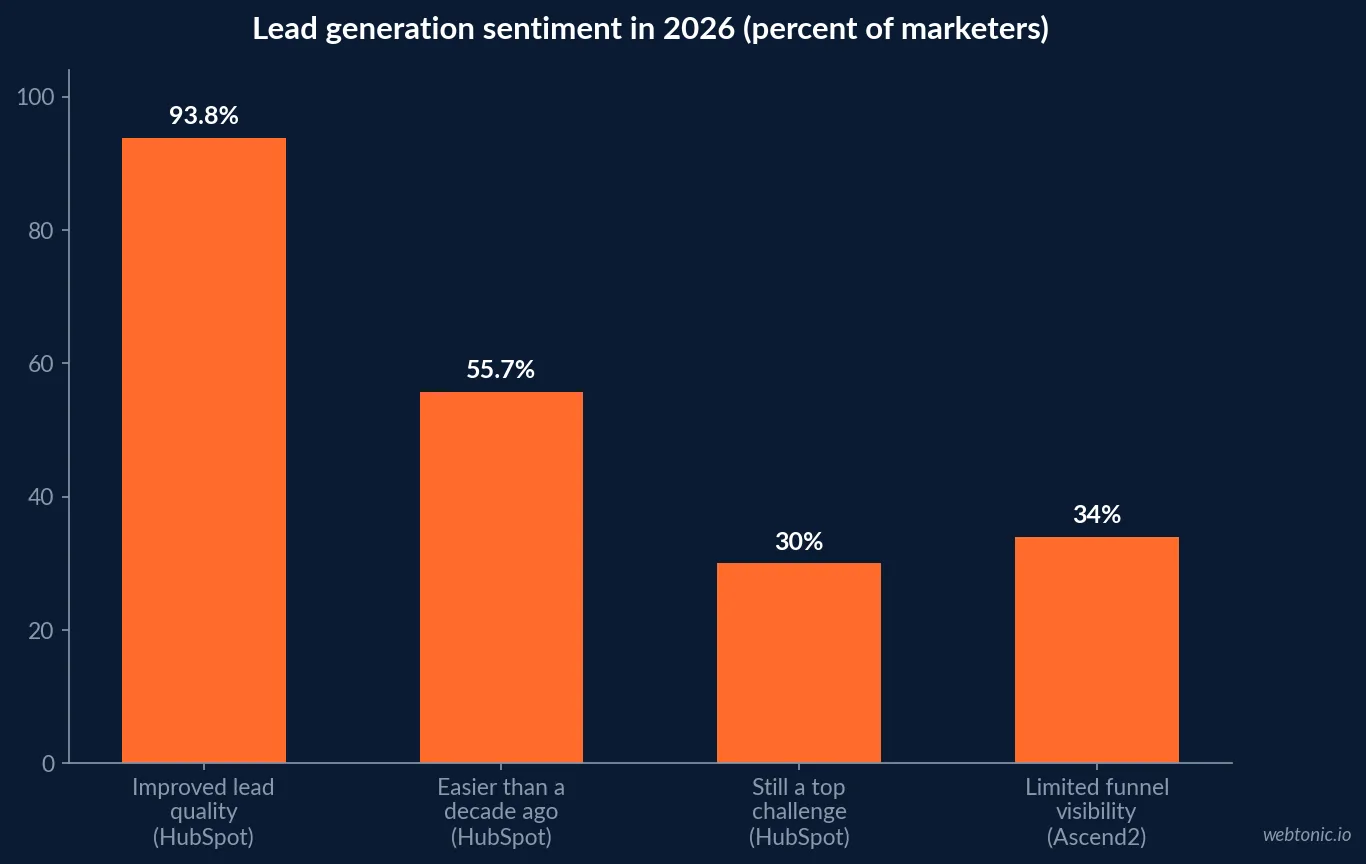
HubSpot's 2026 marketer survey paints a genuinely two-sided picture: 55.7% say generating leads is easier than a decade ago, 24.5% saw lead volume significantly increase in the past year, and 93.8% say the leads they get are better quality than they were - yet 30% still name lead generation a top challenge for 2026.
That is not a contradiction so much as a shift in where the difficulty sits. The volume and quality problems marketers fought a decade ago have largely been addressed by better targeting tools; what has replaced them is the harder job of proving which of those better leads actually turns into revenue.
| Lead generation signal (HubSpot, 2026) | Figure | Direction |
|---|---|---|
| Marketers saying lead gen is easier than a decade ago | 55.7% | Positive |
| Marketers reporting significantly increased lead volume | 24.5% | Positive |
| Marketers reporting improved lead quality | 93.8% | Positive |
| Marketers naming lead gen a top challenge | 30% | Still unresolved |
| Marketers citing lead volume as a key success metric | 29.2% | Volume still tracked |
The actual obstacle: visibility, not volume
Ascend2's 2026 research on full-funnel B2B marketing success names limited visibility into funnel performance or attribution the single biggest obstacle, at 34%, ahead of too few channels (33%) and, notably, ahead of generating top-of-funnel leads itself (31%). Marketers report more difficulty proving which leads matter than producing leads in the first place.
HubSpot's own data backs this from a different angle: measuring marketing ROI is the single largest roadblock marketers report for 2026, at 33%, ahead of keeping up with platform changes and generating leads itself.
| Top obstacle to full-funnel marketing success (Ascend2, 2026) | Share citing it | Rank |
|---|---|---|
| Limited visibility into funnel performance / attribution | 34% | 1st |
| Too few channels | 33% | 2nd |
| Generating top-of-funnel leads | 31% | 3rd |
| Measuring marketing ROI (HubSpot, separate survey) | 33% | Top HubSpot roadblock |
Which channel actually returns the most per lead
HubSpot's channel ranking puts website, blog and SEO first for reported ROI at 30.2%, ahead of email marketing at 23.6% and paid social content at 23.3%. Litmus separately quantifies email's return directly at an average USD 36 for every dollar spent - the highest of any channel it tracks - which explains why email keeps surfacing near the top of lead-gen ROI data even in years when budget keeps shifting toward paid social and video.
| Channel | Reported ROI rank (HubSpot 2026) | Separate ROI figure |
|---|---|---|
| Website / blog / SEO | 1st, 30.2% | - |
| Email marketing | 2nd, 23.6% | USD 36 per dollar spent (Litmus) |
| Paid social content | 3rd, 23.3% | - |
| Organic social / content marketing | Ranks highly, below top 3 | See content marketing section below |
What content marketing is actually converting into
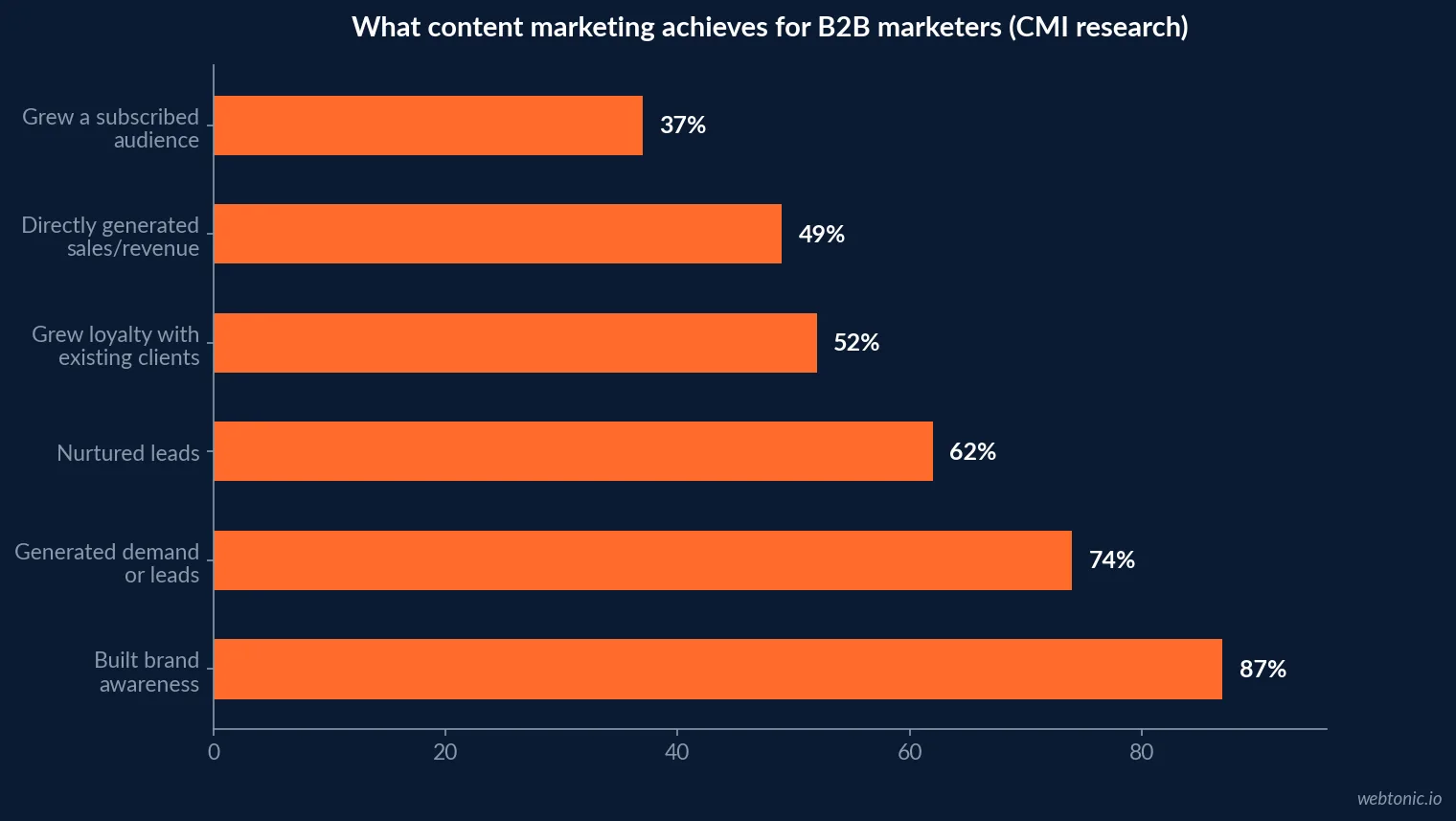
The Content Marketing Institute's B2B research asked marketers what content marketing achieved for them directly, not what they hoped it would: 87% say it built brand awareness in the past 12 months, 74% say it helped generate demand or leads, 62% say it nurtured existing leads, 52% say it grew loyalty with existing clients, and 49% say it directly generated sales or revenue.
That descending order - awareness highest, revenue lowest - is the expected shape of a funnel metric, not a flaw in content marketing. It is also the reason content programs measured only on revenue attribution routinely undercount what they are actually doing higher up the funnel.
| What content marketing achieved (CMI B2B research) | Share of B2B marketers reporting it |
|---|---|
| Built brand awareness in the past 12 months | 87% |
| Helped generate demand or leads | 74% |
| Nurtured subscribers / audience / leads | 62% |
| Grew loyalty with existing clients / customers | 52% |
| Directly helped generate sales or revenue | 49% |
| Grew a subscribed audience | 37% |
What a lead actually costs once it converts
WordStream's data across roughly 20 business categories puts the average cost per lead across Google Ads at USD 70.11, but the range around that average is wide: Attorneys & Legal Services pay up to USD 131.63, Furniture pays USD 121.51, and Business Services pays USD 103.54 - all longer-consideration categories. Restaurants & Food and Animals & Pets sit near USD 30 per lead, at the cheap end of the same dataset.
A lead-gen budget that ignores this spread will consistently misjudge performance: a USD 100 cost per lead is expensive in a low-consideration category and reasonable, even good, in a long-cycle one.
| Category | Avg. cost per lead (Google Ads) | Sales-cycle read |
|---|---|---|
| Attorneys & Legal Services | USD 131.63 | Long consideration |
| Furniture | USD 121.51 | Long consideration |
| Business Services | USD 103.54 | Long consideration |
| All categories, average | USD 70.11 | - |
| Restaurants & Food | USD 30.27 | Low consideration |
| Animals & Pets | ~USD 31 | Low consideration |
What AI-assisted follow-up is doing to the same funnel
HubSpot's own customer data offers a directional read on where AI is already changing lead generation outcomes: customers using AI tools to define target audiences, draft outreach and automate routine follow-ups are generating 4x more leads than comparable customers who are not, and those using AI to improve how they show up in AI-driven answers are capturing nearly 3x more marketing-qualified leads.
Read this figure as a customer-base comparison, not an independent academic study - HubSpot is measuring its own product's effect. It is still a useful directional signal that the visibility gap described above is exactly where AI-assisted follow-up is being pointed first.
| Where AI is applied (HubSpot customer data) | Reported outcome |
|---|---|
| Audience definition, outreach drafting, automated follow-up | 4x more leads generated |
| Improving visibility in AI-generated answers | Nearly 3x more MQLs |
| Prospect research and personalized sales email drafting | 80% more meetings booked |
| Data enrichment on existing pipeline | 56% faster deal close, 64% higher close rate |
Closing the visibility gap that marketers actually flag
Since attribution, not lead volume, is the obstacle marketers name most in 2026, the highest- leverage fix is rarely another top-of-funnel campaign. It is a measurement layer that can say which channel, content piece or campaign actually produced the lead that closed - the exact gap Ascend2's 34% and HubSpot's 33% describe from two different surveys.
Our data and analytics practice builds that attribution layer before recommending new spend, on the logic that a program cannot be optimized on a number it cannot yet see clearly.
Where paid channels fit into this pipeline picture
The cost-per-lead figures above come from paid search specifically; the same logic applies once paid social or a full-funnel program is added. See our guides on building a Google Ads strategy and whether paid social is worth it for how channel-level ROI and lead cost interact once a campaign is actually live.
Turning this data into a pipeline plan
None of the figures above recommend a single channel mix; they describe where marketers report the return sitting and where they report the visibility gap sitting. A plan built on both - funding the channels HubSpot and Litmus rank highest, while closing the attribution gap Ascend2 and HubSpot both flag - is the version of this data that actually changes a pipeline number.
If the goal is a lead-gen plan built on your own attribution rather than a survey average, talk to us, or see how our growth marketing practice sequences channel investment against measured, not reported, return.
What to check before the next budget cycle
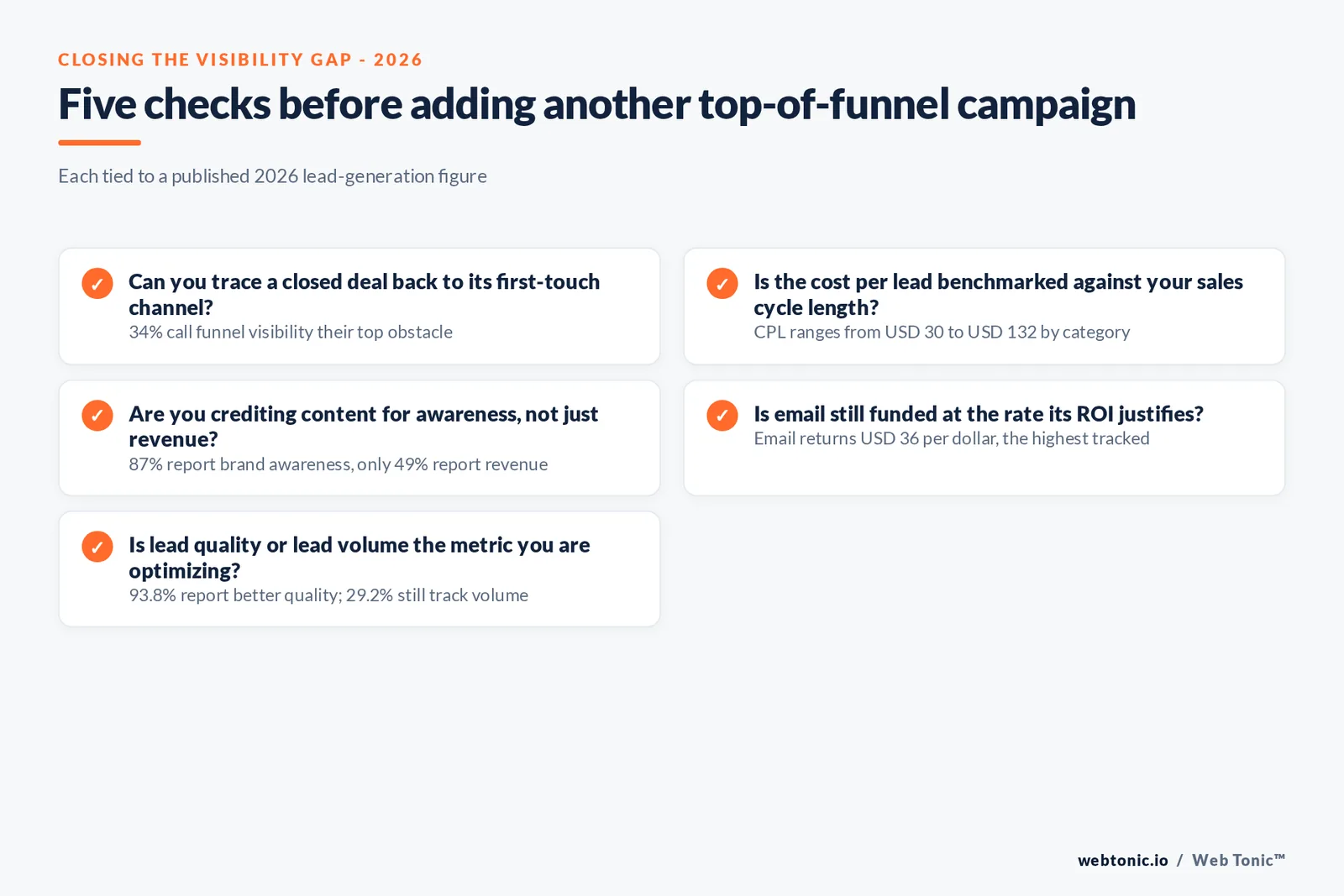
Revisit three things before adding spend: whether the channel producing the most leads is also the channel HubSpot's and Litmus's data rank highest on ROI, whether the funnel has a way to trace a closed deal back to its first-touch source, and whether cost-per-lead expectations are set against the right sales-cycle length rather than a single blended average. Those three checks account for most of the gap between the reported figures in this piece and what a specific pipeline is actually seeing.
Frequently Asked Questions
Is lead generation getting easier or harder in 2026?
Both, by the marketers' own account. HubSpot's survey found **55.7%** say generating leads is easier than a decade ago and **93.8%** say lead quality improved over the past year, yet **30%** still name lead generation a top challenge and, separately, Ascend2's 2026 research found **34%** of B2B marketers cite limited funnel visibility as their leading obstacle. The tools have improved faster than the ability to prove what they are actually producing.
What is the average cost per lead in 2026?
WordStream's data across roughly 20 business categories puts the **average cost per lead across Google Ads at USD 70.11**, ranging from around **USD 30** in low-consideration categories like Restaurants & Food and Animals & Pets up to **USD 131.63** for Attorneys & Legal Services and **USD 121.51** for Furniture - both long sales-cycle categories where each lead is worth defending with a bigger acquisition budget.
Which channel produces the best lead generation ROI?
HubSpot's marketer survey ranks **website, blog and SEO first at 30.2%** reported ROI, ahead of **email marketing at 23.6%** and **paid social content at 23.3%**. Litmus separately quantifies email specifically at an average **USD 36** return per dollar spent - the highest of any channel it tracks - which is why email keeps appearing near the top of lead-gen ROI rankings even as budget keeps shifting toward paid social.
Does content marketing actually generate leads?
Yes, by a wide margin according to B2B marketers themselves. The Content Marketing Institute's B2B research found **87%** of B2B marketers say content marketing helped create brand awareness in the past 12 months, **74%** say it helped generate demand or leads, **62%** say it nurtured existing leads, and **49%** say it directly helped generate sales or revenue.
What is the single biggest lead generation obstacle right now?
Visibility, not volume. Ascend2's 2026 research on B2B full-funnel marketing found **34%** of marketers name **limited visibility into funnel performance or attribution** as their top obstacle, ahead of having **too few channels (33%)** and **generating top-of-funnel leads (31%)** itself. In other words, marketers report more trouble proving which leads matter than actually producing leads.
Sources
HubSpot - 2026 state of marketing: data from 1,500+ global marketers
HubSpot - The top marketing channels of 2026, according to marketers
HubSpot - How successful marketing teams optimize performance in 2026
Ascend2 - The state of B2B thought leadership in 2026
Content Marketing Institute - B2B Content Marketing Benchmarks, Budgets and Trends
Litmus - Email Marketing ROI guide
WordStream - Conversion rate benchmarks for your industry
HubSpot - HubSpot data: AI is driving real outcomes for GTM teams