Table of contents
Roofing pays more per paid-search lead than any other home-services trade tracked in 2025 - and the published 2026 contractor data shows budget visibly rotating away from that single channel toward reputation, referrals, insurance-adjacent demand and faster lead follow-up. Here is what the primary sources actually say about where the money is moving, in order.
Key Takeaways
- $228.15 average cost per lead for Roofing & Gutters paid search, the highest of 16 home-services subcategories.
- 3.70% average conversion rate on those roofing search ad clicks, the second-lowest tracked.
- $10.70 average cost per click for roofing and gutters search ads in 2025.
- 41% of contractors are focused specifically on marketing efficiency in 2026.
- 59% cite reputation as their top competitive differentiator, ahead of communication and service.
- Only 16% of contractors follow up the same day on an unsold estimate.
- 67% have adopted some form of faster-response process on paper.
- 40% of contractors participate in insurance-driven roofing work.
- 47% cite claims complexity and 36% cite adjuster delays as insurance-pipeline drag.
- 39% of contractors name rising labor and overhead costs their top business threat.
- 34% cite skilled-labor shortages as a compounding pressure.
- The average home-services search ad cost per lead across all trades is $90.92 - roofing runs at roughly 2.5x that figure.
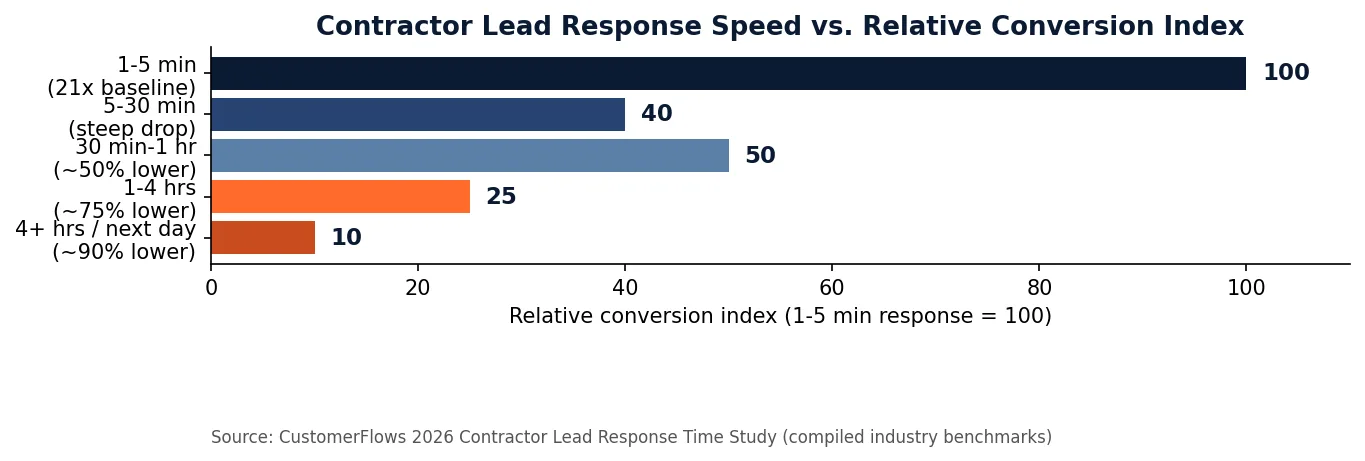
- A 5-minute lead response is linked to a 21x higher qualification rate than a 30-minute one.
- Contractors who wait 4-plus hours or until the next business day see roughly 90% lower conversion.
- 36% of contractors see customization as next year's biggest growth opportunity.
- 75% of contractors surveyed expect revenue growth in 2026 despite tighter margins.
Why paid search is the expensive channel, not the only one
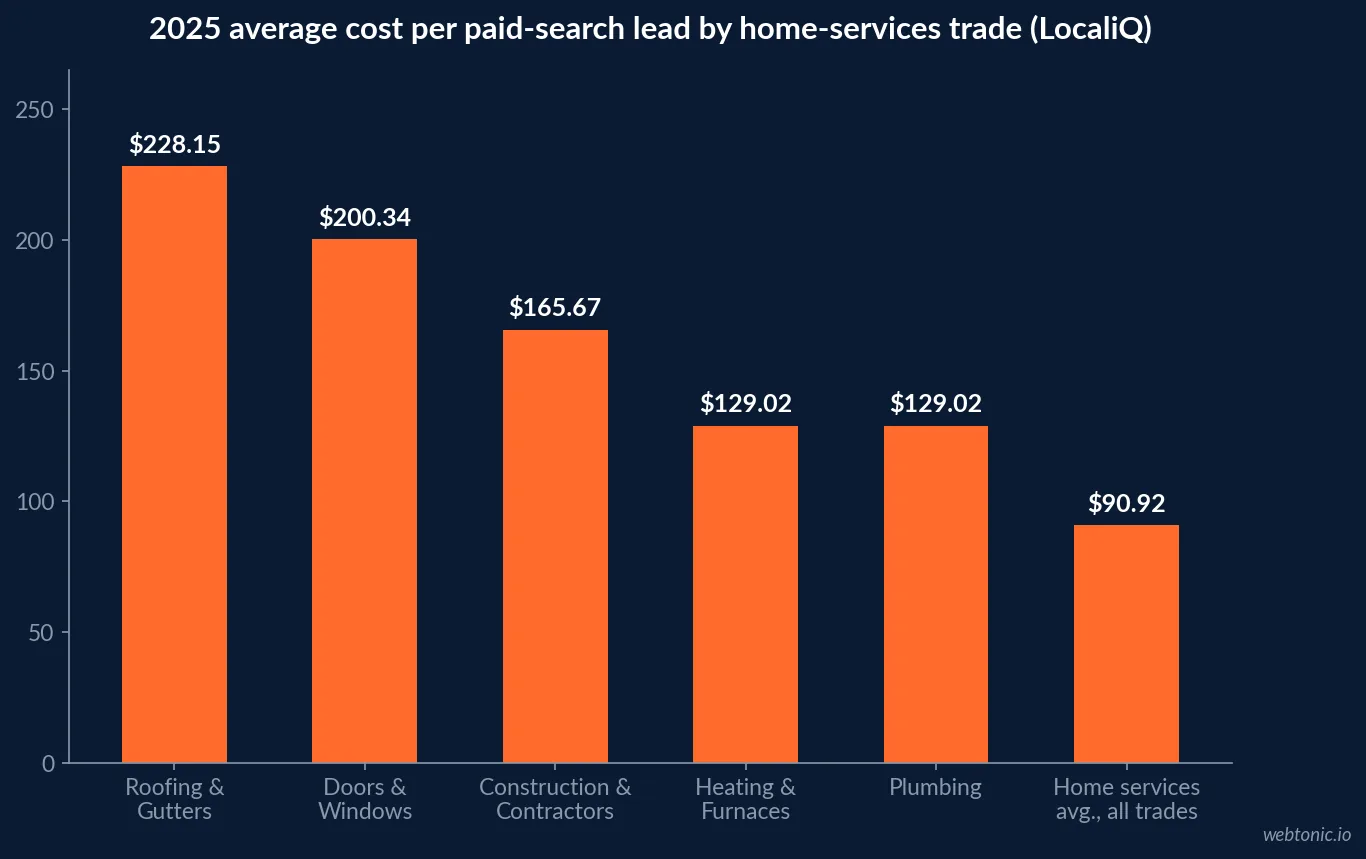
LocaliQ's 2025 Home Services Search Ads Benchmarks report, built from LocaliQ's own advertiser account data, puts the average roofing and gutters cost per lead at $228.15 - the single highest figure among the 16 home-services subcategories it tracks, ahead of Doors & Windows Sales ($200.34) and general Construction & Contractors ($165.67). The category average across all home services is $90.92, so roofing runs at roughly 2.5 times the category norm. Conversion rate on those clicks is also weak at 3.70%, second-lowest of the 16 subcategories, against a cost per click of $10.70.
That combination - high click cost, low conversion, high resulting lead cost - is the single clearest published reason a roofing budget cannot be built on paid search alone.
| Home services subcategory (2025) | Avg. CPC | Avg. conversion rate | Avg. cost per lead |
|---|---|---|---|
| Roofing & Gutters | $10.70 | 3.70% | $228.15 |
| Doors & Windows Sales | $8.76 | 4.41% | $200.34 |
| Construction & Contractors (General) | $5.31 | 2.61% | $165.67 |
| Heating & Furnaces | $9.30 | 7.48% | $129.02 |
| Plumbing | $10.49 | 7.63% | $129.02 |
| Home services average, all trades | $7.85 | 7.33% | $90.92 |
What ServiceTitan's 2026 contractor survey says budget is moving toward
ServiceTitan's 2026 Roofing & Exterior Market Report, fielded by Thrive Analytics across more than 1,000 residential and commercial roofing-focused companies with revenue above $5 million, found 41% of contractors now name marketing efficiency a specific area of focus - not simply more spend, but better-targeted spend. Reputation is the single most-cited competitive differentiator, at 59%, ahead of transparent communication (47%) and exceptional customer service (43%). Those three factors, not ad spend, are what contractors say separates the winners in a tighter-margin market.
| What contractors say drives competitive advantage (2026) | Share citing it |
|---|---|
| Reputation | 59% |
| Transparent communication | 47% |
| Exceptional customer service | 43% |
| Robust production/technology features | 47% |
| Ease of use of technology | 29% |
| Workflow configurability | 24% |
The follow-up gap that is cheaper to fix than any media budget increase
The same ServiceTitan report found only 16% of contractors follow up with a homeowner the same day on an unsold estimate, even though 67% say they have adopted a faster-response approach in principle - a gap between stated process and actual practice. CustomerFlows' 2026 Contractor Lead Response Time Study (an industry-benchmark compilation, not an original survey) quantifies the shape of that gap: contractors who respond within 1 to 5 minutes are 21 times more likely to qualify a lead than those responding at the 30-minute mark, and the benchmark drop-off keeps getting steeper - roughly 90% lower conversion once a contractor waits 4-plus hours or until the next business day, which the same compilation flags as typical for most contractors.
Where insurance-driven demand fits, and where it does not
Insurance claims are a large but operationally heavy source of roofing volume. ServiceTitan's 2026 survey found 40% of contractors participate in insurance work, but claims complexity (47%) and adjuster delays (36%) create real drag on that pipeline. Insurance-driven leads are event-triggered by weather, not bought the way a paid-search click is, so most published contractor guidance treats them as a supplement to a budgeted referral-and-reputation program rather than a channel a business can dial up or down on demand.
Cost pressure compounds the case for diversifying away from paid search alone: 39% of contractors name rising labor and overhead costs their top business threat, and 34% cite sustained skilled-labor shortages, per the same ServiceTitan 2026 data - both of which squeeze the margin a $228.15 lead has to earn back.
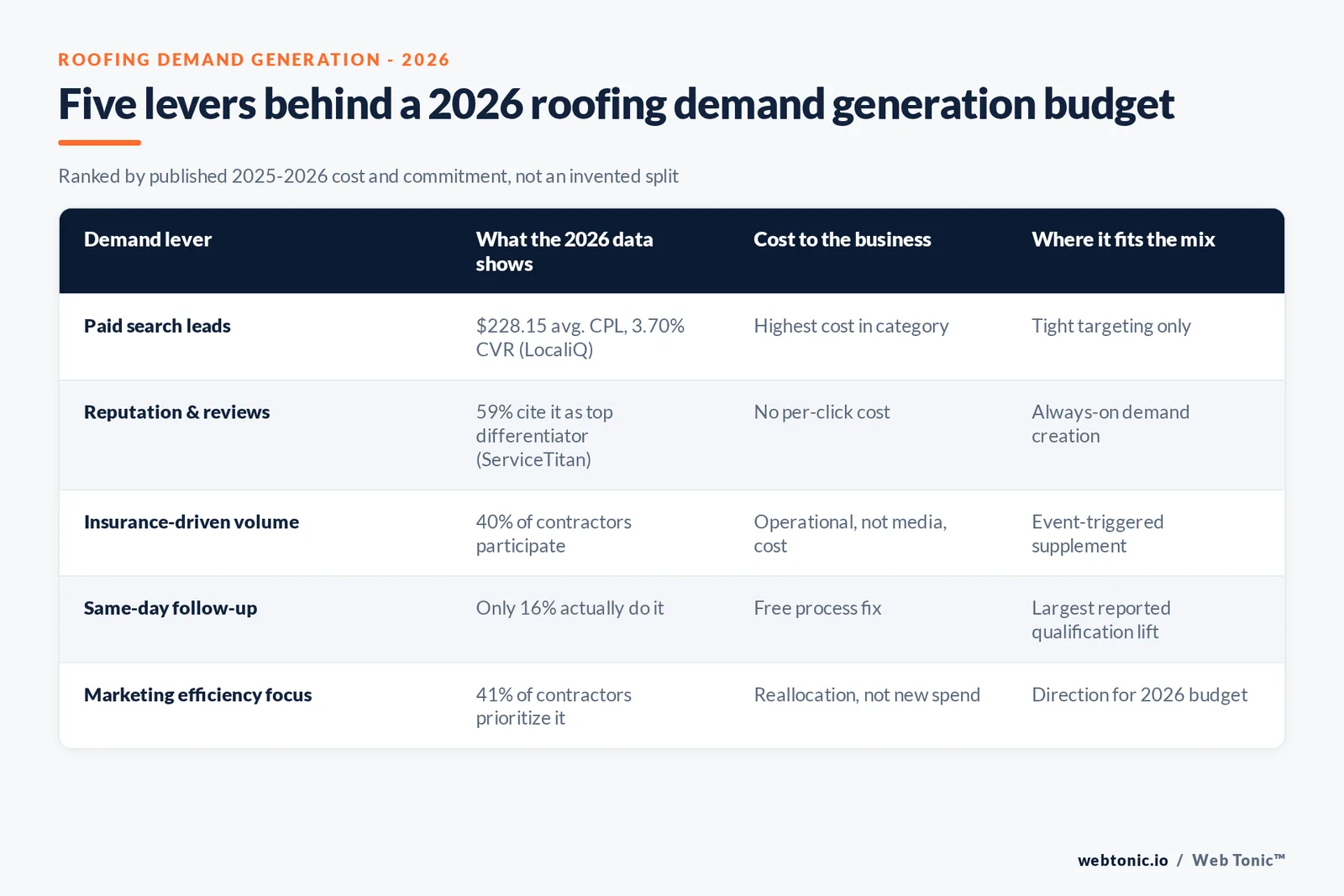
| Roofing demand source (2026 data) | Reported figure | What it means for budget |
|---|---|---|
| Paid search leads | $228.15 avg. CPL, 3.70% CVR | Highest cost, needs the tightest targeting |
| Reputation / reviews | 59% cite it as top differentiator | Compounding, no per-click cost |
| Insurance-driven volume | 40% of contractors participate | Event-triggered, not a bought channel |
| Same-day follow-up | Only 16% actually do it | Free fix, largest reported qualification lift |
| Marketing efficiency focus | 41% of contractors prioritize it | Reallocation over raw spend increase |
Growth expectations against a tighter margin environment
None of this is happening in a shrinking market. ServiceTitan's 2026 report found 75% of surveyed roofing and exterior contractors expect revenue growth this year and 74% foresee increased profits, even as 60% focus on optimizing labor costs and 45% on material costs. For next year, contractors see the biggest growth opportunities in customization (40%), expanding into new trades (36%), and digital transformation (34%) - all demand-side moves, not simply spending more on the same paid-search line.
| 2026 contractor outlook (ServiceTitan) | Figure |
|---|---|
| Expect revenue growth | 75% |
| Expect increased profits | 74% |
| Focused on optimizing labor costs | 60% |
| Focused on optimizing material costs | 45% |
| Focused on marketing efficiency | 41% |
| See customization as next year's top opportunity | 40% |
Demand creation vs. demand capture: why a roof rarely gets bought "in-market"
Most roofing demand is not sitting in a search box waiting to be captured - it is created by a leak, a storm, or a slow accumulation of visible wear, then captured by whichever channel is positioned when the homeowner finally searches. Google's own Demand Gen campaign documentation describes the format's job as reaching up to 3 billion monthly active users across YouTube, Discover, Gmail and Maps specifically to build that pre-search awareness, not just to catch the bottom-of-funnel click a Search campaign already targets. The LinkedIn B2B Institute's widely cited 95-5 rule - based on Ehrenberg-Bass Institute researcher John Dawes' finding that roughly 95% of a category's buyers are not in-market at any given time - was built on B2B categories, not homeowners, but the underlying buying pattern maps onto roofing reasonably well: almost nobody is shopping for a new roof until a specific trigger event happens, which is exactly why reputation and brand presence have to be built before the storm, not after it.
| Demand generation concept | What it targets | Roofing-relevant example |
|---|---|---|
| Demand capture | The small share actively searching right now | Paid search on "roof leak repair near me" |
| Demand creation | The much larger share not yet searching | YouTube/Discover awareness, reputation, reviews |
| Trigger event | What moves a homeowner from not-in-market to in-market | Storm damage, a visible leak, an insurance claim |
What this means for a 2026 roofing marketing budget
Read against each other, the LocaliQ cost data and the ServiceTitan contractor survey point the same direction: paid search still generates real volume, but at the category's highest cost per lead and a below-average conversion rate, which is why a growing share of the reported focus is going to reputation, referral programs and the free fix of faster follow-up rather than simply raising the paid media line further. None of the sources above publish a single "correct" percentage split for a roofing budget - use the direction of the data, not an invented ratio, when planning next year's mix. Our growth marketing practice and performance creative practice build that channel mix from a contractor's own cost-per-lead data rather than a industry-wide average; talk to us if you want that built against your numbers, not this page's averages.
What the data does not yet show
None of the sources cited above publish a roofing-specific breakdown of referral or reputation lead volume the way they publish paid-search cost data - so any number claiming an exact referral share for roofing specifically should be treated as an estimate, not a benchmark. What is well documented is the direction: cost per lead on paid search is the highest in the category, and contractor-reported focus is shifting toward channels that do not carry that per-click cost.
Frequently Asked Questions
Why is roofing's cost per lead the highest of any home-services category?
Because demand is concentrated and urgent. LocaliQ's 2025 Home Services Search Ads Benchmarks report, built from its own advertiser base, puts the average roofing and gutters cost per lead at $228.15 - the highest of the 16 home-services subcategories it tracks, ahead of Doors & Windows Sales at $200.34 and Construction & Contractors at $165.67. Conversion rate on those clicks is also the second-lowest tracked, at 3.70%, so a high cost per click ($10.70) compounds with a low close rate on the click itself.
Is paid search still worth the budget for a roofing company in 2026?
The published data says it is one channel in a mix, not the whole plan. ServiceTitan's 2026 Roofing & Exterior Market Report, fielded by Thrive Analytics across more than 1,000 roofing-focused companies, found 41% of contractors are now focused specifically on marketing efficiency and reputation (59%) is the single most-cited competitive differentiator - ahead of transparent communication (47%) and customer service (43%). That is a signal that budget is shifting toward the channels that compound (reviews, referrals) rather than only the channel with the highest per-lead cost.
What is the biggest free win in roofing demand generation that most contractors are missing?
Speed of follow-up on the leads already being paid for. ServiceTitan's 2026 report found only 16% of contractors follow up with homeowners the same day on an unsold estimate, even though 67% of contractors say they have adopted faster-response processes on paper. CustomerFlows' 2026 Contractor Lead Response Time Study (an industry-benchmark compilation) puts responders in the 1-to-5-minute window at 21x more likely to qualify a lead than those waiting 30 minutes - a process fix, not a media-budget fix.
How much of roofing revenue should come from insurance-driven demand versus direct-to-consumer marketing?
ServiceTitan's 2026 survey found 40% of roofing and exterior contractors participate in insurance work, but claims complexity (47%) and adjuster delays (36%) create real operational drag on that pipeline. Insurance-driven leads are not a marketing channel a contractor buys - they are triggered by a storm event and a claim - so most published guidance treats insurance volume as a supplement to, not a replacement for, budgeted referral and reputation demand generation.
What share of roofing leads should be budgeted toward referrals and reviews instead of ads?
There is no single published percentage specific to roofing, and any number claiming otherwise should be treated with suspicion. What the data does show is direction: reputation is roofing's top-cited differentiator at 59% (ServiceTitan 2026), and LocaliQ's own CPL table shows paid search costing more per roofing lead than any other home-services category - which is why a growing share of budget is going to review generation and referral programs that do not carry a per-click cost, even without a single industry-wide split figure to cite.
Sources
LocaliQ - 2025 Search Ad Benchmarks for Home Services
ServiceTitan - 2026 Roofing & Exterior Market Report (Thrive Analytics)
CustomerFlows - 2026 Contractor Lead Response Time Study
WordStream - Google Ads Benchmarks 2025
Invoca - Home Services Lead Conversion Benchmarks Report 2026
Google Ads Help - About Demand Gen campaigns
LinkedIn B2B Institute - Why You Should Follow The 95-5 Rule