Table of contents

.
Keyword research is the process of finding and evaluating the exact words and phrases real people type into Google, so a website can build content around what its audience is actually searching for, rather than what a brand assumes they're searching for. It's the foundation every other part of SEO sits on: the wrong keyword strategy means a beautifully written, technically perfect page that nobody ever finds.
Most people who try keyword research for the first time make the same mistake. They chase big, broad, obvious terms, the kind with huge search volume and huge competition, and wonder six months later why nothing ranks. The practitioners who actually win at this treat keyword research as a filtering exercise, not a brainstorming one: start broad, then systematically narrow down to the specific, high-intent terms a site can realistically rank for and convert.
Key takeaways
- 95% of all search queries are long-tail keywords that get 10 or fewer searches a month, while just 0.16% of keywords drive 60% of total search demand.
- Ranking for a keyword depends more on matching search intent than on chasing raw search volume, since content that mismatches intent won't rank regardless of technical quality.
- 69% of Google searches now end without a click, which means raw search volume can overstate a keyword's real traffic value.
- The top 3 organic results capture 68.7% of all clicks on queries that do produce a click, making ranking position far more valuable than ranking at all.
- Only 1.74% of newly published pages reach Google's top 10 within a year, but low-competition long-tail keywords can realistically rank in 1 to 3 months.
- Free tools (Google Search Console, Google Trends, Google Keyword Planner) can start a keyword list; paid tools like Ahrefs (from $29/month) and Semrush (from $139.95/month) add volume, difficulty, and competitor data at scale.
Step 1: Start with seed keywords
Seed keywords are the broad terms that describe what a business actually does: the core products, services, or topics, stripped of any modifiers. A dental practice's seed keywords might be "dentist," "teeth whitening," or "dental implants." A software company's might be "project management" or "invoicing software."
Seed keywords are rarely worth targeting directly, since they're the most competitive and least specific terms in the entire keyword universe. Their real job is to act as the starting point for every expansion step that follows.
Step 2: Expand your keyword list
Once the seed list exists, the next step is turning a handful of broad terms into a much larger list of real, specific phrases people actually type.
Google's autocomplete shows exactly what people search for as they type, which makes it one of the most reliable free signals available. People Also Ask boxes on the search results page reveal the follow-up questions real searchers have about a topic. Competitor analysis, looking at what already ranks for a seed term, reveals gaps and adjacent topics worth targeting. And for an existing site, Google Search Console shows the exact queries already driving impressions and clicks, often surfacing "almost-ranking" keywords that just need a small content push to break into the top 10.
Step 3: Understand search intent
Search intent is the reason behind a search, and it's become the single most important factor in keyword selection. A keyword can have solid volume and low competition and still fail to convert if the content built for it doesn't match what searchers actually want when they type that phrase.
| Intent type | Example query | Content to build | Funnel stage |
|---|---|---|---|
| Informational | "how to whiten teeth at home" | Blog post, how-to guide, FAQ page | Top of funnel |
| Commercial | "best teeth whitening kits 2026" | Comparison page, best-of list, buying guide | Middle of funnel |
| Transactional | "book teeth whitening appointment near me" | Service page, location page, booking form | Bottom of funnel |
| Navigational | "[brand name] login" | Homepage, account page | N/A (brand-specific) |
Always confirm intent by checking the actual search results before writing. If the top results for a keyword are all blog posts, a service page won't outrank them, no matter how well it's optimized.
Step 4: Evaluate volume, difficulty, and the long-tail opportunity
This is where most keyword strategies go wrong. It's tempting to chase the keyword with the biggest search volume number, but that number alone doesn't say much about whether a page can actually rank for it or convert once it does.
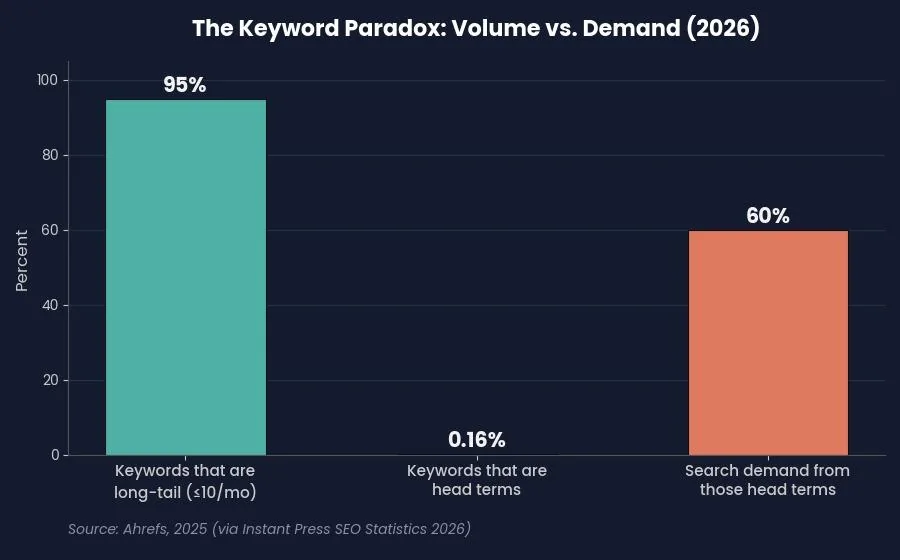
95% of all search queries are long-tail keywords that individually get 10 or fewer searches a month — a figure Instant Press's 2026 SEO Statistics traces back to Ahrefs' 2025 keyword-database analysis. On its own, one long-tail keyword looks unimpressive. But long-tail terms carry two advantages broad terms don't: they're dramatically less competitive, and they convert at a much higher rate because the searcher's intent is already specific. A site with modest authority chasing "running shoes" will likely never see page one. That same site targeting "best running shoes for flat feet" can realistically compete, often within a matter of months rather than years.
Meanwhile, just 0.16% of keywords (the highest-volume head terms) account for 60% of total search demand, which is exactly why they're dominated by the sites with the most authority and the biggest budgets. The practical takeaway: build a keyword strategy around clusters of specific, related long-tail terms rather than betting everything on one broad head term.
Step 5: Check click potential before you commit
Search volume tells you how often a keyword is searched. It doesn't tell you how many of those searches actually result in a visit to a website, and in 2026, that gap has gotten significant.
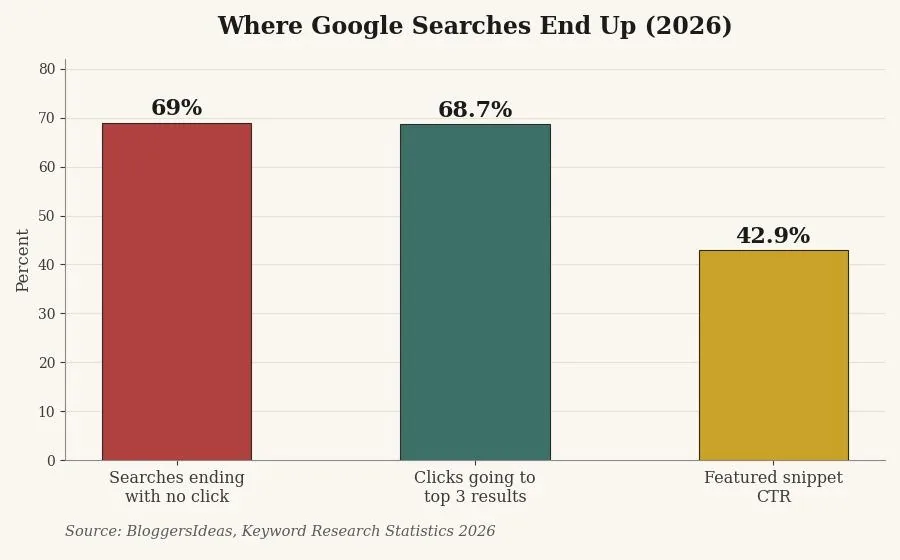
69% of all Google searches now end without a click at all, largely because AI Overviews and featured snippets answer the question directly on the results page. BloggersIdeas' 2026 Keyword Research Statistics puts the numbers behind this precisely: the top 3 organic results capture 68.7% of all clicks, and featured snippets alone achieve a 42.9% click-through rate, higher than a standard position 1 listing. This is why a keyword with high search volume but a purely informational, easily-summarized answer can be far less valuable than a lower-volume keyword tied to a question Google can't fully answer without a click.
Step 6: Prioritize and map keywords to content
With a filtered, intent-tagged list in hand, the last step is deciding what to build first and where each keyword lives.
Every keyword should map to exactly one page. Assigning the same keyword to multiple pages creates internal competition, called keyword cannibalization, where a site's own pages compete against each other instead of against outside competitors, as Ahrefs' glossary entry on the topic explains in more depth. Related long-tail terms should cluster together under a single, more comprehensive page rather than being split into several thin ones. Prioritization generally comes down to three questions: How much realistic traffic and revenue could this keyword bring in? How difficult would it be to rank for, given current site authority and competition? And how directly does it match a stage in the buyer's journey where content is actually needed?
Keyword research tool
Keyword prioritization scorer
Score a keyword against the three questions that actually decide what to build first.
Priority score
--
Adjust the sliders to see a recommendation.
Free vs. paid keyword research tools
Keyword research doesn't require an expensive toolset to get started, but paid tools add speed and scale once a strategy is running at volume.
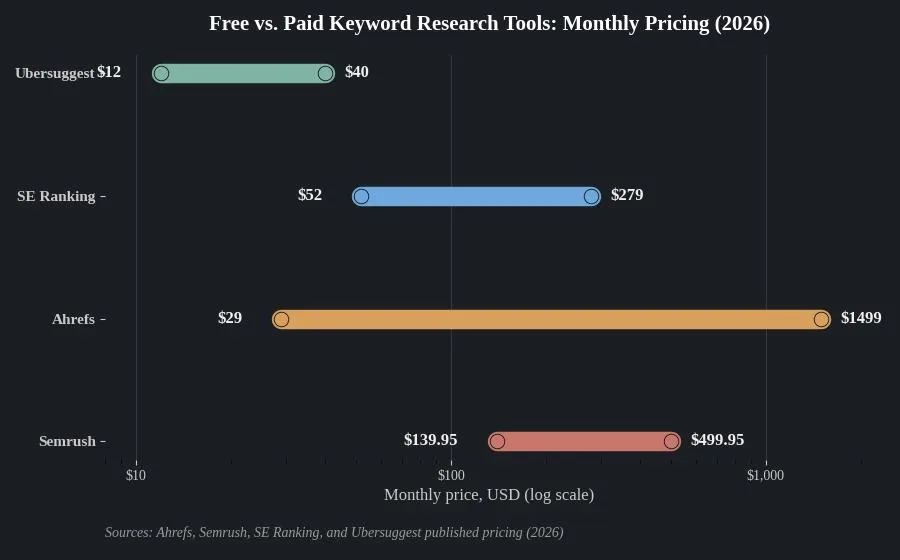
Free tools: Google Search Console (real click and impression data for keywords already ranking), Google Trends (rising, seasonal, or declining interest over time), and Google's own autocomplete and People Also Ask boxes.
Paid tools: Ahrefs runs from $29/month (Starter) up to $1,499/month (Enterprise), with its most common professional tier, Standard, at $249/month — Contentforce's 2026 pricing breakdown has the full tier structure. Semrush follows a similar spread, $139.95/month (Pro) up to $499.95/month (Business), with Guru at $249.95/month landing almost identically priced against Ahrefs Standard; AI Productivity's 2026 Semrush guide confirms the overlap. Ubersuggest is the more budget-friendly alternative at $12 to $40/month, per That Marketing Buddy's 2026 pricing breakdown, while SE Ranking sits higher, at roughly $52 to $279/month depending on tier, per Costbench's 2026 pricing analysis.
One caution worth keeping in mind regardless of which tool is used: keyword volume estimates from tools like Google Keyword Planner overestimate actual search volume more than half the time, so treat any tool's numbers as directional, not exact, and cross-reference against real Google Search Console data whenever possible.
Common keyword research mistakes
- Chasing volume over intent. A high-volume keyword that doesn't match what the content actually offers won't rank, no matter how well it's optimized.
- Ignoring the SERP itself. The fastest way to know if a keyword is winnable with a given content format is to look at what's already ranking for it, before writing a single word.
- Targeting one keyword per piece of content instead of clusters. Related long-tail terms almost always perform better grouped under one comprehensive page than scattered across several thin ones.
- Trusting tool-reported search volume as exact. Treat it as a directional signal, and validate against real performance data once a page is live.
- Giving up on a keyword after 60 days. Realistic ranking timelines for competitive head terms run 12 to 24 months or more; abandoning a keyword strategy too early usually means walking away right before it compounds.
Frequently asked questions
How long does keyword research take to show results?
Low-competition, long-tail keywords can realistically rank within 1 to 3 months. Competitive head terms typically take 12 to 24 months or longer, and only about 1.74% of newly published pages reach the top 10 within a full year.
Do I need a paid tool to do keyword research?
No. Google Search Console, Google Trends, and autocomplete cover the fundamentals for free. Paid tools like Ahrefs (from $29/month) or Semrush (from $139.95/month) add speed, competitor visibility, and volume data at scale once a strategy is running across many pages.
Is search volume the most important metric?
No. Search intent is now considered the single most important factor in keyword selection, since 69% of all searches end without a click and volume alone doesn't reflect how many of those searches would ever reach a website.
What's the difference between a head term and a long-tail keyword?
Head terms are short, broad, and high-volume (like "shoes"). Long-tail keywords are longer, more specific phrases that reflect clearer intent (like "best running shoes for flat feet"). Long-tail terms make up the vast majority of all search queries and convert at a meaningfully higher rate.
How many keywords should one page target?
Ideally, one primary keyword plus a small cluster of closely related long-tail variations that share the same search intent. Spreading unrelated keywords across a single page, or the same keyword across multiple pages, both undermine rankings.
Turning search data into a real content strategy
The point of keyword research was never the biggest number on a volume report. It's finding the specific words a real person types right before they're ready to read, compare, or buy, then building the exact page that answers that moment. Do that consistently, cluster by cluster, and the traffic compounds in a way that chasing broad head terms never will.
Practices that treat keyword research as an ongoing discipline rather than a one-time list tend to pull ahead over time, simply because search behavior, intent signals, and SERP features keep shifting, and a strategy built on last year's data quietly goes stale.
More from Web Tonic: growth marketing services, data & analytics, performance creative.
Sources: instantpress.co · bloggersideas.com · ahrefs.com · blog.contentforce.ai · aiproductivity.ai · thatmarketingbuddy.com · costbench.com